Ch 16. Respiratory Physiology
 Call Kai
 Learn
 Practice Test
 Spaced Repetition
 Match
 Flashcards
 Knowt Play
1/39

There's no tags or description
Looks like no tags are added yet.
40 Terms
What is pulmonary ventilation?
Breathing air in and out
What is external respiration?
Gas exchange between the lungs (alveoli) and the pulmonary capillaries
O₂ moves from the lungs into the blood
CO₂ moves from the blood into the lungs to be exhaled
What is internal respiration?
Gas exchange between the systemic capillaries and the tissues
What do the conducting zone and respiratory zone do?
Conducting zone transports gas only (nose to terminal bronchioles)
Respiratory zone is where gas exchange happens (respiratory bronchioles to alveoli)

Which way does air move, and does it need energy?
From high pressure to low pressure
It's passive, so no energy is needed
What is Boyle's law?
Pressure is inversely related to volume (P = 1/V)
When volume goes up, pressure goes down
When volume goes down, pressure goes up
How does intrapulmonary pressure compare to atmospheric pressure during inhalation and exhalation?
Inhalation: lung pressure is lower than atmospheric, so air flows in
Exhalation: lung pressure is higher than atmospheric, so air flows out
We can't change atmospheric pressure, so how do we move air?
Muscles change the volume of the thoracic cavity, which changes the pressure inside it
What are intrapulmonary pressure and intrapleural pressure?
Intrapulmonary: pressure inside the lungs
Intrapleural: pressure inside the pleural cavity
What is transpulmonary (transmural) pressure, and why does it matter?
It's intrapulmonary pressure minus intrapleural pressure
As long as it's positive, the lungs stay inflated and don't collapse
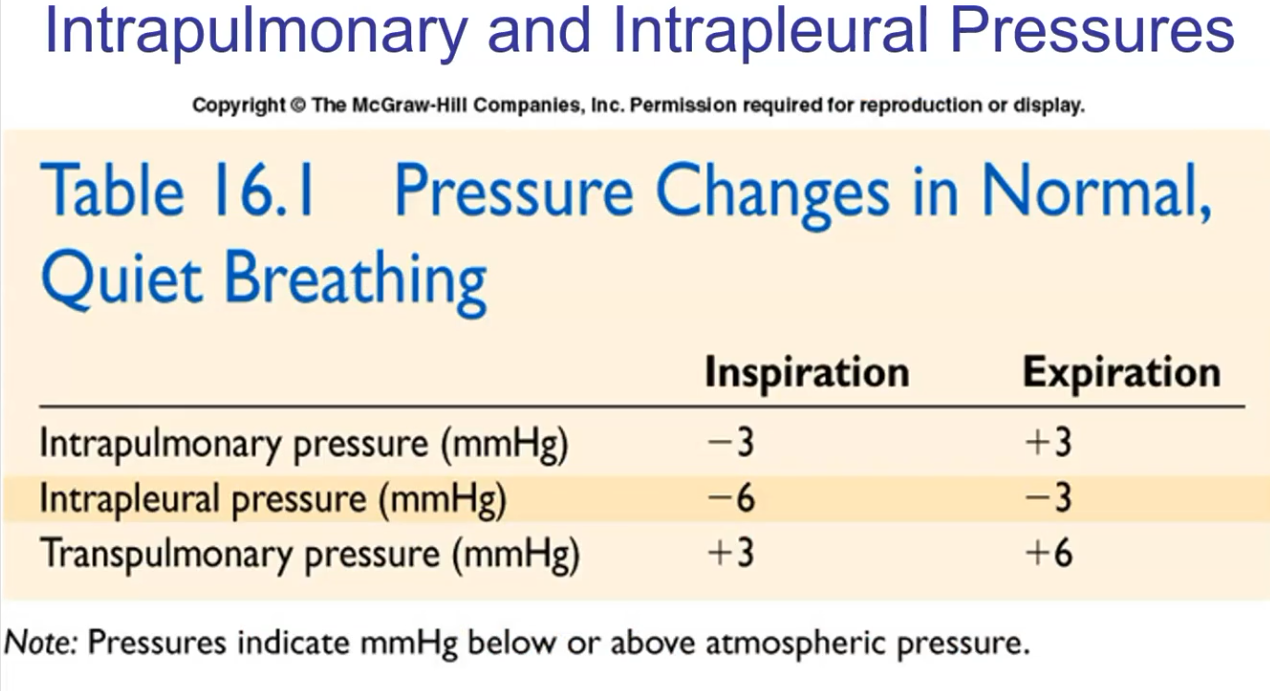
What are the pressures during quiet inspiration and expiration?
Intrapulmonary: −3 on inspiration, +3 on expiration
Intrapleural: −6 on inspiration, −3 on expiration
Transpulmonary: +3 on inspiration, +6 on expiration
All values are mmHg relative to atmospheric pressure
What happens when a lung is punctured?
The lung loses its pressure, so both pressures drop to 0
Transpulmonary pressure becomes 0 and the lung collapses
To fix it, you have to close the hole and also restore the pressures
Describe quiet inhalation and exhalation.
When we inhale, the diaphragm contracts and moves down. That increases thoracic volume, so pressure drops below atmospheric and air flows in passively. When we exhale, the diaphragm relaxes and moves back up. That decreases thoracic volume, so pressure rises above atmospheric and air flows out passively. Energy is only used for muscle contraction, not for moving the air.
What is the difference between quiet and forced (deep) breathing?
Quiet breathing mainly uses the diaphragm
Forced breathing adds extra muscles that raise or lower the ribs
This changes thoracic volume and pressure much more, so more air moves in or out
Which extra muscles are used in forced inspiration?
Scalenes
Pectoralis minor
Sternocleidomastoid
All of them elevate the ribs
Which extra muscles are used in forced expiration?
Internal intercostals
Abdominal muscles
Both depress the ribs
What is tidal volume (TV)?
The volume of air moved in and out during normal, quiet breathing
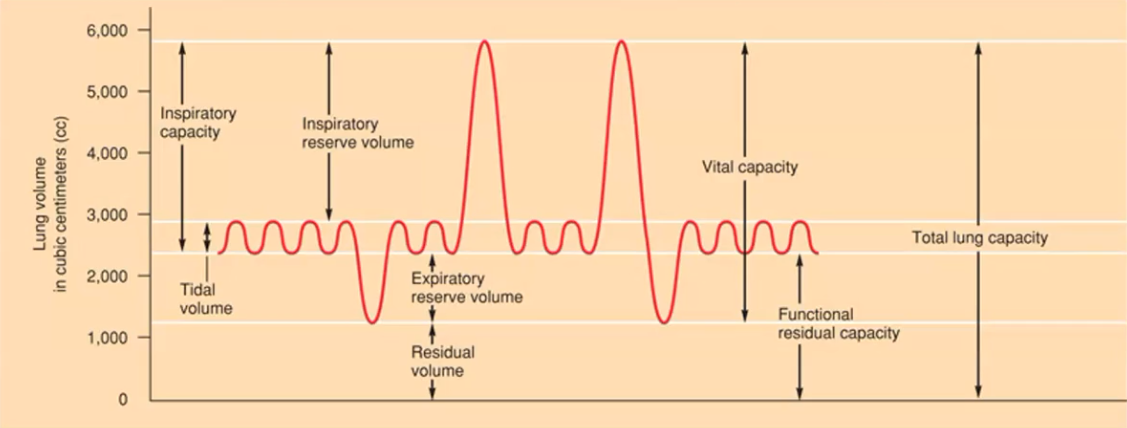
What is inspiratory reserve volume (IRV)?
The extra air you can breathe in beyond a normal breath
What is expiratory reserve volume (ERV)?
The extra air you can force out after a normal exhalation
What is residual volume, and why can't we exhale it?
It's the air that stays in the lungs even after you exhale as hard as you can
Positive transpulmonary pressure keeps the lungs inflated, so this air can't be pushed out
It only leaves if the lung collapses
What is vital capacity?
TV + IRV + ERV
The most air you can move in and out
What is total lung capacity, and can exercise increase it?
It's all the volumes added together (vital capacity plus residual volume)
Exercise can't increase it, because it depends on lung size
Exercise can raise vital capacity slightly, because the breathing muscles get stronger
What happens to the lung volumes during exercise?
TV goes up
IRV goes down
ERV goes down
The bigger tidal volume takes up space from both reserves
What happens when you breathe into a paper bag?
You breathe your exhaled CO₂ back in, so CO₂ builds up in the body
Tidal volume goes up to try to get rid of the extra CO₂
What three factors affect how easily pulmonary ventilation happens?
Compliance
Elasticity
Surface tension
What is compliance, and which part of breathing does it affect?
How easily the lungs inflate as air comes in
It affects inhalation
Low compliance makes it hard to breathe in
What lowers compliance?
Cystic fibrosis or pulmonary fibrosis
Fibrous tissue replaces elastic tissue, so the lungs become less stretchy
What is elasticity, and which part of breathing does it affect?
How easily the lungs recoil back to their original size
It affects exhalation
Low elasticity makes it hard to push air out
How does emphysema affect breathing?
It breaks down elastic tissue, so elasticity goes down
The lungs don't recoil well, so it's hard to exhale
How does surface tension affect breathing?
Water in the alveoli acts like glue, holding the walls of collapsed alveoli together
High surface tension makes the alveoli hard to expand
It affects inhalation
What is surfactant, what makes it, and what does it do?
It's made by type II alveolar cells
It's rich in phospholipids, which repel water
It lowers surface tension, so the alveoli expand more easily on inhalation

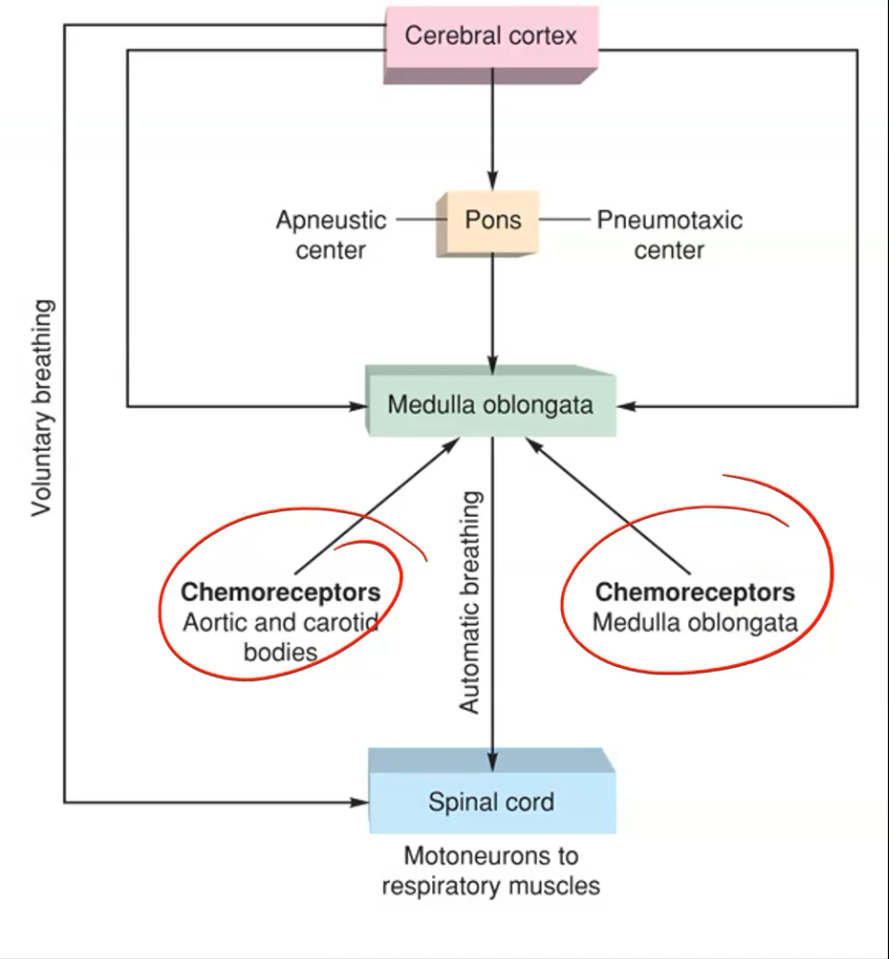
How do the pons and medulla produce automatic breathing?
The rhythmicity center in the medulla oblongata sets the basic rhythm of inspiration and expiration. The apneustic center in the pons stimulates the inspiratory neurons in the rhythmicity center, so we inhale. The pneumotaxic center in the pons then inhibits the apneustic center. The inspiratory neurons are no longer stimulated, so we exhale.

What controls voluntary breathing?
The cerebral cortex
Where are the chemoreceptors that control breathing rate, and what do they detect?
Peripheral (in the PNS): aortic and carotid bodies
Central (in the brain): medulla oblongata
They detect changes in CO₂, O₂ and pH
What is the CO₂ equation, and how does CO₂ affect blood pH?
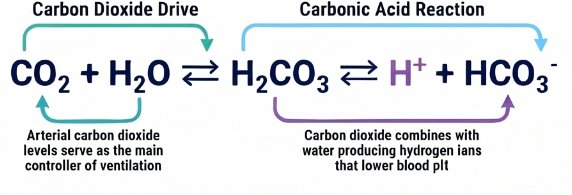
H₂O + CO₂ ⇌ H₂CO₃ ⇌ H⁺ + HCO₃⁻
High CO₂ pushes the reaction to the right, making more H⁺, so pH goes down
Low CO₂ pushes it to the left, removing H⁺, so pH goes up
Normal blood pH is 7.35–7.45
PCO₂ matters most because of its effect on pH
How does breathing change when blood is too acidic or too basic?
Too acidic: breathe faster to blow off CO₂ and remove H⁺
Too basic: breathe slower so CO₂ builds up and adds H⁺
What do hyperventilation and hypoventilation do to CO₂?
Hyperventilation causes low CO₂ (hypocapnia)
Hypoventilation causes high CO₂ (hypercapnia)
Describe what happens when you hold your breath.
Decreased ventilation lets CO₂ build up in the blood, which lowers blood pH. The chemoreceptors in the aortic and carotid bodies detect the drop in pH and signal the respiratory center in the medulla oblongata. At the same time, CO₂ crosses into the brain and lowers the pH of the brain's fluid, which the medulla's own chemoreceptors detect. The respiratory center then signals the respiratory muscles through the spinal cord, and ventilation increases. Breathing faster blows off CO₂ and removes H⁺, so this is negative feedback.

Why do the central chemoreceptors respond to CO₂ instead of blood H⁺?
H⁺ can't easily get into the brain
CO₂ can, and once inside it lowers the pH of the brain's fluid
When you hold your breath, what forces you to breathe: low O₂ or high CO₂?
High CO₂
Ventilation rises steadily as soon as CO₂ starts building up
Falling O₂ barely changes ventilation until O₂ drops dramatically