A1.2
 Call Kai
 Learn
 Practice Test
 Spaced Repetition
 Match
 Flashcards
 Knowt Play
1/30

There's no tags or description
Looks like no tags are added yet.
31 Terms
Strands
DNA is double stranded while RNA is single stranded
Sugar
Deoxyribose for DNA and ribose for RNA
Bases
Base pairs for DNA are bonded through hydrogen bonds
RNA has a single nucleobase
Function
Long-term storage of genetic information = DNA
Transfers genetic information for protein synthesis = RNA
Shape of DNA
Each strand has a sugar-phosphate backbone with nitrogenous bases projecting inward
The two strands wind around each other to form a double helix
Bases Pairing
The bases pair in a fixed way: adenine with thymine, and cytosine with guanine
This is called complementary base pairing.
The base pairs are joined by hydrogen bonds: two between A and T, and three between C and G.

Antiparallel Strands
The two DNA strands run in opposite directions.
One strand runs 5' to 3', while the other runs 3' to 5'.
Drawing the Structure of DNA
Antiparallel strands, one labelled 5' to 3' and the other 3' to 5'.
Complementary base pairing, with A paired to T and C paired to G, connected by hydrogen bonds.
The sugar-phosphate backbone as a continuous chain of alternating sugar and phosphate groups.
Condensation Reaction
Chemical reaction used to produce polymers
Involves the loss/production of a water molecule
Condensation Reactions Link Nucleotides Into a Polymer
Nucleotide monomers are joined by condensation reactions
Each reaction forms a phosphodiester bond and releases a molecule of water
The polymer grows in the 5' to 3' direction as new nucleotides are added to the 3' end.
Forms RNA polymer

Ligase
Enzyme that joins two molecules together by forming a bond between them
DNA ligase helps seal the sugar-phosphate backbone by joining DNA fragments
5’ to 3’
Direction a nucleic acid strand is built and read
5' end = phosphate end
3' end = hydroxyl end
Basis of the Genetic Code
DNA and RNA store genetic information using nitrogenous bases
Sequence of these bases, not the backbone, that stores the code.
Each letter gives us information for each protein

DNA Nitrogenous Bases
Adenine (A)
Thymine (T)
Cytosine (C)
Guanine (G)
RNA Nitrogenous Bases
Same as DNA except thymine (T) = uracil (U)
Central Dogma
1. DNA stores the gene
2. Transcription copies the gene into mRNA
3. mRNA leaves the nucleus
4. Ribosomes read the mRNA in codons
5. tRNA brings amino acids
6. Amino acids join to form a polypeptide
7. The polypeptide folds into a functional protein
mRNA
Messenger RNA
Phosphodiester Bond
A covalent bond between nucleotides in a nucleic acid chain (polypeptide)
Sugar Phosphate Backbone
Gives nucleic acids structural framework
sequence of nitrogenous bases carries the genetic information.

DNA and RNA Directionality
Backbone = chain with two “ends,” and each end is labeled by which carbon on the sugar is free
5' end has a free phosphate group\
3' end has a free hydroxyl group (-OH)
Purines
Double ring bases
Includes adenine (A) and guanine (G)
Pyrimidine
Double ring bases
Includes cytosine (C), thymine (T) for DNA, and Uracil (U) for RNA
Nucleotide
The monomer that builds DNA and RNA
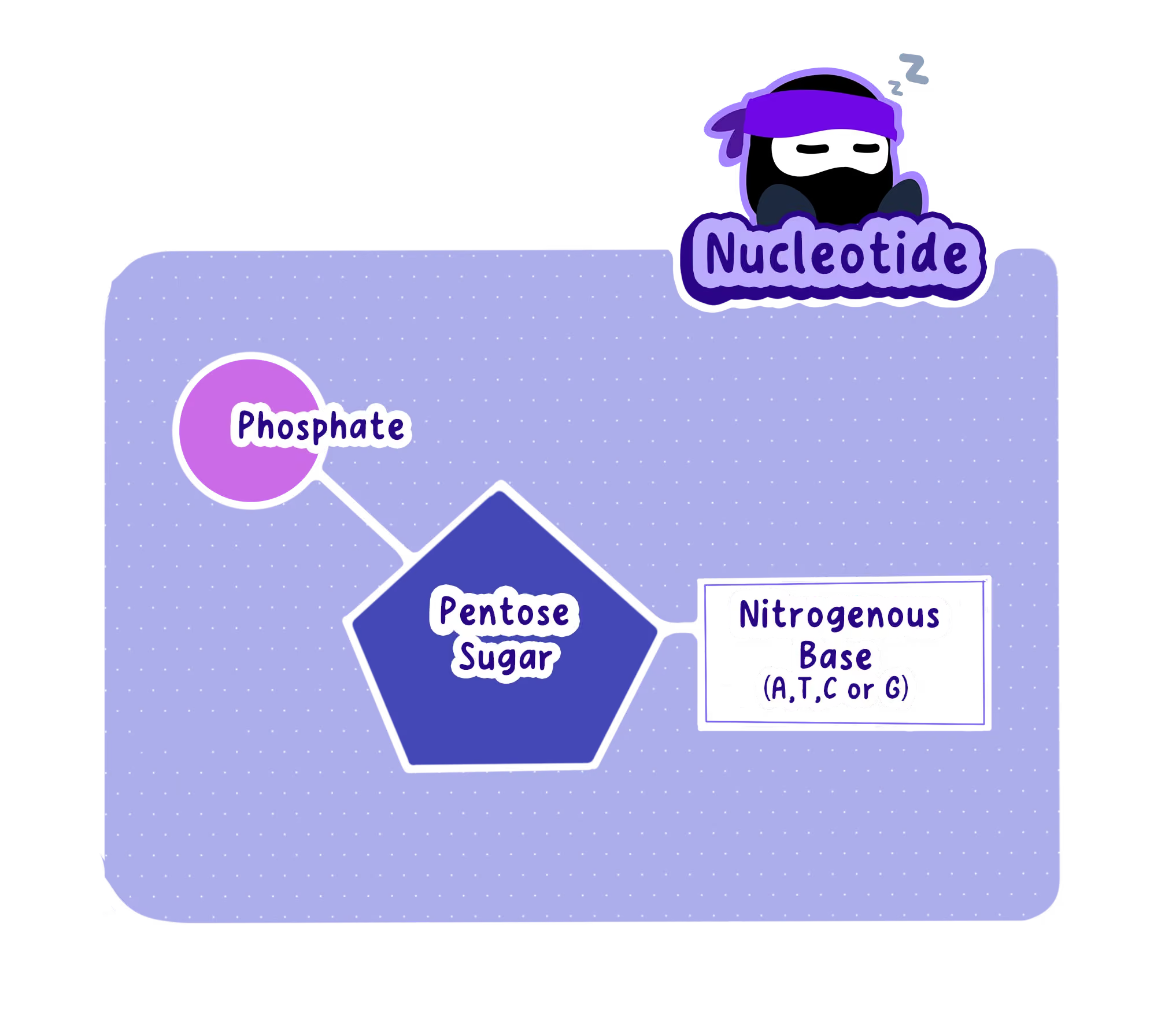
Parts of a Nucleotide
Phosphate
Sugar
Base
Nucleotide Diagram
Start With the Sugar (Pentagon)
Draw a pentagon in the centre to represent the pentose sugar
The sugar is the core connection point for both the phosphate group and the nitrogenous base
Add the Phosphate Group (Circle)
Attach a circle to the sugar's carbon 5 position (C5'), the upper left corner
This circle represents the phosphate group, which lets nucleotides link together in chains
Add the Nitrogenous Base (Rectangle)
Connect a rectangle to the sugar's carbon 1 position (C1'), the upper right corner.
This represents the nitrogenous base, which determines the nucleotide's identity (A, T, C, G, or U)
Pentose sugar for RNA
Ribose has an -OH on both 1’ and 2’ carbons

Pentose sugar for DNA
Deoxyribose has a -OH on 1’ carbon and a H on 2’ carbon

DNA
Stands for deoxyribonucleotide
Double stranded molecule that stores + transmits genetic info in living organisms
RNA
Stands for ribonucleic acid
Single stranded nucleic acid
Plays a key role in coding, decoding, regulation, and expression of genetic info
DNA Biomolecular Makeup
A biopolymer constructed from monomer deoxyribonucleotides
RNA Biomolecular Makeup
A biopolymer constructed from monomeric ribonucleotides