BMED 2420 Midterm 1
 Call Kai
 Learn
Learn Practice Test
 Spaced Repetition
 Match
Match Flashcards
 Knowt Play
1/51

There's no tags or description
Looks like no tags are added yet.
Name | Mastery | Learn | Test | Matching | Spaced | Call with Kai | Chat |
|---|
No analytics yet
Send a link to your students to track their progress
52 Terms
What makes materials different:
Composition: atoms/molecules present
Structure: how are they arranged
Processing: how is the material made/treated
What is a biomaterial?
a biomaterial is a material used for medical application to support, enhance, or replace damaged tissue or a biological function (not drugs)
Ionic Bonding
large electronegativity difference
Properties:
hard and stiffness, but brittle
high melting points
electrically insulating
wear resistant
Ex: hydroxyapatite
Common for CERAMICS
Covalent Bonding
small electronegativity different
single, double or triple bonds
Pros: Flexible, tunable degradation
strong, directional bonds
can form long chains
Ex: UHMWPE, PMMA, silicone, PLGA, scaffolds
Common for POLYMERS
Metallic Bonding
“Electron sea” —> valence electrons roam freely
Pros: conductive, strong, ductile (atoms slide without breaking bonds)
Cons: corrosion, stress shielding, ion release
Ex: Ti-6Al-4V, 316 SS, CoCr, Nitinol
Common for METALS
Secondary Bonding
Much weaker than primary bonds
Common in POLYMERS
Controls how polymer chains interact with each other
NOT the same as crosslinks (permanent)
Controls how proteins stick to material surfaces
Crystal Structures
Two materials can have the same type of bonding but very different properties!
3D arrangement of atoms (crystal structure) controls:
ductility: how easily atoms slide past e/o
packing efficiency and density
directional dependence of properties
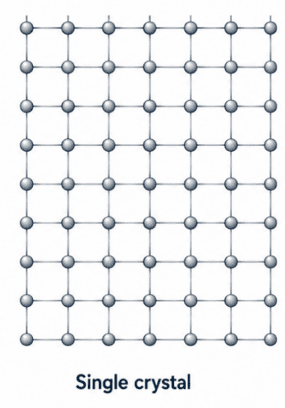
Crystalline Structure
atoms in a regular, repeating 3D pattern
*most metals and many ceramics
Amorphous Structure
atoms have local organization, but no regular pattern over long distances
*polymers are amorphous or semicrystalline
Can change how a material dissolves, degrades, or interacts with the body
Ex: PMMA bone cement, bioactive glass (structure helps it react w body fluids and bond to bone)

Body-Centered Cubic (BCC)
(exist within crystalline structures)
Atoms at corners + one in center
Coordination Number: 8
Atoms: 2
APF: 0.68
Atomic Movement: More difficult / temperature dependent
Typical Behavior: Ductility can be temp. dependent
EX: tantalum

Face Centered Cubic
(exist within crystalline structures)
Atoms at corners + one on each face
Coordination Numbers: 12
Atoms: 2
APF: 0.74
Atomic Movement: Many easy slip paths
Typical Behavior: most ductile, isotropic
Ex: CoCr, 316 SS

Hexagonal Close Packed
(exist within crystalline structures)
Hexagonal layers + 3 atoms in middle plane
Coordination Numbers: 12
Atoms: 6
APF: 0.74
Atomic Movement: fewer easy slip paths
Typical Behavior: ductile, anisotropic
Ex: Titanium, magnesium, zinc

Isotropic
having identical physical, mechanical, or optical properties in all directions
Anisotropic
meaning properties vary depending on the direction of measurement (such as wood being stronger along the grain than across it). [1]
Atomic Packing Factor
The fraction of volume in a crystal structure that is occupied by constituent atoms, assuming atoms are hard spheres
(a = edge length)

Polycrystalline Materials
Found in most engineering metals
Grains: regions with different orientation
Impact on Medical Implants:
Smaller grain: stronger
Boundaries: corrosion + fatigue crack sites

Specific Heat Capacity
Energy needed to change a material’s temperature
High Cp: takes more energy to heat up —> temperature changes slowly
Low Cp: takes less energy to heat up —> temperature changes quickly
q = m(Cp)(Tf - Ti)
q: energy/heat added (J)
m: mass

Thermal Conductivity (k)
How easily heat flows through a material
Metals: high k (free electrons)
Ceramics: vary widely (photons)
Polymers: low k (no free electrons + disordered chains)
Ex: metal fillings are sensitive to cold bc they transfer hot/cold to nerve faster than enamel
Coefficient of Thermal Expansion
Materials expand/contract as temperature changes
Issue: CTE mismatch as at interfaces —> thermal stress —> cracking or debonding
Ex: critical for dental composites, coatings

Thermal Shock Resistance
Rapid temperature change causes uneven expansion and cracking
Vulnerable: Ceramics (brittle)
Resistant: Metals (ductile)
Biomaterial Relevance:
Autoclaving: 121* —> room temp
Sterilization: Thermal Properties in Action
Every reusable medical device must be sterilized
Autoclaving (steam): 121*, 15-30 min
Metals and ceramics tolerate it well
Many polymers can deform or degrade
Alternatives for heat-sensitive material:
Ethylene oxide (EtO) gas: low temp
Hydrogen peroxide-based low-temp sterilization
Gamma or electron-beam irradiation
Electrical Conductivity
Metals: high conductivity
Semiconductors: intermediate and highly tunable
Polymer & many ceramics: generally insulating
Biological tissues: conduct mainly through ions in fluids

Electrical Insulation in Devices
Many electrical implants need insulating coatings
Ex: Pacemaker leads = silicone or polyurethane coating
Insulates the wire from surrounding tissue
Only the electrode tip is exposed
Piezoelectric Effect
Some materials generate voltage when squeezed
Direct: stress —> voltage (sensing)
Converse: voltage —> deformation (actuation)
Magnetic Behavior Materials
Diamagnetic: very weakly repelled
polymers, ceramics, copper, gold
Paramagnetic: weakly attracted
titanium, aluminum, platinum
Ferromagnetic: strongly attracted (can retain magnetization)
iron, cobalt, nickel, some alloys
MRI danger
MRI Compatibility
Concerns: heating, device malfunction, image artifacts
Higher concern with ferromagnetic materials, older/unknown implants
Specific Absorption Rate (SAR)
How quickly radiofrequency energy is absorbed by tissue (W/kg)
Higher SAR —> more potential heating
What affects MRI Heating?
implant size = larger absorb more energy
implant orientation = orientation relative to RF field changes induced currents
geometry = shape and features affect current
Material
Location: tissue types and proximity to other structures influence heating
MRI Fielding Conditions: field strength, RF coil type, scan parameters
Optical Properties
Transparent: light passes through (contact lenses)
Translucent: light partially scattered (dental crows match natural teeth)
Opaque: light blocked (metals)
Imaging Visibility
How materials interact w X-rays and CT
Radiolucent:
X-rays pass through (low attenuation)
Appears darker on X-ray/CT
Ex: polymers (PEEK)
Radiopaque
X-rays are strongly attenuated
appears brighter (whiter) on X-ray/CT
Ex: metals, many ceramics

Metals primary use in implants
Metals dominate load-bearing implants
Pros: strong, fatigue-resistant, ductile, sterilizable, and manufacturable
Cons: Corrosion, ion release from wear, stress shielding
Corrosion
The loss of metal atoms from a metal surface through electrochemical reactions with the surrounding environment
Body fluids are warm, wet, and salty. Chloride ions and moisture can promote corrosion.
Passivation
The spontaneous formation of a thin, stable oxide layer on some metals
Acts as a barrier between the bulk metal and body fluids, reducing direct contact and slowing electrochemical corrosion reactions.
Approximately 1-10 nm thick
Many passive metals can reform the layer, called repassivation
Metallic Alloys
Metals + one or more element
Ferrous: iron base metal
Non-ferrous: non-iron base metal (less corrsion)
316L Stainless Steel
Ferrous
Pros
High strength and toughness
Ductile: deforms before fracture
Relatively low cost and widely available
Cons
Lower corrosion resistance than titanium allows and CoCr alloys
High stiffness contributes to stress shielding
Potential for metal ion release
Applications: fracture fixation devices (plates, screws, nails), temporary and some permanent implants
Cobalt Chromium (CoCr)
Non-ferrous
Pros
Excellent corrosion resistance: forms stable, protective oxide layer
Outstanding wear resistance (ideal for articulating/joint surfaces)
Very high strength and fatigue resistance
Well suited for long-term, load-bearing implants
Cons
very high stiffness: greatest stress shielding concern
Potential for Co/Cr iron and particle release
More difficult to machine and fabricate
Higher cost
Applications: hip and knee bearings, stems, rods, wires
Ti-6Al-4V
Nonferrous
Pros
Excellent corrosion resistance: forms stable, protective oxide layer
Highly biocompatible
Lightweight
Lower elastic modulus: closer to bone stiffness —> less stress shielding
Good bone bonding
Cons
Poor wear resistance: not ideal for highly loaded articulating surfaces
More expensive
Can still experience corrosion at interfaces
Application: Widely used in permanent implants due to biocompatibility, corrosion resistance and low density (ie hip implants, knee implants, spinal fixations)
Nitinol (NiTi)
Pros
Shape-memory and superelasticity: can be deformed at low temps and returns to original shape at body temp
Enables minimally invasive devices
Good fatigue resistance: withstands many loading cycles
Tunable properties: adjusted by composition and processing
Cons
Nickel ion release
More expensive
Lower strength
Temperature sensitive
Applications: self expanding stents, clamps, clips
Shape Memory in NiTi
Martensite (low temp)
atoms arranged in a less symmetric structure
easier to deform
Austenite (high temp)
atoms in more symmetric structure (cubic)
More rigid/strong
“remembered” shape
Biodegradable Metals: Mg Alloys
Implant dissolves as bone heals
Applications: tissue engineering, resorbable screws
Cons: safety concerns about metal-related toxicity, and corrosion could be too fast
Why polymers for biomaterials?
Most versatile material class
Pros
Tunable properties: soft to rigid, flexible to brittle
Biocompatibility
Biodegradable options
Lightweight: typically low density
Easy to process: mold, extrude, 3D print, electrospin fibers
Smart polymers respond to stimuli
Cons
Weaker than metals
Properties can change with time, temp, or environment
Number-Average Molecular Weight (M_n)
Given that polymer chains vary in length, this is used to describe average molecular weights
weights each chain equally,
more sensitive to shorter chains
influences mechanical properties, degradation rate, and biocompatibility
M = mass of each chain (g/mol)
N = number of chains
Weight-Average Molecular Weight (M_w)
Given that polymer chains vary in length, this is used to describe average molecular weights
heavier chains count more
more sensitive to longer chains
influences mechanical properties, degradation rate, and biocompatibility
M = mass of each chain (g/mol)
N = number of chains
Polydispersity Index
Indicates the width of the molecular weight distribution
PDI = 1 —> all chains same length (theoretically)
Most polymers have PDI > 1 (broader distribution)
MW and PDI Affects on Biomaterials
Higher Molecular Weight (longer chains)
stronger, tougher
slower degradation
higher viscosity
more stable in vivo
Polymer Chain Architecture
(from most to least chain mobility)
Linear
Branched
Crosslinked
Network
Polymer Class: Thermoplastic
Linear or Branched Chains
Soften/melt when heated
Can be reshaped
Stress Strain Behavior: Plastic
yield + neck + draw
Ex: PE, PP, PEEK
Polymer Class: Elastomer
Lightly crosslinked chains
Recover when stretched
Soft and flexible
Stress Strain Behavior: Elastomeric
huge strain, recoverable
Ex: silicone rubber
Polymer Class: Thermosets
Do NOT melt when heated; eventually degrades
Rigid and permanently set
Stress Strain Behavior: Brittle
high E, low strain, fractures without yielding
Ex: epoxy
Polymer Crystallinity
Polymers are never 100% crystalline
Amorphous Polymers
random coils (spaghetti)
more flexible
often transparent
Semi-Crystalline Polymers
ordered regions + amorphous regions
stronger, stiffer, denser
often opaque
Ultra High Molecular Weight Polyethylene (UHMWPE)
Pros:
low friction
excellent wear resistance
tough, but flexible
Cons:
even small amounts of wear at bearing surfaces can cause inflammation and aseptic loosening
Polyether ether ketone