Lecture 7 - Oral Mucosa, Salivary Glands
 Call Kai
 Learn
 Practice Test
 Spaced Repetition
 Match
 Flashcards
 Knowt Play
1/78

There's no tags or description
Looks like no tags are added yet.
79 Terms
What are the 3 aspects of the oral mucosa?
masticatory, lining, specialized
What are the masticatory parts of the oral mucosa?
gingiva, hard palate
What are the lining parts of the oral mucosa? (5 parts)
lips, cheeks, floor of mouth, soft palate, ventral tongue
What makes up the specialized oral mucosa?
dorsum of tongue
Which classification of the oral mucosa covers the MOST area?
lining
Which classification of the oral mucosa covers the LEAST area?
specialized
Give the order of greatest to least covered area for the classifications of the oral mucosa.
lining, masticatory, specialized
Most epithelium in the body is…
stratified squamous epithelium
The epithelial types of the oral mucosa are based on what?
keratinization
This list of structures makes up what?
labial mucosa, buccal mucosa, alveolar mucosa,
Soft palate, Ventral tongue, Floor of mouth
lining mucosa

This is nonkeratinized stratified squamous epithelium. Give the top tan colored layer.
superficial
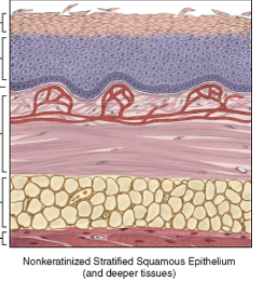
This is nonkeratinized stratified squamous epithelium. Give the 2nd purple colored layer.
intermediate

This is nonkeratinized stratified squamous epithelium. Give the third layer from the top.
basal

This is nonkeratinized stratified squamous epithelium. Give the 4 layer, the largest one.
lamina propria

This is nonkeratinized stratified squamous epithelium. Give the yellow cuboidal layer.
submucosa
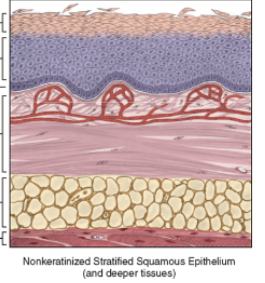
Give the bottom layer.
muscle

What is the alveolar mucosa classified as?
lining mucosa
Give the term: It is reddish, pink tissue with blue vascular areas. This
shiny, moist region is very mobile and lines the vestibules of the oral
cavity.
alveolar mucosa

Give the term:
ventral tongue surface
Given the clinical appearance, a rubbery surface texture and
resiliency serving as a firm base, what is this structure?
masticatory mucosa
This list of structures makes up what?
attached gingiva
hard palate
dorsal tongue
masticatory mucosa
Under a microscope, the masticatory mucosa is a _______ epithelium with an _______ surface. It has many ____ ridges and CT
papillae with thin layer of submucosa or none.
keratinized, interdigitated, rete
What is pigment formed by melanocytes?
melanin
What is the term related to the attached gingiva that appears as small depressions, giving the gingiva an “orange peel” appearance?
stippling
The mucogingival junction is a division between what and what?
keratinized attached gingiva, non keratinized alveolar mucosa
How many types of lingual papillae are there?
4
What are tiny projections of keratinized epithelium?
lingual paillae
What are the types of tongue papillae?
filiform, fungiform, foliate, circumvallate

What is this?
fungiform papillae
Which papillae are mushroom shaped, appear darker pink, and are on the superior surface?
fungiform
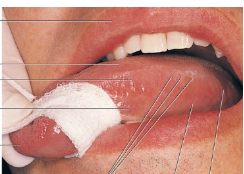
What is this papillae type?
foliate lingual
What appears as 4-11 vertical ridges parallel to each other on the lateral surface of the posterior part of the tongue?
lingual papilla
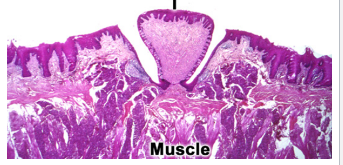
What kind of papilla is this?
circumvallate

what is this pointing out?
von ebner salivary glands
Which 3 lingual papillae are related to taste?
fungiform, foliate, circumvallate
Which papilla have NO taste buds?
filiform
Some taste buds are also found in the ____ _____ and ______.
soft palate, pharynx
How are taste buds shaped? Where are they dervied from?
barrel, epithelium
How is taste perception changed with age?
reduced
What happens to the marginal and attached gingiva when perio disease is present?
enlarged

What type of muscle is the tongue?
striated covered by oral mucosa
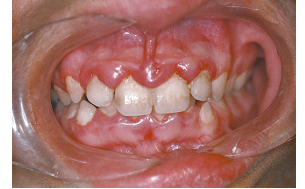
What is this condition?
gingival hyperplasia
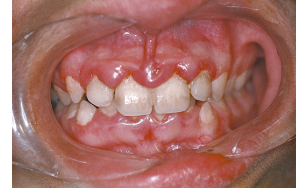
Why does this occur?
certain meds

What is this condition?
nicotinic stomatitis

what is this?
amalgam tattoo
What kind of cells appear in the epithelium when there is inflammation?
lymphocytes, leukocytes
Nerves and blood vessels are located in the…
lamina propria
Free nerve endings are associated with…
pain
Why is the floor of the mouth a good area for placement and absorption of some meds?
rapid, epithelium is thin and nonkeratinized
What is a group of specialized cells that produces a substance used by other parts of the body?
gland
What are two categories of glands?
endocrine, exocrine
What kind of glands have no ducts and depend on the circulatory system to carry hormones?
endocrine
What kind of glands have ducts and carry secretions externally?
exocrine
The exocrine glands are divided into ____ and ____ salivary glands.
major, minor
What is the largest gland that accounts for about 25% section of total salivary output?
parotid
Where are the serous secretions of the parotid gland drained?
Stensons duct
Where is Stenson’s duct located?
parotid papailla
What is the 2nd largest gland that accounts for 60% of total salivary output?
submandibular
Where are the mixed secretions of the submandibular gland drained?
Whartons duct
Where is Wharton’s duct located?
sublingual caruncle
What is the smallest gland that accounts for 5% of total salivary output?
sublingual
Where are the mucous secretions of the sublingualr gland drained?
Bartholin ducts
The parotid gland has _____ secretions, the submandibular gland has _____ secretions, and the sublingual gland has ______ secretions.
serous, mixed, mucous

Give the teal area.
serous
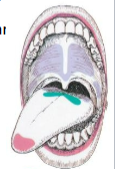
Give the light purple area.
mucous
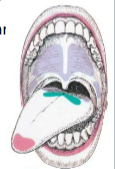
Give the pink area.
mixed
Epithelial cells that produce saliva are called ______ cells.
secretory
How are secretory cells classified?
serous or mucous
Where are secretory cells found? it is a group similar in shape to a cluster of grapes.
acinus
What is a lumen?
opening where saliva is deposited
Each acinus is located at the _____ part of the gland connected to the ductal system, with many _____ within each ____ of the gland.
terminal, acini, lobule
This list of functions is for…
• Lubricates lips
• Moisten oral cavity
• Cleanse teeth
• Control microbial flora (immunoglobulins)
• Initiate digestion (digestive enzymes)
• Lubricate food for swallowing
• Dissolve food to facilitate taste
• Clotting within oral cavity
• Forms a seal that maintains a denture
saliva
What is 99% of saliva made of?
water
Give the two items that are important for the remineralization of
enamel and calcification of plaque.
calcium, phosphates
In relation to saliva, give the groupings for these components:
1) sodium, chloride, potassium, calcium, phosphate, fluoride.
2) digestive enzymes, immunoglobulins, clotting factors, hormones,
bacteria (flora), neutrophils, lymphocytes.
inorganic, organic
What is the term for dry mouth?
xerostomia
If there is a salivary flow obstruction, it is called…
sialolith
What is the most common location for a sialolith?
submandibular gland
What are the 3 Types of Tonsils?
pharyngeal, palatine, lingual