BLOCK 5 Lecture 1
 Call Kai
 Learn
 Practice Test
 Spaced Repetition
 Match
 Flashcards
 Knowt Play
1/8

There's no tags or description
Looks like no tags are added yet.
9 Terms
during exercise - overview

AMPK overall

So then when you stop using ATP the leves will go back up and this will switch off AMPK
ATP inhibits AMPK because AMP gone down enough
activation of AMPK
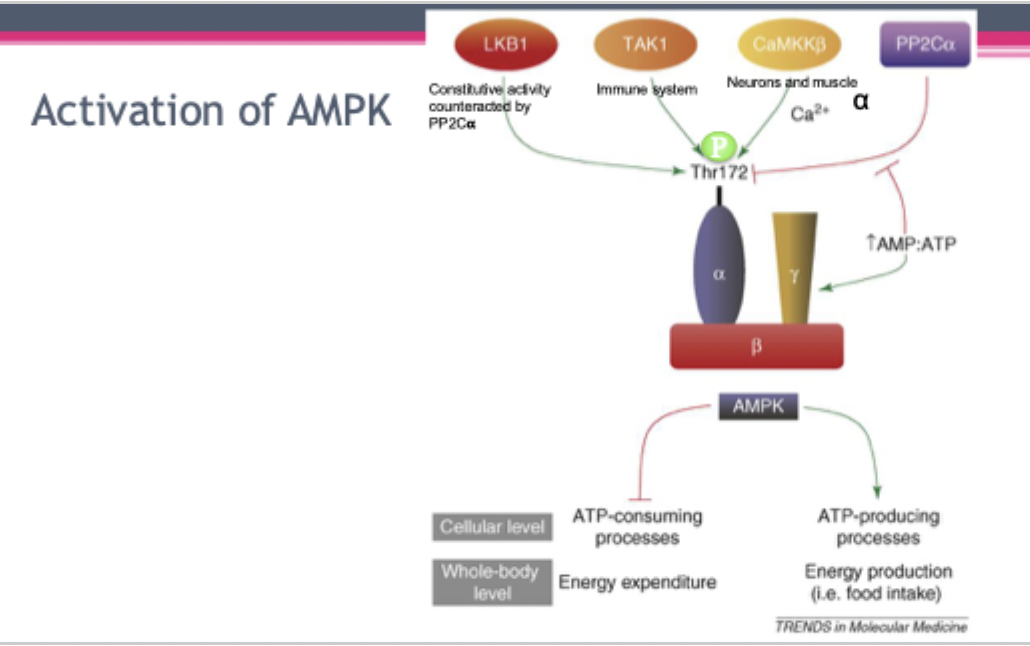
So other than ATP kinases can also act on AMPK to maintain balance in cell
There are 4 of these:
LKB is constitutively active and can P AMPK
At the same time there is a dephosphorylase PP2Ca which de phosphorylates at the same site
AMP is a negative regulator of phosphorylase (PP2Ca) activity so get more P of AMPLN than dephosphorylation
In some cells also have different activators - specific to the cell type
AMPK has 3 subunits
AMPK structure
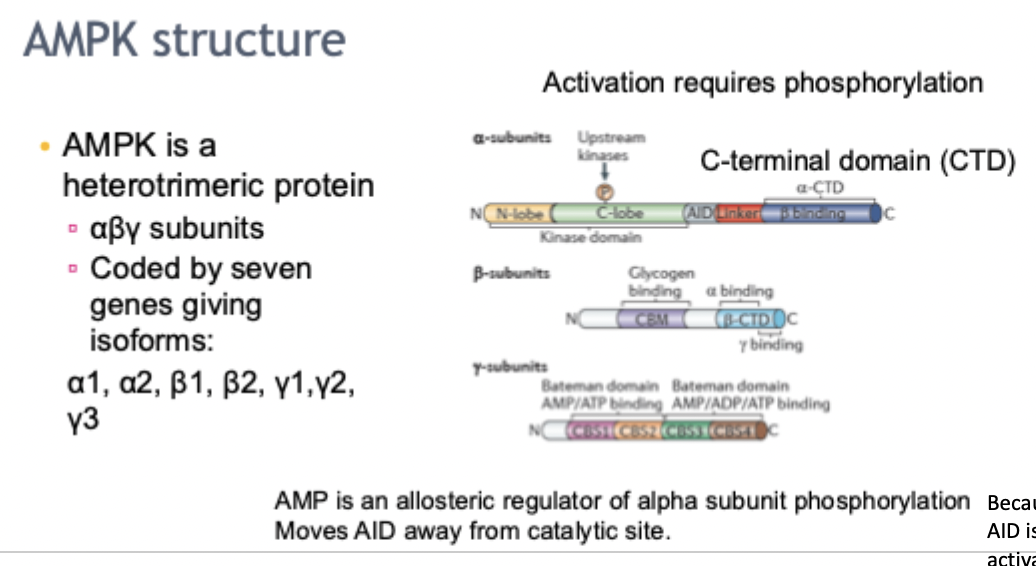
P happens at the alpha subunit at a specific tyrosine residue
This is within the kinase domain - the domain which phosphorylates other proteins
Also has an AID and beta binding domain - needed for binding to beta subunit
Bta subunit has glycogen binding - important in liver and alpha binding domain - mostly is just there to hold the alpha and beta together
Gamma senses the amount of AMP vs ATP in the cell
Has 4 CBS domains which can each bind AMP or ATP
All bound to AMP leads to activation of AMPK as long as upstream kinases have also P the alpha domain
Depending on what combo of alpha beta and gamma you have a in specific cell, that can change the activation state and whether stuff upstream can activate
Can have 12 different potential combos which will all suubtely change the activity
Because it changes the conformation when bound at all of these sites
AID is the inhibitory domain - change in conformation makes it move away so that kinase domain can be activated
AMPK in contracting muscle

When AMP is high we want catabolidm - want to use more glucose and more ATP - want glycolysis
Hexokinase and phosphofructokinase in the glycolysis pathway are activated by P by AMPK
So pushes more glucose down this pathway
Also first to get the glucose need to activate the glycolysis pathway
getting fatty acid into the mitochondria

once fatty acids are in the muscle need to get to mitochondria for fatty acid oxidation
Fatty acids need to be moved into the matrix of the mitochondria in order to be made into ATP
But cant get through the inner membrane without a transporter - need a carnitine shuttle
AMPK can block ACC2 which activastes malonyl-CoA which usually inhibts this pathway - so overall ends up activating CPT1 - allows more fatty acids to be transported into the matrix of the mitochondria so more beta oxidation can occur
switching off anabolic pathways
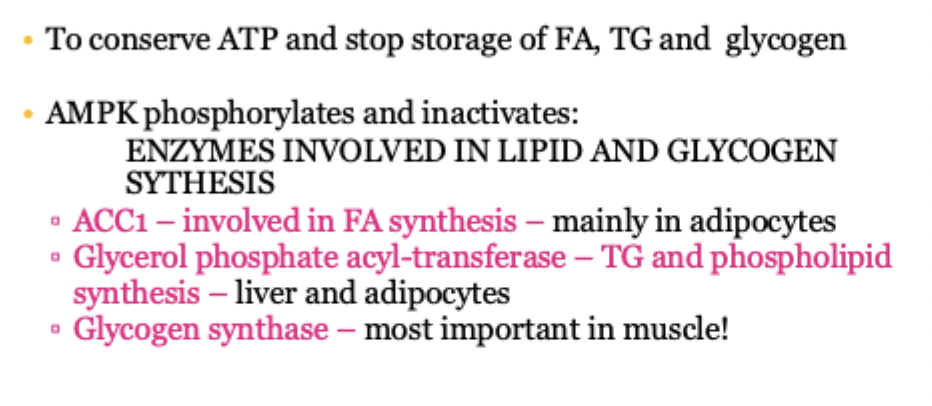
AMPK overall diagrams
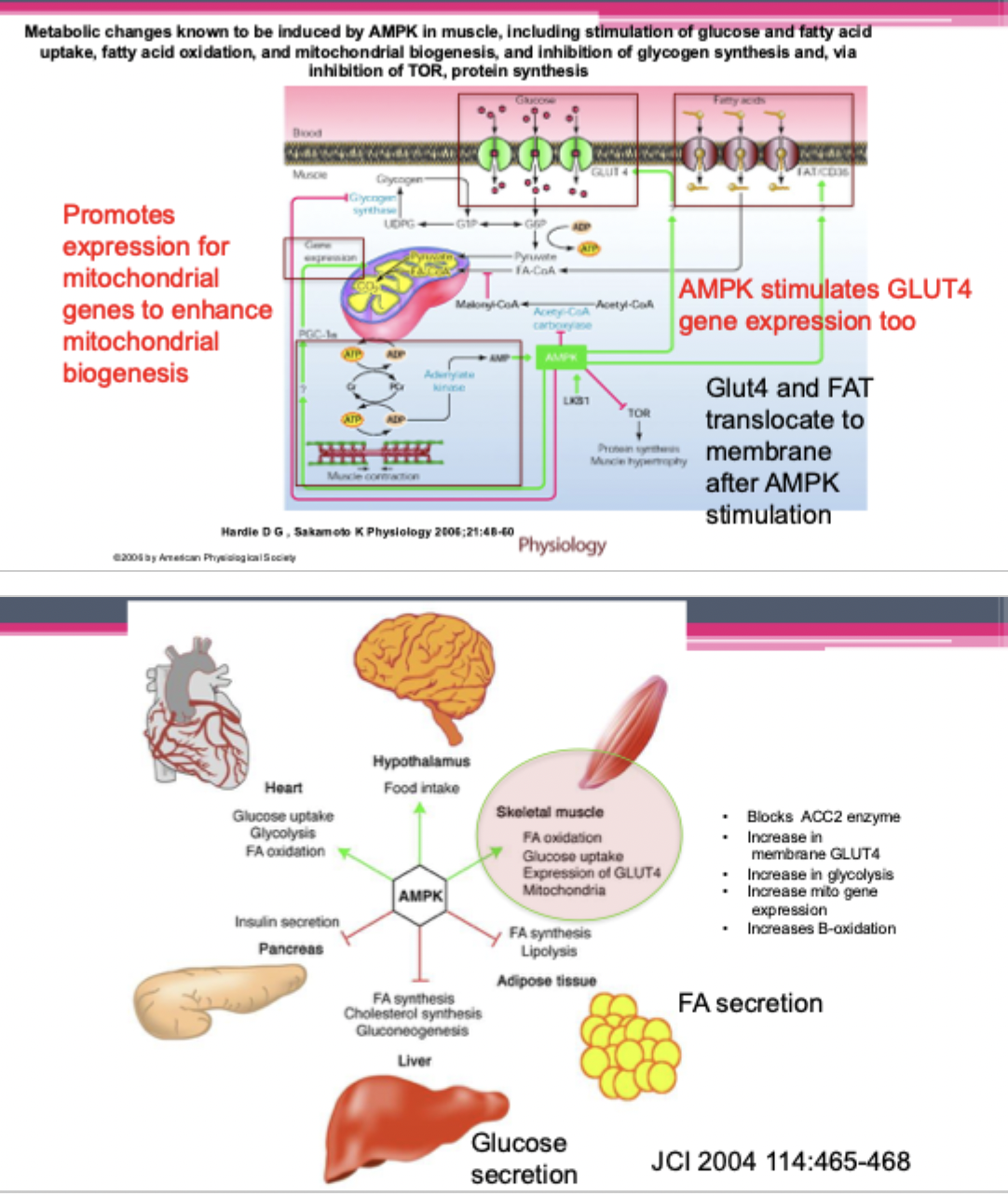
First need to get fatty acids out of the bloodstream and into the muscle cells - 2 different transporters
GLUT4 for glucose
CD36/FAT receptor for fatty acids
GLUT4 can be stimulated at the expression level by AMPK signalling so get more made in muscle cells
Also stimulates the transloaction of GLUT4 into the membrane to transport glucose into the cell
FAT receptors also sit in intracellular vesicles and when they are required AMPK stimulates translocation into membrane through P
Both allows icnreased transport into the cell
Then fatty acids have to get into the mitochondria - metnioned above how it is also regulated by AMPK
Can also limit protein synthesis by blocking TOR
AMPK exam pathways

Shows how complex these pathways are
Somewhat simplified but still complex
E.g. insulin
Insulin ligand binds to the receptor and activates PI3K
Then have a couple steps which leads to activation of Akt then mTOR
mTOR can activate or inhibit various components
Inhibits protein synthesis
Akt can also inhibit AMPK by blocking PI3K which would usually promote protein synthesis
Basically saying you can use this diagram to go thrrough the various pathways
So don’t need to menorise just interpret