physics flashcards
 Call Kai
 Learn
 Practice Test
 Spaced Repetition
 Match
 Flashcards
 Knowt Play
1/69

There's no tags or description
Looks like no tags are added yet.
70 Terms
A solar power system is installed in the remote village in addition to the hydroelectric generator.
Explain why this improves the reliability of the electricity supply to the village.
In the summer the power output from the hydroelectric generator is lower but the solar power output would be greater
so less variation in total power output which improves the reliability of the supply

Explain how the results in above table can be used to compare the thermal conductivity of the two materials.
same temperature decrease in a shorter time means a higher thermal conductivity
because the rate of energy transfer is higher

The total power output of the girl was greater than the answer to part (a).
Suggest two reasons why
girl increases her kinetic energy, some energy is wasted in her muscles
some energy transferred as thermal energy to surroundings
The baby bouncer should not be used with babies that have a mass greater than 12 kg.
Suggest one reason why
spring may become permanently extended

In positions A and B the baby is stationary.
Describe the energy transfers as the baby moves from position A to position B.
in position A the baby has gravitational potential energy
as the baby moves down this is transferred to kinetic energy
of the baby then elastic potential energy of the spring
in position B all the energy is elastic potential energy

Which metal had the highest thermal conductivity?
Give a reason for your answer
copper
greater change in mass than the other metals
It is unlikely that all of the electricity that the UK needs can be generated by solar power systems.
Explain why.
a really large area of land would need to be covered with solar cells
due to the low useful power output of the solar cells
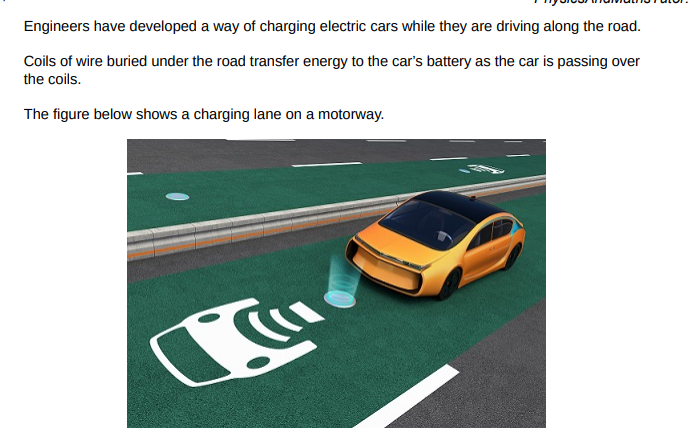
Suggest two advantages of using this method to charge electric cars compared with plugging them into the mains electricity supply
recharging is a continuous process
more cars can be charged at the same time
When electric cars are not being driven, energy stored in their batteries could be used to meet sudden peaks in electricity demand.
Suggest how
when cars are plugged in
the energy from car batteries could be transferred back to the National Grid
At the bottom of the slide, all riders and their sleds have approximately the same speed.
Explain why
decrease in gravitational potential energy = increase in kinetic energy
masses cancel on both sides of the equation
final speed only depends on vertical height and gravitational field strength
variations will be due to air resistance/friction
Give two environmental advantages of using a gas-fired power station to generate electricity compared with using a coal-fired power station.
less global warming
doesnt cause acid rain

A student does not believe that climate change is occurring.
Explain how the data in Figure 2 suggests the student is wrong.
mean sea surface temperature shows a steady increase
over the time period on the graph

The motor in the lawn mower can only be turned on when the person using it holds the handle of the lawn mower with both hands.
Explain why.
both switches need to be closed
to complete the series circuit

As the person moves down the zip wire her increase in kinetic energy is less than her decrease in gravitational potential energy
work done against air resistance
causes thermal energy to be transferred to surroundings

Different people have different speeds at the end of the zip wire.
Explain why.
different people have different surface areas
so would be affected by air resistance differently
The maximum speed this cyclist can travel on a level road is 14 m/s.
How does cycling uphill affect the maximum speed of this cyclist?
Explain your answer
maximum speed is lower
because maximum power output of cyclist is constant
but additional work is done against gravity
The coffee machine has a metal case.
Why would it be dangerous for the live wire of the electric cable to touch the metal case?
risk of electric shock if someone touched the case
Shale gas is natural gas trapped in rocks. Shale gas can be extracted by a process called fracking. There is some evidence that fracking causes minor earthquakes. Burning shale gas adds carbon dioxide to the atmosphere.
Describe the advantages of nuclear power compared with the use of shale gas to generate electricity.
no carbon dioxide emitted to produce electricity
doesn’t cause global warming
nuclear power doesn’t cause earthquakes
Explain how the resistance of a filament lamp changes as the potential difference across it increases.
the current increases when the potential difference increases
which causes the temperature of the filament to increase
so the resistance increases

When the plunger was pushed slowly into the syringe, the pressure in the syringe increased.
The temperature of the air remained constant.
Explain why the pressure increased.
air particles are closer together
so frequency of collision between air particles and syringe walls increased
larger total force on a smaller surface area
Some thermal energy was transferred to the surroundings while the water was being heated.
Explain how this affected the student's value for the specific latent heat of vaporisation of water.
less energy than 25 200 J was transferred to the water
so student’s value of L is too high
When the tyre is at the correct pressure, pumping more air into the tyre causes the pressure to increase further.
The volume and temperature of the air in the tyre do not change.
Explain why the pressure increases as more air is pumped into the tyre.
more air particles in the tyre
greater number of collisions with tyre walls per second
The air pressure in a car tyre changes if the temperature of the air in the tyre increases. Explain why
as temperature increases the air particles have greater mean kinetic energy
so more collisions with tyre walls per second
and greater force in each collision
greater mean force per square metre causes greater pressure on wall of tyre
When the volume of gas in the syringe increased, the pressure on the inside walls of the syringe decreased.
Explain why
there are less frequent collisions between the particles and the walls of the syringe
causing a lower average force on the walls of the syringe
and pressure is the total force per unit area
The temperature of the helium in the balloon was increased.
The mass and volume of helium in the balloon remained constant.
Explain why the pressure exerted by the helium inside the balloon would increase.
particles would have a higher mean kinetic energy
so increased number of collisions with the walls of the balloon per second
greater forces exerted in collisions between particles and balloon walls
greater force exerted on same area

Explain how the internal energy of the water changes as it is heated from 20 °C to 25 °C
the mean kinetic energy of the particles increases
which increases the internal energy of the water
The internal energy of the air increases as the tyre is inflated.
Explain why
work is done on the air in the tyre
so the temperature of the air increases
The power output of the turbine is directly proportional to the kinetic energy of the air passing the blades each second.
Describe the effect on the power output when the wind speed is halved.
mass of air passing the turbine blades is halved which decreases kinetic energy by a factor of two
wind speed is halved decreasing kinetic energy by a factor of four
so kinetic energy decreases by a factor of eight
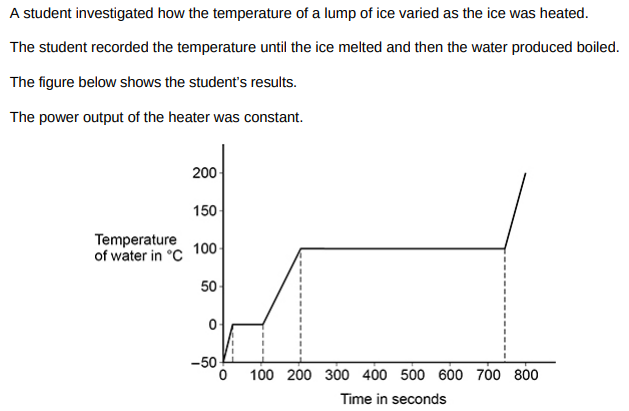
The specific heat capacity of ice is less than the specific heat capacity of water.
Explain how the figure above shows this.
the gradient for ice is steeper than the gradient for water liquid
which means that less energy is needed to increase the temperature by a fixed amount

The specific latent heat of fusion of ice is less than the specific latent heat of vaporisation of water.
Explain how the figure above shows this.
water took more time to vaporise than the ice took to melt
which means that less energy is needed to change the state from solid to liquid than from liquid to vapour
A second student did the same investigation and recorded the temperature until the water produced boiled.
In the second student’s investigation more thermal energy was transferred to the surroundings.
Describe two ways the results of the experiment in the figure above would have been different.
ice would take more time to increase in temperature
ice would take more time to change state
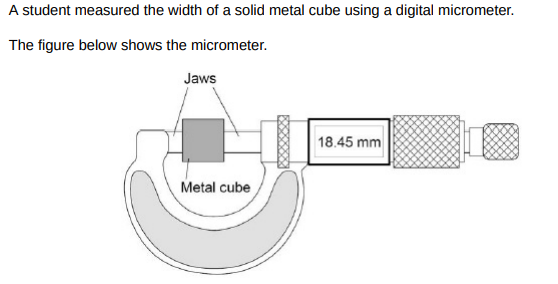
The mass of the metal cube was measured using a top pan balance.
The balance had a zero error.
Explain how the zero error may be corrected after readings had been taken from the balance.
record the value of the zero error when there is no object on the balance
subtract / add the value of the zero error
What is frequency?
Number of complete waves passing a point per second. Unit: Hz.
What is the period of a wave?
Time taken for one complete wave/oscillation. Unit: seconds
What is wavelength?
Distance between corresponding points on consecutive waves
What is the law of reflection?
Angle of incidence = angle of reflection
What type of wave is sound?
A mechanical longitudinal wave. It needs particles and cannot travel through a vacuum
What is the human hearing range?
Approximately 20 Hz to 20 kHz
What is the electromagnetic spectrum in order of increasing frequency?
Radio → microwave → infrared → visible → ultraviolet → X-ray → gamma
What happens to wavelength when frequency increases?
Wavelength decreases, assuming wave speed stays constant
How fast do electromagnetic waves travel in a vacuum?
3 × 10⁸ m/s
What do convex and concave lenses do?
Convex lenses converge light; concave lenses diverge light.
What is the wave speed equation?
wave speed = frequency × wavelength
v = fλ
What are the units for wave speed, frequency and wavelength?
Wave speed = m/s
Frequency = Hz
Wavelength = m
Explain why exposure to gamma rays can be harmful but exposure to radio waves is not harmful.
gamma rays are weakly ionising but radio waves are not ionising
so gamma rays can increase the risk of cancers
Explain how radio waves are produced at a specific frequency.
radio waves are produced by oscillations in electrical circuits of the scanner
the radio waves have the same frequency as the oscillations
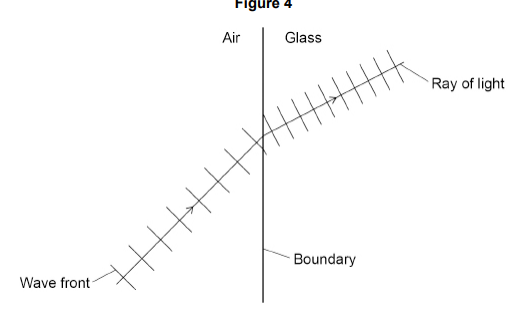
Explain in terms of the wave fronts, why refraction happens at the boundary between air and glass
different parts of the wavefront enter the glass at different times
the speed of light is less in glass
so one part of the wave front changes speed before other parts

Compare how different factors affect the minimum sound level that these people can hear.
The minimum audible sound level increases at very low and very high frequencies (the human ear is most sensitive to mid-range frequencies).
Age: As age increases, the minimum audible sound level increases (hearing sensitivity declines).
Working Environment: Working in a loud/noisy environment increases the minimum sound level required to hear.
Combined Impact: Age and noise exposure compound together, meaning older individuals who work in loud environments have the highest hearing thresholds. [1, 2]
What is the difference between mass and weight? (Include units, scalar/vector, and if they change)
Mass: Amount of matter, measured in kilograms (kg), scalar, and stays the same anywhere in the universe.
Weight: Force acting on an object due to gravity, measured in Newtons (N), vector, and changes depending on the gravitational field strength (W = mg).
When work is done against frictional forces, what happens to the energy?
Energy is transferred to the thermal energy store of the object and its surroundings, causing the temperature to rise.
What is the difference between the 'limit of proportionality' and the 'elastic limit'?
Limit of proportionality: The point beyond which force and extension are no longer directly proportional (the graph stops being a straight line).
Elastic limit: The point beyond which the spring deforms plastically (inelastically) and will permanently stay stretched, failing to return to its original length.
Explain the 4 stages of an object reaching terminal velocity (e.g., a skydiver).
1. Object drops: Weight > Air resistance (drag), so it accelerates downwards.
2. As speed increases, air resistance increases.
3. Eventually, air resistance equals weight (forces become balanced / resultant force = 0).
4. The object stops accelerating and falls at a constant maximum speed, known as terminal velocity.
What must be true for an object to be in equilibrium (balanced) using moments?
The total clockwise moment must equal the total anticlockwise moment about any pivot.
How do a smaller gear and a larger gear differ in speed and turning effect (moment) when connected?
Smaller gear: Turns faster (higher speed), but gives a smaller turning effect (less force).
Larger gear: Turns slower (lower speed), but gives a larger turning effect (more force).
What is the equation for pressure at a depth in a fluid (p = hPg), and what does each letter stand for?
p = Pressure (Pascals, Pa)
h = Height/depth of the fluid column (metres, m)
P = Density of the fluid (kg/m3)
g = Gravitational field strength (N/Kg)
Why does an object experience upthrust when placed in a liquid?
Because the bottom of a submerged object is deeper than the top, the liquid pressure is greater at the bottom, creating a net upward force.
How do safety features like crumple zones or airbags reduce injuries during a crash? (Use momentum terminology)
They increase the impact time, which decreases the rate of change of momentum, significantly reducing the force felt by the passengers.
State the law of conservation of Energy
Energy cannot be created or destroyed, only transferred, stored or dissipated
Define one Joule
One joule is the work done when a force of 1 N moves an object 1 m
Define resultant force
The single force that has the same effect as all the forces acting on an object together.
State the principle of moments
If an object is balanced, the total clockwise moment about a pivot equals the total anticlockwise moment.
How do gears transmit a rotation
Interlocking teeth make the next gear turn in the opposite direction; a larger driven gear turns more slowly with a larger moment
State hookes law as an equation with units
Force (N) = spring constant (N/m) × extension (m) (F = ke)
What is the limit of proportionality
The point beyond which extension is no longer directly proportional to force
Define centre of mass.
The point at which the weight of an object can be considered to act
Describe how a student could find the spring constant of a spring using masses, a clamp stand and a metre rule
Hang the spring from a clamp with a metre rule alongside and measure its original length
add masses one at a time (e.g. 100 g) and calculate each weight using W = mg
measure the new length each time and calculate extension = new length − original length
plot force against extension; the gradient is the spring constant.
Explain why a longer spanner makes it easier to undo a tight nut
Moment = force × distance
a larger distance gives the same moment with a smaller force
Explain why a spring in a newtonmeter must not be stretched beyond its limit of proportionality
Beyond it, extension is not proportional to force / the spring is permanently stretched, so readings would be wrong.
A crate moves at a constant speed. Explain why the resultant force on it is zero.
The pushing force is equal to the friction force
so the forces are balanced and the velocity does not change (Newton's first law)