Key Points to Consider
 Call Kai
 Learn
 Practice Test
 Spaced Repetition
 Match
 Flashcards
 Knowt Play
1/22

There's no tags or description
Looks like no tags are added yet.
Name | Mastery | Learn | Test | Matching | Spaced | Call with Kai | Chat |
|---|
No analytics yet
Send a link to your students to track their progress
23 Terms
What is Simple Random Sampling (SRS)
Weak and Strong Definition
A sample chosen so that every possible group of size n has an equal chance of being selected. Fixed numbers will not be considered a SRS, because every individual / group must have an equal chance of being chosen.
Weak Definition of SRS: Every possible sample of size n has an equal chance of being chosen. Focus is more placed on the groups.
Example: You have 100 students and want a sample of 10.
Every possible group of 10 students is equally likely to be selected.
Strong Definition of SRS: Every individual in the population has an equal chance of being chosen. Focus is more placed on the individual.
Example: 100 students, sample of 10.
Each student has a:
10/100=10% chance of being selected.
SRS guarantees this.
What are the Pros SRS
Reduces Bias: Everyone has an equal chance of being selected. More fair than convenience sampling.
Easy to Analyze: Most statistical formulas assume the sample is random. Makes calculations easier.
Usually Representative: Random selection tends to produce a sample that reflects the population. Results are often more reliable.
Simple Concept: Number everyone and randomly select. Easy to understand.
Cons of Simple Random Sampling - SRS
Need a Complete List: You need a list of every member of the population.
Example: Surveying all Canadians would require access to a complete population list. Often impractical.
Can Be Expensive: Selected individuals may be spread over a large area. More time and travel costs.
Important Groups May Be Missed: Random chance can lead to underrepresentation.
Example: A school is 90% Grade 12 and 10% Grade 9. A random sample might include very few Grade 9 students. Not guaranteed to represent all subgroups.
Nonresponse Can Cause Bias: Even if the sample was random, people may not respond.
Example: You randomly sample 500 people, but only 100 reply. The respondents may not represent the original sample.
Difference in Opinion: If you are already assuming that there may be differences in certain groups, this might not be the best method (use stratified instead).

Stratified Sampling
Divide a population into smaller groups based on shared characteristics, then randomly select people or items from each group.
Divide population into groups first.
Randomly select from every group.
Ensures representation of defined groups.
The goal is to make sure that every important group is represented in your sample.
Each group is called a stratum (plural: strata). In this example, the researcher uses proportionate stratified sampling because the number selected from each group matches its share of the total population.
It is especially useful when:
A population contains different subgroups that researchers want represented.
Researchers want to compare groups.
A small subgroup might otherwise be underrepresented in a random sample.
The characteristic used to divide the groups is relevant to the research question.
When you assume that different groups may have differing opinions.
Examples include:
Education: Sampling students from different grade levels.
Healthcare: Sampling patients from different age groups.
Pros of Stratified Sampling
Potentially more accurate results: Estimates can be more precise when the groups differ from one another but contain similar individuals within each group.
Allows group comparisons: Researchers can compare first-year and fourth-year students, for example.
Reduces the chance of missing small groups: Particularly useful when a subgroup is small but important.
Cons of Stratified Sampling
More complicated: Researchers must divide the population before sampling.
Requires information in advance: They need to know which group each person belongs to.
Can take more time and money: Separate groups must be identified and sampled.
Not always more accurate: If the chosen groups aren't relevant to what is being studied, stratifying may offer little benefit.
Depends on the type of research that you are doing.
Multistage Sampling
Researchers select their sample in multiple stages, moving from larger groups to smaller groups until they reach the individuals they want to study.
You randomly choose a sample in several steps, starting with large groups and gradually narrowing down to individual people. Think of it like going from big groups to smaller groups until you reach the people you want to study.
Randomly select groups, then sample smaller groups or individuals within them.
Sampling happens in multiple stages.
Example: Imagine you want to survey university students across Canada.
Step 1 Provinces: Randomly select 3 provinces.
Step 2 Universities: Randomly select 2 universities in each province.
Step 3 Students: Randomly select 20 students from each university.
Instead of trying to contact every university student in Canada, the researcher selects groups in stages until they reach the students they need.
Pros of Multistage Sampling
Saves time and money.
Makes studying large populations easier, especially geographically.
Allows researchers to use different sampling methods at each stage.
Can be practical for a national survey.
Cons of Multistage Sampling
Takes more planning.
Mistakes or bias at one stage can affect the final sample.
The sample may be less representative if the groups selected don't reflect the wider population.
May be less precise than simple random sampling.
Systematic Sampling
Choose a random starting point, then select every \(k\)-th person on a list until you reach your desired sample size.
To pick the kth number use N/n = sampling interval.
Random start + fixed interval = systematic sampling.
When researchers have an ordered list of people or items and want to select a sample efficiently.
Pros of Systematic Sampling
Easy and quick to use.
Saves time when sampling a large population.
Spreads the sample across the population list.
Cons of Systematic Sampling
Can produce biased results if the list has a repeating pattern.
Requires an organized list of the population.
Not fully random after the starting point is chosen.
If there are patterns (for example certain days), this is problematic and this should not be used.
Three Principles of a Design Experiment
Randomization = Fair assignment by chance.
Randomly decide which subjects receive each treatment so that one group isn't unfairly advantaged.
Example: You have 20 plants and two fertilizers. You randomly assign 10 plants to Fertilizer A and 10 to Fertilizer B.
Some plants might naturally be healthier or grow faster. Random assignment helps spread these differences across the groups, reducing the influence of lurking variables.
A lurking variable is another factor that could affect your results without being the main thing you're studying.
Control = Reduce the influence of other factors. Limit effects of other variables.
Keep other conditions consistent, or account for them, so you can determine whether the treatment caused the difference in results. This includes blocking, placebo, and double-blind experiments.
Example: You're testing two fertilizers. You give both groups the same amount of water, sunlight, and soil.
If one group receives more sunlight, you won't know whether its plants grew taller because of the fertilizer or the sunlight.
Replication = Use multiple subjects. More subjects per treatment.
Apply each treatment to several subjects instead of just one.
Example: You test each fertilizer on 10 plants rather than one plant.
Individual plants naturally vary. Testing several plants helps you see the overall effect of the fertilizer instead of relying on an unusual result from a single plant.
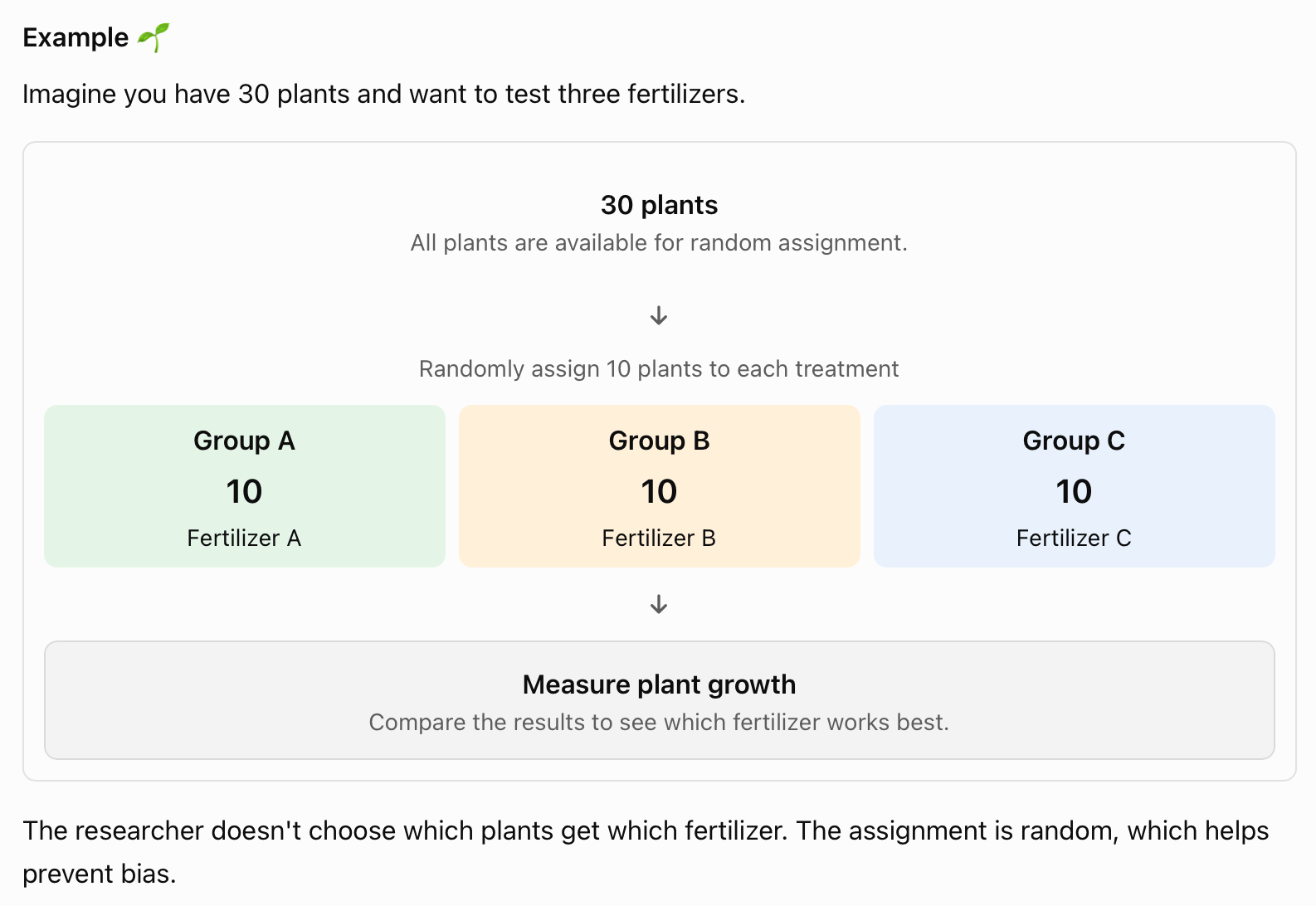
Completely Randomized Design (CRD)
A completely randomized design is an experiment where subjects are assigned to different treatments entirely by chance.
Making groups fair to compare so researchers can investigate whether the treatment causes a difference in the results.
The researcher doesn't choose which plants get which fertilizer. The assignment is random, which helps prevent bias.
All experimental units are assigned to treatments by chance, without first dividing them into blocks or groups based on other characteristics.
Select the experimental units: Choose what you will study. For example, 30 plants.
Identify the treatments: Decide what you want to compare. For example, Fertilizers A, B, and C.
Randomly assign treatments: Use chance to decide which plants receive each fertilizer.
Apply the treatments: Give each plant its assigned fertilizer.
Collect data: Measure how much each plant grows.
Analyze the results: Compare the groups to determine whether the fertilizers produced different growth outcomes.
Pros of CRD
Subjects are fairly similar. Blocks would not improve the accuracy, so more straightforward / simple to setup.
There is no obvious source of variation to control for.
Random assignment helps reduce bias.
Statistical analysis is generally straightforward.
Cons of CRD
Groups may differ by chance, especially with small samples.
If the subjects are very different from one another before the experiment begins, a completely randomized design may make it harder to tell whether the treatment caused the results.
Other factors (lurking variables) can still influence results, even with random assignment.
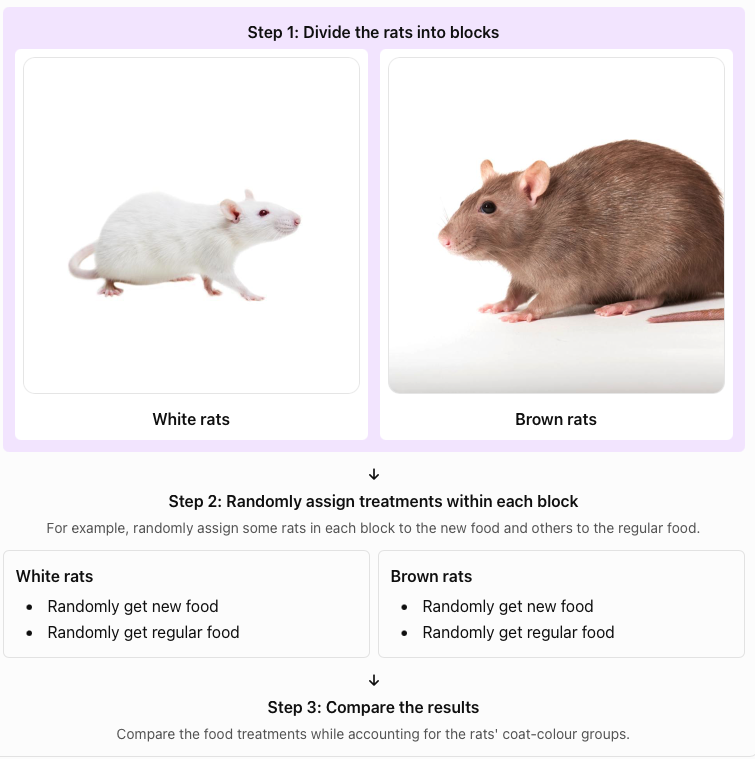
Randomized Block Design
Experiment
Divide subjects into groups based on a characteristic that you think could affect the results, then randomly assign treatments within each group.
Reduces variation and improves comparisons, but they require planning and only help when the blocking variable is relevant.
Imagine you want to test whether a new type of food makes rats run faster through a maze. You think the rats' coat colour might be related to their running speed.
Divide the rats into blocks: White rats and brown rats
Randomly Assign Treatments within Blocks: For example, randomly assign some rats in each block to the new food and others to the regular food.
Compare Results: Compare the food treatments while accounting for the rats' coat-colour groups.
Randomized Block Design Considerations
You should have a reason to believe the characteristic might influence the outcome. You wouldn't create blocks based on a random characteristic that is unlikely to matter.
For example in a drug trial if one treatment group accidentally gets mostly younger people and another gets mostly older people, it might look like the drug works better when really it is just an age difference.
You don't randomly assign rats to either colour group. You first group them by their existing colour, then randomly assign the food treatments within each group.
Each block has its own random assignment process. In this example, the white rats have one random assignment process, and the brown rats have another.
Coat colour could be a lurking variable if it affects running speed but isn't accounted for. Once you deliberately group rats by coat colour to account for its possible effect, it becomes a blocking variable.
Randomized Block Design Pros
Reduces the impact of lurking variables: Groups subjects based on a characteristic that could affect the results, such as age, weight, or coat colour.
Makes comparisons fairer: Treatments are compared within similar groups, rather than comparing subjects who may have important differences.
Can improve accuracy: Reducing variation between subjects can make it easier to detect whether a treatment actually has an effect.
Reduces the influence of natural differences: For example, if you are testing fertilizers, grouping plants by their initial size helps account for differences in growth potential.
Randomized Block Designs Cons
Requires knowledge beforehand: You need a reason to believe a particular characteristic could affect the outcome.
Can be more complicated: You must divide subjects into blocks before randomly assigning treatments.
May not help if the blocks aren't useful: If the characteristic you choose does not affect the outcome, blocking may provide little benefit.
Doesn't control for every variable: Other differences between subjects may still affect the results (other lurking variables).
SRS Requirements
SRS Requirements
Every individual must have the same chance of being selected.
Every possible group (sample) of size n must have the same chance of being selected.
The population is split into three universities:
Manitoba: 30,000 students, Winnipeg: 10,000 students, Brandon: 3,000 students
The sample sizes were fixed at:
Manitoba: 600 students, Winnipeg: 200 students, Brandon: 60 students
This means we must choose:
exactly 600 from Manitoba, exactly 200 from Winnipeg, exactly 60 from Brandon.
Why isn't this an SRS?
Because some possible groups of students can never be selected. For example, imagine a sample containing:
500 Manitoba students, 310 Winnipeg students, 50 Brandon students
In a true SRS, this sample would be possible. But under the stratified sampling plan in part (b), it is impossible because we are required to take:
600 Manitoba, 200 Winnipeg, 60 Brandon
So many possible samples have a probability of 0 of being chosen.
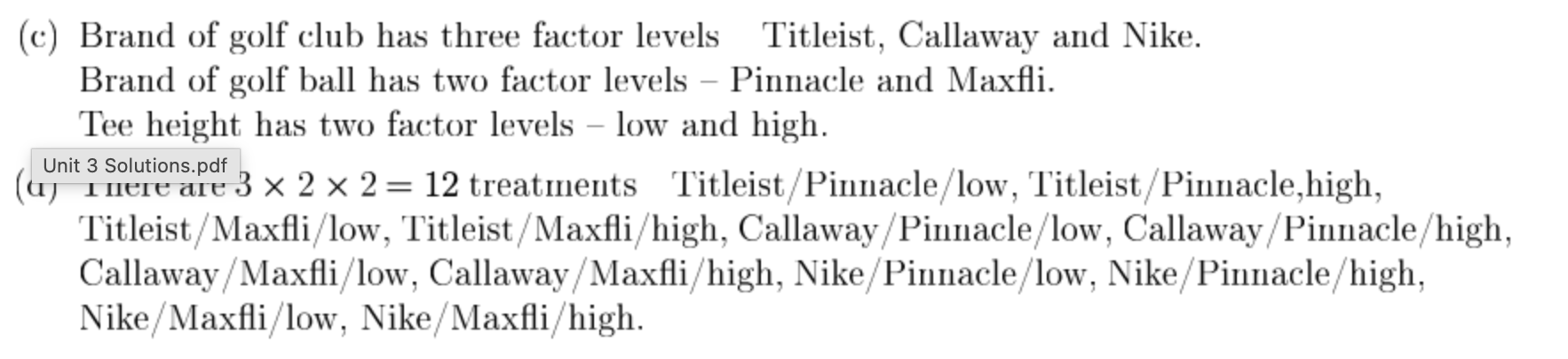
Finding Factor Levels & Treatments
Number of Treatments = Levels of Factor 1 x Levels of Factor 2 ……
Factor 1: Type of diet (3 levels)
Factor 2: Exercise program (2 levels)
3 × 2 = 6 Treatments total
When there are more then two factor levels, just keep multiplying the levels by one and other.
Just looking at the factor levels that fall under neath the factor, not the actual factor header itself.
Ways to Identify
Find the factor(s) (what is being changed).
Find the levels of each factor (the options).
Multiply the number of levels together.
Each unique combination is a treatment.
3 Principles of Experimental Design [RCR]
Replication
Repeating a treatment on many subjects.
It helps make results more reliable and reduces the effect of random chance.
Example: Testing a fertilizer on 50 plants instead of just 1 plant.
Remember: More repetitions = more trustworthy results.
Control
Keeping other factors the same so only the factor being studied can affect the results.
It lets us be confident that any difference observed is caused by the treatment and not something else.
Example: If testing a fertilizer, give all plants the same amount of sunlight and water.
Remember: Control = keep everything else constant.
Randomization
Randomly assigning subjects to treatments.
It prevents bias and helps create comparable groups.
Example: Randomly assigning patients to receive either a new drug or a placebo.
Remember: Randomization = fairness.