HART B130 Midterm guide
 Call Kai
 Learn
Learn Practice Test
 Spaced Repetition
 Match
Match Flashcards
 Knowt Play
1/27

There's no tags or description
Looks like no tags are added yet.
Name | Mastery | Learn | Test | Matching | Spaced | Call with Kai | Chat |
|---|
No analytics yet
Send a link to your students to track their progress
28 Terms
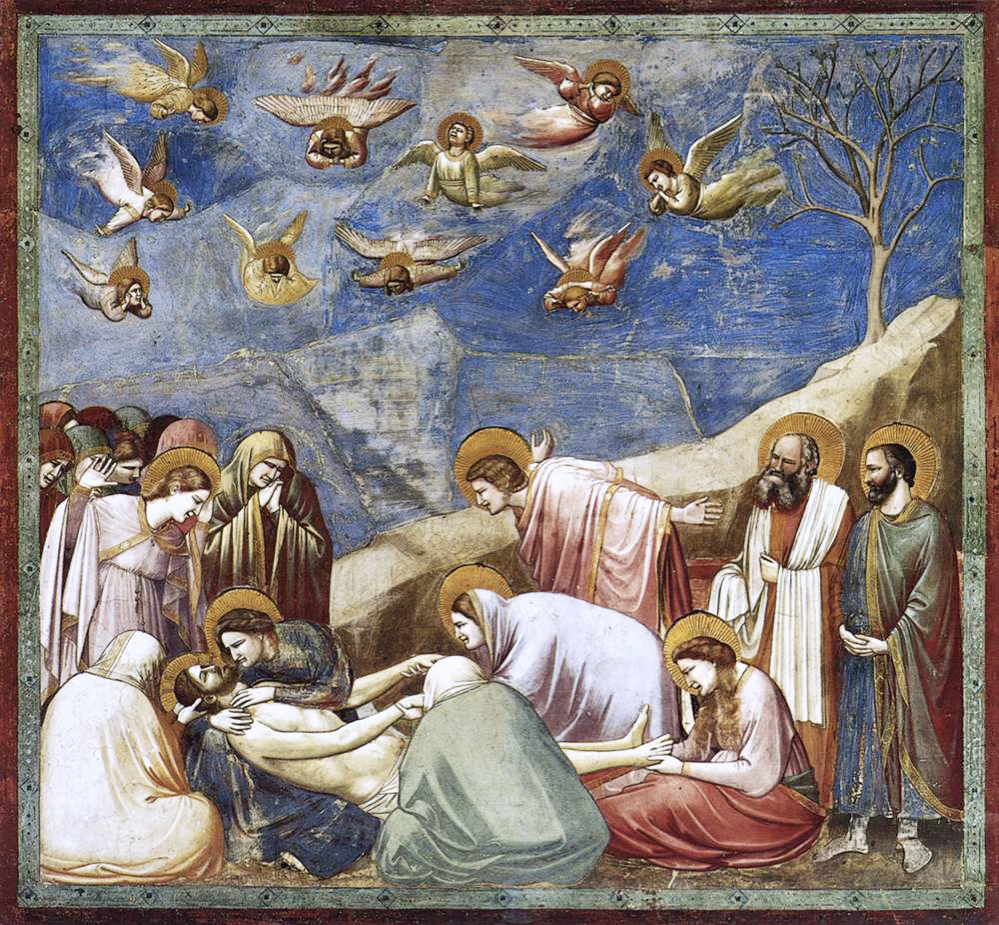
Lamentation of Christ's Death (Scrovegni Chapel/Arena Chapel), Giotto di Badone, 1304-06, Fresco, Padua
Giotto shows stylistic changes from previous religious art traditions- such as with the 1164 Lamentation of Christ fresco
uses 3D elements, more layers of people
blue background to depict our own sky
naturalistic rendition, recognizes value of the body, more complex composition of figures ex figures turning their backs, behind main figures, sense of depth
variety of expression, almost more cherubesque, seem more angelic, end of clothes are more airy
Foreshortening: A way of depicting a body, emphasizing the illusion of depth extending back into space. Body looks compressed or shorter
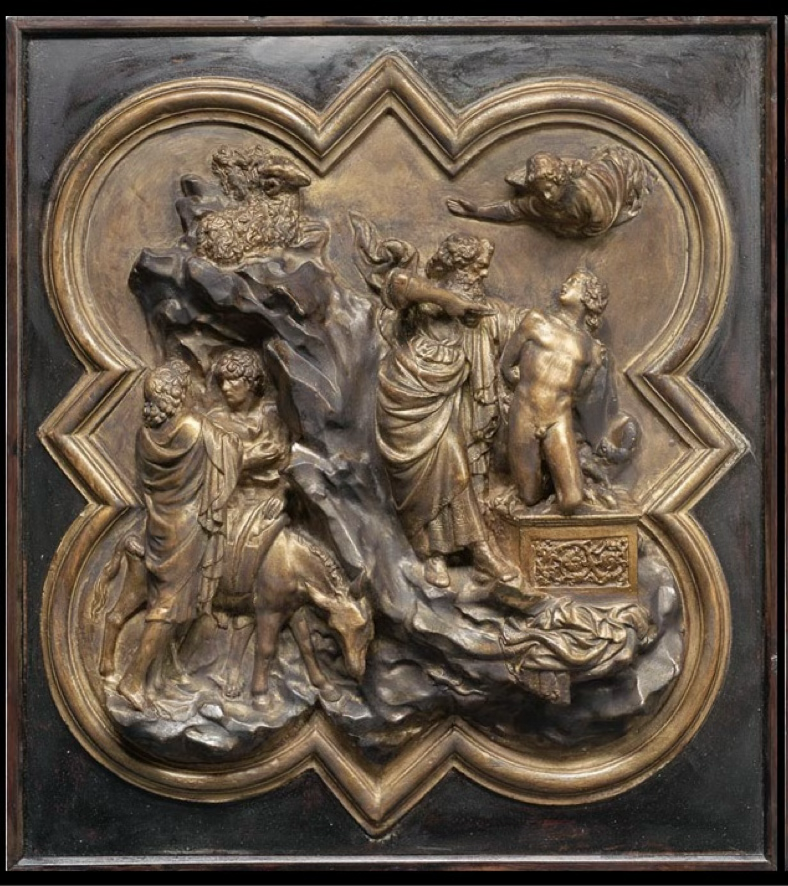
Sacrifice of Isaac (The Competition Panel), Lorenzo Ghiberti, 1401-02, Bronze, Florence
Ghiberti: Italian sculptor, came from family of goldsmiths, trained in a late medieval sculptures' workshop
Competition to see who should create panel on south doors of Florence Baptistery, artists asked to create single panel of baptistery to show the sacrifice of Isaac-many climaxes in the story, all narratives condensed in one panel
The choice to pick Ghiberti was partly economical-cast most of the panel as one piece, with two small pieces added-used less bronze, lighter, more economical
angel seem to emerge from the bronze in the background, sense of depth, carries through in the rest of the sculpture
rocky landscape to unify the composition, beginning at the upper left where we see the ram, moving down to the lower right. Creates believable landscape for these figures to occupy

Sacrifice of Isaac (The Competition Panel), Filippo Brunelleschi, 1401-02, Bronze, Florence
Brunelleschi: architect, sculptor, goldsmith, son of notary, cast seven separate pieces and put them together on bronze plate to create this panel, strong references to antiquity
Brunelleschi stated that the competition was a tie, when Ghiberti stated that he won
a more aggressive scene than the Ghiberti. It feels more dangerous, uses entirety of panel to fill space of story, more drama
lower left corner a young man who seems to be looking at his foot. This is a direct quote from a very famous ancient sculpture, and it's an expression of the young Brunelleschi's interest in classical art (reference to The Thorn Puller sculpture from first century BCE)

Dome of Florence Cathedral, Filippo Brunelleschi, 1420-36, Florence, bricks structure/terracotta roof, Italy
Cathedral did not have roof for some time, contest was held to create one
Brunelleschi won in 1418-initially collaborated with Ghiberti
wanted to do something drastically different from current period
Studied the pantheon
Made of three parts:
lantern: Completed after Brunelleschi's death, medieval inspiration, gothic churches flying buttresses or gothic architecture-shaped liturgical metalwork
Used ribs and double shell to elegantly support the weight-gothic buttresses no longer supporting all the weight, now it is almost ornamental, at the very top not serving large purpose
dome: ribs-eight large ribs from corners of octagon with smaller in between, distributed weight of lantern evenly to drum below, wooden/iron girdle bands held the structure inward
Double-shell-inner shell of bricks bore the weight, outer shell of terracotta concealed structure
Combined visual effect-external ribs alluded to hidden inner structure
Medieval pointed arch system merged with classical references
drum
Brunelleschi's dome was influential in establishing the renaissance dome as symbol of architectural, technological, and civic ambition
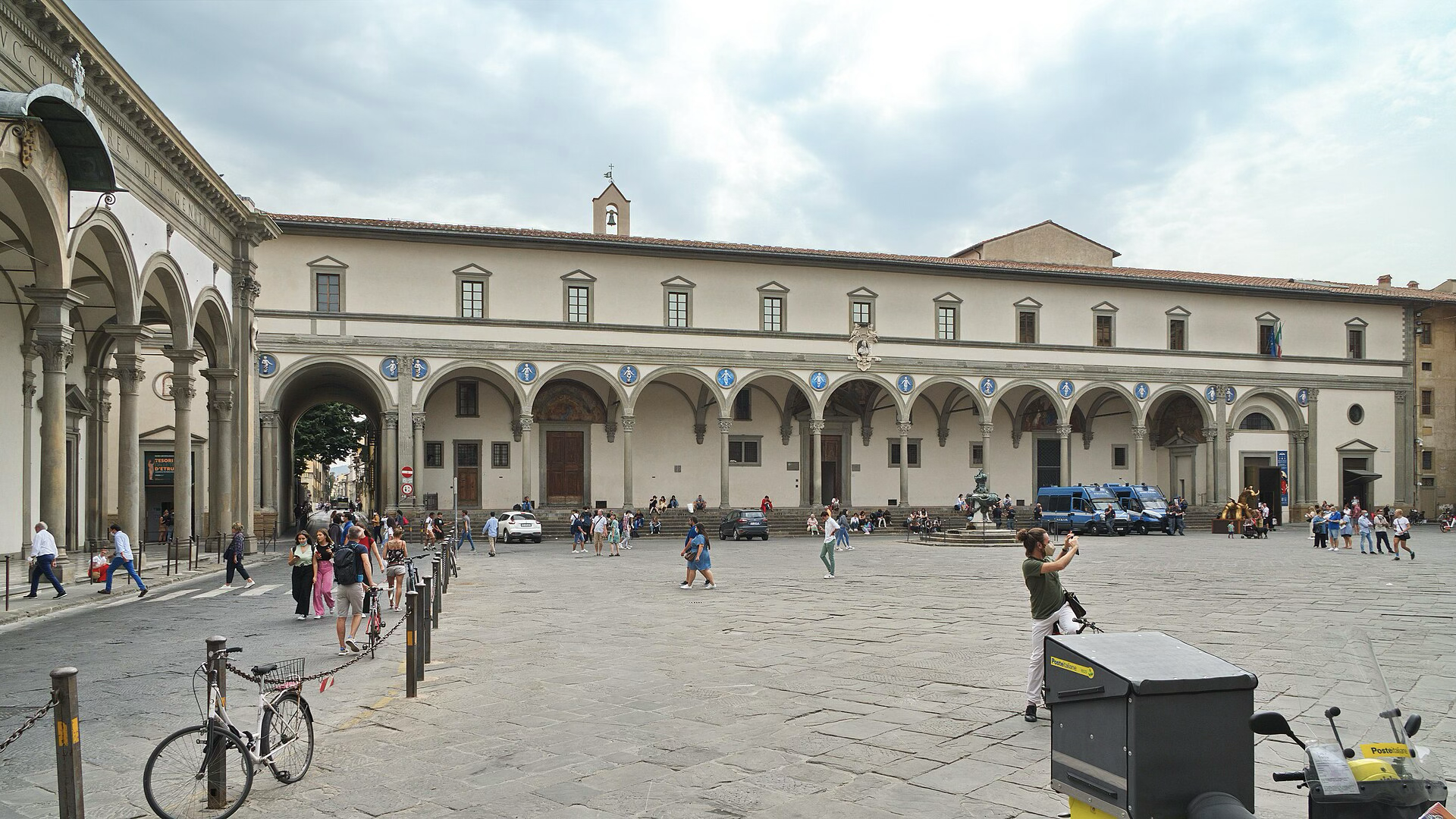
Ospedale degli Innocenti (Hospital of the Innocents), Filippo Brunelleschi, 1417-36, Florence, Italy
1-1-1 ratio with pillars to arches, simple square model
Ospedale: hospital; charity institute as children's orphanage-depicted through circles above pillars, bright blue color pops in contrast to overall simplicity
"Innocents" are christian saints, killed when king herald ordered to kill all newborn babies
Artistic competition and civic wealth: Florence guilds, medici fam, civic committees. Panel and dome competition, rivalry stimulated artistic innovation
Antiquity reinterpreted for christianity and humanism. Florentine architecture sought harmony through simple proportion and human-centered-contrasts gothic cathedrals, which see humans as humble in contrast to grandiose of architecture

Martyrdom of St. Sebastian, Antonio and Piero del Pollaiuolo, Florence, after 1475, oil on canvas, Italy
Triangular composition made with bodies, aim of bows to the saint
Artificial look almost, symmetrical positioning of figures at the bottom, same posing just flipped
Sebastian's body color is brighter, looking up to heaven, leaving fate to god
Good guy" is mostly naked..."bad guy" is most clothed, wearing vivid clothing, associated with sin

Battle of the Nudes, Antonio del Pollaiuolo, Florence, 1470s, Engraving, Italy
Very muscular, facial expressions seem to be impassioned/furious, no gore
Chaos, viewer cannot tell who is on what side due to nudity, no markings to distinguish
Disegno: studies, experiments and investigations through which the artist conceives the form of an artwork; artists thinking process by hand-can be preparatory work or an autonomous exercise that does not necessarily assume the end product
One theory is that this is a disegno, that is why all figures look very similar, experimentation with human muscles and poses
Engraving: printmaking technique that became established as medium in 1430s german-speaking lands and north Italy, indebted to longer metalworking traditions
Every individual sheet of print is impression
Diff states are determined by the change made onto the plate
Seen as ambitious engraving for the time, meticulous and large scale

The Creation of the World and the Explusion from Paradise, Giovanni die Paolo, 1445, Siena, tempera and gold on wood, Italy
Paradise reminiscent of that described by Dante in "The Divine Comedy."
The universe is shown as a celestial globe, with the earth at the center surrounded by a series of concentric circles representing first the four elements, the known planets (including the sun, in accordance with medieval and Renaissance cosmology), and finally the constellations of the zodiac.
A diminutive Adam and Eve are expelled from the garden by a angel whose unusual nakedness and human form may symbolize his deep compassion for the corrupted state of humankind after the fall from grace.

Amerigo Vespucci's Voyage to the New World, from
Lettera di Amerigo Vespucci delle isole nuovamente trovate in quattro suoi viaggi, Florence, 1505, woodcut, Italy
frontispiece of travel account
15th century depiction of nudity when it comes to europeans/places elsewhere seen on voyages–stripping of identity, seeing African people/indigenous peoples as being lesser than in their nudity, European accounts of Africa depict them in viciousness

Tale of Nastagio degli Onesti (panel 2), Sandro Botticelli, Florence, 1482/83, tempera on panel. Italy
Naked woman being chased by vicious dogs and man on horse
Continuous storytelling–he learns he has been rejected by the woman he is interested in, surprised to see naked woman, tries to help and chase the dog off, the knight caught and killed her, cutting her open, dogs eating her heart, she comes alive again and the man reveals he is also a ghost, nastagio crashes the party by bringing ghosts to the scene

Tale of Nastagio degli Onesti (panel 3), Sandro Botticelli, Florence, 1482/83, tempera on panel, 83 x 142 cm. Italy
Series intended for a wedding chamber of Bini-Pucci couple–panels surrounded the four walls
Brutal treatment of woman's nude body–surrounding area where “consumation” occurred–gender ideology
Main lesson that their wedding should be celebrated, and that the woman should not reject her husband
Depth seen in each panel–scale of human figures can help to emphasize depth
Trend in 1400s art to represent 3d space on 2d surface using single vantage point–using singular vanishing point

Tale of Nastagio degli Onesti (panel 4), Sandro Botticelli, Florence, 1482/83, tempera on panel. Italy
4th and last panel was not derived from Botticelli’s decameron–added this scene based on reality
shows both family’s crests
Linear perspective: a mathematical system for representing 3D space on a 2D surface, using a horizon line and vanishing point

“German Gentleman chooses the German Lady over the Italian Women” from Album amicorum of Johann Georg Schwingersherlein, Unknown artist, 1588–1602, German, watercolor.
album anicorum: blank book that travelers carried with them and asked friends and acquaintances to sign or contribute drawings, poems, and other mementos
Shows the ideals of the persons circle
The italian women seem more open towards the man, “active”, german woman seems more chaste because of how she is dressed and her demeanor, they are all holding playing cards and the germanic woman holds the one of hearts, showing he will choose her
Assigned national and gender roles and how they are played through costumes

Trachtenbuch (Book of Costumes) written by Hans Weigel, Jost Amman (artist), colored woodcut, 1577, Nuremberg. Germany
Continuation of showing German women as more chaste, based on posture, clothing, in comparison to italian woman, many accessories, leaning posture, colorful, she seems more aggressive and open in her gestures
German ruler vs persian lord: both proud and composed, matching ranks
Persian lord has wider stance, hand on hip, he seems smaller in comparison because of pole and his hat
Coloring on persian lords garments seems to be more random than the german ruler
Belt on german is lower on hips, makes stomach protrude, whereas persian has higher waistline, making his torso look smaller, less manly

Ancient and Modern Costumes of the Whole World (Habiti antichi et moderni di tutto il mondo), Cesare Vecellio (writer, designer), Christoph Krieger (cutter), woodcut, first published in Venice, 1590. Italy
A member of the Confraternity charged with Justice, which accompanies those condemned to death in the City of Venice (1664 edition).
A matron of China (1590 edition)


Chimney-hanging from the Leipzig Town Hall, Unknown artist, embroidery, 1571, Leipzig. Germany.
Being completely clothed does not relate to being civilized; german is naked holding clothes
Turk is head to toe dressed in heavy coat, uncivilized brutality by killing an infant in image
German man is hesitant to wear which kind of identity, array of expanding world in front of him–cultural nudity; he's too civilized, knows too much about the world, expanding knowledge of the globe
Inscription on the bottom suggest people who come ot town hall keep their rank in contrast to being interested in other costumes

A Miniature from the Vienna Hours of Mary of Burgundy, Master of Mary of Burgundy, c. 1475, Early Netherlandish, parchment
She is in foreground prominently reading prayerbook, but also in the background with the virgin and Mary herself
Meditation while she is reading, identification she is getting from the reading, following the story
She is in her own room but the window is open to show her meditation, expands into architecture of the church
Private space, book is conveniently open, personal belongings strewn about
Witness in foreground looking back at us, breaking wall
Foreground is the crucifixion, mary on the left being held back from touching her son, saint johann holding her, typical coloring of clothing for them with the red and blue
Golotha location
No mary magdalene in image–mary of burgundy assumes her role, so there is no need to include the saint, mental participation of biblical history
Sacrifice of Isaac seen on the side in the actual room, other side shows moses and brazen serpent–old testament coming before Christ, sculptures framing the scene prediction of Christ's sacrifice
Not a portrait but a depiction of Mary's observation and her devotion, as long as showcasing her nobility

Madonna of Chancellor Nicolas Rolin, Jan van Eyck, c. 1435, Bruges, early Netherlandish, oil on oak, height 66 cm (25.9 in) x width: 62 cm (24.4 in), Louvre Museum
he is in prayer, on the same ground/space as mary and christ
Her body is alike to an altar
He was politically powerful–accused of financial greed. His money pouch was originally painted but covered up, did not want to invite that criticism
Minute detail and textures, lavish depiction
Bleaming color, light, reflection
Symbolic meaning embedded in objects and surroundings
The ornament on the pillars are hebrew bible/old testament stories from genesis

Diptych of Maartin van Nieuwenhove, Hans Memling, 1487, Bruges, early Netherlandish, oil on oak, 41.5 x 52.5 cm (16.3 in × 20.7 in)
Memling: luminous, soft surfaces, serene figures, orderly compositions, empathetic depictions of his subjects
Sitter looks in awe of Mary, mouth open and eyes watery
Hard to tell they are in the same space at first, when you look at mirror behind the virgin you can see reflection of both the figures close together

Portrait of Lisa del Giocondo (Mona Lisa), Leonardo da Vinci, 1503-1506 and later (1510), Florence, Italy, oil on wood, Louvre Museum
Sfumato: from italian “sfumare” to tone down, evaporate like smoke. Subtle gradiations, without lines or borders, form light to dark areas
Applying numerous layers of low pigmentation glazes, Leonardo created tonal unity and caused the exact contours of depicted objects to blur
Aura: a distinctive quality of atmosphere that seems to surround someone or something; halo
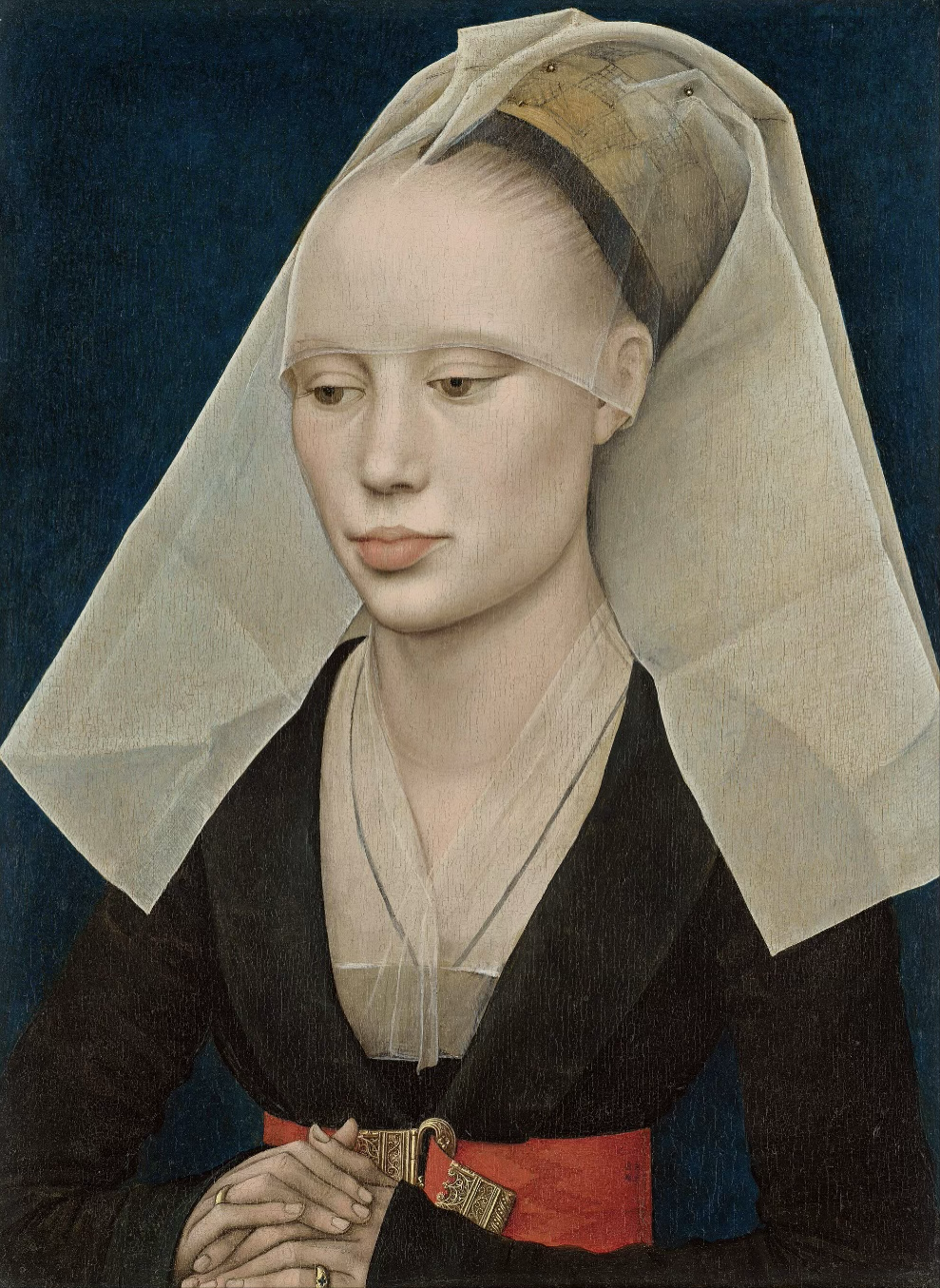
Portrait of a Lady, Rogier van der Weyden, c. 1460, Netherlandish, oil on wood
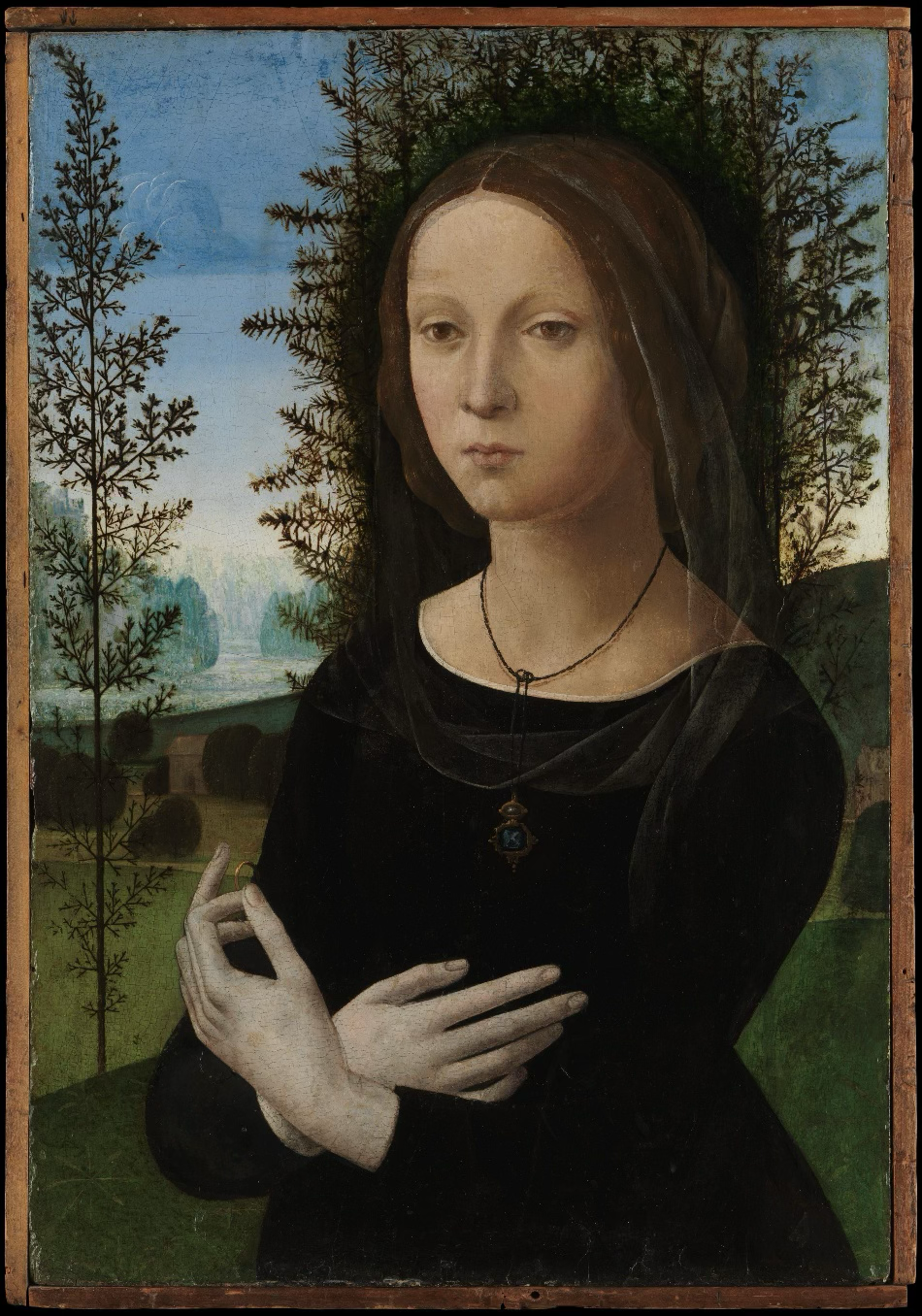
Portrait of a Young Woman, Lorenzo di Credi, c. 1490-1500, Florence. Italy. The Metropolitan Museum of Art , New York

Sacrament Tabernacle, Unknown artist, 1490, Fiesolle, Italy, marble with engraved gilt copper door.
made for Rucellai family
Bears family crest
Door depicts Jesus on the cross, rising from the sarcophagus, entire marble frame was made in consideration of door in center

Virgin and Child with Saint Jerome and Saint Dominic, Filippino Lippi, altarpiece for the Saint Pancrazio church in Florence, Italy, 1485, oil and tempera on wood, height 203 cm.
Predella: the horizontal base or lowest part of an altarpiece, often featuring a narrow strip of small-scale paintings or sculptures– seen in Man of Sorrows
Italian altarpiece usually depicted in passion: death, sorrow
Full cycle of christs life occurring, main image is him as a baby, bottom shows his death

The Exhumation of Saint Hubert , Workshop of Rogier van der Weyden, 1437, early Netherlandish, oil on oak, 88 x 80.5 cm, originally Chapel of St Hubert in the Church of St. Gudula, Brussels
miracle story, his body does not even look dead, even though he has been deceased for at least a hundred years
Main altar of the whole church is placed in the east end, small additional chapels along the isle and could have their own little altars, but not nearly as important as central one where mass and eucharist performed
Screen separates larger space from altar and keeps regular attendees, laypeople, away–they convey human excitement of situation, smiling faces, peaking over crowd

Man of Sorrows Triptych, Parisian goldsmith, France, c.1400–1410, gold, enamel, height 12.5 cm, open width 12.7 cm.
Charm in its smallness gives experience that big altarpiece cannot
Triptych, reliquary
joyeux: French for jewels, a term that often is burgundian inventories. The term encompassed exceptionally valuable luxury objects that were cherished, kept, and intimately appraised. Included precious small scale devotional artworks, rosaries and richly decorated books
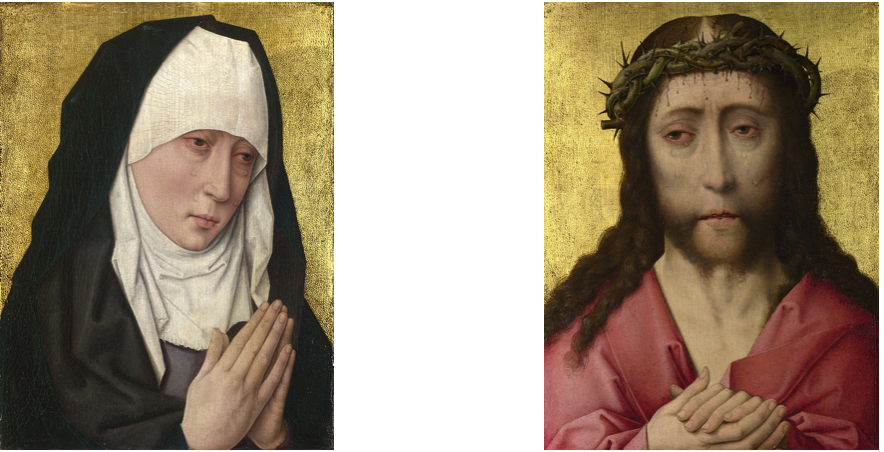
Grieving Virgin (Mater Dolorosa), Workshop of Dirk Bouts, 15th c. Early Netherlandish, oil on wood. 36.8 x 27.9 cm, and Christ Crowned with Thorns, Workshop of Dirk Bouts, 15th c. Early Netherlandish, oil on wood. 36.8 x 27.8 cm
Intense emotion, physical tears, christs bloodied lips, blood from his thorn crown, typically netherlandish style in dress, virgin is in plain dress, background goes back to byzantine–reflective background that gives a brightness, glowing aura
Why would people demand such close up portraits? Very relatable imagery, virgin is dressed humbly like a layperson
Growing desire from laypeople during this time to feel connection to saints—especially in the face of the plague

Saint Veronica, Hans Memling, Saint Veronica, Early Netherlandish, 1470/1475, oil on wood, 30.2 x 23 cm, and The Chalice of Saint John the Evangelist (Reverse of the same panel) Hans Memling, Early Netherlandish, 1470/1475, oil on wood, 30.2 x 23 cm
Compassionate woman came up to Jesus to wipe his face as he carried the cross. As she handed him her cloth, Jesus used it to wipe his face, leaving behind a miraculous, true image of his features.
On other side of panel is image of snake in chalice, chalice st john almost drank from, poisoned wine, he survived–miracle and lesson that belief can vanquish sin and evil
Meditative, invites other senses besides looking at image, use of hands, spiritually move the viewers mind