Psychology Goldstein Midterm 3
 Call Kai
 Learn
 Practice Test
 Spaced Repetition
 Match
 Flashcards
 Knowt Play
1/76

There's no tags or description
Looks like no tags are added yet.
77 Terms
Social Psychology
concerned with the way people’s thoughts, feelings, and behaviors are influenced by others
person perception
process of making impressions of others
illusory correlation
people selectively recall facts that fit with their stereotypes
evolutionary POV on bias in person perception
in-group = group that one belongs to/identifies with
outgroup = group that one doesn’t belong to/identify with
attributions
inferences drawn about causes of events, our behaviors, and others’ behaviors
internal attributions
explanations ascribing causes of behaviors to personal dispositions, traits, abilities, and feelings
external attributions
explanations scribing uses of behaviors to situational demands and environmental constraints
stability and internal/external dimension chart for attributions

actor/observer bias/fundamental attribution error
observers’ bias in factor of internal attributions to explain others’ behavior
self-serving bias
we tend to internally attribute personal successes and externally attribute personal failures
individualism
personal goals placed ahead of group goals and one’s identity defined in terms of personal attributes rather than group membershipo
collectivism
group goals > individual goals and one’s identity defined in terms of the groups one belongs to
what are collectivist societies less susceptible to than individualist societies?
fundamental attribution error
self serving bias
matching hypothesis
males/females of approximately equal physical attractiveness are likely to select each other as partners
similarity effects
similarities attract more than opposites
reciprocity effects
developing interest in those interested in us
passionate love
complete absorption in another that includes tender sexual feelings and the agony/ecstasy of intense emotion
companionate love
warm, trusting, tolerant affection for another whose life is deeply intertwined with one’s own
can passionate and companionate love coexist?
yes
T/F: some social media only highlights good news and can create compulsive, maladaptive behavior
TRUE
consistent standards of attraction across cultures (2)
facial symmetry b/c perceived as being associated with good health
hourglass figure in women b/c perceived as being associated with easier childbirth
gender differences in mating preferences (consistent across cultures)
men —> youth and physical attractiveness, both associated with greater reproductive potential
women —> ambition, social status, financial prospects, all associated with material resources for their children
attitudes can include up to three components: what are they?
cognitive —> beliefs held about the object of an attitude
affective —> emotional feelings stimulated by an object of thought
behavioral —> predisposition to act in certain ways toward an attitude objects (reinforcement/punishment)
are attitudes good predictors of behavior?
No they’re mediocre. people fail to factor in influence of attitude strength and behavior depends on situational constraints
explicit attitudes
attitudes that one holds consciously and can readily describe
implicit attitudes
covert attitudes expressed in subtle, automatic responses over which one has little conscious control
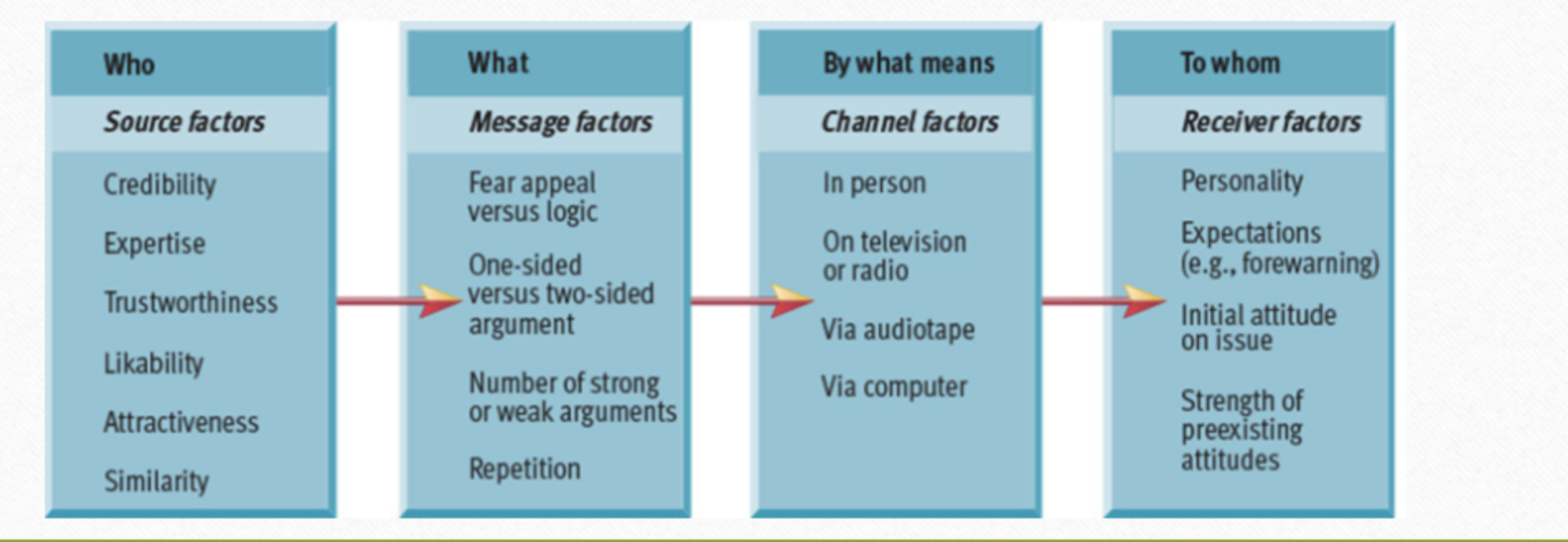
four sets of variables influence the persuasion
source, message, channel, receiver
biopsychosocial model
physical illness is caused by interaction of biological, psychological, and sociocultural factors
stress
any circumstance that threatens or is perceived to threaten one’s well-being burden one’s coping abilities
can routine hassles have significant harmful effects on health?
yes — stress is cumulative and collectively can cause great strain
general adaptation syndrome (GAS)
theory of stress response
alarm response
resistance: attempt to cope with stress
exhaustion: body suffers damage
what does stress activate?
HPA Axis
what does the activation of the HPA axis cause?
hypothalamus releases corticotropin-releasing factor (CRF) and stimulates pituitary glands
what does pituitary gland activate?
adrenal gland, secreting cortisol (stress hormone) which activates sympathetic nervous system and our body goes into fight/flight/freeze
T/F: the hippocampus ordinarily turns off stress response and cannot be damaged by excessive or chronic stress
FALSE. the hippocampus ordinarily does turn off response, but it can be damaged by chronic or excessive stress
psychoneuroimmunology
psychological influences on the neurological component of immune response
what is stress directly related to in humans?
suppressed immune activity
exposure to long-term stress can promote chronic inflammation, which contributes to many other diseases/conditions
immune response
a defensive reaction to invasion by bacteria, viral agents, or other foreign substances
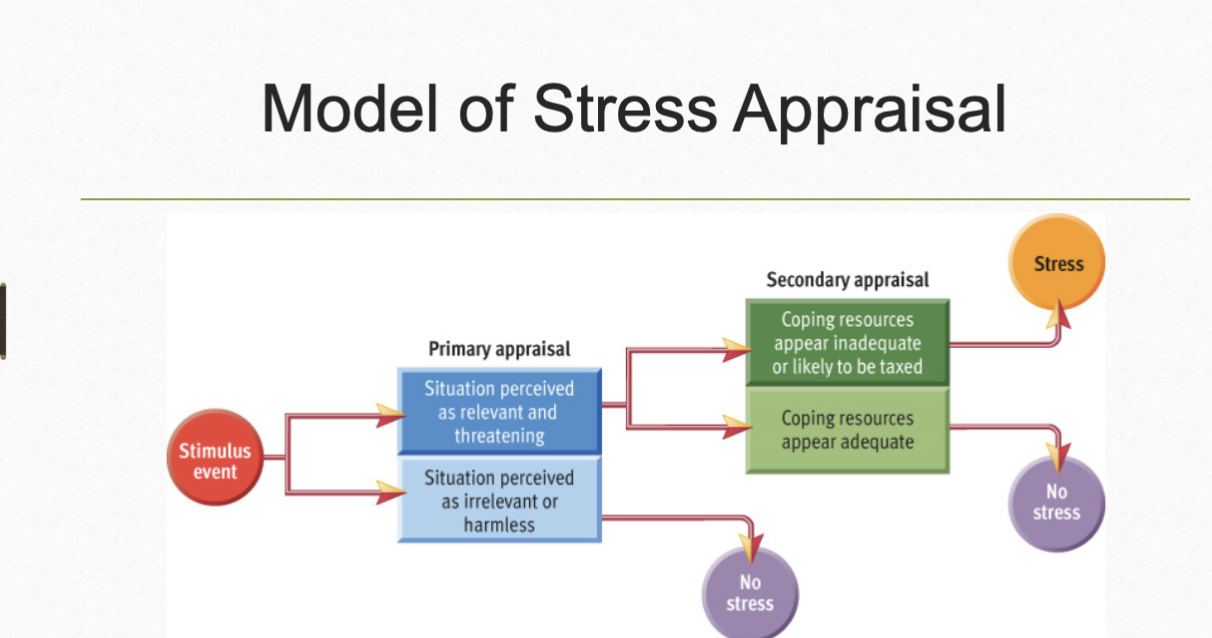
primary appraisal of stress
initial evaluation of whether an event is:
irrelevant to you
relevant, but not threatening; or
stressful
secondary appraisal of stress, which is likely made after viewing an event as stressful
an evaluation of your coping resources and options for dealing with the stress
4 major types of stress
frustration: when pursuit of some goal is blocked
internal conflict: when incompatible motivations/behavioral impulses compete for expression
change: substantial alterations in one’s life requiring readjustment
pressure: expectations/demands that one behave in certain way
DBT: dialectic behavioral therapy
therapy that helps one to accept two conflicting ideas to coexist (alleviating internal conflict)
emotional responses to stress include… (4)
annoyance, anger, rage
apprehension, anxiety fear,
dejection, sadness, grief
can also have positive emotions
broaden-and-build theory of positive emotions
positive emotions promote resilience by altering people’s mindsets (broadens scope of attention and increasing their creativity/flexibility in problem solving), undoing lingering effects of negative emotions and potentially damaging physiological responses to stress, and promoting rewarding social interactions to help build valuable social support and enhanced coping strategies
effects of emotional arousal
increased arousal is associated with improved performance up to a point, after which higher arousal leads to poorer performance

coping
active effort to master, reduce, or tolerate demands created by stress
5 behavioral responses to stress
giving up and blaming oneself (learned helplessness)
striking out at others
indulgence
defensive coping
constructive coping
learned helplessness
passive behavior produced by exposure to unavoidable aversive events
striking out at others: aggression and catharsis
aggression: any behavior that is intended to hurt someone, either physically or verbally
catharsis: release of emotional tension
what effect does stress have on impulse control?
stress can sometimes reduce impulse control
defensive coping
largely unconscious reactions that protect a person from unpleasant emotions; self-deception distorts reality so it seems less threatening
constructive coping
confront problems directly
avoid excessive self-deception and highly unrealistic negative thinking
reappraise stressful events in less threatening ways
ensure that your body is not especially vulnerable to the damaging effects of stress
are the favorable effects of social support strong enough to impact mortality?
yes. social support increases people’s odds of survival by around 50%
factors moderating stress
optimism
conscientiousness
social class disparities
resilience
trait developed from experiencing increased stress — stress can promote personal growth or self improvement
SHORT ANSWER QUESTION: PROCESS OF STRESS
Medical Model
the view that it is useful to think of abnormal behavior as a disease
became dominant way of thinking about abnormal behavior during 18/19th centuries. before that, most conceptions were based on superstition
what did the medical model generate? what do critics say about it?
generated improvements in treatment BUT critics say it promotes derogatory labels, stereotypes, and social stigma
diagnosis
distinguishing one illness from another
etiology
apparent causation and developmental history of an illness
prognosis
forecast about the probable course of an illness
psychological disorder aspects (3)
psychological dysfunction
distress/impairment
atypical response
T/F: sometimes distress and dysfunction are typical
TRUE — this makes diagnoses of psychological disorders harder for distress and dysfunction. an atypical response occurs when an individuals is much more distressed than others are expected to be
psychopathology
study of psychology dysfunction
three categories to support our understanding of psychological disorder (psychopathology)
clinical description (behavioral and objective)
etiology/causation (context)
treatments/outcomes (progress monitor and be flexible)
clinical description (5)
demographic info
symptoms
environmental factors (predisposing factors, risk factors)
prevalence and incidence
course and prognosis (rarity of disorder)
risk factor
clearly defined behavior or constitutional (genetic) psychological, environmental, or other characteristic that makes it more likely a disease/disorder will subsequently develop in an individual
protective factor
clearly defined behavior or constitutional (genetic) psychological, environmental, or other characteristic that is associated with decreased probability that a particular disease/disorder will develop in an individual, that reduces severity of an existing pathological condition, or that mitigates effects of stress generally
treatment development questions
what is our treatment goal? what is best for our client? what is most beneficial in the short-term, long-term, depending on the environment?
diagnostic and statistical manual of mental disorders (DSM)
uses a categorical approach, questioned if diagnostic system can reliably place people in a discontinuous diagnostic category, exponential growth in a number of specific diagnoses
multidimensional integrative approach
interdisciplinary system that posits that atypical behavior comes from multiple influences (biological, behavioral, environmental, emotional, social/cultural, developmental)
genetic contributions
believed that genes account for <50% of variation in psychopathology
genes
basic units of heredity. DNA has 46 chromosomes in 23 pairs
development and behavior is almost always ___
polygenetic
gene environment interactions
the genetic structure of cells change as a result of interactions with the environment
diathesis-stress model
disorders are the result of underlying risk factors combining with life stressors that cause a disorder to emerge. outcomes result from interactions between genetic vulnerabilities and experience. genetics may make people more likely to seek out certain envirronments
epigenetics
environmental influences affect the expression of certain genes both for the individual and descendants