BIO 2060 Exam 2 Flashcards
 Call Kai
 Learn
Learn Practice Test
 Spaced Repetition
 Match
Match Flashcards
 Knowt Play
1/230

There's no tags or description
Looks like no tags are added yet.
Name | Mastery | Learn | Test | Matching | Spaced | Call with Kai | Chat |
|---|
No analytics yet
Send a link to your students to track their progress
231 Terms
Studies metabolism, morphology, reactions to stimuli (antibiotics, nutrients), investigations of novel proteins, etc
Physiological Studies
Testing against other microbes, hosts, etc
Genetics Studies
Testing against other microbes, hosts, etc
Microbial Interactions
Microscopic characters, phylogenetics, etc
Culture required for naming
Taxonomy
Can synthesize all nutrients needed for growth (with a single C source and other precursors)
Ptototroph
Cannot synthesize all nutrients needed for growth
Must get nutrients from environment
Most microbes are considered this
Can have more than 1 ________(y)
Auxotroph
Close association of two or more microbes
Symbiosis
Symbionts often rely on each other for _________
Nutirents
Malria parasite has to steal _________ from its host
Nucleosides
Arbuscular Mycorrhizal Fungia are __________ symbiotes
Mutualist
Arbuscular Mycorrhizal Fungia trade _____ from plants for nutrients thr fungus gets from the soil
Lipids
Mycobacterium leprae causes ______ in animals
Leprosy
___________ = slower growth rate as dependence of host increases
Auxotrophy
Mycobacterium leprae is a __________ pathogen
Intracellular
Helicobacter pylori is a ________, slow growing organism
Fastidious
Helicobacter pylori causes ________ in humans, and leads to ulcers and can contribute to cancer
gastritus
___% of microbes are unculturable
99
How are unculturalble microbes studied?
Microscopy/DNA based metagenomics

FISH: fluorescent in situ hybridization
Amplifies one target gene from mixed DNA, typically 16S rRNA gene for prokaryotes
Amplicon sequencing
Amplifies as much DNA as possible, can get the sequences of many genes and not just one
Metagenomics
A mixture of nutrients for growth
Medium
Agar is a ______ type of medium
Solid medium
Broth is a ______ type of medium, contains no agar
Liquid medium
A medium with an unknown chemical composition
Complex medium
precisely defined chemical composition
Defined/Synthetic Medium

Complex Recipes

Defined Recipes

Low in nutrients
Weak Medium

High in nutrients
Rich Medium
Modified from general recipes
Specialized Medium
Used to allow the growth of only certain target organisms
Selective Medium
Used to visually distinguish organisms (often closely related), often using color changes
Differential Medium
Designed to favor the growth of only certain target organisms with specific requirements (typically rare species)
Enrichment Medium

Contains only a single organism
separates specific species from mixed environmental samples
Needed for organismal studies
also known as “pure culture”
Axenic Culture
Some are unicellular, others are multicellular
Fungi

“Fuzzy”
Irregular colonies
Variations in form, texture, elevation, and color
Fungi and filamentous bacteria

Smooth & gelatenous
Compact & circular
Variations in form, texture, elevation, and color
Bacteria and Yeasts
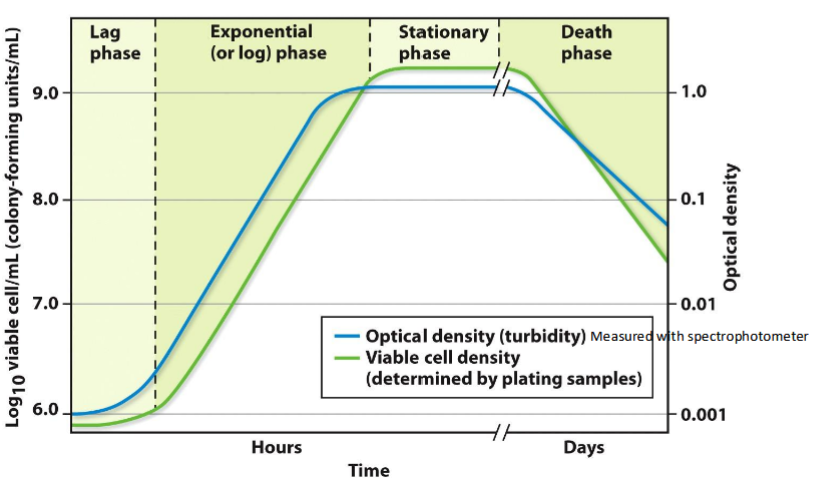
Bacterial growth curve
Nutrients are not replenished, waste is not removed. Mainly applies to bacteria and yeast
Closed Culture
Prokaryotes divide by _____ fission (asexual)
Binary Fission
Time cells need to adjust to medium and begin replication
Lag Phase
Lag Phase is the time needed to alter gene _______
Gene Expression
The time required to double population in the exponential phase
Generation Time
Growth rate decreases
Nutrients are being used up
Accumulates waste
May be replication rate = death rate
Responses include flagella, anti-microbial compounds, and endospores
Stationary Phase
Cells deplete supply of nutrients
Synthesis of macromolecules slows
Cells can no longer replicate
Death Phase
Number of generations/unit of time
Growth Rate
Growth Rate is ______ of the Generation Time
Inverse
The maximum population density and/or amount of cellular material produced by the culture
Growth Yield
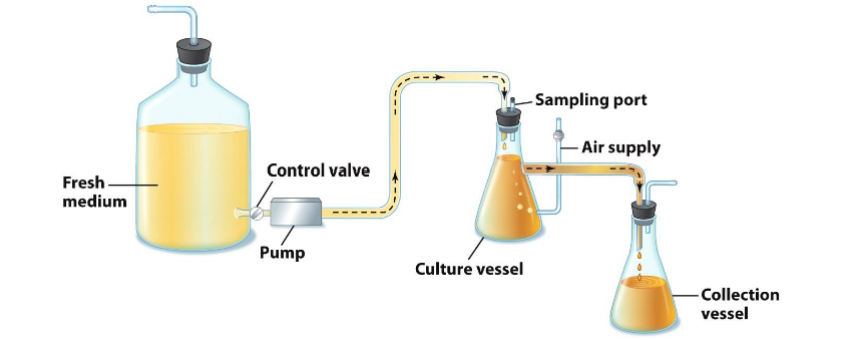
A continuous culture
Nutrients added; waste removed
Dilution rate must be balanced with growth rate
indefinite exponential phase
e.g. human gut
Chemostat
The cloudiness of a liquid culture
Turbidity
Sends light through a culture to measure Turbidity
Spectrophotometer
Can give a rough measure of cell density, but must have at least 10 million cells/mL for accuracy
Optical Density
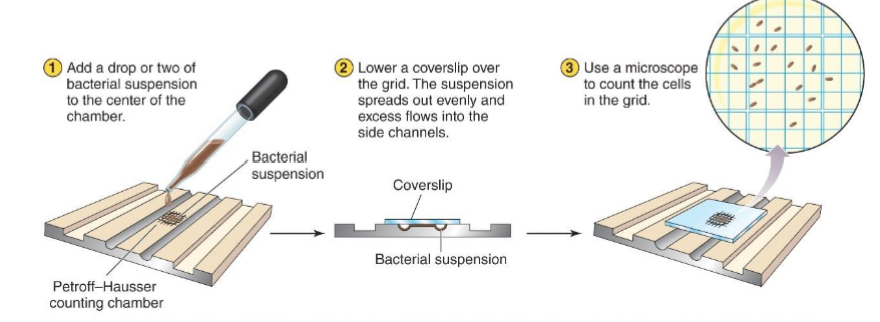
Microscope slide with a counting chamber
Measured volume is loaded onto a grid
Cells are counted under a light microscope
Cheap, fast, easy
Cant differentiate live and dead cells
Direct Counts
First culture is diluted
Dilutions are plated
Colonies are Counted
_____-_____ ___ per milliliter of initial culture is calculated
Only counts viable (live) cells
more time consuming
Serial Dilutions and CFU’s
Growth rate will depend of the amounts of ___(same answer)____ in the environment, AND which ___(same answer)____ species can use
Nutrients
O2 is the terminal electron acceptor in the respiratory electron transport system
Aerobic Respiration
O2 byproducts are ____ to cells! (e.g TOS or ROS)
Toxic
Can be used as a weapon against other organisms
Reactive Oxygen Species (ROS)

Fill in the blanks
Yes, but weak
No, but O2 isn’t toxic
Growth only at top where O2 is highest
Obligate Aerobic
Growth only at bottom when O2 is lowest
Obligate Anaerobic
Growth throughout the tube, densest at top
Facultative Anaerobic
Growth is evenly scattered throughout with no preference for O2 level
Aerotolerant Anaerobic
Growth in band just below surface where O2 is in low concentration
Microareophilic
Affects protein structures and proton motive force
pH
Related to water availability, cells must be able to uptake some water
Osmotic Pressure
Vapor pressure of a liquid compared to pure water
Water Activity
Can decrease Water Activity values
Pure water aw = 1.0
Seawater aw = 0.98
Honey aw = 0.6
Most bacteria = above 0.9
0 - 0.6 aw = no growth
aw 0.85 used to regulated canned goods
Solutes
Affects macrocmolecular structure, membrane fluidity, and enzyme activity
Temperature
Most human pathogens are _________
Mesophiles
Denatures proteins and nucleic acids
Heat
High temperature and pressure heating
Autoclaving
Low temperature heating
Pasteurization
Can damage cells with ice, used for preservation
Freezing
Radiation of UV 260 to 280 nm can ________ DNA
Damage
Used on living tissue
Antiseptics
Used on nonliving surfaces
Disinfectants
Metabolism
All chemical reactions in a cell
Enzymes
Metabolism depends on the ___(same answer)___present, ___(same answer)___ make up a majority of proteins in cytoplasm
Light
The energy source of Phototrophs
Oxidation of reduced chemicals (e.g. sulfite)
The Energy source of Chemotrophs
Inorganic CO2 (primary producers)
The carbon source of Autotrophs
Organic CO2 (aldehydes, AAs, lipids, alcohols)
The carbon source of Heterotrophs
Organic Molecules (e.g. glucose)
The electron source for Organotrophs
Inorganic Molecules (e.g. H2, Fe2+, ammonium NH4, nitrite NO2-, sulfur S)
The electron source for Lithotrophs
Assimilation
Incorporating nutrients into cellular parts
Mixotroph
An organism that is more than one type of “troph”
Enzymes
Catalyzes metabolism
Catabolism
Breaking down larger molecules into smaller ones, is Exergonic
Anabolism
Using smaller molecules to build up macromolecules, is Endergonic
Exergonic
Energy releasing reactions
Endergonic
Energy absorbing reactions
Active site
An enzymes __________ binds specific substrates and helps to convert them to products
Oxidation
Loss of e- or H+
Reduction
Gaining of e- or H+
Redox
The type of reaction that Oxidation and Reduction reactions are reffered to as
Activation
Enzymes lower the ______ energy