Electron Transport Chain and Oxidative Phosphorylation
 Call Kai
 Learn
Learn Practice Test
 Spaced Repetition
 Match
Match Flashcards
 Knowt Play
1/132

Earn XP
Description and Tags
Lecture 7
Name | Mastery | Learn | Test | Matching | Spaced | Call with Kai | Chat |
|---|
No analytics yet
Send a link to your students to track their progress
133 Terms
What charge does a proton have?
Positive
What charge an electron?
Negative
In the ETC, _____ move through the chain while _____ are pumped across the inner mitochondrial membrane.
electrons, protons
Oxidation
loss of electrons
Reduction
gain of electrons
what form is NAD+ ?
oxidized form
What happens when NAD+ accepts electrons?
it becomes NADH, the reduced form.
When NADH donates electrons, it
is oxidized back to NAD+
Particles tend to move _____ their gradient when a pathway is available.
down
Ions such as H⁺ do not freely cross the hydrophobic lipid bilayer. A membrane can
therefore maintain an ion gradient until a _____provides a route across
transporter or channel

outer mitochondrial membrane
a smooth phospholipid bilayer that surrounds the entire organelle and acts as a boundary between the mitochondrion and the cell's cytoplasm

inner membrane mitochondrial space
a specialized, highly protein-rich barrier that compartmentalizes the mitochondrial matrix and drives cellular energy production via oxidative phosphorylation
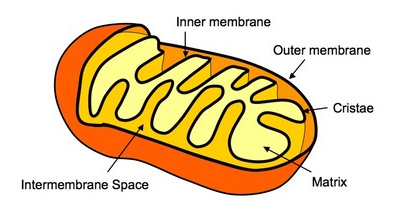
mitochondrial matrix
the innermost fluid-filled compartment enclosed by the inner mitochondrial membrane, serving as the core biochemical site for the citric acid cycle, fatty acid oxidation, and the cell's own genetic system
ATP can be hydrolyzed to ADP + Pᵢ to support ____
cellular work
T or F: Cells must continually regenerate ATP from ADP + Pᵢ.
true
From one glucose, glycolysis produces
2 pyruvate, net 2 ATP, and 2 NADH.
Glycolysis occurs in the
cytosol
Why regenerate NAD⁺?
NAD⁺ is required as an electron acceptor in metabolic reactions. If NADH cannot be reoxidized to NAD⁺, NAD⁺-dependent pathways eventually slow.
Cells without mitochondria include
Mature red blood cells, which lack mitochondria and depend on glycolysis for ATP.
Why can an aspirin overdose make the body dangerously hot?
high levels of salicylates uncouple oxidative phosphorylation in the cell's mitochondria
How does the energy carried by NADH and FADH₂ become ATP?
Much of the energy released from fuels such as glucose and fatty acids is captured in NADH and FAD-linked electrons, which feed the ETC
The ETC converts electron-transfer energy into a proton gradient that ATP synthase uses to make ATP. What is the pathway?
NADH/FADH₂ → electron transport → proton gradient → ATP synthesis
Oxygen is essential because it serves as the
final electron acceptor
Explain how electron transport creates a proton gradient across the inner mitochondrial membrane
energy released from moving electrons is used to pump hydrogen ions (H+) from the mitochondrial matrix into the intermembrane space
Trace electron flow from NADH or succinate/Complex II to oxygen
NADH → Complex I → CoQ → Complex III → cytochrome c → Complex IV → O₂
Identify which ETC complexes pump protons
complexes I, III, IV
Explain why NADH yields more ATP than FADH2
NADH enters the electron transport chain at Complex I, while FADH₂ enters at Complex II. Because NADH starts earlier, it causes more H⁺ to be pumped across the inner mitochondrial membrane, creating a larger proton gradient and producing more ATP.
Explain how ATP synthase uses the proton gradient to make ATP.
Protons (H⁺) flow down their gradient through ATP synthase. This flow provides energy that makes ATP synthase convert ADP + Pi → ATP.
The proton gradient stores the energy, and ATP synthase uses that energy to make ATP.
Distinguish ETC inhibition, ATP synthase inhibition, and uncoupling
ETC inhibition: Blocks electron flow → ↓ H⁺ pumping → ↓ proton gradient → ↓ ATP production.
ATP synthase inhibition: H⁺ cannot flow through ATP synthase → ↓ ATP production; proton gradient builds up.
Uncoupling: H⁺ bypasses ATP synthase → ETC continues, but gradient energy is released as heat instead of making ATP.
ETC inhibition:
Blocks electron flow → ↓ H⁺ pumping → ↓ proton gradient → ↓ ATP production.
ATP synthase inhibition
H⁺ cannot flow through ATP synthase → ↓ ATP production; proton gradient builds up.
Uncoupling
H⁺ bypasses ATP synthase → ETC continues, but gradient energy is released as heat instead of making ATP.
ETC still runs, but ATP production is separated from electron transport
Use cyanide, DNP, salicylate toxicity, and UCP1 to predict changes in mitochondrial ATP production
Cyanide: Inhibits Complex IV → ETC stops → H⁺ pumping stops → ATP ↓↓↓
DNP: Uncoupler → H⁺ bypasses ATP synthase → ATP ↓ heat ↑
Salicylate toxicity: Acts as an uncoupler → ATP ↓ heat ↑
UCP1: Natural uncoupling protein in brown fat → H⁺ bypasses ATP synthase → ATP ↓, heat ↑
Explain why impaired electron transport raises the mitochondrial NADH/NAD⁺ ratio and can promote lactate formation
When the ETC is impaired, NADH cannot efficiently donate its electrons, so NADH builds up and NAD⁺ decreases → ↑ NADH/NAD⁺ ratio.
High NADH also favors pyruvate → lactate, because this reaction converts NADH back to NAD⁺. This allows glycolysis to continue producing some ATP.
Explain why mature red blood cells cannot use oxidative phosphorylation.
Mature RBCs lack mitochondria, so they cannot perform the ETC or oxidative phosphorylation. They must make ATP through anaerobic glycolysis in the cytoplasm.
Where are protons pumped during electron transport?
H⁺ ions are pumped from the mitochondrial matrix into the intermembrane space.
What does proton pumping create?
Proton pumping creates an electrochemical gradient across the inner mitochondrial membrane. This includes a membrane potential and a pH difference.
What is the proton-motive force and what does it do?
The electrochemical gradient creates the proton-motive force, which provides the energy that drives ATP synthesis.
Protons later return toward the ___ through ATP synthase.
matrix
Electron transport builds the ___, and ATP synthase provides a controlled route for using the stored energy
gradient
Where do NADH and succinate-derived electrons enter the ETC?
NADH → Complex I.
Succinate → Complex II via enzyme-bound FAD/FADH₂.
Where do electrons from Complex I and II go?
Both pathways transfer electrons to coenzyme Q (CoQ), which carries electrons to the next part of the ETC.
Which other pathways can bypass Complex I?
FAD-linked dehydrogenases can transfer electrons directly to CoQ, bypassing Complex I. Examples: fatty acid oxidation and the glycerol-3-phosphate shuttle.
How does NADH enter the ETC?
NADH donates its electrons to Complex I of the electron transport chain.
How does succinate enter the ETC?
Complex II (succinate dehydrogenase) oxidizes succinate → fumarate and reduces its bound FAD → FADH₂. Electrons then go to CoQ.
Does FAD/FADH₂ freely diffuse as an electron carrier?
No. FAD/FADH₂ remains bound to succinate dehydrogenase (Complex II) and transfers electrons to CoQ.
NADH route
NADH → Complex I → CoQ → Complex III → cytochrome c → Complex IV → O₂
Succinate / Complex II route Succinate → enzyme-bound FAD/FADH₂ in Complex II → CoQ → Complex III → cytochrome c → Complex IV → O₂
Complex I during ETC
Accepts electrons from NADH, transfers them to CoQ, and pumps H⁺
Complex II (succinate dehydrogenase)
Transfers succinate-derived electrons through enzyme-bound
FAD/FADH₂ to CoQ; it does not pump H⁺
Complex III
Transfers electrons from CoQ to cytochrome c and pumps H+
Complex IV
Transfers electrons from cytochrome c to O₂, forming water, and pumps H⁺
NAD+ is reduced by accepting a
hydride
NAD+ receives a ____ containing 1 proton + 2 electrons, the other proton is released as H+
NAD+ + H- —> NADH
hydride
Why is Complex II unusual?
Complex II (succinate dehydrogenase) participates in both the TCA cycle and the ETC, linking the two pathways.
What happens if Complex II activity is reduced?
Succinate-linked electron entry decreases, but NADH can still donate electrons through Complex I.
At Complex IV, electrons are transferred to molecular oxygen, the final electron acceptor. Reduction of one O₂ molecule requires four electrons and four matrix protons and produces two molecules of water:
O₂ + 4 e⁻ + 4 H⁺ → 2 H₂O
What happens to O₂ at Complex IV
O₂ acts as the final electron acceptor and combines with 4 e⁻ + 4 H⁺ → 2 H₂O.
How does Complex IV contribute to the proton gradient?
Complex IV uses H⁺ to form water and also pumps additional H⁺ across the inner mitochondrial membrane, strengthening the proton gradient.
What happens when electrons escape the ETC?
Escaped electrons can partially reduce O₂, forming reactive oxygen species (ROS) that can damage proteins, lipids, and DNA.
How does cyanide affect the ETC?
Cyanide inhibits cytochrome c oxidase (Complex IV), decreasing electron transfer to O₂ and mitochondrial O₂ consumption.
What happens to ATP production during cyanide poisoning?
Complex IV inhibition → ↓ proton pumping → ↓ proton gradient → ↓ ATP synthesis.
Why does cyanide poisoning cause NADH accumulation and lactic acidosis?
NADH cannot be efficiently oxidized to NAD⁺, so NADH accumulates. High NADH promotes lactate formation → lactic acidosis.
What is NAD+ synthesized from?
Niacin (Vitamin B3)
How does carbon monoxide affect oxygen?
Primarily impairs oxygen delivery by hemoglobin
How does cyanide affect oxygen?
Impairs mitochondrial oxygen utilization by inhibiting Complex IV
hydroxocobalamin
binds cyanide to form cyanocobalamin, reducing the amount of free cyanide available to
inhibit mitochondrial respiration.
What happens to NADH at the ETC?
NADH donates electrons to complex I
Inside complex I, NADH donates 2e- internal cofactors pass those electrons through the complex to coenzyme Q
ATP synthase converts the proton gradient into ATP
Protons return from the intermembrane space to the matrix through ATP synthase (Complex V). The energy
released during this movement drives ADP + Pᵢ → ATP. ATP synthase acts as a molecular rotary machine:
proton flow drives rotation within the enzyme, and that movement helps its catalytic sites form ATP
How does ATP synthase use the proton gradient?
H⁺ flows from the intermembrane space → matrix through ATP synthase (Complex V). The energy released drives ATP production.
What reaction does ATP synthase drive?
The energy from H⁺ movement drives ADP + Pᵢ → ATP.
Why is ATP synthase called a molecular rotary machine?
H⁺ flow causes ATP synthase to rotate, and this movement changes its catalytic sites so they can form ATP.
Oxidative phosphorylation is the coupled process:
electron transport builds the proton gradient, and ATP synthase uses that gradient to produce ATP
Physiology connection: ATP production follows demand
When cells use ATP, ADP rises, providing more substrate for ATP synthase and increasing mitochondrial respiration. When ATP demand falls and ADP is low, respiration slows
What happens to mitochondrial respiration when ATP is being used?
When cells use ATP, ADP levels increase. More ADP provides more substrate for ATP synthase, which increases ATP production and mitochondrial respiration.
What happens to mitochondrial respiration when ATP demand is low?
When cells do not need much ATP, ADP levels are low. With less ADP available for ATP synthase, mitochondrial respiration slows down.
When cells do not need much ATP, ADP levels are low. With less ADP available for ATP synthase, mitochondrial respiration slows down.
ADP helps match ATP production to cellular energy demand. High ADP signals that ATP is being used, increasing mitochondrial respiration. Low ADP signals low ATP demand, slowing respiration.
When cells use ATP, ADP levels increase. More ADP provides more substrate for ATP synthase, which increases ATP production and mitochondrial respiration.
When cells do not need much ATP, ADP levels are low. With less ADP available for ATP synthase, mitochondrial respiration slows down.
When cells do not need much ATP, ADP levels are low. With less ADP available for ATP synthase, mitochondrial respiration slows down.
ADP helps match ATP production to cellular energy demand. High ADP signals that ATP is being used, increasing mitochondrial respiration. Low ADP signals low ATP demand, slowing respiration.
How does ADP regulate ATP production?
High ADP means ATP is being used, so mitochondrial respiration increases to make more ATP. Low ADP means ATP demand is low, so mitochondrial respiration slows.
Where do NADH-derived electrons enter the ETC?
NADH donates electrons to Complex I. These electrons support proton pumping at Complexes I, III, and IV.
Where do succinate-derived electrons enter the ETC?
Succinate-derived electrons enter through Complex II. Succinate is oxidized by succinate dehydrogenase, which uses enzyme-bound FAD/FADH₂ to transfer electrons to coenzyme Q.
Why does NADH produce more ATP than succinate/FADH₂?
NADH enters at Complex I, so its electrons support proton pumping at Complexes I, III, and IV. Succinate/FADH₂ enters at Complex II, which does not pump protons and therefore bypasses Complex I. Fewer H⁺ are translocated, producing a smaller proton gradient and lower ATP yield.
NADH-linked electrons yield approximately
2.5 ATP per NADH oxidized
Succinate-derived, Complex II-linked electrons yield approximately 1.5 ATP per electron pair transferred through enzyme-bound FAD/FADH₂
NADH-derived electrons enter through Complex I and support proton translocation at Complexes I, III, and IV.
Succinate-derived electrons enter through Complex II via enzyme-bound FAD/FADH₂ and bypass Complex I.
Because Complex II does not pump protons, fewer protons are translocated, resulting in a lower ATP yield
How much ATP does succinate-derived FADH₂ produce?
Succinate-derived electrons entering through Complex II produce approximately 1.5 ATP per electron pair.
Why does Complex II result in a lower ATP yield
Complex II does not pump protons. Therefore, electrons entering through Complex II cause fewer total H⁺ to be translocated compared with electrons entering through Complex I. This produces less proton-motive force and less ATP.
Can cytosolic NADH directly cross the inner mitochondrial membrane?
No. Cytosolic NADH cannot directly cross the inner mitochondrial membrane. Its reducing equivalents must be transferred into the mitochondria using a shuttle system.
What does the malate–aspartate shuttle do with cytosolic NADH?
The malate-aspartate shuttle transfers the reducing equivalents of cytosolic NADH to mitochondrial NADH. The resulting mitochondrial NADH enters through Complex I and produces about 2.5 ATP.
What does the glycerol-3-phosphate shuttle do with cytosolic NADH?
The glycerol-3-phosphate shuttle transfers electrons from cytosolic NADH to coenzyme Q (CoQ), bypassing Complex I. This produces about 1.5 ATP.
Why does the ATP yield from cytosolic NADH depend on which shuttle is used?
The malate–aspartate shuttle transfers reducing equivalents to mitochondrial NADH, which enters at Complex I and produces about 2.5 ATP. The glycerol-3-phosphate shuttle transfers electrons to CoQ, bypassing Complex I, so fewer protons are pumped and only about 1.5 ATP are produced.
Why is the total ATP yield per glucose approximately 30–32 ATP?
The total ATP yield varies because cytosolic NADH from glycolysis can use either the malate–aspartate shuttle (~2.5 ATP) or the glycerol-3-phosphate shuttle (~1.5 ATP). This difference contributes to the approximate 30–32 ATP per glucose yield.
What happens when ATP synthase is inhibited?
Proton flow through ATP synthase decreases, so ATP synthesis falls. Because H⁺ cannot flow back through ATP synthase efficiently, the proton gradient builds up.
Why does electron transport eventually slow when ATP synthase is inhibited?
ATP synthase inhibition causes H⁺ to build up in the intermembrane space, creating a very large proton gradient. Pumping additional H⁺ against this increasingly strong gradient becomes more difficult, so electron transport eventually slows.
How is ATP synthase inhibition different from uncoupling?
With ATP synthase inhibition, H⁺ cannot efficiently flow through ATP synthase, so the proton gradient builds up and ETC eventually slows. With uncoupling, H⁺ bypasses ATP synthase, so the gradient is dissipated without making ATP; electron transport can continue, often producing heat.
How does bedaquiline demonstrate that ATP synthase can be a drug target?
Bedaquiline is used in drug-resistant tuberculosis regimens and preferentially inhibits the ATP synthase of Mycobacterium tuberculosis over human mitochondrial ATP synthase. This demonstrates that ATP synthase can be selectively targeted by a drug.
Uncoupling overview
An uncoupler allows protons to cross the inner mitochondrial membrane without passing through ATP synthase. The proton gradient decreases, ATP synthesis becomes inefficient, and more energy is released as heat. Electron transport can continue and oxygen consumption can increase when oxygen and metabolic substrates are available
What is an uncoupler?
An uncoupler allows H⁺ to cross the inner mitochondrial membrane without passing through ATP synthase. This separates electron transport from ATP production.
What happens to the proton gradient during uncoupling?
The proton gradient decreases because H⁺ can cross the inner mitochondrial membrane without going through ATP synthase.
What happens to ATP production during uncoupling?
ATP synthesis becomes inefficient because H⁺ is no longer using ATP synthase to return to the matrix. Less of the proton gradient's energy is captured as ATP.
What happens to heat production during uncoupling?
More of the energy from the proton gradient is released as heat instead of being used to make ATP.