BIO EXAM 2: First lecture!
 Call Kai
 Learn
Learn Practice Test
 Spaced Repetition
 Match
Match Flashcards
 Knowt Play
1/39

There's no tags or description
Looks like no tags are added yet.
Name | Mastery | Learn | Test | Matching | Spaced | Call with Kai | Chat |
|---|
No analytics yet
Send a link to your students to track their progress
40 Terms
What are the levels of protein structure?
Primary, secondary, tertiary, and quaternary
Primary
Sequence of amino acids(polypeptides)
Ex: protein containing 100 amino acids (20^100 or 10^130)

Secondary
Interaction of groups in peptide backbone

What are the two types of secondary structures?
a-helix(coiled spiral) and B-pleated sheet

Tertiary
Final folded shape of globular protein(Final level of structure for proteins + consists of single polypeptide chain)

Quaternary
arrangement of individual chains(2 or more polypeptide chains)

Transient dipole
(weak bond) temporary, uneven distribution of electric charge within a molecule- electron shift
What do the side chains(r-groups do)
They do not form hydrogen bonds, but they affect whether a helix or sheet is favorable by steric hindrance or chemical properties
Interactions depend only on?
Peptide backbone (C=O and N-H)
Hydrogen bond visual

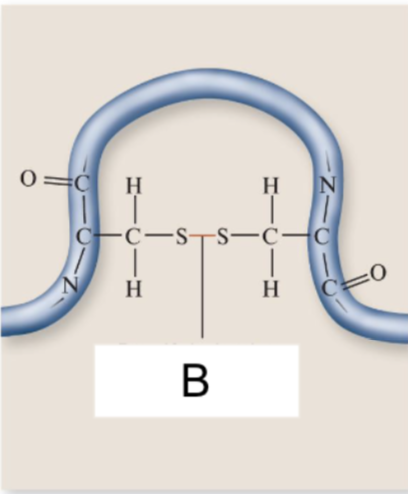
Disulfide bridge
Ionic bond

van der Waals attraction
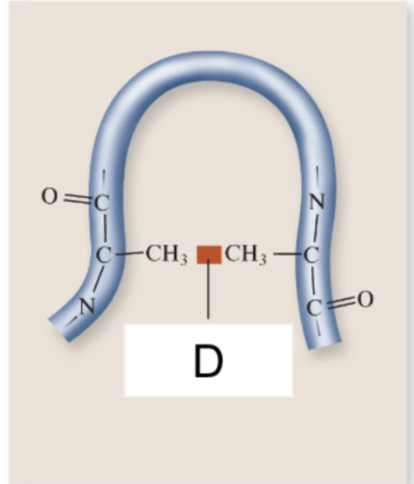
Hydrophobic exclusion

Perm chemistry-disulfide bridge
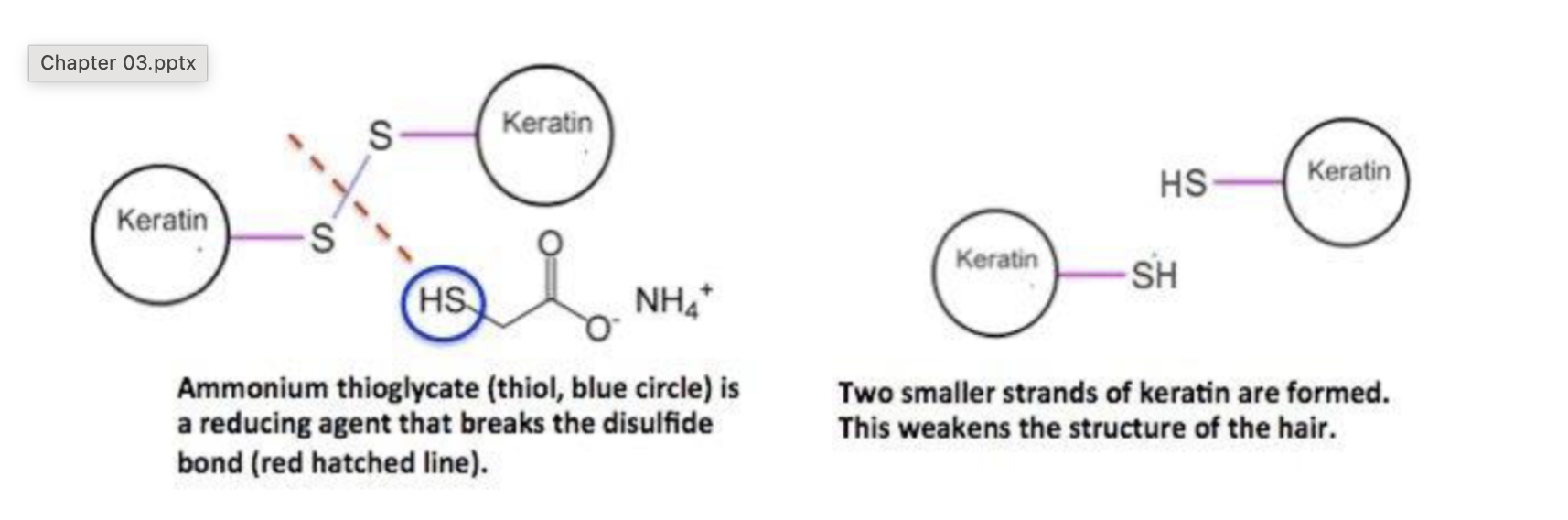
Perm: 1. reducing agent applied
Perm solution (ammonium thioglycolate) → Breaks disulfide
bridges (–S–S–) into free sulfhydryl (–SH) groups → Hair becomes soft and flexible, can be reshaped (curled around
rollers)
Perm: 2. Re-shaping
Hair is physically curled or straightened while bonds are broken →Keratin chains slide into new positions→New hair shape is
set mechanically
Perm: 3.Oxidizing agent applied
Neutralizer” (usually hydrogen peroxide, H₂O₂)→Re-oxidizes –SH
groups → reforms new disulfide bridges (–S–S–) between cysteines
in their new positions→ Hair retains the new curly or straight shape
How is perm chemistry related to cystic fibrosis?
Through the breaking of disulfide bonds in protein structure

Motifs
Short, recurring patterns of secondary structure (like α-helices
and β-sheets) that appear in many proteins→ provide clues about the overall fold or potential function of a protein
Domains
Larger, independently folding structural and functional units
within a protein→Most proteins contain multiple domains, and each domain usually carries out a specific part of the protein’s overall function

What motif is this?
Rossmann fold (important for binding nucleotides
like NAD⁺)

What motif is this?
Common in DNA-binding proteins
Which is larger? Motif or domain?
Domain! Domains are independently stable and functional, while
motifs are not→composed of multiple interacting motifs
Lipids
Loosely defined group of molecules that are insoluble in water
Are lipids polar or non polar?
High proportion of *nonpolar C-H bonds causes the
molecule to be hydrophobic

Which part of this is hydrophilic
HO
Triglycerides
composed of one glycerol and three fatty acids

Is this the structured formula for saturated or unsaturated fat?
Saturated→Hydrophobic/linear

Is this the structured formula for saturated or unsaturated fat?
Unsaturated→ double bond-kink
Van der Waals interaction make molecules more?
rigid
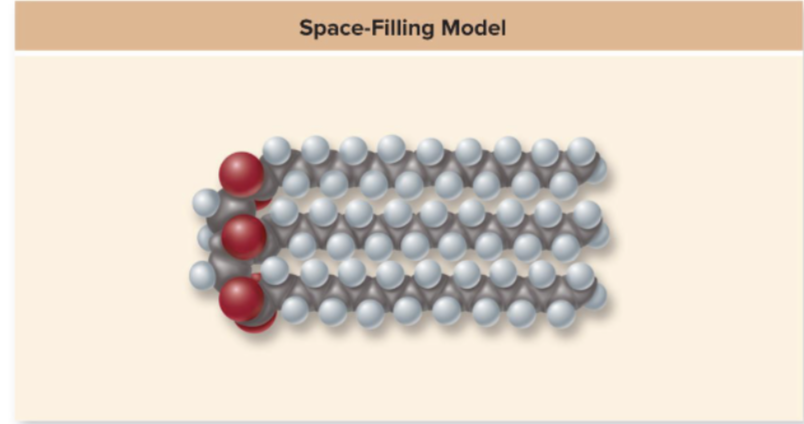
Is this a saturated or unsaturated filling model?
saturated!

Is this a saturated or unsaturated filling model?
unsaturated
What are the Lipid molecules that orient with polar(hydrophilic) head toward water and non polar(hydrophobic) tails away from water
Micelles(spheres)

what are the molecules that more complicated structure where two
layers form
• Hydrophilic heads point outward.
• Hydrophobic tails point inward toward each other.
Phospholipid bilayer

Enlgish natural philosopher. Cells were first observed
using a microscope in 1665
Robert Hooke
Cellulae
small rooms
Dutch Microscopist. First observed living cells, bacteria and
protozoa in 1674
Anton van Leeuwenhoek
Animalcules
little animals
Leeuwenhoek researches proved
provided empirical proof that tiny life form had their own reproductive cycles refuting the doctrine of spontaneous generation. Ex) maggots from rotting meat.