Rad Onc Physics: Nuclear Decay Review Qs
 Call Kai
 Learn
 Practice Test
 Spaced Repetition
 Match
 Flashcards
 Knowt Play
1/82

There's no tags or description
Looks like no tags are added yet.
83 Terms
Match unit with quantity:
Dose equivalent
Sieverts (Sv) & Rem
Match unit with quantity:
Exposure
Roentgen
Match unit with quantity:
Absorbed Dose
Gray (Gy) & Rad
Match unit with quantity:
Activity
Becquerel (Bq) & Curie (Ci)
How to get the energy of characteristic x-rays?
Difference in binding energies of 2 shells
Ek-EL= ___ keV
Match properties to entities (in comparison to an e-) :
Neutrino
smaller mass
more positive charge
Match properties to entities (in comparison to an e-) :
Photon
smaller mass
more positive charge
Match properties to entities (in comparison to an e-) :
Neutron
larger mass
more positive charge
Match properties to entities (in comparison to an e-) :
proton
larger mass
more positive charge
Match properties to entities (in comparison to an e-) :
Positron
equal mass
more positive charge
what does a neutrino, photon, neutron, proton, and positron all have in common in relation to an electron?
ALL HAVE MORE POSITIVE CHARGE
atomic number (Z)
number of PROTONS
unique to each element and helps identify
atomic mass (A)
# protons + # of neutrons
neutron number (N)
A - Z
atomic mass (A) - atomic # (Z)

identify what means what (ignore comma)
X = element
A= atomic MASS = # protons + # neutrons
Z= atomic NUMBER = # of protons only
N= neutron number = # of neutrons… A minus Z
isotopes
nuclides with SAME # of protons

isotones
nuclides with SAME # of neutrons

isobars
nuclides with SAME atomic mass (A)
bars… bar on sliding scale… scale... weight… mass!

isomers
nuclides in DIFFERENT excited/metastable states

rest mass of an electron
0.511 MeV

match the list below to the elements in diagram :
isotopes
isotones
isobars
isomers

If there is an e- with a kinetic energy of 6 MeV, it’s total mass is?
6.51 MeV
(rest mass of an e- = 0.511; total mass = 6 + 0.511)
electron binding energy
-increases with increasing Z (# of protons)
-is greater in the K shell than the L shell
-is greater in the k shell of Barium than the k shell of Hydrogen (because Hydrogen has lower Z # than Barium)
electron is electrostatically attracted/repelled/not affected by:
alpha
attracted
electron is electrostatically attracted/repelled/not affected by:
electron
repelled
electron is electrostatically attracted/repelled/not affected by:
positron
attracted
electron is electrostatically attracted/repelled/not affected by:
proton
attracted
electron is electrostatically attracted/repelled/not affected by:
neutron
not affected
mass # of an atom is equal to the sum of?
nuclides (neutrons & protons)
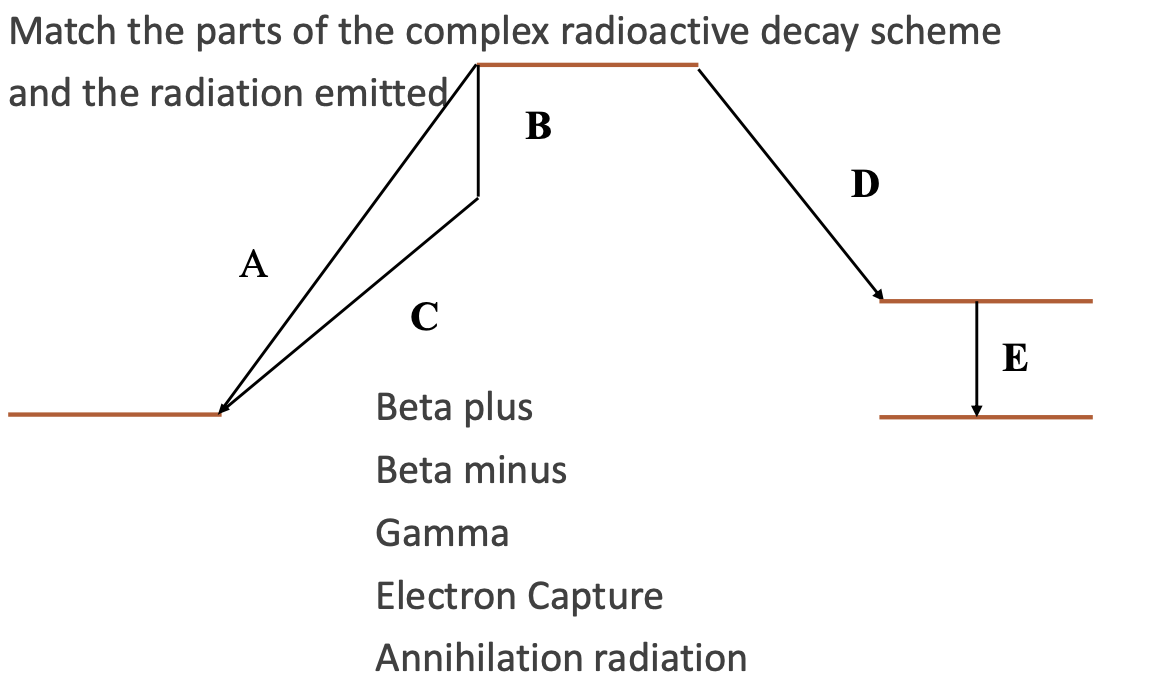
match term to letter in diagram
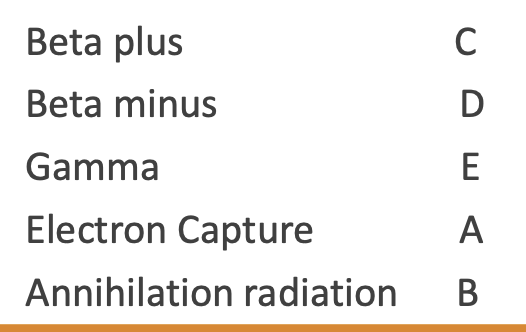
mode of decay and change in atomic number (Z):
alpha
Z —> Z-2
mode of decay and change in atomic number (Z):
beta minus
Z —> Z+1
mode of decay and change in atomic number (Z):
beta plus
Z —> Z-1
mode of decay and change in atomic number (Z):
electron capture
Z —> Z-1
mode of decay and change in atomic number (Z):
isomeric
Z —> Z
mass number (A) only changes for which decay?
alpha
why? mass # doesn’t change for isobaric and isomeric decay
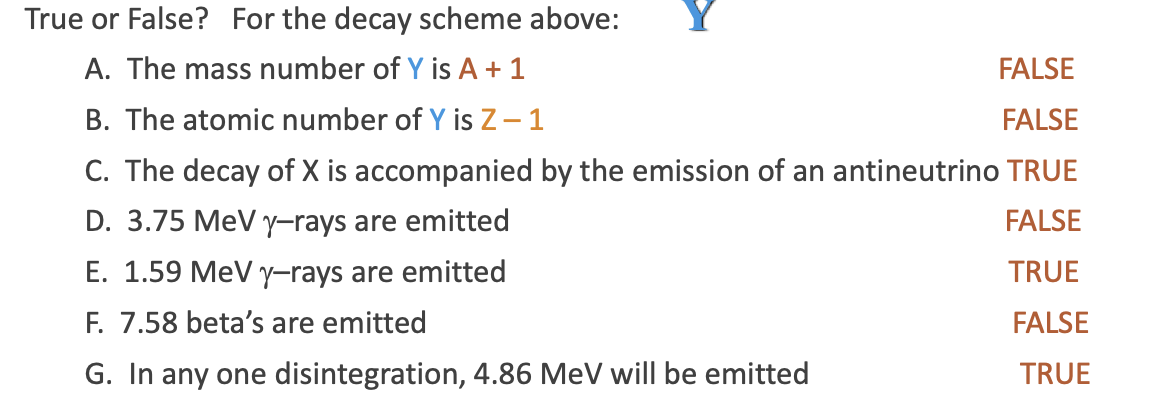
in terms of knowing/asking total energy emitted… what is beta minus always accompanied by?
antineutrino!

where is the single disintegration in this decay scheme?
Beta minus 2

nuclide 1= zaX
nuclide 2= z-1aX
How does 1 turn into 2?
Electron capture or beta plus or isobaric transition
why?
EC and B+ both have Z-1
isoBARic means same atomic mass. which rings true because A didn’t change

what decay is this transition?
Electron capture!
Why?
Because Z-1 but there is no B+ emitted
whats the neutron number of a 60Co atom with Z=27?
33
what is equilibrium?
a roughly constant relationship w daughter and parent activity in terms of half lives
when is equilibrium reached?
when the daughter decays with half life of the parent
@ approx. 4-7 daughter T1/2
what does equilibrium depend on?
ratio of parent and daughter half lives
secular equilibrium is what?
T1/2 parent >>> T1/2 daughter
(ƛparent >>> ƛdaughter)
equilibrium @ approx. 4-7 daughter T1/2
transient equilibrium is what?
T1/2 parent > T1/2 daughter (5, 10, 20)
(ƛparent > ƛdaughter)
equilibrium @ approx. 4-7 daughter T1/2
Law of decay
Nt = N0 e-ƛt
At = A0 e-ƛt
half life T1/2
T1/2 = ln(2)/ ƛ….
T1/2 = 0.693/ƛ
avg half life
1/ƛ … 1.44 * T1/2
effective half life
ƛeff = ƛphys + ƛbio
OR
0.693/ T1/2eff = 0.693/T1/2phys + 0.693/T1/2bio
OR
1/T1/2eff = 1/T1/2phys + 1/T1/2bio
bio half life is very long in comparison to phys half life.
what is effective half life approx equal to?
PHYSICAL half life
effective & physical approx. same
activity (A) is defined as
number of nuclear transformations (dN) occuring in a given quanitity of material per unit time (dT)
dN/dT…(N = # of atoms ; T = half life)
since dN/dT = -ƛN… then A = -ƛN
KNOW THESE NUMBERS
CURIE:
1 Ci = 3.7 × 10¹⁰ Bq/disintegrations per SEC
1 Ci = 1 gram 226Radium
BEQUEREL:
1 Bq = 1 disintegration per SEC = 27 × 10-12 Ci
CONVERSION FACTORS
1 mCi = 37 megaBq (MBq)
1MBq = 27 µCi
CONVERSION PNEUMONIC
K ing (kilo)
H enry (hexa)
D anced (deca)
M errily (Main)
D own (deci)
C ourt (centi)
M ain (milli)
A source has a half life of 12 hours and an initial activity of 10 mCi. After 3 days, the activity will be ___ mCi?
At = A0*e-ƛt
10*e-(0.693)(72/12) = 0.156… 0.16
Exposure rate constant
Γ = (Ẋ * d2)/A
exposure rate constant = exposure rate * distance squared / activity
DISTANCE WILL ALWAYS BE 1m
exposure rate constant depends on
isotope (energy, #photons/decay)
encapsulation
KNOW THIS
mg Radium equivalency
radium to whatever other variable element
(A_ * Γ_) /d2 = (ARa * ΓRa) /d2
d2 WILL ALWAYS BE 1… so it goes away… so
(A_ * Γ_) = (ARa * ΓRa)
Γ WILL BE GIVEN
SO! if solving for radium then equation looks like…
ARa = A_ * Γ_ / ΓRa
mg-radium equivalent example problem:
How many mg of Ra is equivalent to 1 mCi 137Cs?
ΓCs = 3.26 R-cm2/mCi-hr
ΓRa = 8.25 R-cm2/mg-h
ARa = ACs * ΓCs / ΓRa
ARa = (1mCi * 3.26) / 8.25
ARa = 0.395 mg 226Ra
what is nuclear fission?
neutron bombardment and breaking apart
KNOW THIS
How much energy is REQUIRED for Beta plus interaction to happen?
1.022 MeV
Internal Conversion
energy transferred to an orbital e-
energy given to e- being kicked out MUST be higher than the BE
NO CHANGE in A or Z
ZAX —> ZAX + e-
Isometric Transition
decay of metastable state to ground state with gamma ray
NO CHANGE in A or Z
ZAX —> ZAX + gamma
beta -
neutron converted into proton and e-
beta +
proton to neutron and positron
TOTAL DECAY to be assumed when?
after 5 half lives
radium and radon is famous example of what?
secular equilibrium
Radium (1600 yrs)
Radon (4 days)
NO equilibrium is when?
daughter half lives is more than parent
What are the two competing processes?
EC and B+
What is required for alpha decay to take place?
Element with HIGH atomic number (>140)
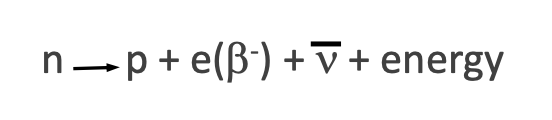
match decay to equation
beta -

match decay to equation
Isometric Transition

match decay to equation
Internal conversion

match decay to equation
EC
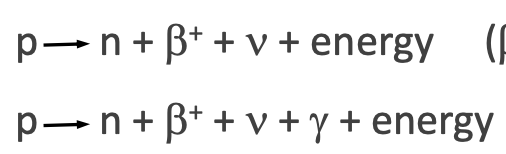
match decay to equation
Beta +
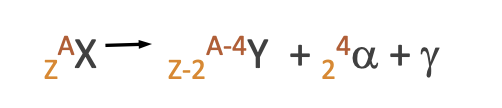
match decay to equation
Alpha
Air Kerma strength
predetermined factors to help go from exposure to dose
1/r2 in terms of dose
best friend moving AWAY from radiation
enemy moving TOWARD it