Glycoprotein + Polysacc + Disacc
 Call Kai
 Learn
Learn Practice Test
 Spaced Repetition
 Match
Match Flashcards
 Knowt Play
1/33

There's no tags or description
Looks like no tags are added yet.
Name | Mastery | Learn | Test | Matching | Spaced | Call with Kai | Chat |
|---|
No analytics yet
Send a link to your students to track their progress
34 Terms
Reducing sugar:
monosaccharides and disaccharides with a free,
reactive carbonyl group or anomeric carbon
Non-reducing sugar:
disaccharides with both
anomeric carbons involved in
glycosidic bond formation
Fructose is an example
When naming disacharides
The non-reducing sugar is labeled first, on the left
Important to give the alpha or beta and D and then name of sugar and type of ring and then type of linkage between the sugars

What is the glycosidic bond
primary structural linkage of all monosaccharide polymers
A ring with an unreacted anomeric carbon is still in equilibrium with the
open form and can be _____
oxidized
T/F: The anomeric carbon, even in hemiacetal
(or hemiketal) state is reactive, and there are
a number of compounds that contain sugars
joined through a glycosidic bond –
nucleosides, bonds between
oligosaccharides and lipids or proteins;
these reactions displace the hydroxyl
true
What is amylose and amylopectin (starches) used for?
energy storage
What is glycogen in animals used for
energy storage
What are structural polysaccharides?
Chitin and cellulose
What are the linkages of Amylose
Amylose is a homopolysaccharide of glucose that is made for energy storage. It is a linear polymer linked by alpha 1→ 4 D-glucosidic bonds
What is amylopectin’s linkages:
alpha 1→ 6 D-glucosidic bonds
Glycogen has the same structure as amylopectin, but more frequent 1→ 6 branches and shorter linear regions.
What does amylopectin look like
is it branched!

What does glycogen look like?
It is made up of only glucose in alpha 1 → 4 linkages and Beta 1 → 6 linkages (branch linkages).
it is highly branched
What bonds does cellulose have?
Beta 1 → 4 linkages
b-D-Glucopyranosyl-(1 → 4)-b-D-glucopyranose
The strength of cellulose comes from packing of cellulose and by H-bonding stabilization between polymers
Animals are not able to break these beta 1→4 linkages, which is why we cannot digest cellulose. We lack the Beta glycosidase enzyme
What is a homoglycan of N-acetylglucosamine?
chitin
It is structurally similar to cellulose: glycosidic bonds are exclusively b-(1 → 4);
The structure is linear, straight and extended if alternating sugars are rotated

What is this?
cellulose
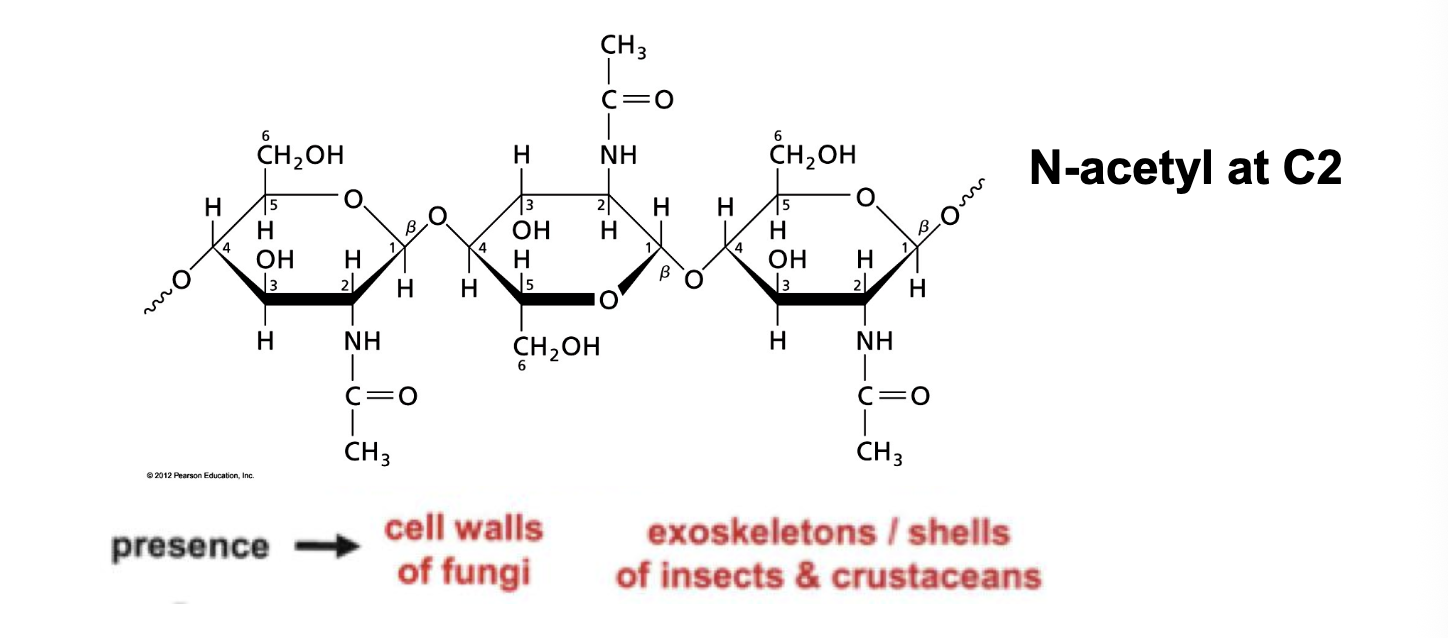
What is this?
Chitin
What are glycoproteins?
have one or more oligosaccharides of varying complexity joined covalently to a membrane protein or secreted protein; the oligosaccharide part of the molecule usually ends up extracellular. It also contains a glycophosphatidylinositol membrane anchor. and a protein ribbon.
What can be O-linked?
Through the O atom of the side chain
hydroxyl of Ser, Thr, Hydroxy-lysine (Hyl)
Commonly linked to N-Acetylgalactosamine (think O-gal)
What is N-linked?
Through the N
atom of the side chain
carboxylamine of Asn (NOT Gln) —> N-Acetylglucosamine
What are N-linked glycans used for?
USED for recognition:
example: antibodies are glycosylated to interact with
phagocytic cells to destroy the antibody after it
recognizes and binds to a foreign object
• Intracellular targeting to different organelles, eg to the
plasma membrane
What is O-linked used for?
antigenic surface of cells (blood type)
salivary receptors
T/F: everyone has the H antigen
true
A enzyme
adds an additional sugar N-acetylgalactosamine
B enzyme
adds galactose
T/F: Everyone makes antibodies that recognize type A and B. However, if you are type A, you remove the A antibody since it is “self”.
true
Type O:
for only the H antigen present; antibodies will be raised against both A and
B antigens if a patient receives blood of type A, B or AB;
Type A
for the A antigen present; antibodies will be raised against the B antigen if a
patient receives blood of type B, or AB;
Type B
for the B antigen present: antibodies will be raised against the A antigen if a
patient receives blood of type A or AB
Type AB
for both antigens present: no antibodies raised.
Universal acceptor.
T/F: For A, B, or AB, there is still some H antigen present because addition of GalNAc or Gal is incomplete, so there is no antibody raised against the H antigen.
true
Who is the universal donor?
Type O
Type A and B can donate
to their own type of to type AB
Type AB can donate to
only AB