Gen Bio 116 - Exam 1
 Call Kai
 Learn
Learn Practice Test
 Spaced Repetition
 Match
Match Flashcards
 Knowt Play
1/40

Earn XP
Description and Tags
Good Luck!
Name | Mastery | Learn | Test | Matching | Spaced | Call with Kai | Chat |
|---|
No analytics yet
Send a link to your students to track their progress
41 Terms
Systematics
Diversity of organisms and evolutionary relationships
How many types of systematics are there?
2 types. Taxonomy and phylogenetics.
Binomial nomenclature
Unique 2-part name. Genus + specific epithet.
Hierarchical classification
Levels (Domain, Kingdom, etc.). Higher levels are more inclusive.
Species
Basic level of hierarchical classification.
Taxon
Grouping at any 1 level.
Character
Defined attribute of a species. States is an alternate form.
Phylogenetics
Study of evolutionary history of a species or groups of species. Based on character similarities based on shared ancestry.
Homologous
Share common evolutionary history. Common ancestor with that character.
Analogous
Similar adaptations from different lineages. Independently acquired. Doesn’t share a common ancestor with that character.
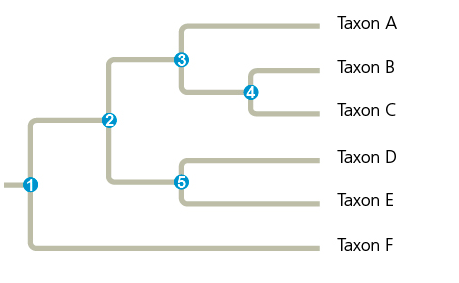
What are Taxon B and Taxon C?
Sister Taxa
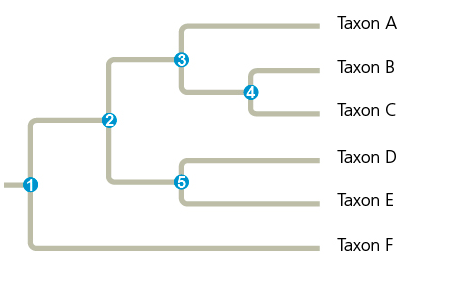
What is Taxon F?
Basal taxon

What is the arrow pointing to?
Polytomy

What is this group?
Polyphyletic, distantly related species not including CA.

What is this group?
Monophyletic, CA and ALL of its descendants.

What is this group?
Paraphyletic, CA and SOME of its descendants.
Evolution
Accumulation of genetic changes within a population over time.
Natural selection
Mechanism of evolution, acts on variation.
General characteristics of viruses
Noncellular, obligate intracellular parasites, cannot reproduce on own, very small, genetic material, and structure.
Obligate intracellular parasites
Invade susceptible host cells. Use host resources and processes.
Structure of Viruses
Capsid which is a protein coat. It determines shape and role in attachment.
Capsomere
Protein subunit
Envelope
From host plasma membrane during budding. Bilayer membrane outside capsid.
Bacteriophages (phages)
Viruses that infect bacteria.
Virulent phages
Kill host at end of cycle, only use lytic cycle.
Lytic cycle
Attachment/entry - Phage remains separate from host - Phage DNA replication, phage protien synthesis, self-assembly - cell lyses + phage exits
Temperate phage
Replication of phage genome without destroying host cell, use lysogenic + lytic cycle.
Lysogenic cycle
Attachment/entry - Phage DNA integrates into host genome - Host cell divides, prophange DNA passed on to daughter cells.
Features of a prokaryotic cell
Cytoplasm, Cell wall, Plasma membrane, Capsule, Pill, Flagellum, Nucleoid region, Chromosome, Ribosomes, and Plasmids.
Cell wall functions
Maintain cell shape and prevent bursting in hypertonic environment.
Peptidoglycan
Polymer (sugars + polypeptides), domain bacteria. Not in archaea or eukaryotes.
Bacterial Flagellum
Motor, hook, filament
Bacterial Flagellum function
H+ pumped out across plasma membrane by electron transport chain - form gradient - diffuse into cell through motor - produces force - hook turns - filament rotates
Binary fission
1 cell to 2 cells, optimal conditions: 1-3 hours. 2 identical cells created.
Prokaryotes reproduce…
Asexually (exact copies). Still have high levels of genetic diversity.
Mutation
Genetically different, probability is 1 in 10 million.
Reproduce rapidly (prokaryotes)
2 × 10^10 new cells per day in intestine. 9 million mutations per day.
Transformation
Harmless strain turned into virulent.
Transduction
Occurs during phage replication. Fragment of host DNA packaged into new phage. Phage transfers DNA to another cell. Incorporated into genome.
Conjugation
Genetic material transferred between living prokaryotic cells. F+ uses pilus to attach to F- cell through a mating bridge.
Extremophiles
Like extreme conditions (ex: pH, Temperature, and concentration)