Blood Part 4
 Call Kai
 Learn
Learn Practice Test
 Spaced Repetition
 Match
Match Flashcards
 Knowt Play
1/23

There's no tags or description
Looks like no tags are added yet.
Name | Mastery | Learn | Test | Matching | Spaced | Call with Kai | Chat |
|---|
No analytics yet
Send a link to your students to track their progress
24 Terms

what antibody binds to A antigen
anti-A antibody
what antibody binds to B antigen
anti-B antibody
what antibody binds to D antigen
anti-D antibody
There are different types/classes of antibodies that the body can generate for any specific antigen. Antibodies of the ABO system (of the ___ class) are classified as naturally occuring antibodies. The ABO antigens are made of ___molecules.
IgM
carbohydrate
RBC A has which antigens attached onto its surface and which antibodies?
has A antigens on its surface
has anti-B antibodies in the plasma
RBC B has which antigens attached onto its surface and which antibodies?
has B antigens on its surface
has anti-A antibodies in the plasma
RBC AB has which antigens attached onto its surface and which antibodies?
has A AND B antigens on its surface
has NO antibodies in the plasma
RBC O has which antigens attached onto its surface and which antibodies?
has NO antigens on its surface
has anti-A AND anti-B antibodies in the plasma
Genes DONT directly make the A or B antigens on RBCs. Instead, if a person has an A or B gene, they create an A or B ___, respectively, which add a specific sugar onto the __-antigen, converting it into an A or B antigen.
enzyme
H-antigen (oligosaccharide)


Blood type A people could have the genotype AA or AO but O is recessive and the resulting blood type is A.
Blood type B people could have the genotype BB or BO but O is recessive and the resulting blood type is B.
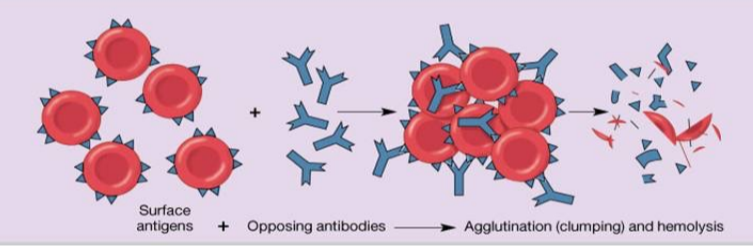
the process where opposing antibodies attach to surface antigens on RBCs and make them stick together.
agglutination
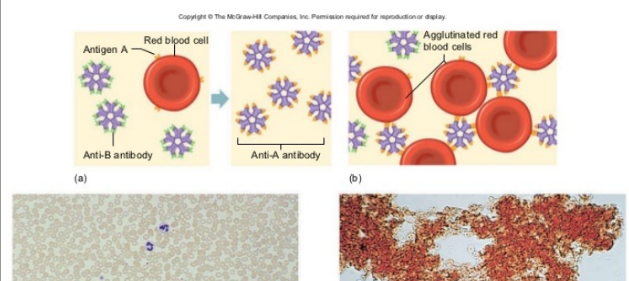
the process where opposing antigens and antibodies that are stuck together are broken down.
hemolysis
How are ABO blood types determined?
unknown sample of blood is separated into RBC and plasma.
a drop of RBC is mixed with a known plasma containing either A or B antibodies.
the mixture is observed for RBC agglutination or clumping.

in a major cross match, a donor’s___ is mixed with a recipient’s ___ to test___
RBCs
plasma
to test if the recipient’s antibodies will recognize the antigens on the donor’s RBCs as foreign and attack them
What occurs in a mismatched blood transfusion where the donor is type A and recipient is type B.
the donor is type A, their RBCs have A antigens and anti-B antibodies.
the recipient is type B with B antigens and their plasma contains anti-A antibodies.
Once the recipient’s anti-A antibodies see the A antigen on the donor RBCs, they will bind to them and cause the donor RBCs to agglutinate.
the antibodies then trigger destruction of the RBCs (hemolysis)

Type A and type B blood can be donated to type __.
type O blood can be donated to type __
AB
A, B, or AB

__ is a universal donor. __ is a universal recipient but as a donor, it can only donate to itself.
O
AB
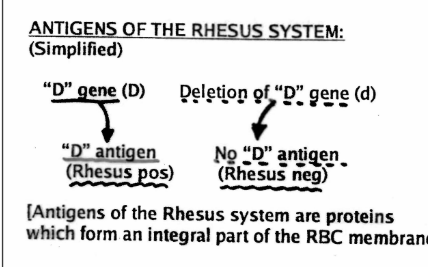
Antigens of the rhesus system are ___molecules that are integral in the RBC membrane.
protein molecules (NOT carbohydrates)
the presence of the dominant D gene codes for ___on the surface of RBC and makes the individual Rh __
D antigens
Rh+

the deletion of D gene codes for ___on the surface of RBC and makes the individual Rh __
NO D ANTIGENS
Rh-
There are different types/classes of antibodies that the body can generate for any specific antigen. Antibodies of the rhesus system are part of the __class. Only Rh- people can produce these antibodies after exposure to __
IgG
D antigen
What occurs in a mismatched blood transfusion where the donor is Rh+ and recipient is Rh-?
The Rh- recipient has RBC which contain NO D ANTIGEN. they also have NO ANTI-D ANTIBODIES.
The donor RBCs of Rh+ blood HAVE D antigens.
Immune response: the Rh- person’s immune system sees the D antigen as foreign and produces anti-D antibodies (sensitization).
Second exposure: Rh- person recieves Rh+ blood again. Now that they have anti-D antibodies, those bind to D antigens on donor Rh+ RBCs and cause agglutination and hemolysis.

What occurs in a rhesus mismatch during birth where the mom is Rh- and both children are Rh+?
the mom is Rh- and LACKS D antigens. her feuts is Rh+ and HAS D antigens.
during pregnancy the mother’s blood and fetal blood are separate. during delivery, some fetal Rh+ RBCs could enter the mother’s bloodstream.
now that the mother is exposed to D antigens from the Rh+ fetus, her immune system responds through sensitization and produces anti-D antibodies.
if a second pregnancy occurs and the child is also Rh+, the mother’s new anti-D antibodies can cross the placenta and bind to D antigens in the fetal blood.
this causes agglution and hemolysis and is called hemolytic disease of the newborn (HDN)
what are some symptoms of HDN?
fever, chills, nausea, clotting within blood vessels, Hb in urine (dark urine), and potentially stillborn.