FOOD3017 Final Exam
 Call Kai
 Learn
 Practice Test
 Spaced Repetition
 Match
 Flashcards
 Knowt Play
1/205

Earn XP
Description and Tags
Food Safety & Quality Management
206 Terms
Drivers of changing food safety landscape
Demand for convenience, fresher, healthier and less processed foods
Innovations in food processing and packaging
Gloval ingredient sourcing
Rising expectations from authorities
Challenges for food safety authorities
rapid growth in food trade and diversity
new agricultural and manufacturing practices
emerging hazards and technology
public demand for health protection
WTO SPS agreement requiring science based risk assessment
What are the components of risk analysis?
risk assessment
risk management
Risk communication
Why is risk analysis important?
preferred method of linking food hazards to health risks
supports decision making weith scientific and stakeholder input
promotes transparency, consistency and global harmonisation
facilitates trade and sets control measures
What are the ouputs of risk assessment?
Regulatory
Standards/enforcement
documents/guides
import certificates
education/training
Industry
control hazards
correct processing’
proper labelling
recall procedures
What is risk assessment?
Evaluation of known and potential adverse health effects
Includes qualitative and quantitative measures
considers uncertainties and supports health protection decisions
What are the characteristics of risk assessment?
Objective, transparent, systematic
based on scientific data
covers entire food chain
peer-reviewed and updates with new data
What are sources of scientific information?
published/unpublished studies
national monitoring and surveillance data
international databases (JECFA, JMPR)
Expert panels and risk asssessments from other countries
What factors affect the risk assessment methodology?
hazard classs
hazard characteristics
scenario
available methods
What is the risk assesment procedure?
Hazard identification
Hazard characterisation
Exposure assessment
Risk characterisation
What is hazard identification?
Identification of hazard and nature of hazard
What is involved in identification of microbiological hazards?
identification of infection pathway
Identify toxins
How does chemical hazard identification differ by history?
No history
Use toxicology or structure studies
History
Use existing data or experimental studies
What factors are involved in chemical hazard identification?
Dose response
NOAEL, LOAEL, LD50
Thresholds
Lowest dose with effect
ARfD - Acute reference dose for short term exposure
What is hazard characterisation?
Describe nature and extend of health effects
Establish dose-response relationships
What factors are involved in microbial hazard characterisation?
food vehicle
host factors
What is considered in chemical hazard characterisation?
Determine safe intakes
ADI
ARfD
PTWI
PMTDI
What is exposure assessment?
Track hazard levels through food chain
Combine consumption and concentration data
Adjusted for body weight and compared to health standards
Depends on quality of data, purpose and statistical methods
Probabilistic
Deterministic
What is risk characterisation?
Integrate hazard and exposure data
Estimates probability and severity of health effects
Accounts for uncertainties and population-specific effects
What is involved in microbiological risk characterisation?
Qualitative descriptions
What is involved in chemical risk characterisation?
Margin of safety between intake and hazard
What is a dose response curve?
mathematical relationship translating number of organisms into probability of adverse outcomes
experimental and observational data
limited availability, outliers and widely scattered
What must be accounted for when determining exposure?
Concentration
growth
reduction
level/amount of food consumed
What is risk management
What is involved in risk management?
select control methods based on risk assessment
define appropriate level of protection (ALOP)
Balances public safety, feasibility, consumer expectations
What are the approaches to risk management?
Zero Risk
negligible exposure levels
ALARA
as low as reasonably achievable
Threshold
below specific numerical limit
Benefit-cost
weigh health benefits vs cost
Comparative risks
Consider trade-offs
Precautionary
Interim measures when data is limited
What are the classes of risk management tools?
General
Microbiological
Chemical
Setting limits
What are some general risk management tools?
Standards
Guidelines
Education
What are some microbiological management tools?
HACCP
Limits
Surveys
What are some chemical risk management tools?
Prohibit
restrict
label
educate
What are some limits that can be used in risk management?
MRLs
Maximum residue limit
For agriculture/vetinary residues
MLs
Maximum limit
For contaminants
What is risk communication?
Interactive exhange amongst assessors, management and general public
explains risks, control measures and scientific basis
What are some risk communication activities
workshops
forums
consultations
public documents
media
education
What is root cause analysis?
Tool used to identify underlying cause(s) of problem or incident
immediate cause
underlying cause that contributed
Why is root cause analysis important?
preventing reccurence
continuous improvement
informed decision making
What are the types of incidents that could trigger root cause analysis?
food safety incident
consumer health at risk
food safety standard contravened
regulatory incident
regulatory requirement not met
however, no safety risk
quality incident
doesn’t impact safety but impacts suitability
economic consequences
What is a contributing factor in root cause analysis?
Specific environmental, biological, procedural, attitudinal or behavioural factors that directly resulted in failure. What went wrong, not why.
What are the steps of root cause analysis?
Problem statement
Collect information and data
Investigate and analysis
identify implicated products and processes and identify all possible root causes
Determine preventative/corrective strategies
Implement and validate strategies
Review
What are some root cause analysis tools?
5 Whys
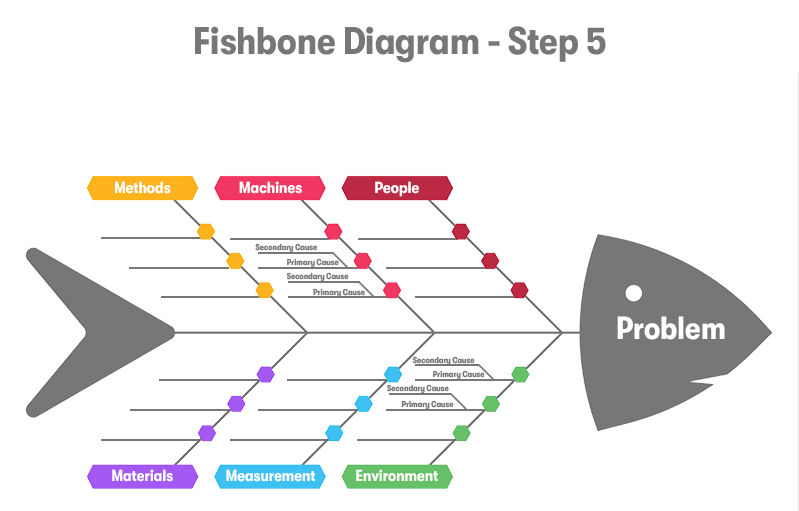
Fishbone/Ishikawa Diagram
Pareto charts
What is involved in the 5 Whys?
Ask why five times to distinguish symptoms from root cause
not set at five…
What is involved in the fishbone/ishikawa diagram?
head is problem
bones represent causes of problem
What is involved in a pareto chart analysis?
80:20 principle
vital few, trivial many
focus on major issues rather than minor causes
What are the most common causes in root cause analysis?
management failures
production and process control failures
personnel failures
What are the benefits of root cause analysis?
Prevent future recalls
prevent outbreaks
strengthen continuous improvement processes
provide evidence of commitment to supply chain partners
nurture employee pride
enhance organisational culture
What is validation?
Evidence that control measures or combination of control measures, if properly implemented, is capable of controlling the hazard to a specific outcome.
What are the types of validation?
Process (validate CCP)
Shelf-life
Cleaning (allergen)
What is the purpose of validation?
Demonstrate controls are effectve in reducing risk to public health
Regulatory agencies & certification bodies
Customers expect validated procedures
Requirements for many standards
What are the types of validation tools?
Historically recognised processes
Published documents
Scientifically valid data (in-house/provider)
Microbiological modelling
Challenge studies
What are the considerations when using microbiological modelling?
requires data
validity for food in question
be conservative!
What are the pre-validation steps?
Identify hazards or pathogens
Identify outcome required
identify measures required
What are the steps of validation?
Decide approach
Identify equipment and parameters
Define critical limits
Assemble values and studies
Analyse results
Document
What are the considerations for allergen cleaning?
Must be validated
Review process, ingredients and equipment
Describe frequency, process, schedule of cleaning
Identify sampling sites and swab to verify
What are the limits of HPP in validation?
highly variable impact
depnds on species, pressure, processing time, temp, etc.
What are phytochemicals?
Non-nutritive chemical compounds produced by plants
Not necessarily toxic, most neutral, some protective
Can have beneficial or adverse biological effects
What are phytotoxins?
Subset of phytochemicals
toxic to humans at sufficient dose
What are risk factors of phytotoxins?
Usually low level
High risk scenarios
low variety diet
poor preparation or processing
impairment of nutrient absorption
individual susceptibility to effects of phytotoxin
What are the main classes of phytotoxins?
Cyanogenic glycosides
Alkaloids
Lectins
Antinutrients
Goitrogens
What are cyanogenic glycosides?
Sugar attached to cyanide containing group
damage to tissue allows enzyme to create hydrogen cyanide (HCN)
Found in 2500+ species
tubers, legumes, sorghum, nuts, stonefruit pits, bamboo shoots
Cycads in aboriginal foods, removed by washing and fermentation
What is the mechanism for cyanogenic glycosides?
Physical damage releases HCN
HCN inhibits cytochrome oxidase (last stage of electron transport chain)
Blocks cellular respiration
Rapid onset toxicity
What can be done to reduce the effect of cyanogenic glycosides?
Chopping/grinding (releases HCN to air)
Fermentation (Enzymes and microbes break down HCN)
Washing (physical removal)
What are alkaloids?
Nitrogen containing heterocyclic ring compounds
Wide range of biological effects and activity
What are the two main types of alkaloids?
Pyrrolizidine alkaloids
Glycoalkaloids
What are some sources of pyrrolizidine alkaloids?
Direct
Herbal teas, weeds, seeds
Indirect
Honey, milk, eggs
What is the mechanism for pyrrolizidine alkaloids?
Acute
Presents as liver failure
Chronic
Abdominal pain, ascites
Late manifestation of hepatic failure
Recoery if intake stopped
What are sources of glycoalkaloids?
Tomatoes
Eggplants
Potatoes
Kangaroo apples (unripe)
What are the characteristics of glycoalkaloids?
Heat stable
Produced when plant/vegetable under stress (solanine)
What is the mechanism of glycoalkaloids?
Acute
Nausea, diarrhoea, vomiting
High dose
Halliucinations, paralysis, respiratory failure
What are lectins?
Carbohydrate binded glycoproteins
Raw/uncooked material
What are the sources of lectins?
Raw
Legumes
Wholegrains
What is the mechanism and outcomes for lectins?
Bind carbohydrate groups on surface of gut epithelial cells
inhibits membrane repair pathogens
leads to cell death, GI symptoms, reduced nutrient absorption
Explain toxicity caused by kidney beans
High PHA levels
4-5 can have severe GI symptoms
cramps, diarrhoea, vomiting
1-3 hr onset
slow cooking can increase availability
pre-soak, 100C+ cooking
What are antinutrients?
Phytochemicals that interfere with nutrient bioavailability and absorption
Reduce through preparation
What are three types of antinutrients?
Oxalates
Tannins
Phytic acid (phytates)
What is the mechanism of oxalates?
Oxalic acid binds calcium to find calicum oxalate (insoluble)
Crystals can accumulate in kidneys
people with prior stones or low calcium at risk
What are the sources of oxalates?
spinach
chocolate
tea
nuts
rhubarb leaves
What are some characteristics of oxalates?
heat stable
water soluble
What is the mechanism of tannins?
bind non-haem iron
bind dietary protein
inhibit digestion
interfere with enzymes
What are some sources of tannins?
Tea
Coffee
Chocolate
Wine
How can antinutrient activity of tannins be limited?
Limit consumption with other foods
eg. tea with iron rich meat
high risk for those with low iron
What is phytic acid (phytate)?
phosphorous storage in plants, cereals, legumes, nuts
What is the mechanism of phytic acid?
Chelates essential minerals, prevents absorption
How can the antinutrient effects of phytic acid be limited?
heat alone ineffective
Activate phytase
germination
soaking
fermentation
What is the mechanism of goitrogens?
Interfere wiith thyroid hormone synthesis
Reduces iodine reaching or being used by thyroid
Iodine needed for T3 and T4 hormones
stimulates TSH production, gland works harder, enlarges (goitre)
Chronic
hypothyroidism
impaired neurodevelopment
No problem with normal iodine intake
What are sources of goitrogens?
brassica (cabbage, broccoli, mustard)
Explain risk-benefit in context of phytotoxins
foods contain many important nutrients and phytochemicals
generally high benefit, low risk
What are risk factors of
Explain risk-benefit using caffeine as an example?
Benefits
Alertness
focus
physical performance
Risks
Addictive
headache/nausea
Sleep disruption
Pregnancy outcomes
What are mycotoxins and their characteristics?
Toxic secondary metabolites produced by fungi that contaminate food crops
non-protein, non-carbohydrate low molecular weight chemical structures
persist beyond cooking and processing
Often Invisible and odourless
What factors affect mycotoxin formation?
Warm temperatures
high water activity
poor storage
What foods are commonly affected by mycotoxins?
cereals (maize, rice wheat)
nuts, oil seeds
spices
coffee
animal products (carry-over)
How do mycotoxins reach people?
Eating contaminated crops
Carry-over through animals
Hidden methods
How do mycotoxins carry-over through animals?
Dairy cattle eat contaminated feed
Toxin converts and appears in milk
B1 alfatoxin in feed to M1 in milk
What are hidden methods in mycotoxin exposure?
Plant attaches sugar to toxin for defence
gut strips sugar off, releasing toxin
Grain handlers inhaling contaminated dust
What is acute exposure for mycotoxins?
short-term, high dose
once over hours to days
rare/uncommon but severe
sudden vomiting (deoxynivalenol)
Acute liver failure for alfatoxins
What is chronic exposure for mycotoxins?
repeated low-dose exposure
months to years
no immediate symptoms
major contributor to disease burden
Focus on
Tolerable daily intake (TDI)
Daily exposure over lifetime
long-term exposure assessment
What are some mycotoxin groups?
Fumonisin
Deoxynivralenol (DON)
Alfatoxins
What are the characteristics of fumonisins?
Toxins produced by Fusarium species
Primarily contaminate corn
Structurally like sphingolipids
What is the mechanism of fumonisins?
Resemble sphingolipids (building blocks for cell membrane)
Blocks cell assembly (ceramide synthase)
Sphinganine builds up in cells
Inhibits construction of membranes
affects cell signalling, apoptosis
How can fumonisins cause animal toxicity?
fatal brain damge in horses
fluids in lungs in pigs
redued growth in poultry
rodents, liver cancer, kidney damage