(3) Communication, Integration, and Homeostasis
 Call Kai
 Learn
 Practice Test
 Spaced Repetition
 Match
 Flashcards
 Knowt Play
1/41

There's no tags or description
Looks like no tags are added yet.
42 Terms
What are the three types of local communication?
Gap Junctions, contact dependent signals, and secreted chemicals (paracrine and autocrine)

Gap Junctions
signals pass directly from the ICF of one cell to another
Contact Dependent Signals
signal molecule on one cell membrand contacts receptors on another cell membrane
Autocrine secreted chemicals
binds to receptors on the same cell that secreted them.
Paracrine secreted chemicals
binds to receptors on adjacent cells
What are the two types of long distance communication?
Endocrine system and nervous system communication
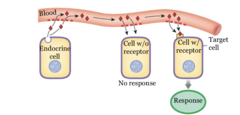
Endocrine system communication
hormones are secreted by endocrine glands or cells into the blood
Nervous system communication
Electrical signals travel across electrically excitable cells.
Neurotransmitters
Chemical messengers secreted by neurons to transmit signals across synapses
Neurohormones
Hormones released by neurons into the bloodstream to affect distant target organs
Signal pathway steps
signal molecule, binds to membrane receptor protein, activates intracellular signal molecules, alter target proteins, create response
Lipophilic signal proteins (steroids)
Can diffuse accros cell membrane
Steroids (signal pathways)
Bind to receptors in ICF or nucleus and activate proteins associated with gene transcription.
Steroids cause slow or fast responses?
Slow, production of new proteins
Lipophobic signal molecules (most chemical signals)
Cannot diffuse through cell membrane
Lipophobic signal molecules bind where?
Surface of cell membrane
Lipophobic signal molecules trigger slow or fast response
Fast, activates existing proteins
Signal Transduction
The transformation of the signal from one form to another

Signal Amplification
Allows a small amount of signal to have a large effect
What happens when ions enter through an open channel?
Changes the membrane potential
Ion specific protein channels open in response to
- direct binding of ligand
- binding of ligand to GPCR
- binding of intracellular messenger
- electrical or mechanical systems
G protein-coupled receptors (GPCRs)
Membrane receptors that activate G-proteins, cause phosphorylation cascades, and amplify cell signals
Tyrosine kinase receptors (RTK's)
Membrane receptor is connected to tyrosine kinase inside CM, causes phosphorylation cascades, and amplifies cell signals
Specificity
The ability of a receptor to bind to a certain ligand or group of ligands
Competition
multiple ligands for one receptor
Saturation
All proteins occupied
Agonists
Competing ligands that also elicit a response
Antagonists
Competing ligands that block receptor activity
The response of any cell to the ______ depends on what type of ______ is present
ligand, receptor
Down regulation
A decrease in receptor number.
When does down regulation commonly occur?
In response to a higher than usual amount of ligand
Desensitization
Using chemical modulators to inactivate receptors
Desensitization is usually the cause of what?
Drug tolerance
Up-regulation
An increase in receptor number
When does up-regulation commonly occur?
In response to a lower than usual amount ligand
Stimulus
Input or change
Sensor
Thing that monitors the variable
Input Signal
Integrating Center
Compares input signal with the setpoint and initiates output
Output Signal
Transfers output info to target
Target
Receives the output signal and carries out response
Response
Change in variable being monitored