B cell Imm 1 Lec 8
 Call Kai
 Learn
Learn Practice Test
 Spaced Repetition
 Match
Match Flashcards
 Knowt Play
1/35

There's no tags or description
Looks like no tags are added yet.
Name | Mastery | Learn | Test | Matching | Spaced | Call with Kai | Chat |
|---|
No analytics yet
Send a link to your students to track their progress
36 Terms
What are antibodies? What is their ability?
Soluble polypep. molecules that are made and secreted by B cells
Can recognize any substance w/o any req. for antigen presentation
How did Max cooper discover that b cells make anibodies?
Chickens were used as his experimental animal
When bursa was removed, the chickens could no longer produce antibodies, hence how we discovered the site of antibody production is the BURSA
In mammals, b cells are from the bone marrow
What 2 chains make up antibodies?
a heavy and light chain

What happens to the intervening DNA during early B-cell gene rearrangement?
One V segment is rearranged to one D segment and one J segment, and all the DNA in between gets deleted through this genetic rearrangement mechanism.
What region of the B-cell protein do the rearranged VDJ segments encode, and why does every B cell have a slightly different sequence for it?
encode the RNA for the variable region of protein
every b cell has diff seq. because of the random selection of different V, D and J segments
True or false; there is no rearrangement between J and C
True, there is no rearrangement between J and C
What are the steps of BCR development
Begins as a hematopoetic cell in bone marrow
IgH (heavy chain) VDJ rearrangement takes place
Chain pairs with another molecule to form pre-BCR (*Quality control)
Cells rearrange their light chains (κ or λ)
Light chain and heavy chain pair to form a BCR (2 heavy, 2 light)
What is the basic protein subunit structure of a complete B-cell receptor (BCR)?
2 identical heavy chain proteins and 2 identical light chain proteins paired together to form a Y-shaped molecule.
Do B cells undergo positive selection like T cells?
No. B cells do NOT undergo positive selection like T cells
How does Negative Selection (Clonal Deletion) work for B cells before they become Naïve B cells?
Once the complete BCR is on the surface, if it binds to a self-antigen with strong/high affinity, the B cell receives a signal and is programmed to die (clonal deletion).
What is the goal at the end of this process of gene rearrangement of B cell
every b cell makes a BCR/antibody of a single specificity
What are the functional characteristics and limitations of B cells in monoclonal antibody production?
B cells make antibodies, but they do not grow in culture.
What are the functional characteristics and limitations of Multiple Myeloma Cells in monoclonal antibody production?
Multiple myeloma cells do not make antibodies, but they grow in culture (immortal).
What cell type is created by fusing a B cell with a Multiple Myeloma Cell, and what are its two key properties?
A "Hybridoma" cell. Its two key properties are:
Makes antibodies (derived from the B cell)
Able to grow in culture (derived from the myeloma cell)
What proportion of the top 10 bestselling drugs by revenue in 2025 were humanized monoclonal antibodies?
4 out of 10
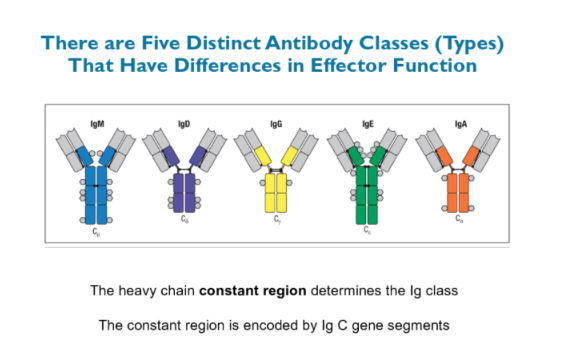
What component of the antibody molecule determines its class (isotype)?
The heavy chain constant region.
What genetic segments encode the constant region of an antibody?
Ig C gene segments.
Which protein is required to link individual antibody monomers together to form IgM pentamers and IgA dimers?
The J (Joining) chain protein
What specific polymeric structure does IgM form using the J chain, and what type of bonds connect the monomers in this structure?
IgM forms a pentamer linked together by disulfide bonds
What polymeric structure does IgA form when linked by the J chain?
IgA forms a dimer

How does IgA move from tissue into gut lumen to protect body from infections?
Dimeric IgA is actively transported across epithelial cells via the pIgR receptor into the gut lumen
it neutralizes pathogens and bacterial toxins.
Which antibody isotype is transferred from mother to fetus during pregnancy, across what layer, and via which receptor?
IgG antibodies
across syncytio-trophoblasts
by receptor FcRn.
Which antibody isotype is transferred from mother to baby after birth in breastmilk, and by what receptor across the mammary gland epithelium?
Secretory IgA antibodies
PIgR receptors.
The 6 effector functions of antibodies
1) What is neutralization of Pathogens and Toxins
Antibodies bind to substances via antigen binding sites to neutralize them
Ex. antibody will bind to virus to neutralize it so it can no longer infect
All classes of antibodies can do this
The 6 effector functions of antibodies
2) Agglutination of Particulate antigens
Antibodies can cross link molecules
Every antibody has two binding sites so one binding site can bind to one antigen and the other could bind to another antigen which creates massive crosslinking
best done by IgM and IgA
The 6 effector functions of antibodies
3) What is opsonization
Makes phagocytosis more efficient
best done by IgG
The 6 effector functions of antibodies
4) Complement activation
The Classical pathway of complement activation
initiated by IgM and IgG
The 6 effector functions of antibodies
5) Antibody- Dependent Cellular Cytotoxicity
Triggers NK to kill
mediated best by IgG
The 6 effector functions of antibodies
6) Degranulation of Mast cells, Basophils and Eosinophils
occurs in allergic response and parasite infections
mediated by IgE
What antibodies are made in the primary response?
IgM and IgD
What antibodies are made in the secondary response?
IgG, IgA, IgE

What does this slide tell us about vaccines?
Vaccines job is to generate good antibody responses
Antibodies are very important to neutralize a virus
These graphs show that when these vaccines were introduced, these diseases decreased

What are the three main approaches to making a vaccine
Using a whole virus
Using part that triggers immune system
Using just the genetic material
Do live attenuated vaccines typically require an adjuvant, and why or why not?
No.
because the live organism itself stimulates both innate and adaptive immunity
What do all vaccines require stimulation of?
Of innate and adaptive immunity
What is passive immunity?
A person receives ready-made antibodies from another source rather than producing them through their own immune system
placental transfer
breastfeeding
short lived