substitution
 Call Kai
 Learn
 Practice Test
 Spaced Repetition
 Match
 Flashcards
 Knowt Play
1/10

There's no tags or description
Looks like no tags are added yet.
11 Terms
Nucleophilic Aliphatic Substitution
substitution of one group for another at a saturated, sp3-hybridized carbon atom

SN1
two steps
heterolytic cleavage, or ionization, of the bond between the carbon atom and the leaving group (slow)
bond formation
rate of the reaction depends only upon the concentration of the substrate (unimolecular)

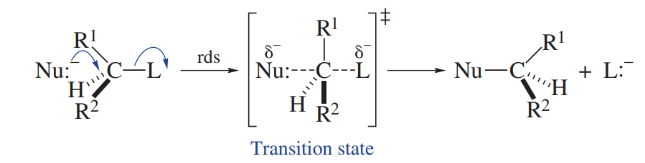
SN2
nucleophile directly attacks the substrate, with the angle of approach being 180° to the C–L bond
both the substrate, R–L, and the nucleophile are involved in the transition state of the rate-determining step (bimolecular)
Infrared Spectroscopy (IR)
filler
Halide Test
Nucleophilic substitution requirements
Leaving group
nucleophile
why we chose HCl
Sn1 vs Sn2
As more alkyl groups are attached to the carbon atom C–L undergoing substitution, it becomes sterically more difficult for the nucleophile to attack from the backside because of the bulk of these groups, thereby decreasing the ease with which the SN2 process can occur.
With increasing substitution of alkyl groups on the carbon atom C–L, the in-cipient carbocation in the SN1 reaction becomes more stable, thereby increasing its ease of formation along the SN1 pathway.
Wash vs Extraction
IR analysis
Three functional group frequencies discussed in lecture
Peak Intensity vs peak frequency
Halide Test analysis
Alcoholic Silver Nitrate (AgNO3)
Sodium Iodide Test (NaI)
Alcoholic Silver Nitrate (AgNO3)
sn1
Sodium Iodide Test (NaI)
sn2

our mechanism
