Chapter 15 and 18 Genetic code and Translation
 Call Kai
 Learn
 Practice Test
 Spaced Repetition
 Match
 Flashcards
 Knowt Play
1/57

Earn XP
Description and Tags
Test 2 for Genetics
58 Terms
What is the significance of the observation that many synonymous codons differ only in the third nucleotide position?
Synonymous codons code for the same amino acid, or, in other words, they have the same meaning. Degeneracy in the codon table is often (but not always) because different codons specifying the same amino acid differ at the third position.
Define the following terms as they apply to the genetic code:
a. Reading frame
The reading frame refers to how the nucleotides in a nucleic acid molecule are grouped into codons containing three nucleotides. Each sequence of nucleotides has three possible sets of codons, or reading frames.
Define the following terms as they apply to the genetic code:
b. Degenerate code
The genetic code is degenerate because most amino acids are specified by more than one codon. For example, arginine is specified by six different codons
Define the following terms as they apply to the genetic code:
c. Unambiguous code
The genetic code is unambiguous because each codon specifies only one amino acid. For example, the codon UUU always specifies phenylalanine.
Define the following terms as they apply to the genetic code:
d. Nonoverlapping code
In a nonoverlapping code, a single nucleotide is part of only one codon. If an overlapping code were used, a single nucleotide would be found in more than one codon. Because the genetic code is nonoverlapping, codons within a gene do not overlap.
Define the following terms as they apply to the genetic code:
e. Universal code
In a universal code, each codon specifies, or codes, for the same amino acid in all organisms. The genetic code is nearly universal, but not completely. Most of the exceptions occur in mitochondrial genomes. Known exceptions are the termination codons, which in the mitochondria may code for amino acids.
Define the following terms as they apply to the genetic code:
f. Translation initiation codon
The translation initiation codon establishes the appropriate reading frame and specifies the first amino acid of the polypeptide chain. Typically, the initiation codon is AUG
Define the following terms as they apply to the genetic code:
g. Translation termination codon
The translation termination codon signals the termination or end of translation and the end of the polypeptide. There are three termination codons (UAA, UAG, and UGA) which are also referred to as stop codons. These codons do not specify an amino acid.
Define the following terms as they apply to the genetic code:
h. Sense codon
A sense codon is a group of three nucleotides that specifies an amino acid. In the genetic code, there are 61 sense codons that specify the 20 amino acids commonly found in proteins
Define the following terms as they apply to the genetic code:
i. Synonymous codon
If two codons specify the same amino acid, they are said to be synonymous.
How are tRNAs linked to their corresponding amino acids?
Each of the 20 different amino acids that are commonly found in proteins has a corresponding aminoacyl-tRNA synthetase that covalently links the amino acid to the correct tRNA molecule
What are isoaccepting tRNAs?
Isoaccepting tRNAs are tRNA molecules that have different anticodon sequences but carry the same amino acids. For example, two tRNAs with different anticodons that both carry the amino acid serine are isoaccepting tRNAs.
How does the process of translation initiation differ in bacterial and eukaryotic cells?
Bacterial initiation of translation requires that the 16S rRNA in the small ribosomal subunit base-pairs with the mRNA at the ribosome binding site (Shine-Dalgarno sequence) in the 5’UTR. The Shine-Dalgarno sequence is essential to place the ribosome next to the translation start codon.
In eukaryotes, there is no Shine-Dalgarno sequence. The small ribosomal subunit recognizes the 5' cap of the mRNA and then scans along the mRNA until it encounters an AUG start codon in a Kozak consensus.
Name the elongation factors used in bacterial translation and explain the role played by each in translation.
EF-Tu binds to GTP and a tRNA charged with an amino acid. The charged tRNA is delivered to the ribosome at the A site, and hydrolysis of GTP provides the energy to stabilize the charged tRNA in the A site.
EF-Ts replaces GDP on EF-Tu with GTP.
EF-G is necessary for translocation, or movement of the ribosome along the mRNA during translation. EF-G uses GTP to provide energy for translocation.
What events bring about the termination of translation?
The process of termination begins when a ribosome encounters a termination codon. Because the termination codon is located at the A site, no corresponding tRNA will enter the ribosome. This allows release factors to bind the ribosome, triggering the release of the polypeptide and dissociation of the ribosome and mRNA. Release factors hydrolyze GTP to GDP to provide energy for termination.
What is the difference between a transition and a transversion?
Transition mutations are base substitutions in which one purine (A or G) is changed to the other purine, or a pyrimidine (T or C) is changed to the other pyrimidine. Transversions are base substitutions in which a purine is changed to a pyrimidine or vice versa.
What is the difference between a missense mutation and a nonsense mutation? Between a silent mutation and a neutral mutation?
A base substitution that changes one amino acid in the polypeptide to another is called a missense mutation.
A base substitution that changes a codon for an amino acid to a stop codon is called a nonsense mutation.
A base substitution that changes a codon specifying an amino acid to a different codon for the same amino acid is called a silent mutation. Neutral mutations can be either missense or silent. If the neutral mutation is a missense mutation, the amino acid substitution has little or no effect on protein function.
Contrast the effects of frameshift, missense and nonsense mutations on a protein amino acid sequence.
A frameshift mutation changes the reading frame and causes the wrong amino acids to be inserted into the polypeptide after the alteration in the DNA. Typically, frameshift mutations will result in an inactive protein.
Missense mutations result in a single amino acid substitution in the protein (the total number of amino acids remains unchanged). The mutation may or may not affect protein function depending on where in the protein it occurs.
Nonsense mutations replace a codon specifying an amino acid with a stop codon. The protein is shortened or truncated and is often non-functional.
Explain the wobble hypothesis. In what sense might wobble be beneficial to the efficiency of translation?
The 5’ nucleotide of the anticodon in tRNA can base pair with more than one 3’ nucleotide in the mRNA codon. Thus, although each tRNA can be charged with only one amino acid, the anticodon can recognize more than one codon for a given amino acid. This reduces the number of tRNAs needed for translation
If an RNA that consisted only of guanine nucleotides were translated, what polypeptide would be made?
A polypeptide consisting only of glycine
What would be the minimum codon size (number of nucleotides) required to specify all amino acids if the number of different types of amino acids in proteins were:
c. 175
Four nucleotides. There are 4 different bases, and if a codon is four nucleotides, there would be 4^4 = 256 possible codons, which is sufficient to specify 175 different amino acids. A codon size of three nucleotides would not be enough, as there would be 4^3 = 64 possible codons
What would be the minimum codon size (number of nucleotides) required to specify all amino acids if the number of different types of amino acids in proteins were:
a. 2
One nucleotide. There are 4 different bases, and if each nucleotide were a codon, there would be 4^1 = 4 possible codons, which is sufficient to specify 2 different amino acids.
What would be the minimum codon size (number of nucleotides) required to specify all amino acids if the number of different types of amino acids in proteins were:
b. 17
Three nucleotides. There are 4 different bases, and if a codon is three nucleotides, there would be 4^3 = 64 possible codons, which is sufficient to specify 17 different amino acids. A codon size of two nucleotides would not be enough, as there would be 4^2 = 16 possible codons.
A tRNA has the anticodon sequence 5’ CGA 3’
a. What would be the sequence and polarity of the corresponding codon in the mRNA?
5’ UCG 3’ 3’ GCU 5’ is also correct.
A tRNA has the anticodon sequence 5’ CGA 3’
b. What would be the sequence and polarity of the corresponding codon in the DNA on the non-template strand?
5’ TCG 3’ 3’ GCT 5’ is also correct.
Referring to the codon table in your slides, show the polypeptide specified by the following bacterial mRNA sequence. Begin translation at the first start codon and show the amino and carboxy terminal ends.
5’-AUGUUUAAAUUUAAAUUUUGA-3´
NH2-fMet-Phe-Lys-Phe-Lys-Phe-COOH
The mRNA sequence begins with the three nucleotides AUG. This indicates the start point for translation and allows for the reading frame to be set. In bacteria, the AUG initiation codon codes for N-formyl methionine. A stop codon (UGA) is present at the end of the translatable sequence.
The amino terminal end refers to the end of the protein with a free amino group and will be the first amino acid in the polypeptide chain. The carboxyl terminal end refers to the end of the protein with a free carboxyl group and is the last amino acid in the polypeptide chain.
A polypeptide has the amino acid sequence Met-Ala-Phe-Tyr-Leu. How many different nucleotide sequences could encode this polypeptide in DNA?
288
The potential nucleotide sequences encoding the polypeptide can be determined from the codon table. From the table, we can see:
Met - 1 codon (or 1 sequence)
Ala - 4 codons
Phe - 2 codons
Tyr - 2 codons
Leu - 6 codons
We must also include the 3 possible translation STOP codons, as they also encode the polypeptide.
So, 1 x 4 x 2 x 2 x 6 x 3 = 288 different nucleotide sequences
Which of the following amino acid changes could result from a mutation that changed a single base? For each change that could result from the alteration of a single base, determine which position of the codon (first, second, or third nucleotide) in the mRNA would be altered.
a. Leu to Gln
Of the six codons that encode Leu, only two could be mutated by the alteration of a single base to produce codons for Gln:
CUA (Leu) - change the second position U to A to get CAA (Gln).
CUG (Leu) - change the second position U to A to get CAG (Gln).
Which of the following amino acid changes could result from a mutation that changed a single base? For each change that could result from the alteration of a single base, determine which position of the codon (first, second, or third nucleotide) in the mRNA would be altered.
b. Phe to Se
Both Phe codons (UUU and UUC) could be mutated at the second position to produce Ser codons:
UUU (Phe) - change the second position U to C to get UCU (Ser).
UUC (Phe) - change the second position U to C to get UCC (Ser).
For each of the following, indicate the process most immediately affected by deletion (removal) of the sequence.
Choose only one process for each sequence.
DNA Replication
Transcription
RNA Processing
Translation
a. ori site
DNA replication - the ori site or origin of replication is necessary for the initiation of replication
For each of the following, indicate the process most immediately affected by deletion (removal) of the sequence.
Choose only one process for each sequence.
DNA Replication
Transcription
RNA Processing
Translation
b. 3' splice site consensus sequence
RNA processing: the 3' splice site is necessary for proper excision of the intron. Therefore, RNA processing events will be affected.
For each of the following, indicate the process most immediately affected by deletion (removal) of the sequence.
Choose only one process for each sequence.
DNA Replication
Transcription
RNA Processing
Translation
c. polyadenylation signal
RNA processing - the polyadenylation signal directs cleavage of the pre-mRNA followed by addition of the poly(A) tail. Without the polyadenylation signal, cleavage would not occur, and processing of the mRNA could not be completed. The pre-mRNA would be degraded.
For each of the following, indicate the process most immediately affected by deletion (removal) of the sequence.
Choose only one process for each sequence.
DNA Replication
Transcription
RNA Processing
Translation
d. translation start codon
Translation - the start codon is necessary for translation initiation
For each of the following, indicate the process most immediately affected by deletion (removal) of the sequence.
Choose only one process for each sequence.
DNA Replication
Transcription
RNA Processing
Translation
e. -10 consensus sequence in bacteria
Transcription: In bacteria, the -10 sequence is an important component of the promoter. Deletion of the -10 sequence will prevent transcription initiation because RNA polymerase will not bind to the promoter
For each of the following, indicate the process most immediately affected by deletion (removal) of the sequence.
Choose only one process for each sequence.
DNA Replication
Transcription
RNA Processing
Translation
f. Shine-Dalgarno sequence
Translation: The Shine-Dalgarno sequence, or ribosome-binding site, is recognized by the 16S rRNA in the 30S ribosomal subunit during the initiation of translation in bacteria. If the sequence is deleted, the ribosome will not associate with the mRNA molecule, and translation will not occur.
A codon that specifies the amino acid Gly undergoes a single-base substitution to become a nonsense mutation. Use the codon table to determine if this mutation is a transition or a transversion. At which position in the codon does the mutation occur?
By examining the four codons that encode Gly, GGU, GGC, GGA, and GGG, and the three nonsense codons, UGA, UAA, and UAG, we can determine that only one of the Gly codons, GGA, could be mutated to a nonsense codon by a single substitution. In this case, GGA would be changed to UGA, with the change occurring at the first position.
GGA to UGA
Because guanine is a purine and uracil is a pyrimidine, the mutation is a transversion.
A polypeptide has the following amino acid sequence:
Met-Ser-Pro-Arg-Leu-Glu-Gly
The amino acid sequence of this polypeptide was determined in a series of mutants listed in a through c. For each mutant, indicate whether the mutation is a single-base substitution, insertion, or deletion. Also indicate if the mutation is a nonsense mutation, missense mutation, frameshift mutation, or silent mutation
a. Mutant 1: Met-Ser-Ser-Arg-Leu-Glu-Gly
It seems likely that this is a missense mutation because only one amino acid in the polypeptide has been changed, resulting in the substitution of Ser for Pro in the polypeptide. The change can be explained by a single-base substitution in the Pro codon resulting in a Ser codon. Four of the Pro codons can be changed to Ser codons by a single transition mutation.
Pro Ser
CCU UCU
CCC UCC
CCA UCA
CCG UCG
A polypeptide has the following amino acid sequence:
Met-Ser-Pro-Arg-Leu-Glu-Gly
The amino acid sequence of this polypeptide was determined in a series of mutants listed in a through c. For each mutant, indicate whether the mutation is a single-base substitution, insertion, or deletion. Also indicate if the mutation is a nonsense mutation, missense mutation, frameshift mutation, or silent mutation
b. Mutant 2: Met-Ser-Pro
The observation that the polypeptide is truncated suggests a nonsense mutation, however you should always check that a single nucleotide deletion or insertion (frameshift) didn’t create an in-frame stop codon.
In this case, a single-base substitution has occurred in the Arg codon, resulting in a nonsense mutation. Two of the potential codons for Arg can be changed by single-base substitutions to stop codons.
Arg Stop
CGA UGA transition mutation
AGA UGA transversion mutation
A polypeptide has the following amino acid sequence:
Met-Ser-Pro-Arg-Leu-Glu-Gly
The amino acid sequence of this polypeptide was determined in a series of mutants listed in a through c. For each mutant, indicate whether the mutation is a single-base substitution, insertion, or deletion. Also indicate if the mutation is a nonsense mutation, missense mutation, frameshift mutation, or silent mutation
c. Mutant 3: Met-Ser-Pro-Asp-Trp-Arg-Asp-Lys
The observation that all the amino acids are altered after the third amino acid suggests a frameshift mutation.
The deletion of a single nucleotide at the first position in the Arg codon (most likely CGA) would result in a frameshift mutation in which the mRNA is read in a different frame, producing a different amino acid sequence for the protein.
What does it mean to say the genetic code is “degenerate”?
Multiple codons can code for one amino acid
The third position of the codon is less important for the binding of the tRNA than the first two. Since a tRNA can bind even if the third nucleotide does not match, multiple codons with different third nucleotides are bound by the same tRNA, thus coding for the same amino acid
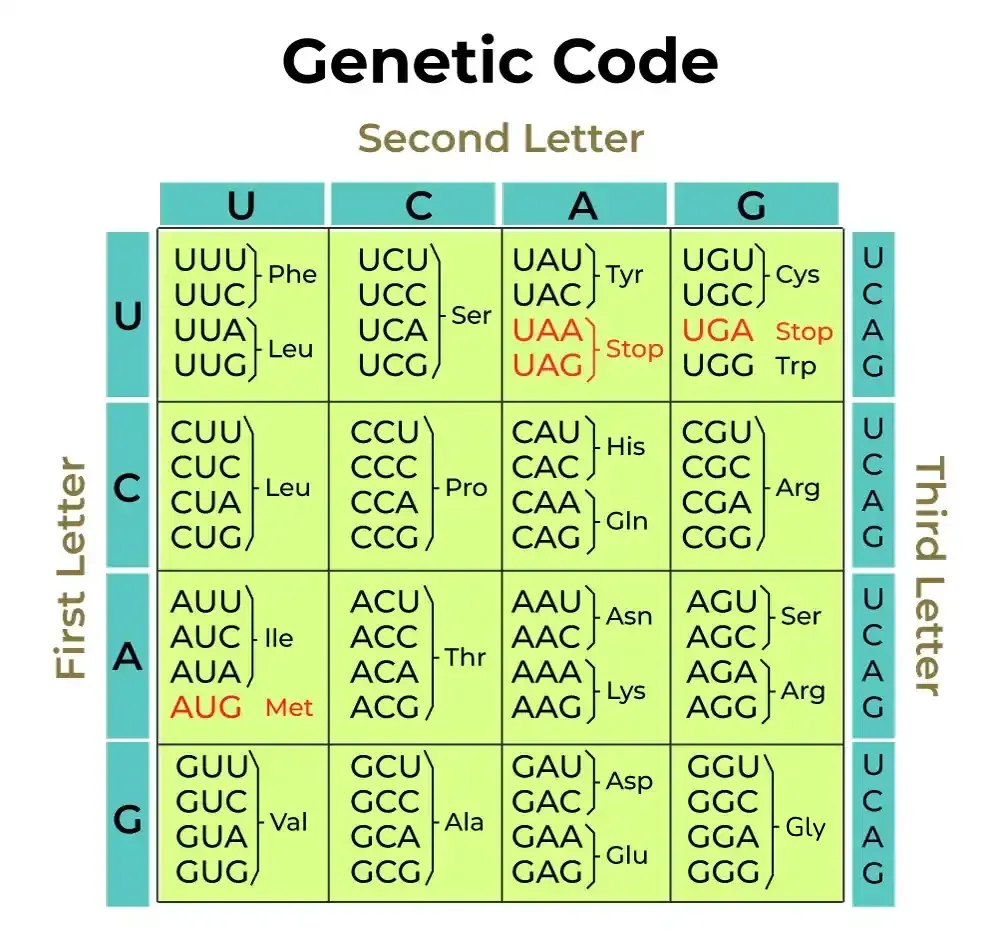
Which amino acid, if any, foes the codon UGG encode?
Trp - tryptophan
To find the amino acid corresponding to UGG, the first row on the left (U) is used for the first base, the fourth codon (G) is used for the second base, and the fourth sub-row on the right (G) is used for the third base. Thus, UGG encodes the amino acid Trp (tryptophan).

Which codons code for amino acid arginine (Arg)?
CGC
UGC
AGA
CGU
AGC
CGC, AGA, CGU
The table shows that Arg is encoded by the codons CGU, CGC, CGA, CGG, AGA, and AGG. Often, codons with the same first two bases but a different last base encode the same amino acid. However, important exceptions exist. For example, AGA and AGG both encode Arg, but AGU and AGC encode serine (Ser). And CGA and AGA differ in the first base, but both encode Arg.
Codons are read left to right in the 5′ to 3′ direction. So UGC, which encodes cysteine (Cys), is not the same as CGU, which encodes Arg.
Evaluate whether the following statement is true or false:
Anticodons are three-nucleotide sequences found in mRNA.
False
Anticodons are found in tRNA, not mRNA. Anticodons are complementary to the codons in mRNA.
The “wobble” nucleotide in a codon is defined as
The third nucleotide
The third position of the codon is less important for the binding of the tRNA than the first two. Since a tRNA can bind even if the third nucleotide does not match, this nucleotide is called the wobble.
Place the events in chronological order to show how transcription and translation typically proceed in eukaryotes. Place the first event at the top and the last event at the bottom.
mRNA binds to ribosome
A release factor recognizes the codon UAG in mRNA
RNA polymerase synthesizes mRNA from a DNA template
A tRNA with the anticodon UAC binds to mRNA
mRNA is exported from the nucleus
RNA polymerase synthesizes mRNA from a DNA template
mRNA is exported from the nucleus
mRNA binds to ribosome
A tRNA with the anticodon UAC binds to mRNA
A release factor recognizes the codon UAG in mRNA
With respect to initiation of translation in bacteria, which one of the following statements is CORRECT?
the small and large ribosomal subunits bind simultaneously to initiate translation
the small subunit of the ribosome binds to the 5’ cap of the mRNA and scans along the mRNA looking for the Shine-Dalgarno sequence
the initiator tRNA binds to the future A site of the ribosome
the 16S rRNA of the small ribosomal subunit base pairs with the Shine-Dalgarno sequence in the mRNA to position a ribosome at the translation start codon
the initiator tRNA carries methionine
the 16S rRNA of the small ribosomal subunit base pairs with the Shine-Dalgarno sequence in the mRNA to position a ribosome at the translation start codon
The Shine-Dalgarno sequence is immediately upstream of the translation start codon placing the ribosome in the correct position to initiate translation
The protein amino acid sequence ‘ala-pro-trp-ser-glu-lys-cys-his’ is found to be altered in a mutant bacteria.
The altered amino acid sequence is ala-pro-trp-arg-glu-lys-cys-his. Which type of mutation is most likely to have occurred?
Missense mutation
Since a single amino acid has been changed with no other alterations to the amino acid sequence, a missense mutation is the most likely reason for the altered sequence.
What is a missense mutation?
A mutation that alters a codon to a codon for a different amino acid
Referred to as a neutral mutation

What is nonsense mutation?
A mutation that alters a codon for an amino acid to a stop codon causing protein synthesis to terminate prematurely
What is a silent mutation?
A mutation that makes no change in the amino acid sequence and doesn’t alter protein function
Also called same-sense or neutral mutation
What are frameshift mutations?
base insertions and/or deletions that alters the reading frame and may change many codons
It can cause the protein to be shorter (truncated) or longer than expected depending on whether a stop codon in the new reading frame occurs before or after the correct stop codon
usually non-functional and not seen in wild-type protein
If there were 75 common amino acids (instead of 20), what would be the minimum size of a codon in nucleotides to cover all the amino acids?
a. 1
b. 2
c. 3
d. 4
e. 5
d. 4
If a codon is 3 nucleotides there are 43 = 64 possible codons - not enough to encode 75 amino acids
If a codon is 4 nucleotides there are 44 = 256 possible codons which is enough to code for 75 amino acids
The genetic code is degenerate. This means?
a. one amino acid can be specified by more than one codon
b. each codon specifies more than one amino acid
c. the same genetic code is found in all organisms
d. the genetic code is overlapping
e. the genetic code hangs around in seedy bars and drinks too much
a. one amino acid can be specified by more than one codon
Different types of rRNA have constant lengths, e.g., 23S rRNA is always 2904 nucleotides long.
Do you expect all mRNA’s (encoding polypeptides) to be the same length?
No, their length will vary according to the length of the polypeptide they encode
If the sequence of the non-template strand of DNA is 5’ CGA 3’ what is the sequence and polarity of a tRNA anticodon that base pairs with this sequence in the mRNA?
a. 3’ GCT 5’
b. 3’ CGA 5’
c. 5’ GCU 3’
d. 5’ CGA 3’
e. 3’ GCU 5’
e. 3’ GCU 5’
The sequence of a Trp codon in mRNA is 5’ UGG 3’. What is the sequence and polarity of the tRNA anticodon that base pairs with the Trp codon in the mRNA?
a. 5’ UGG 3’
b. 3’ UGG 5’
c. 5’ CCA 3’
d. 3’ CCA 5’
e. 5’ ACC 3’
c. 5’ CCA 3’
The anticodon will have the opposite polarity and complimentary sequence.
3’ ACC 5’ is also correct
Which one of the following will result in a frameshift mutation throughout the entire length of the protein after the point of the last insertion/deletion?
a. a deletion of one nucleotide followed by a nearby insertion of one nucleotide
b. a deletion of two nucleotides followed by a nearby insertion of two nucleotides
c. a deletion of three nucleotides followed by a nearby insertion of one nucleotide
d. all the changes will result in a frameshift mutation throughout the entire length of the protein after the point of the first insertion/deletion.
c. a deletion of three nucleotides followed by a nearby insertion of one nucleotide
frameshift mutation
The following mutation is observed: wild-type mRNA
AAA ACG GGU AAA CCC ACA UGA
Phe Thr Gly Phe Pro Thr stop
Mutant mRNA
AAA ACG GGG UAA ACC CAC AUG A
Phe Thr Gly stop
This mutation is a?
A frameshift mutation