Topic 11 - Oxidative Phosphorylation
 Call Kai
 Learn
 Practice Test
 Spaced Repetition
 Match
 Flashcards
 Knowt Play
1/43

There's no tags or description
Looks like no tags are added yet.
44 Terms
Oxidative phosphorylation
Electron transfer generates a proton gradient that drives ATP synthesis.
Electron transport chain location
Its components are embedded in or associated with the inner mitochondrial membrane.
Electron flow
Electrons pass between carriers in order of increasing electron affinity.
Cytochromes
Electron-carrying proteins containing a heme prosthetic group with a central iron ion.
Matrix NADH from pyruvate oxidation
Pyruvate oxidation to acetyl-CoA reduces NAD⁺ to NADH in the matrix.
Citric acid cycle NADH yield
Each turn produces three NADH molecules in the mitochondrial matrix.
Malate-aspartate shuttle
Transfers electrons from cytosolic NADH to produce matrix NADH.

Cytosolic NADH
Does not cross the inner mitochondrial membrane directly; it transfers electrons to intermediates.
Complex I
NADH dehydrogenase transfers electrons from matrix NADH to ubiquinone.

Complex I proton movement
Four protons move to the intermembrane space per NADH oxidized.

Ubiquinol
QH₂ diffuses within the inner membrane and delivers electrons to Complex III.
Complex III
The cytochrome b-c₁ complex transfers electrons from QH₂ to cytochrome c.
Cytochrome c
Its heme group carries one electron at a time to Complex IV.
Complex III proton movement
Four protons reach the intermembrane space per QH₂ oxidized.
Complex IV
Cytochrome oxidase transfers electrons from cytochrome c to oxygen, forming water.
Complex IV stoichiometry
Four electrons reduce O₂ to two H₂O while four protons are pumped.
NADH electron pathway
NADH → I → Q → III → cytochrome c → IV → O₂.
Net electron transport from NADH
2 NADH + O₂ + 22 H⁺ matrix → 2 NAD⁺ + 2 H₂O + 20 H⁺ intermembrane.
Complex II
Succinate dehydrogenase transfers electrons from succinate to ubiquinone.
Complex II proton movement
It pumps no protons across the inner mitochondrial membrane.
Net electron transport from QH₂
2 QH₂ + O₂ + 12 H⁺ matrix → 2 Q + 2 H₂O + 12 H⁺ intermembrane.
Protons pumped per matrix NADH
Ten protons are moved to the intermembrane space.
Protons pumped per QH₂
Six protons are moved to the intermembrane space.
Cyanide inhibition
Cyanide inhibits Complex IV, blocking electron transfer to oxygen.
Protonmotive force
The proton concentration difference and electrical potential across the inner membrane.
Mitochondrial proton gradient
The intermembrane space has a higher proton concentration than the matrix.
Chemiosmotic hypothesis
Peter Mitchell proposed in 1961 that proton flow down an electrochemical gradient drives ATP synthesis.

Evidence for chemiosmosis
ATP synthesis requires intact membranes and stops when the inner membrane becomes proton-permeable.
F₁ component of ATP synthase
Contains the catalytic sites for ATP synthesis; isolated as coupling factor 1 by Efraim Racker.
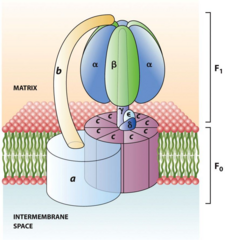
F₀ component of ATP synthase
Its membrane-embedded c-subunit ring permits proton movement and rotates.
Mammalian ATP synthase c ring
Contains eight c subunits, each binding one proton from the intermembrane space.
ATP synthase rotation
Proton-driven c-ring rotation turns the central stalk and changes catalytic β-subunit conformations.
ATP synthase stator
A peripheral stalk prevents the α₃β₃ hexamer from rotating.
Mammalian ATP synthase stoichiometry
One revolution moves eight protons into the matrix and synthesizes three ATP.
Protons per ATP synthesized
Mammalian ATP synthase uses 2⅔ protons per ATP.
ATP-ADP antiporter
Exchanges matrix ATP for cytosolic ADP, driven by electrical potential.
Phosphate-proton symporter
Imports H₂PO₄⁻ with H⁺, driven by the proton concentration gradient.
Energy cost of ATP export and substrate import
Equivalent to the energy from one proton entering the matrix.
Approximate protons per ATP synthesized and exported
Four protons: approximately three for synthesis and one equivalent for transport.
Approximate ATP yield per carrier
Each matrix NADH yields 2.5 ATP; each QH₂ yields 1.5 ATP.
ATP from aerobic glucose oxidation
Approximately 32 ATP: seven from glycolysis, five from pyruvate oxidation, 20 from the cycle.
ATP from anaerobic fermentation
Approximately two ATP per glucose molecule.
Low-pH buffer and isolated mitochondria
An external proton gradient drives proton entry through ATP synthase, producing ATP.
Sodium-driven ATP synthesis
A sodium electrochemical gradient can drive ATP synthase; Propionigenium modestum uses this mechanism.