Series - Maths Sem 1 First partial
 Call Kai
 Learn
Learn Practice Test
 Spaced Repetition
 Match
Match Flashcards
 Knowt Play
1/32

There's no tags or description
Looks like no tags are added yet.
Name | Mastery | Learn | Test | Matching | Spaced | Call with Kai | Chat |
|---|
No analytics yet
Send a link to your students to track their progress
33 Terms
What is a partial sum
Sm = a1 + a2 + a3 + … + am


When lim Sm = ___, the series is convergent and we write _____

When lim Sm = ___, the series is positively / negatively divergent and we write _____

When lim Sm = ___, the series is irregular and we write _____
When lim Sm = ∄, the series is irregular and we write.. nada
What fraction makes the Mengoli series

What is the limit of the Mengoli series as m → ∞ and what is the logic behind it

What is the general formula for the limit of the geometric sequence qn, when q ≠ 1


What is the limit of the geometric series qn when:
q > 1
-1 < q < 1
q < -1

What does the limit become if u start on like m=60 instead of m=0 for the geometric sequence?

What does the harmonic series do (in words)?
The harmonic series adds up unit fractions
What is the sum of the infinite harmonic series?
∞

because if the sum of the infinite series converges, it means eventually the terms start becoming so close to zero that they add nothing, so the limit of the series itself is zero as the terms sufficiently far down enough are practically zero

What is a contrapositive
If your original statement is "If P, then Q", the contrapositive is "If not Q, then not P".
What is the contrapositive of the previous picture of like if am convergent → lim am = 0

Give an example of how this theorem can be used

Each series with positive terms is either ___ or ___
(aka the sum of an infinite series am is either __ or __)
Each series with positive / eventually positive terms is regular - aka either convergent or positively divergent
Give an example of how this can be used
am = (3m + 1) / (4m - 1). Given that lim am ≠ 0 and the sequence is always positive, the sequence must be positively divergent — to + infinity
What can the infinite sum of a positive infinitesimal (am) series be?

For the generalised harmonic series: sum to infinity of 1 / ma, how does the limit of the infinite sum change based on the value of a?

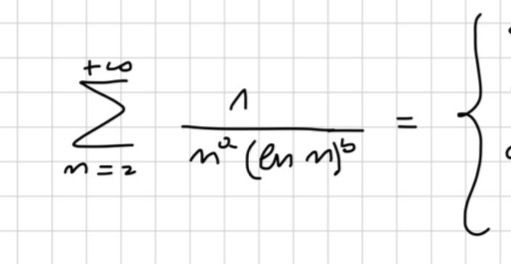
converges or diverges for diff values of a and b

What does the m = .. at the bottom of an infinite sum change?

What is the asymptotic comparison criterion

What is the comparison criterion
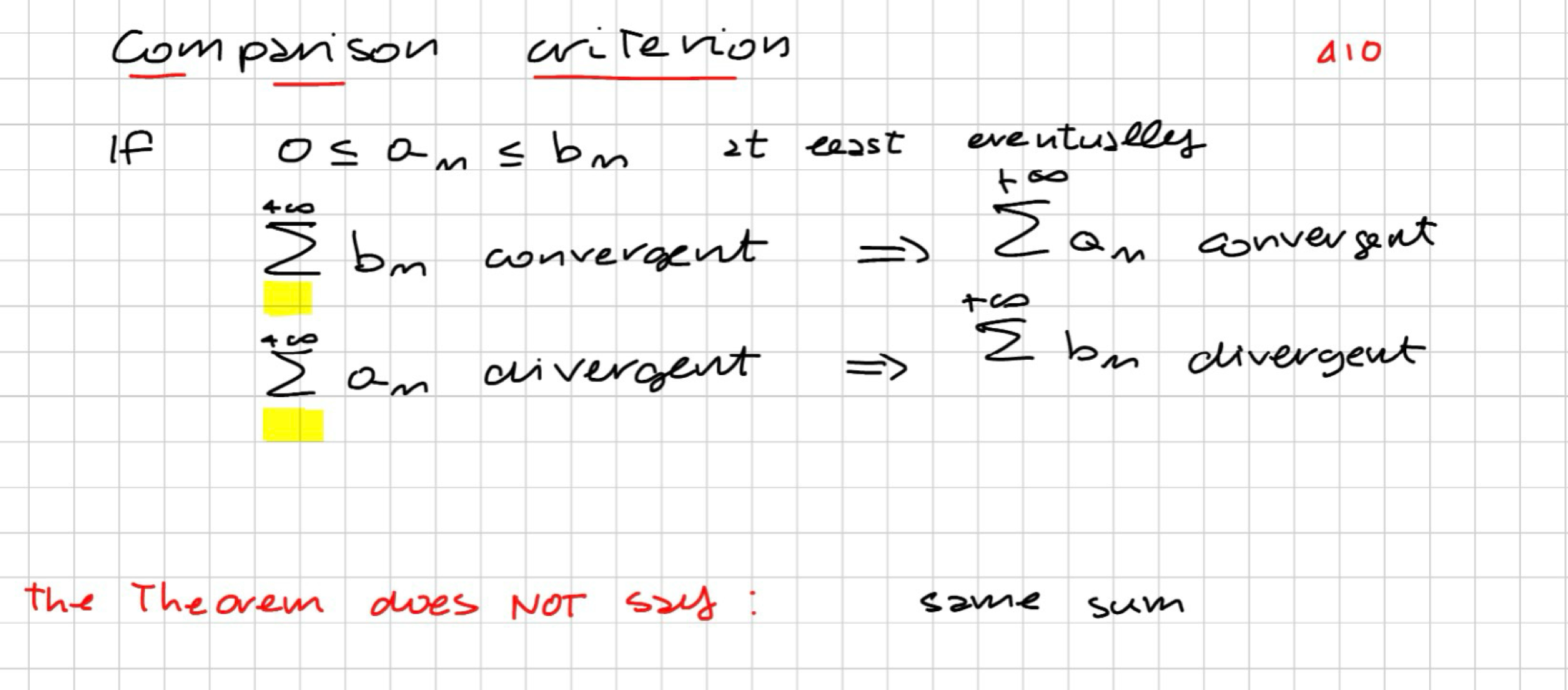


What does the sum of the infinite series 1/m! beginning at m=0 also equal in lim (___) notation


What does the sum of the infinite series xm/m! beginning at m=0 also equal in lim (___) notation

What if m ≠ 0, what if m =1 for the sum of the infinite series (-1)m / m! ?

When do we say that the sum of an infinite series am is absolutely convergent?

How to find the sum of an infinite series where am < 0
just find the sum of the infinite series with positive terms then make it negative

What is the relationship between absolute convergence and convergence
