2 - Non-insulin Formulations
 Call Kai
 Learn
 Practice Test
 Spaced Repetition
 Match
 Flashcards
 Knowt Play
1/55

There's no tags or description
Looks like no tags are added yet.
56 Terms

Metformin?
A first line medication prescribed for T2DM
Biguanide class of oral, anti-hyperglycemics
Delivered as the salt form: Metformin HCl
Typical doses: 500 – 1000 mg

What are the physicochemical properties of metformin?
Solubility → Highly water-soluble
Free form: Weak base.
Physiological pH (2–8) → Primarily positively charged (cation)
LogP → Less than 0 (hydrophilic)

Why might metformin benefit from an extended-release formulation?
High water solubility and hydrophilicity
GI exposure can contribute to gastrointestinal side effects
Extended release can help improve tolerability and reduce dosing frequency

What is glipizide, and how does it lower blood glucose?
Sulfonylurea that stimulates insulin release
Typical dose: 2.5–10 mg
Delivered as the free form

What are the physicochemical properties of glipizide?
Solubility → Poorly water-soluble
Free form → Weak acid
Physiological pH (2–8) → Primarily negatively charged (anion)
LogP → Greater than 0 (more lipophilic)
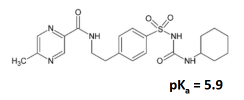
What is glipizide's BCS classification?
BCS Class II: Low solubility, high permeability
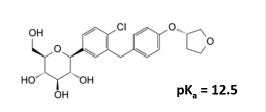
What is empagliflozin, and how does it lower blood glucose?
SGLT2 inhibitor that reduces renal glucose reabsorption
Typical dose →10–25 mg
Delivered as the free form

What are the physicochemical properties of empagliflozin?
Solubility → Poorly water-soluble.
Free form → Non-electrolyte.
Physiological pH (2–8) → Neutral (uncharged).
LogP → Greater than 0 (lipophilic).

Why is empagliflozin classified as BCS Class III despite being poorly water-soluble?
BCS III = high solubility, low permeability
Its classification may reflect its solubility at the relevant dose and test conditions rather than its apparent lipophilicity
BCS classification is based on measured solubility and permeability, not LogP alone
What are the steps an oral solid dosage form goes through before intestinal absorption?
Disintegration → Tablet breaks into granules and small particles
Dissolution → Drug dissolves, primarily from fine particles
Absorption → Dissolved drug crosses the intestinal epithelium
How does particle size affect drug dissolution?
Smaller particles have a higher specific surface area
Higher surface area = faster dissolution (Noyes-Whitney equation)
Why is LogP important for oral drug absorption?
LogP indicates drug lipophilicity.
It helps predict how well the dissolved drug can cross the lipid intestinal membrane
What are the physicochemical properties of metformin HCl that limit its absorption?
LogP = −2.63 (very hydrophilic, low lipophilicity)
Absorption is permeability-limited
Absorbed almost exclusively in the upper GI tract
Why might a conventional extended-release formulation not work well for metformin?
Typical GI transit time may cause the drug to pass beyond the upper GI absorption region before it is fully released
What delivery strategy can improve metformin absorption?
Gastro-retention → Retain metformin in the stomach so it is slowly released into the upper GI tract
What are the five approaches used for gastro-retentive drug delivery?
High density
Swelling/expansion systems
Bioadhesive systems
Superporous hydrogel
Floating systems
How do effervescent floating drug delivery systems work?
Use CO₂ generation to create buoyancy and help the dosage form float in the stomach
High density systems?
Retained in gastric rugae (ridges) and withstand peristalsis
Swelling / expansion forms?
Hydrated polymers expand in the stomach to prevent passage through pyloric sphincter
Bioadhesive approach?
Adhesive polymers adhere to the stomach lining
Superporous hydrogels?
Quick swelling hydrogels
Floating drug delivery systems?
Low density system with sufficient buoyancy to float
Glumetza?
An extended release metformin HCl product with either 500 mg/tablet or 1000mg/tablet
These are take once daily
Glumetza excipients?
Hypromellose – Rate-controlling polymer to adjust release
Magnesium stearate –Lubricant to aid direct compression
Microcrystalline cellulose –Binding agent, compression aid
Polyethylene oxide (PEO) – Swelling agent
What are the advantages of an osmotic pump for metformin delivery?
Controls and extends drug release
Release rate can be tailored
Can achieve zero-order release kinetics → constant drug release rate
What are the three basic components of an osmotic pump?
1. Core: Contains osmotic agent(s)
2. Semi-permeable membrane: Rigid membrane surrounding the core
3. Delivery orifice: Laser-drilled opening that releases the drug
How do osmotic pump formulations differ?
Can have different constructions depending on the application
The technology has existed for decades
What are the three key principles that control drug release from an osmotic pump?
1. Water influx → Water crosses the semipermeable membrane at a constant rate if tablet area, membrane permeability/thickness, and osmotic gradient remain constant.
2. Interior solution formation → Water enters the core and dissolves the drug and osmogen, creating a suspension.
3. Drug release → Release rate depends on water influx and drug concentration. For a suspension, concentration remains constant at its solubility (Cs)
Fortamet?
Type of extended release formulation for metformin HCl with either 500mg/tablet or 1000mg/tablet doses
Is formulated as a single-composition osmotic technology (SCOT)
Fortamet excipients?
Cellulose acetate – Tablet coating (semi-permeable barrier)
Hypromellose – Rate-controlling polymer to adjust release
Magnesium stearate – Lubricant to aid direct compression
PEG 400 and PEG 8000 – Plasticizer (tunes the permeability of the membrane)
Povidone – Dissolution aid (disintegrant)
Sodium lauryl sulfate – Wetting/wicking agent
What property of metformin HCl allows it to be formulated as a SCOT?
High water solubility allows it to dissolve as water enters the tablet core
What is a single-composition osmotic technology (SCOT)?
Osmotically active drug core surrounded by a semipermeable membrane
Water enters through the membrane and dissolves the drug
Drug cannot pass through the membrane, so osmotic pressure develops
What is push-pull osmotic technology?
Two-compartment osmotic system that uses water influx to push dissolved drug out through a delivery orifice
What properties should a semipermeable membrane have in an osmotic pump?
Sufficient strength to withstand osmotic pressure without breaking
Rigid and non-swelling
Biocompatible
Strength is adjusted through material selection and membrane thickness
What materials are commonly used for osmotic pump membranes?
Cellulose-based materials →
Ethyl cellulose
Cellulose acetate
Why are Fortamet and Glumetza not interchangeable?
Both are extended-release metformin products
They use different drug-release mechanisms
Different release mechanisms → different pharmacokinetics (PK) → potentially different clinical responses
What should you know about generic Fortamet and Glumetza?
Generics are available for both products
Make sure the generic corresponds to the correct brand/formulation because their release mechanisms differ
Why does glipizide require a push-pull osmotic pump?
Glipizide has poor water solubility → so it cannot use a single-compartment osmotic system like highly soluble metformin
How does a push-pull osmotic pump release glipizide?
Uses two compartments →
- Drug compartment.
- Osmotic agent compartment.
The lower compartment absorbs water and swells, pushing dissolved drug through a laser-drilled orifice at a controlled rate
What is a fixed-dose combination (FDC) therapy?
Combines two or more drugs into a single dosage form
Can improve patient adherence
What factors must be considered when developing an FDC?
Drug-drug compatibility
Complementary mechanisms of action
Tablet size
Chemical and physical stability
Ozempic / Semaglutide ?
GLP-1 receptor agonist intended for Subq delivery using an injection pen
Formulation is not designed to control release but keep the peptide stable and in solution
Ozempic / Semaglutide excipients?
Disodium phosphate dihydrate – buffer, maintain pH (final pH = 7.4)
Phenol – antioxidant
Propylene glycol – co-solvent with water
What is the net charge of semaglutide at physiological pH (7.4)?
Net charge = −4
What acidic groups are present in semaglutide?
4 acidic residues (3 glutamic acid, 1 aspartic acid) + C-terminus
Lys26 alteration adds 2 additional carboxylic acid
What is semaglutide’s net charge at pH 7.4?
All acidic groups are 100% ionized (pH >2 units above pKa)
2 arginine residues + N-terminus are 100% ionized
Net charge = −4
Rybelsus / Semaglutide ?
GLP-1 receptor agonist but formulated for oral delivery in 3mg, 7mg, and 14mg doses
Rybelsus / Semaglutide excipients?
Magnesium stearate - Lubricant to aid direct compression
Microcrystalline cellulose – Binder, compression aid
Povidone – Dissolution aid (disintegrant)
SNAC – salcaprozate sodium, a GI permeation enhancer → very important for making the oral delivery of the oral delivery of peptide work!!
What are the main transport challenges for oral macromolecular biopharmaceuticals?
Must be released from the dosage form
Poor permeability across biological barriers (lumen/epithelium)
Susceptible to enzymatic degradation (protein breakdown)
Why were chemical modifications made to semaglutide?
To minimize enzymatic degradation
To increase half-life
Why is oral semaglutide (with SNAC) significant?
First protein-based molecule administered orally
Oral delivery is generally not viable for macromolecules
Semaglutide transport may be transcellular or paracellular; the exact mechanism is still debated
How does SNAC help semaglutide get absorbed orally?
Locally surrounds semaglutide
Neutralizes gastric fluids and inactivates pepsin
Increases local solubility to promote transcellular uptake
Where does oral semaglutide absorption occur, and what remains unclear?
Ligated dog models indicate absorption occurs only in the stomach
Exact SNAC/semaglutide transport mechanism remains unclear
What are the extended-release formulations of metformin and their delivery systems?
Fortamet® = osmotic pump
Glumetza® = gastroretentive
Different brand-name metformin products are NOT interchangeable
What delivery system does Glucotrol XL (glipizide) use?
Push-pull osmotic pump
How do exenatide and semaglutide differ in delivery?
Both are GLP-1 receptor agonists given by injection, but use different delivery systems
Rybelsus = first oral GLP-1 receptor agonist