Ch1 + 2 chem
 Call Kai
 Learn
Learn Practice Test
 Spaced Repetition
 Match
Match Flashcards
 Knowt Play
1/99

Name | Mastery | Learn | Test | Matching | Spaced | Call with Kai | Chat |
|---|
No analytics yet
Send a link to your students to track their progress
100 Terms
What is a substance?
Matter with definite/fixed composition and distinct properties
What is a mixture?
Matter made of 2+ physically intermingled substances with variable composition
What does aqueous mean?
Dissolved in water
Mass vs. weight?
Mass = quantity of matter; weight = force gravity exerts on an object
Heat vs. temperature?
Heat = thermal energy transferred warm → cool; Temperature = measure related to the average kinetic energy of particles
SI base unit: mass?
kilogram (kg)
SI base unit: temperature?
kelvin (K)
centi (c) = 10^?
10⁻²
milli (m) = ?
10⁻³
micro (μ) = ?
10⁻⁶
nano (n) = ?
10⁻⁹
1 Å = ? m
10⁻¹⁰ m
What are observations?
Natural phenomena and measured events; if universally consistent, they can be stated as a natural law.
What is a hypothesis?
A tentative proposal that explains observations.
What is an experiment?
A procedure used to test a hypothesis; it measures one variable at a time.
What is a model (theory)?
A set of conceptual assumptions that explains accumulated experimental data and predicts related phenomena.
Extensive property?
Depends on amount/sample size
Examples of extensive properties?
Mass, volume, energy
Intensive property?
Does NOT depend on amount/sample size
Examples of intensive properties?
Density, temperature
Systematic error?
Recurring error causing data to be consistently too high or low

Random error?
Random variation inherent in measurement

How can random error be minimized?
Repeat measurements and pool/average results
Leading zeros?
NOT significant
Trailing zeros to right of decimal?
Significant
Halpin's rule for ambiguous trailing zeros in whole numbers?
Use scientific notation
Exact number?
Defined or counted quantity with no relevant measurement uncertainty
For addition/subtraction, sig-fig rounding depends on...?
Decimal places
For multiplication/division, rounding depends on...?
Number of significant figures
What is an element?
Pure substance consisting of one type of atom. ex: Oxygen
What is a compound?
Pure substance containing 2+ elements chemically combined in fixed proportions
ex: water (H2O), table salt (NaCl)
Homogeneous mixture?
Mixture with uniform composition throughout
Ex:
Saltwater: Salt dissolves evenly in water
Air: A uniform blend of gases like oxygen and nitrogen.
Heterogeneous mixture?
Mixture with nonuniform composition
Ex:
Oil and Water: Two liquids that separate into distinct layers.
Cereal in Milk: A solid food floating in a liquid where pieces are clearly visible.
Salad: A mix of lettuce, tomatoes, and other vegetables that look different.
1 L = ? dm³
1 L = 1 dm³
1 mL = ? cm³
1 mL = 1 cm³
Celsius → Kelvin
K= C + 273.15
Do exact numbers limit significant figures?
No
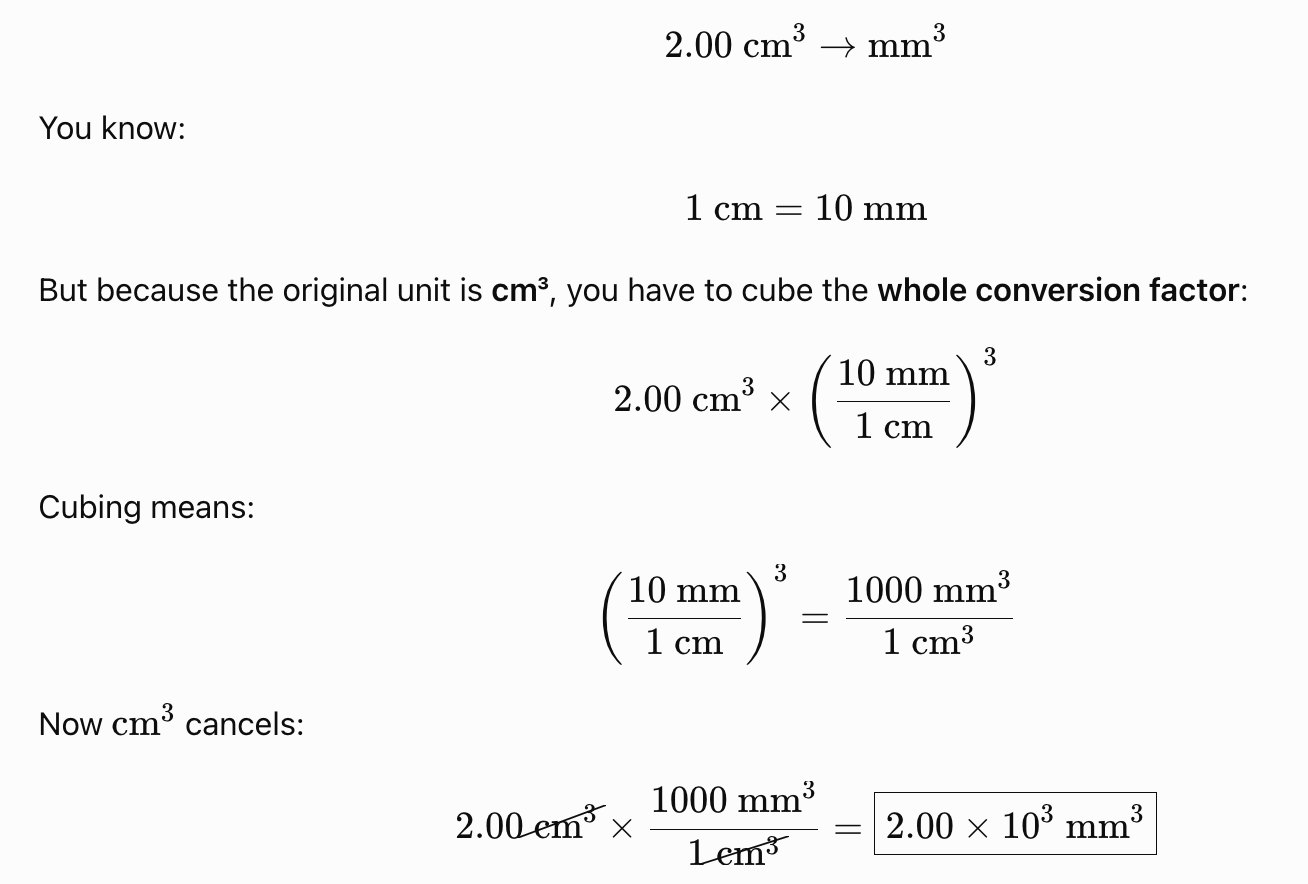
What happens to a conversion factor when converting squared or cubed units?
The entire conversion factor must also be squared or cubed
Law of mass conservation?
Total mass of substances does not change during a chemical reaction.
Law of definite composition?
Different samples of the same compound always contain the same elements in the same relative proportions by mass

.
Law of multiple proportions?
If two elements form more than one compound, the different masses of one element that combine with a fixed mass of the other are in ratios of small whole numbers.

What are cathode rays?
Streams of negatively charged particles → electrons.
What did J.J. Thomson determine?
The charge-to-mass ratio of the electron.
What did Millikan determine?
The charge of an electron; combined with Thomson’s charge-to-mass ratio, this allowed electron mass to be calculated.
What was Thomson’s atomic model?
Diffuse positively charged matter with tiny electrons embedded throughout it.
What particles are in the nucleus?
Protons and neutrons.
Electron: approximate mass + charge?
≈ 0 u; −1
Proton: approximate mass + charge?
≈ 1 u; +1
Neutron: approximate mass + charge?
≈ 1 u; 0
What are isotopes?
Atoms with the same number of protons but different numbers of neutrons.
How do you calculate neutrons?
neutrons = A − Z (mass - atomic)
What is the atomic mass listed on the periodic table?
The average atomic mass representing the naturally occurring mixture of isotopes.
Average atomic mass calculation?
Σ(isotope mass × fractional abundance)
Group 1A?
Alkali metals (except H)
Group 2A?
Alkaline earth metals
Group 6A?
Oxygen group / chalcogens
Group 7A?
Halogens
Ionic bonding?
Electrons are transferred; resulting oppositely charged particles attract.
Usually, metal + nonmetal → ?
Ionic compound.
Usually, nonmetal + nonmetal → ?
Covalent substance.
How is ionic charge written?
As a right superscript on the element symbol.
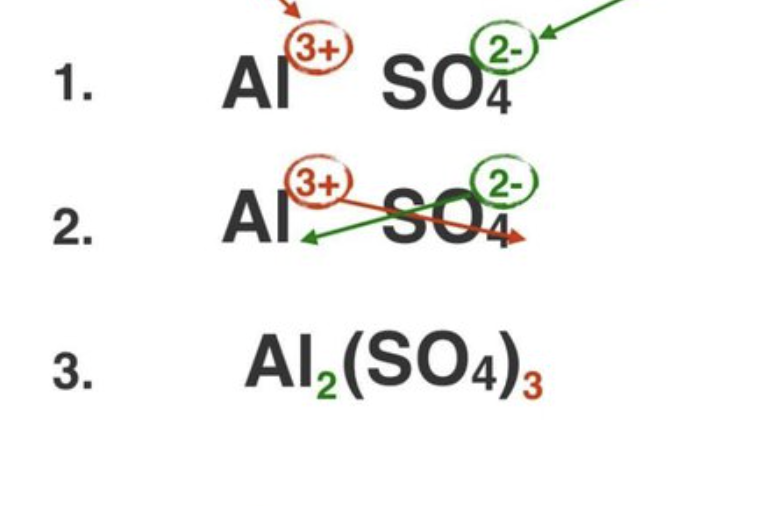
Polyatomic ion?
A covalently bonded group of atoms with a net charge.
Molecular formula?
Shows the actual number of atoms of each element in a molecule.

Empirical formula?
Shows the simplest relative whole-number ratio of atoms.
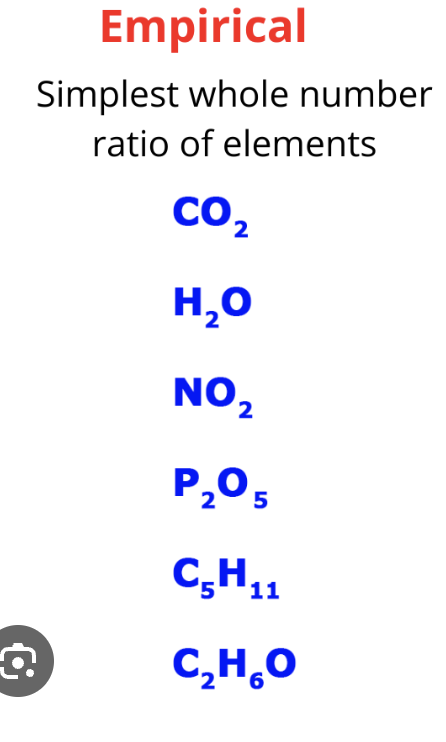
What type of formula is used for ionic compounds?
Empirical formula.
Is NaCl a molecule?
No.
What is a formula unit?
A conceptual unit representing an ionic compound in its simplest ratio.
Structural formula?
Shows the order in which atoms are bonded.

How are ionic compounds named?
Cation name + anion name.
How are metal cations named?
Using the element name.
How are monatomic anions named?
Replace the ending of the element name with -ide.
What is a hydrate?
An ionic compound containing a specific number of water molecules per formula unit within its crystal.
What is an anhydrous compound?

The compound remaining after the hydrate's water is removed by heating.
Acid?
Substance that yields H⁺ or H₃O⁺ when dissolved in water.
Base?
Substance that yields OH⁻ when dissolved in water.
Binary acid naming: -ide → ?
hydro-___-ic acid.
When are binary acids named as acids?
Only when aqueous.
Oxoacid: per___ate → ?
per___ic acid
Oxoacid: ___ate → ?
___ic acid
Oxoacid: ___ite → ?
___ous acid
Oxoacid: hypo___ite → ?
hypo___ous acid.
How are metal hydroxide bases named?
Like ionic compounds: cation name + hydroxide.

How are binary molecular/covalent compounds named?
Use prefixes to indicate the number of atoms of each element; mono- is not used for the first element.

Molecular mass?
Sum of the atomic masses of all atoms in a molecule.
How do you calculate molecular mass from a formula?
Multiply each element's atomic mass by the number of its atoms in the formula, then add all contributions.

NH₄⁺
ammonium
H₃O⁺
hydronium
What name should be used for HCO₃⁻?
Hydrogen carbonate (NOT bicarbonate)
What are most polyatomic anions containing a nonmetal + oxygen called?
Oxoanions
per___ate ion → what oxoacid ending?
per___ic acid
___ate ion
what oxoacid ending? ___ic acid
___ite ion
what oxoacid ending? ___ous acid
hypo___ite ion → what oxoacid ending?
hypo___ous acid
What is mass spectrometry?
A method for precisely measuring the relative masses and abundances of atomic-scale particles.
What happens to an atom first in mass spectrometry?
High-energy electrons knock away an electron, producing a positively charged ion.
How does a mass spectrometer separate ions?
A magnetic field bends their paths according to mass/charge ratio (m/e); lighter ions are deflected more and heavier ions less.
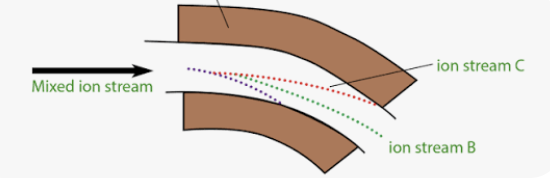
What does the detector in a mass spectrometer determine?
The relative positions and abundances of the ions/isotopes.
What is relative abundance?
The percentage (or fraction) of each isotope in a sample of an element.
How are mass spectrometry data used to find atomic mass?
Atomic mass = Σ(isotopic mass × fractional abundance).
How do you convert % abundance to fractional abundance?
Divide the percent abundance by 100.
