Anatomy exam 1
 Call Kai
 Learn
Learn Practice Test
 Spaced Repetition
 Match
Match Flashcards
 Knowt Play
1/741

There's no tags or description
Looks like no tags are added yet.
Name | Mastery | Learn | Test | Matching | Spaced | Call with Kai | Chat |
|---|
No analytics yet
Send a link to your students to track their progress
742 Terms
What is human anatomy?
The study of the external and internal structures of the body and the physical relationships between body parts
What makes up the language of anatomy?
eponyms, nouns and adjectives
What is an eponym?
associated with the name of a person after whom a structure is named or thought to be named
What are examples of nouns and adjectives in the language of anatomy?
i.e., sternum (bone) vs. sternal (region).
What is the beginning in the language of anatomy?
prefix
shape, size, direction, color, part of the body
What is the middle in the language of anatomy?
root
often part of the body
What is the end in the language of anatomy?
suffix
can be = prefix
describe a test or a problem
What are examples of the language of anatomy, as a combination of beginnings, roots, and endings?
Encephalitis: Encephalo- brain; itis-inflammation.
Leukocyte: Leuko- white; cyte-cell.
What are the two subdivisions of anatomy?
microscopic
gross
What is microscopic anatomy?
The study of structures that
cannot be seen without
magnification
What is gross anatomy?
The study of structures and
features that are visible to
the naked eye
What are the ways to approach gross anatomy?
surface anatomy, regional anatomy, systemic anatomy
What is surface anatomy?
The study of general anatomical form
What is regional anatomy?
The study of the superficial and internal features in a specific area of the body
What is systemic anatomy?
The study of anatomy base upon the body’s organ
systems
What are the levels of organization in order?
chemical
cellular
tissue
organ
organ system
organismal
What is the chemical level?
atoms combine to form molecules. Molecules combine to form the macromolecules (carbohydrates, lipids, proteins, and nucleic acids)
What is the cellular level?
cells and their surroundings are made up of molecules
What is the tissue level?
Tissues consist of similar types of cells and associated extracellular material
What is the organ level?
An organ is a discrete structure made up of multiple tissue types (ie blood vessels, liver, brain, femur)
What is the organ system level?
An organ system is a unified group of organs and tissues that perform a specific function (ie cardiovascular system)
What is the organismal level?
The whole person is the most complex level of organization, the organismal level, resulting from the simpler levels working interdependently
What are the eleven organ systems covered in class?
a) integumentar
b) skeletal
c) muscular
d) nervous
f) cardiovascular
g) lymphatic/ immunity
h) respiratory
i) digestive
j) urinary
k) male reproductive
l) female reproductive
What makes up the standard anatomical position?
Standing with legs together, feet flat on the floor, with hands at the sides and palms facing forward
ventral/ anterior view
dorsal/ posterior
Ventral/ anterior view

Dorsal/ posterior view

What is the supine position?
on the back
a person lying down (face up)

What is the prone position?
on the belly
a person lying down (face down)

How is the abdomen divided?
abdominal quadrants
What are the abdominal quadrants?
right upper quadrant (ruq)
right lower quadrant (rlq)
left upper quadrant (luq)
left lower quadrant (llq)
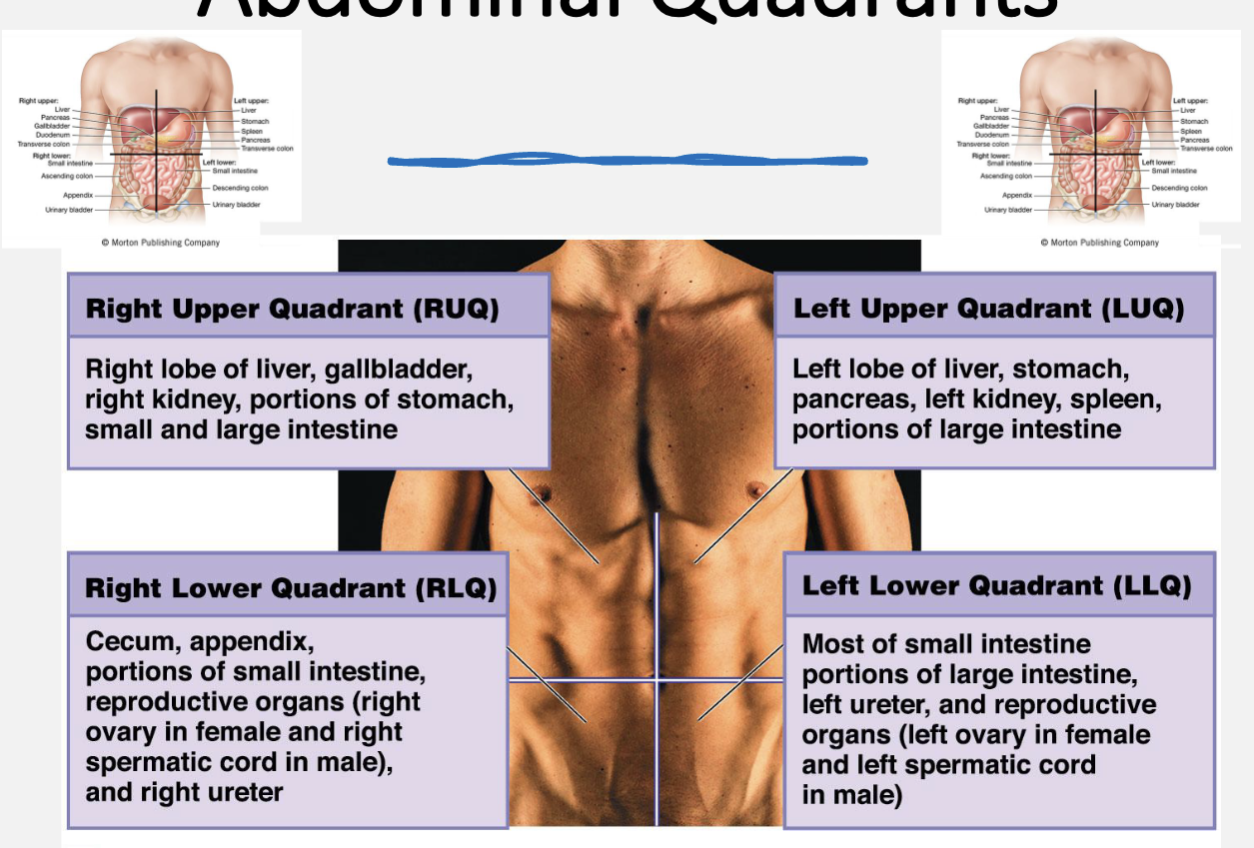
What makes up the RUQ?
right lobe of liver
gallbladder
right kidney
portions of stomach
small and large intestine
What makes up LUQ?
left lobe of liver
stomach
pancreas
left kidney
spleen
portions of large intestine
What makes up RLQ?
cecum
appendix
portions of small intestine
reproductive organs (right ovary in female and right spermatic cord in male)
right ureter
What makes up LLQ?
most of small intestine
portions of large intestine
left ureter
reproductive organs (left ovary in female and left spermatic cord in male)
What abdominal quadrant: right lobe of liver
right upper
What abdominal quadrant: gallbladder
right upper
What abdominal quadrant: right kidney
right upper
What abdominal quadrant: portions of stomach
right upper
What abdominal quadrant: small and large intestine
right upper
What abdominal quadrant: cecum
right lower
What abdominal quadrant: appendix
right lower
What abdominal quadrant: portions of small intestine
right lower, left lower
What abdominal quadrant: right ovary, right spermatic cord
right lower
What abdominal quadrant: right ureter
right lower
What abdominal quadrant: left lobe of liver
left upper
What abdominal quadrant: stomach
left upper
What abdominal quadrant: pancreas
left upper
What abdominal quadrant: left kidney
left upper
What abdominal quadrant: spleen
left upper
What abdominal quadrant: portions of large intestine
left upper
What abdominal quadrant: most of small intestine
left lower
What abdominal quadrant: portions of large intestine
left lower
What abdominal quadrant: left ureter
left lower
What abdominal quadrant: left ovary, left spermatic cord
left lower
What main organs are located in the Right Hypochondriac region?
Liver (right lobe), Gallbladder, and the right kidney.
What main organs are located in the Epigastric region?
Stomach, Pancreas, duodenum, and parts of the liver.
What main organs are located in the Left Hypochondriac region?
Spleen, stomach (body/fundus), and the left kidney.
What main organs are located in the Right Lumbar (Flank) region?
Ascending colon and the right kidney.
What main organs are located in the Umbilical region?
Small intestine (jejunum and ileum) and the transverse colon.
What main organs are located in the Left Lumbar (Flank) region?
Descending colon and the left kidney.
What main organs are located in the Right Iliac (Inguinal) region?
Appendix, Cecum, and the right ovary/fallopian tube (in females).
What main organs are located in the Hypogastric (Pubic) region?
Urinary bladder, Sigmoid colon, and the uterus/prostate gland.
What main organs are located in the Left Iliac (Inguinal) region?
Sigmoid colon (lower part), lower descending colon, and the left ovary/fallopian tube (in females).

1
right hypochondriac region


2
right lumbar region


3
right inguinal region

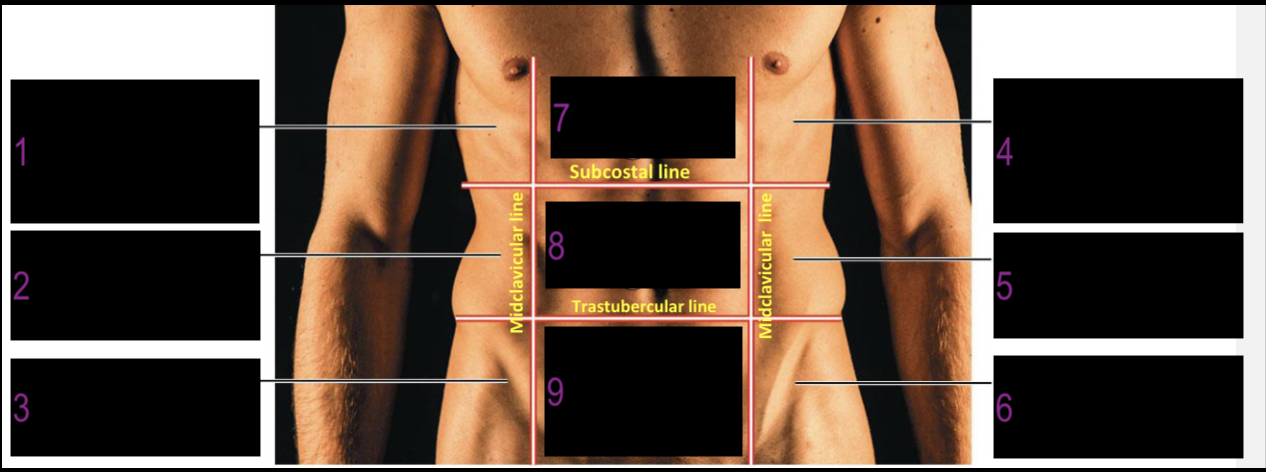
4
left hypochondriac region

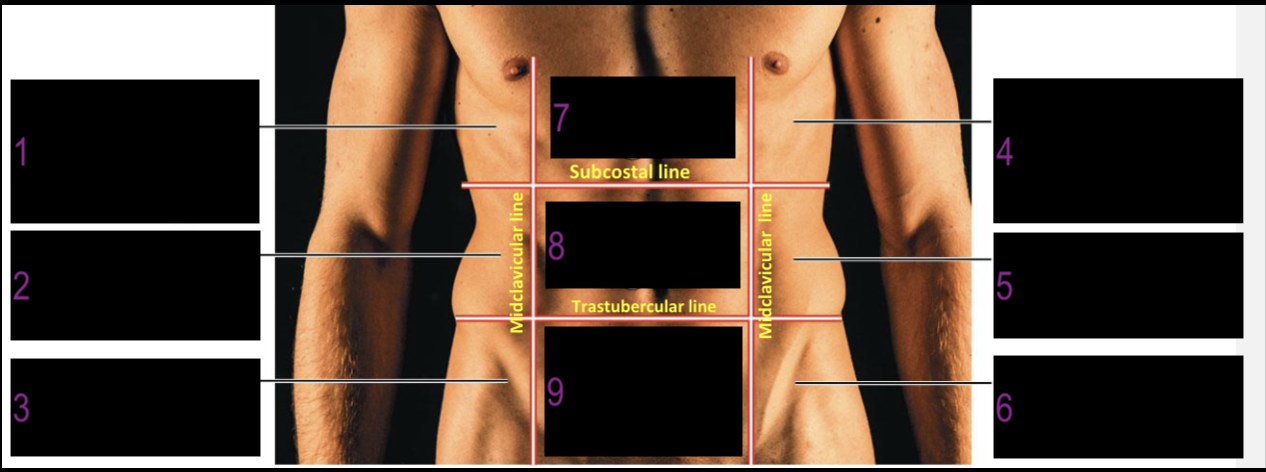
5
left lumbar region


6
left inguinal region


7
epigastric region

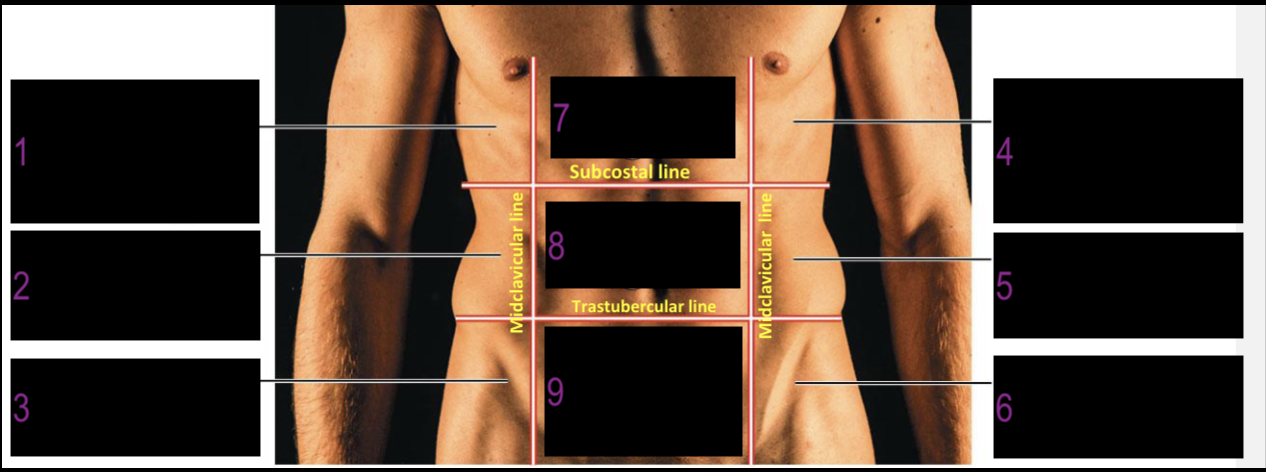
8
umbilical region

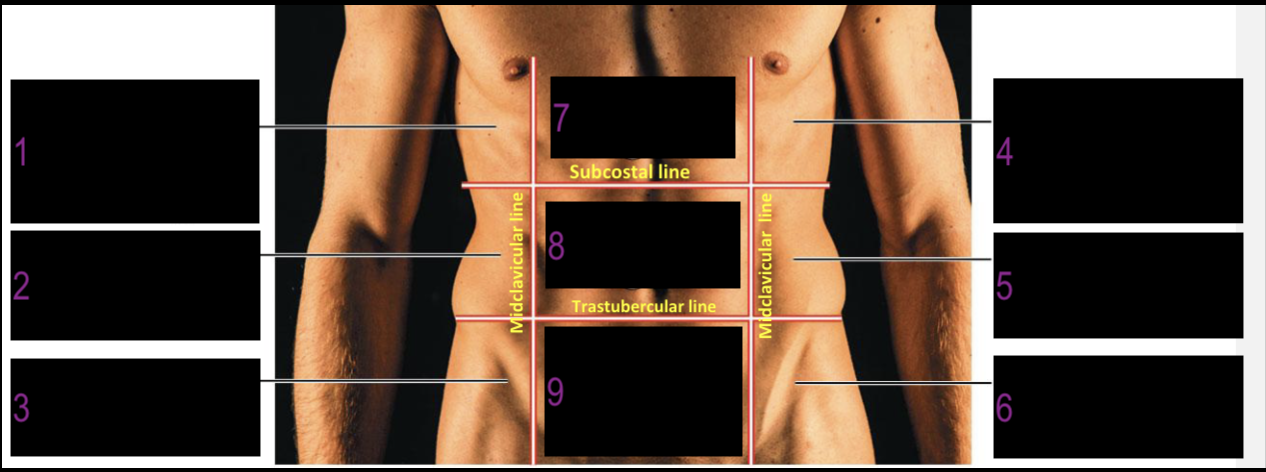
9
hypogastric (pubic) region


top
subcostal line


bottom
trastubercular line
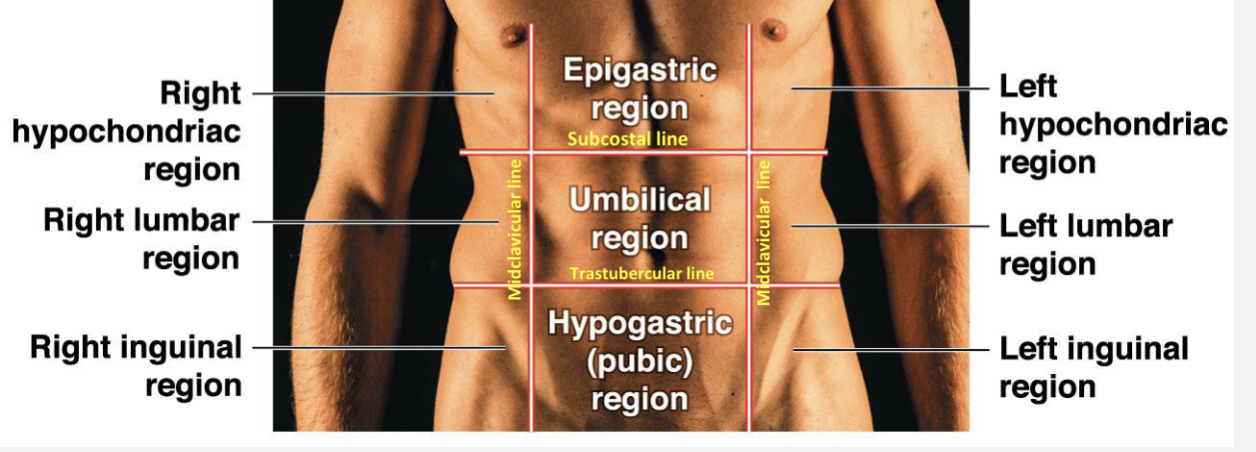

right
midclavicular line


left
midclavicular line
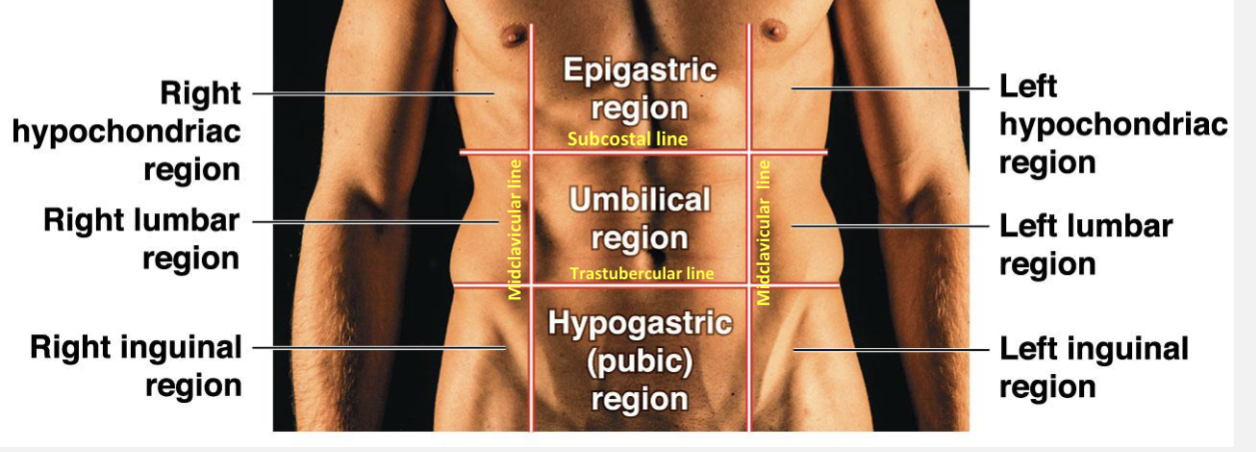
How to remember the vertical lines dividing the abdomen into regions?
midclavicular lines; follow the collar bone directly downwards
How to remember the two horizontal lines dividing the abdomen into regions?
top line: subcostal line (below ribs);
bottom line: transtubercular line (area of tubercules).
What does hypochondriac mean?
The term "hypochondriac" refers to the area of the abdomen located below the cartilage— ribs, specifically at the left and right sides of the epigastric region.
What does the axial region contain?
head, neck, and trunk
What does the appendicular region contain?
arms, hands, legs, feet
How are anatomical structures different between the anterior and posterior side?
ie. different: gluteal only on posterior, orbital only on anterior, pectoral only on anterior, and lumbar only on posterior.
anatomical region and area indicated of: cephalon
cephalic, head
anatomical region and area indicated of: cervicis
cervical, neck
anatomical region and area indicated of: thoracis
thoracic, chest
anatomical region and area indicated of: brachium
brachial, segment of the upper limb closest to the trunk; the arm
anatomical region and area indicated of: antebrachium
antebrachial, forearm
anatomical region and area indicated of: carpus
carpal, wrist
anatomical region and area indicated of: manus
manual, hand
anatomical region and area indicated of: abdomen
abdominal, abdomen
anatomical region and area indicated of: pelvis
pelvic, pelvis (in general)
anatomical region and area indicated of: pubis
pubic, anterior pelvis
anatomical region and area indicated of: inguen
inguinal, groin (crease between thigh and trunk)
anatomical region and area indicated of: lumbus
lumbar, lower back
anatomical region and area indicated of: gluteus
gluteal, buttock
anatomical region and area indicated of: femur
femoral, thigh
anatomical region and area indicated of: patella
patellar, kneecap
anatomical region and area indicated of: crus
crural; leg, from knee to ankle
anatomical region and area indicated of: sura
sural, calf
anatomical region and area indicated of: pes
pedal, foot