Week 1: Concepts of health in Geography
 Call Kai
 Learn
Learn Practice Test
 Spaced Repetition
 Match
Match Flashcards
 Knowt Play
1/42

Earn XP
Description and Tags
Name | Mastery | Learn | Test | Matching | Spaced | Call with Kai | Chat |
|---|
No analytics yet
Send a link to your students to track their progress
43 Terms
* Distances
* Directions
* Shapes & forms
* Patterns
* Cores
* peripheries
1. **Spatial patterns of disease**
2. **Spatial patterns of health service provision/use**
3. **Humanistic awareness - perception agency**
* What people believe/ think about health care
4. **Structuralism/ materialist/ critical**
* Role of broader social structure in affecting health
5. **Cultural Pluralism**
* meanings of healthcare in different cultural contexts
* focus on __broader__ systems of meaning
complimentary
1. Developments within human geography which saw the incorporation of a more socio-spatial view of space and place
\
2. The recognition of the inadequacies of the biomedical disease model which led to changes in the philosophies of health and health policy, and therefore, resulted in the emergence of the socioecological model of health and health care.
\
* ‘place’ is not just an arena for everyday life, but can be seen as a centre of felt value, incarnating the experience and aspirations of people and influencing their health.
\
* patterns of human territoriality result from the interaction between economic, political, and social processes which can constitute, constrain and mediate the role of space.
\
* a single geographical setting can serve multiple functions, simultaneously possessing the constitutive, constraining, and mediating dimensions.
\
* life within any locale is a “seamless fabric of macro- and micro- scale influences representing the localized interactions of structure, institutions, and human agency
\
* Achieving Health for all (EPP) (1986)
\
The Epp Report reintroduced wider social forces into the health debate. In this model, health is determined by individual, group, community and the wider social context.
socioecological
\
→ what occurs in place can have profound influences on health either positively or negatively
* Space viewed as an attribute
* A relational view of space
* a way of cataloguing and categorizing information
* place is a canvas on which events happen
* context and richness of the localities role in health behaviour is neglected
* the significance of space is an outcome of the way people think about and use space
* space is a stage, moulded by actors for their particular purposes
* social space
* Meaning is now focused on the dualism of space and place
theory development
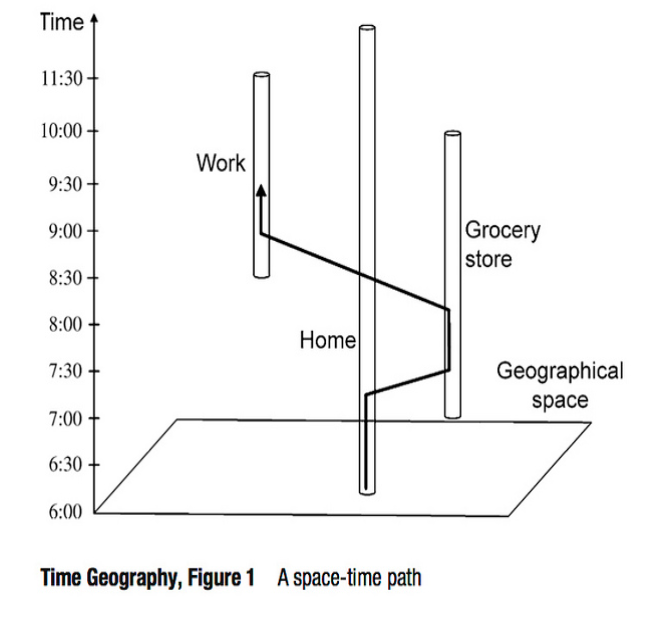
spatio-temporal constraints
Human activities in integrated system of time and space under the effects of spatio-temporal constraints.
the central interest of spatio-temporal constraints
devoted to the analysis is how time is used in households, and to the study of
individual mobility
observation of transport flows
transport accessibility
links between time geo and different fields of social theory
Creation of families,
Choice of study subjects
Choice of job,
Adaptation strategies of women, e.g., in developing countries
The principle basic time geographical concepts include:
Activities
Stations
Space-time paths
Bundles
Constraints
Space-time prism.
Activities
everything done by a human can be referred to as an activity.
Activities take place in certain time and place.
Stations
places where desired or compulsory activities are carried out (e.g., in lecture room).
Stations represent the spatial bases for activities and interactions.
stations as individual channels but also as community
People move between individual stations and communicate with them.
Environment where individuals occur consists not only of stations but also of transport channels and communications
Stations are ______
tubes
through which an individual’s spatio-temporal trajectory referred to as the space-time path passes in the course of day (week, year, life)
space time path
Hägerstrand (1970) considers the life path the basic concept of a space-time path (track, trajectory) and any other paths describing shorter intervals are its partial elements.
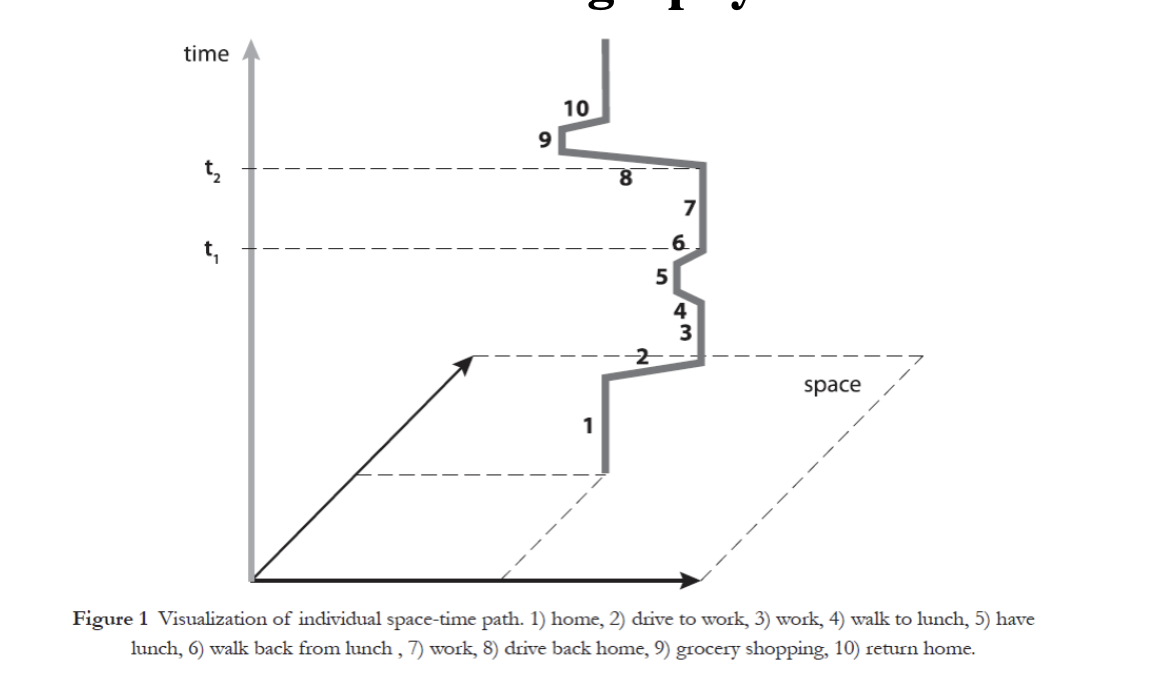
space time paths are most often visualized in a _________________ space.
3D, orthogonal
* space-time map where a two-dimensional horizontal plane represents the geographical space and time is represented by a vertical axis.
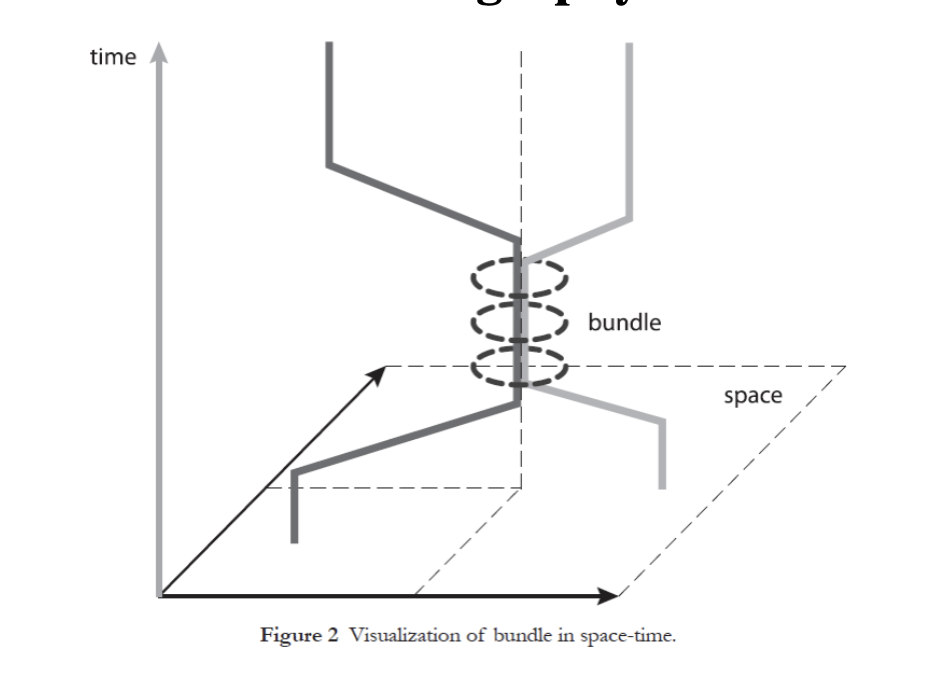
Bundles
if two or more individuals’ trajectories meet at a certain place (station) we talk about bundles.
Typical bundles are household, working place, (e.g., lectures)
the people at stations are the bundles
Activities of humans are limited to certain extent. They are determined by ___________
Constraints
3 types of constraints
Capability constraints
Coupling constraints
Authority constraints
Capability constraints
These are derived of the physical (biological) construction of human needs such as sleeping, eating, hygiene, etc.
Satisfaction of these needs requires space and time, which reduce the overall usable part of an individual’s day, including the constraints given by the capability of individuals and capacity of tools, for instance a car with the limiting factors of maximum speed or possession of driving license.
Coupling constraints
These are given by the fact that people must carry out activities in certain time in a certain place and mostly uses some tools or company of other individuals.
It must be also taken into account that the human being is limited by the fact that he/she cannot stay in all places and with all people. It requires a decision between several alternatives of stay, transport or activity.
eg.
Tims, fast food places, a busy office
Authority Constraints
These are given by the society (legal standards, economic rules and barriers), or they are determined by the general ethical or moral principles or the personal value system of each individual.
Accomplishment of any activity can be carried out in a particular place and in a particular time.
Some individuals can be even prohibited to stay in a particular place or to be active in any way.
Time-Spatial Prism
This expresses the limited movement of an individual in space and time.
space reachable by an individual in certain interval
The time-spatial prism concept may be defined as part of space reachable by an individual in certain interval (day, week, year).
It is based on the principle of return.
→ If a day is taken for a basic organizational time unit of human life, the prism for a human in the course of this day is delimited by the space, from which the individual can return to the point of start that day – place where they live (sleeps)
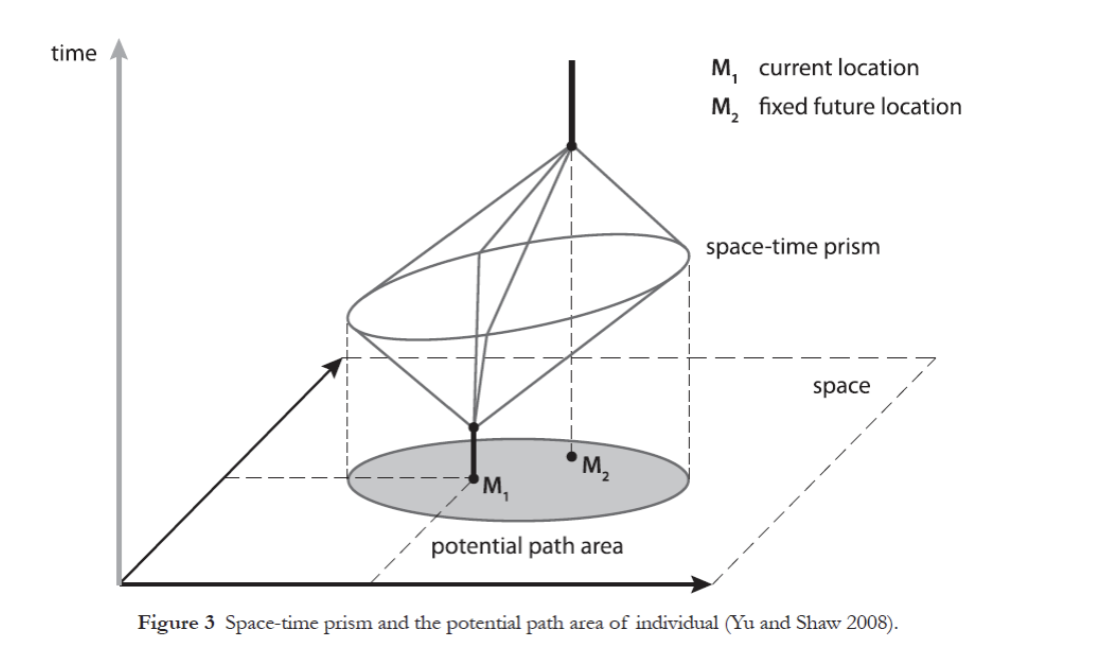
Types of Time-spatial prisms
The all day long prism, says Hägerstrand (1970) consists of several smaller prisms; such partial prism can be sorted out at any transit from one station to another.
In such cases the principle of return is replaced by different points of start and finish.
While the point of start is the same as that of finish, it is a symmetrical prism (or return), if not, the prism is asymmetrical
How is the time-spatial prism determined
the scope of the prism is, apart from individual constraints (location and duration of obligatory human activities: sleeping, going to work and the like), determined by numerous other factors:
available time for the accomplishment of activities
amount of time necessary for the transfer between stations
the speed of used transport means.
Potential Path area
Projection of the time-geographical prism into a two dimensional geographical plane gives the potential path area which delimits all places in space reachable by a human in a given time.
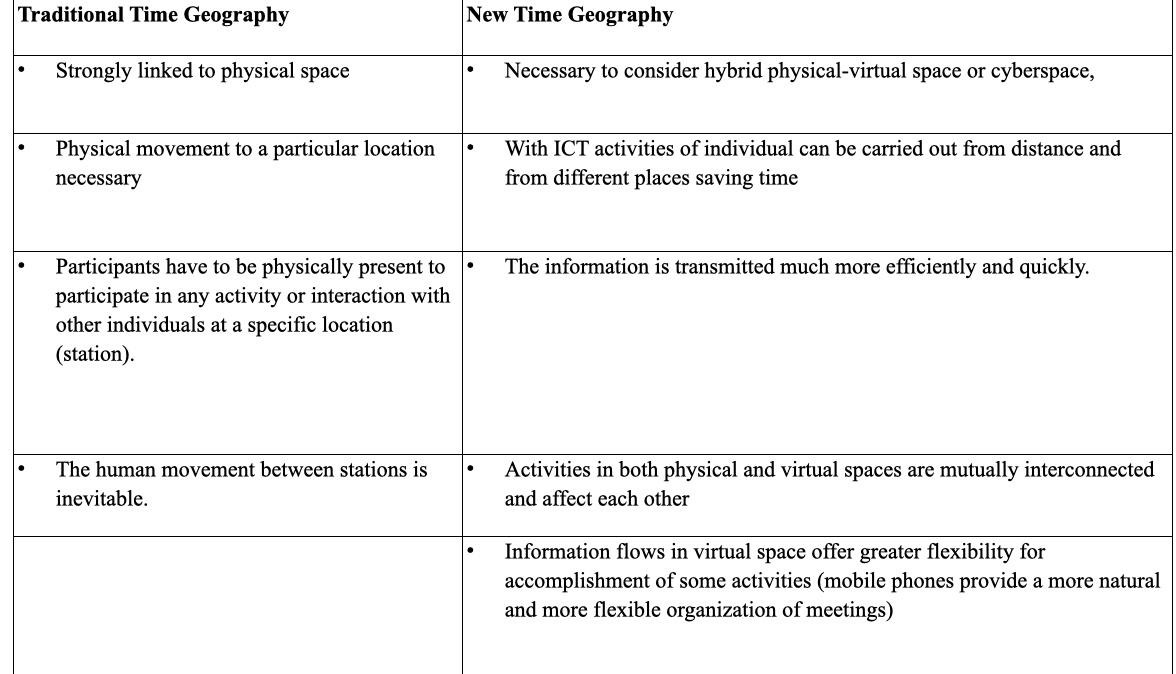
Time geography in the context of IT
Development of information and communication technologies (ICTs) and their role in everyday life of individuals has brought about new phenomena, which disrupted the conventional view of human’s behavior in time and space.
In the post-modern society we are now dealing with mobile communication, internet, hypermobility etc.
facetime, ordering groceries, online jobs
→ changes and disrupts time geography
Virtual mobility
people under the effects of ICTs are able to pursue several parallel activities and most especially, their living space has been enriched by what is referred to as the virtual mobility
This distorts the basic principles of organization, location and coordination of human society, among them, for instance, the face-to-face contacts, bonds to a place, indivisibility of human being, task of distance, and the like.
hybrid physical-virtual space
In the classical time geography an individual and his activities were strongly linked to physical space, in the new time geography is it necessary to consider hybrid physical-virtual space
Hypermobility
a result of combination of the:
Physical - (corporeal) mobility as interaction facilitated by transit by car, bus, train, plane.
Media - (mass) communication via television, radio and other communication means.
Virtual mobility - the interpersonal contact via PC, Internet, mobile phones, and the like.
example:
For instance surfing on Internet while travelling to work on bus.