chem 301 unit 2.2 yipeeee
 Call Kai
 Learn
Learn Practice Test
 Spaced Repetition
 Match
Match Flashcards
 Knowt Play
1/85

Earn XP
Description and Tags
time to be a #womeninstem successful chem nerd yessir
Name | Mastery | Learn | Test | Matching | Spaced | Call with Kai | Chat |
|---|
No analytics yet
Send a link to your students to track their progress
86 Terms
steps drawing lewis dot compunds
count total electrons
put surrounding atoms around central
fill surrounding electrons
put leftover on center as lone pairs
find formal charge when necessary
hypervalent molecule
more than octet rule, more than 8 electrons on central atom
formal charge
when the number of electrons does not equal the number of protons, a positive or negative charge will exist
how to assign formal charge
draw lewis structure
count num of electron in use around each atom in molecule (bond=1, lone pair is 2)
subtract inuse -num of valence
formal charge formula
fc= # e- valence — # e- inuse
formal charge of H
ZERO unless it is charged then it is whatever charge is
neutral molecule is __ stable
more
hypovalency
fewer than 8 electrons available
group 2a and 3a
hypervalency
atoms in n>= 3 (period 3), d orbitals can be involved
surround atoms should not have a
postive formal charge (when central has negative)
nobel gases are highly likely to be hypervalent
how to determine hyper valency
look at number of electrons around central atom and compare to number of unpaired electrons according to the periodic table, how many bonds they like to make vs how many atoms they need to bond with
radical
odd number of electrons
delocalization
sharing electrons across the molecule
resonance
describes a moleculr or ion that cannot be accurately represented by a single lewis structure but instead requires multiple interconnected resonance structures to depict the true arrangement of its delocalized electrons
preferred structure
one that doesnt show charges
resonance hybrid
a single more accurate representation of a molecules true structure, formed by combinig multiple resonance structures (called contributors)
what moves during resonance
only lone pairs and multiple bond
functional groups: heteroatom attached to carbon
alcohol, amine
alcohol
ROH

amine
R2N:H

functional groups: carbonyl derivatives
aldehyde, hetone, carboxylic acid, amide
aldehyde
RCHO
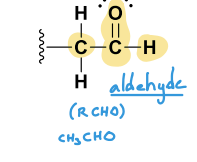
hetone
RC(O)R

carboxylic acid
RCO2H or RCOOH
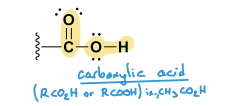
amide
RCONHR

Steps to consider for best formal charge structure,
atoms in period 3 and below cannot be hypervalent/have expanded valance
Formal charge-1 should be on more electronegative atom (+1 on less)
in 3d representations straight line represents
in plane
in 3d representations wedged line represents
in front
in 3d representations dashed wedged line represents
behind
bond angle/line angle structure
using line with endpoints as carbons
lewis structures show
number of bonds (single, double, triple)
types of bonds (covalent, ionic)
but NOT shape of molecules
bond angle of tetrahedral
109.5
shape of molecule determined by
bond angles and lengths
bigger the atom, more shells it has,
more elongated bond
bonding and lone pairs are ____ for electronic geometry
equivalent, geometry based on number of e- rich regions around the central atom
how to predict electronic geometry
ABx
A
central atom
B
bonded pairs (atom sharing the bond)
x
numbers
AB(v2)
2 pairs
linear
180 degrees
AB(v3)
3 pairs
trigonal planar
120 degrees
AB(v4)
4 pairs
tetrahedral
109.5 degrees
(pyramid shape)
AB(v5)
5 pairs
trigonal bipyramidal
120 degrees
(sims diamond shape)
AB(v6)
6 pairs
octahedral
90 degrees
(square pyramid diamond)
VSEPR stands for
valence shell electron pair repulsion
vsepr theory
based on theory electron clouds repel each other
molecules adopt geometry to minimize these repulsive interactions
in vsper lone pair is
bigger than bonding pair
with vsepr lone pair will cause
compression- bond angle decreases and distortion occurs
1 lone pair distorted tetrahedral name
trigonal pyramidal
2 lone pair distorted tetrahedral name
bent
how to predict molecular geometry
ABxUx
U
unbonded lone pairs
AB2U1
bent
AB3U1
trigonal pyramidal
AB2U2
bent
AB4U1
seesaw
AB3U2
tshaped
AB2U3
linear (no distortion)
AB5U1
square pyramidal
AB4U2
square planar (no distortion)
no lone pair
molecular shape not distorted
bond dipole
dipole movement due to difference of electronegativity between two atoms sharing a bond
3 or more plane of symmetry
symmetrical
symmetrical
nonpolar
distortion/asymmetrical
polar
to be symmetrical
all surrounding must be same
no lone pairs (ACTUALLY NO DISTORTION remember two exceptions)
2 exceptions on distorition
AB2U3, AB4U2
dipole goes from
less en to more en
overall polarity can be determined by
adding indiv bond dipoles
hybridization
mixing orbitals from different subshells
sp3 shape
large lobe and tiny lobe
sp3 hybridzation
4 hybrid orbitals, combo of 1 s and 3 p (often single bond)
tetrahedral
sp3 hybridzation
3 hybrid orbitals, combo of 1 s and 2 p, one p stays unhybridized (often double bond)
trig planar
sp hybridization
2 hybrid orbitals, combo of 1 s and 1 p, two p orbitals stay unhybridized (often triple bond)
linear
sp3d hybridization
in hypervalency
5 hybrid orbitals, combo of 1 s and 3 p and 1 d
trigonal bipyramidal
sp3d2 hybridization
6 hybrid orbitals, combo of 1 s and 3 p and 2 d
octahedral
hybridization for a central atom in a structure in the valence bond method can be determined by
write lewis structure
predict electronic geometry
select hybridization to corresponding geometry
directions correspond to
num orbitals
covalent bonding
equilibrium between repulsive and attractive interactions
sigma bond formation
covalent single bond (overlap along same axis)
multiple bonds
pi bonds
pi bond formation
orthogonal overlap of unhybridized p orbitals
triple bond made of
1 sigma 2 pi
cant have pi wo
sigma
double and triple bonds count for
1 direction
resonance will not break
a sigma bond (only pi of double and triple