DAT Bootcamp: Organic Chemistry
 Call Kai
 Learn
 Practice Test
 Spaced Repetition
 Match
 Flashcards
 Knowt Play
1/199

There's no tags or description
Looks like no tags are added yet.
200 Terms
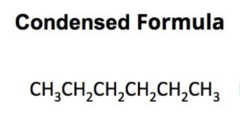
Condensed Formula
can be written on a single line of print; meant to show the order which they appear in the structural formula
Structural Formula
a formula that shows the arrangement of atoms in the molecule of a compound.

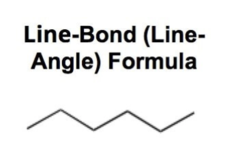
Line - Bond Formula
Abbreviates the carbon atoms and shows only the ZigZag pattern of bonds from carbon atom to carbon atom; assume that they are bonded to hydrogens
A single covalent bond is made up of:
1 sigma bond
a double covalent bond is made up of:
1 sigma bond
1 pi bond
a triple covalent bond is made up of:
1 sigma bond
2 pi bonds
Resonance
the bonding in molecules or ions that cannot be correctly represented by a single Lewis structure; they have pi electrons that can move around from one atom to another

When drawing resonance structures remember:
1. Only electrons move. Specifically, only pi electrons, lone-pair electrons, or negative charges can move. Do NOT move atoms.
2. You CAN move electrons toward or into an atom that does NOT have a full octet, such as carbocations.
3. If an atom already HAS a full octet, then you can move electrons into it ONLY IF you push electrons out the opposite side (electrons in, electrons out).
4. Do not move or break sigma bonds, only pi bonds.
How can you determine what is the greatest resonance contributor?
1. The most stable resonance structure will have a full octet on every atom.
2. The most stable resonance structure will have the smallest possible number of charges.
3. The most stable resonance structure will have negative charges on the most electronegative atoms and positive charges on the least electronegative atoms.
Allyl Carbocation
a carbocation that is one position away from a double bond

Carbocation
An organic ion in which a carbon atom has a positive charge
Carbanion
An organic ion in which a carbon atom has a negative charge.
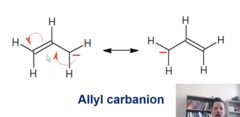
Allyl Carbanion
the negative charge is shared between the leftmost and the rightmost carbons
Radicals
molecules or atoms that have unpaired electrons drawn as single dots
Alkanes
a hydrocarbon containing only single covalent bonds
Alkenes
Hydrocarbons with one or more carbon-carbon double bonds
Alkynes
a carbon compound with a carbon-carbon triple bond.
Cycloalkanes
are alkanes that are cyclic -in other words, ringed alkanes or alkanes with rings in them. Cyclohexane is the most stable cycloalkane.
____________________ positions are mores stable (lower energy) for larger groups because of 1,3-diaxial interactions.
equatorial

Placing the largest substituents in the ___________ positions will help to achieve the greatest stability in cyclohexane rings.
equatorial
Cis
two substituents going in the same direction

Trans
two substituents going in opposite directions

When determining hybridization, remember that the _____________ of bonds does not increase or decrease the hybridization.
number
for example, this would still be sp hybridized -- just because it is a triple bond does not mean that it increases in hybridization

Direct overlap of two orbitals forms a ________ bond.
sigma
Formal Charge =
# valence electrons - (# nonbonding electrons + 1/2 # bonding electrons)
Conjugated Diene
a compound with two conjugated double bonds
Conjugated dienes are more __________ than isolated or cumulated dienes.
stable
a system of connected p orbitals with delocalized electrons in a molecule, which in general lowers the overall energy of the molecule and increases stability
Lewis Acid
a substance that accepts electrons
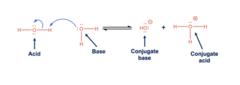
Lewis Base
a substance that donates electrons
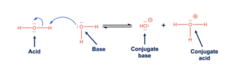
Conjugate Acid
the species produced when a base accepts a hydrogen ion from an acid
Conjugate Base
the species produced when an acid donates a hydrogen ion to a base
The stronger the _________, the weaker the conjugate base.
acid
A substance that can behave as either an acid or a base is called _______________.
amphoteric or amphiprotic
example = water
The stronger the ________, the weaker the conjugate acid.
base
The more stable/less reactive the conjugate ________, the stronger the acid.
base
The more stable/less reactive the conjugate ________, the stronger the base
acid
↑ Ka = ↓pKa = __ acid strength
↑
The more positively charged the compound, the more ___________.
acidic
The more negatively charged the compound, the more ______________.
basic
C =
A =
R =
D & I =
O =
charge
atom
resonance
dipole induction
orbital hybridization
CARDIO is in order of __________.
priority
If all other factors are the same, then hydrogen's acidity increases as the atom that it's bonded to:
1)
2)
1) goes left to right across a row on the periodic table (increasing electronegativity)
2) goes down a column (increasing size)
____________ increases the stability of charges → increases the stability of conjugate acids/bases → increases the stability of acid/base.
Resonance
Electron withdrawing groups increase ____________.
acidity
Electron donating groups decrease ___________.
acidity
When bonded to non-aromatic rings, electron withdrawing groups involve _____________ atoms such as F, Cl, Br, I, N, or O
electronegative

When bonded to non-aromatic rings, electron donating groups involve ___________ groups.
H or C

When bonded to aromatic rings, electron withdrawing groups are more complicated due to resonance delocalization of the ring and most often look like this:
shows double and triple bonds along with halogens
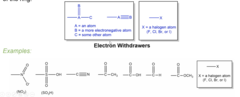
When bonded to aromatic rings, electron donating groups are more complicated due to resonance delocalization of the ring and most often look like this:
shows usually long pairs or an alkyl or aryl group

______ orbitals tend to be more electronegative so, the more "s character" an atom has the stronger the acid.
S
they are closer to the nucleus and thus closer to the protons
To determine the structure or charge of any amino acid:
If the pH of the solution is _________ than the pKa of the functional group, the functional group will be protonated.
lower

To determine the structure or charge of any amino acid:
If the pH of the solution is _________ than the pKa of the functional group, the functional group will be deprotonated.
higher

Amino acids can never exist as _____________ compounds.
uncharged
Carboxylic acid (pKa = 2) is way more acidic than NH₃⁺ (pKa = 9-10)
will always lose the carboxylic acid H before losing a H from the amine group

Zwitterions
atoms that have a negative charge on one atom and a positive charge on another atom
Label the rxn:
acid, base, conjugate acid, conjugate base

In acid/base reactions, Group ____ metals are spectator ions.
one
General IUPAC name looks like:
substituents + parent chain
Parent Chain
the longest chain of atoms (mostly carbon atoms) that contains the molecules highest priority functional group
Simple IUPAC hydrocarbons:
MEMORIZE

Simple substituent names:
MEMORIZE

More simple substituent names:
MEMORIZE

Definition: Alkanes
organic compounds that only have H or C in them with no double or triple bonds
Ringed alkanes are called __________________.
cycloalkanes
Naming: Alkanes
1. Find the parent chain, the longest carbon chain. If two possible parent chains have the same length, but different substituent numberings, pick the one with the smaller substituent number at the first point of difference.
2. Count the number of carbon atoms in the parent chain and match that number to the name from our earlier chart (methane, ethane, propane, etc.)
3. Identify and number the substituents (appendage dangling off the parent chain) in whichever direction gives them the lowest number.
4. Write the name as a single word with the substituents in alphabetical order.
Naming: Cycloalkanes
same rules as alkanes with some differences --
1. When there are two substituents on a cyclic molecule, their direction must be indicated with prefix "cis", meaning "same side", and "trans", meaning "opposite sides"
2. If there are more than two substituents, "cis" and "trans" are no longer enough, and these substituents must be named with their stereochemical configurations (R/S system).
Naming: Alkyl Halides
Follow the rules for naming alkanes except --
1. use prefixes "fluoro-", "chloro-", "bromo-", or "iodo-", to identify each halogen substituent
2. Alternatively, we may use suffixes "-yl fluoride", "-yl chloride", "-yl bromide", or "-yl iodide".
Naming: Alkenes
same rules as alkanes except --
1. Use suffix "-ene" instead of "-ane".
2. Add a number at the start of the double bond.
3. Add prefixes "cis" or "trans" for alkenes with different priority substituents, and at least one hydrogen on either side of the alkene.
4. If all substituents are different, use the E/Z naming system, where E = highest priority substituents on opposite sides, and Z = highest priority substituents on the same side.
In _______________ alkenes, cis/trans does not apply.
terminal
If the two highest priority groups are located on "zee zame zide" then it is a _____ alkene.
Z
the same side
If the two highest priority groups are located on "epposite sides" then it is an _____ alkene.
E
opposite sides
Determining Priority:
1. Highest atomic number = highest priority.
2. If there's a tie, keep going to adjacent carbons until you break the tie.
3. Multiple-bonded atoms are counted as the same number of single-bonded atoms:
Naming: Alkynes
follow the same rules for naming alkanes, except --
1. Use suffix "-yne" instead of "-ane".
2. Add a number at the start of the triple bond.
*do not need to use cis/trans or E/Z when naming alkynes
Naming: Alcohols
follow the same rules for alkanes, except --
1. The parent chain is now the longest chain that has the hydroxyl group, even if there are longer carbon chains available.
2. Number the carbon chain in the direction that gives the smallest number to the carbon bonded to the hydroxyl group.
3. Hydroxyl groups are higher priority than cycloalkanes, amines, alkenes, ethers, and alkyl halides, so they must be numbered according to the lowest-number carbon that is bonded to the hydroxyl group.
4. Change suffix "-e" to "-ol".
Naming: Ethers (Common Method)
Name the two alkyl groups as substituents with "ether" at the end:
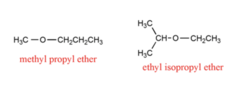
Naming: Ethers (Pure IUPAC Method)
Consider the longest carbon chain to be the parent chain and the alkoxy group to be a substituent:

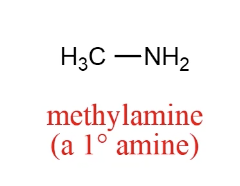
Primary Amine
a nitrogen bonded to one carbon
Secondary Amine
a nitrogen bonded to two carbons

Tertiary Amine
a nitrogen bonded to three carbons
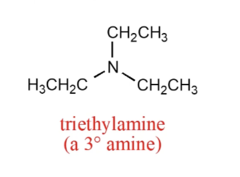
When four carbons are bonded to nitrogen it is called a ___________ _____________ _______.
quarternary ammonium salt
the nitrogen gets a formal charge from sharing so many electrons

Naming: Primary Amines
add the suffix "amine" to the name of the organic substituent.

Naming: Secondary Amines (Symmetrical)
adding "di-" or "tri-" to the alkyl group

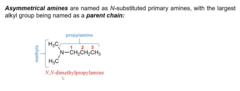
Naming: Secondary Amines (Asymmetrical)
also called N-substituted primary amines
1. largest alkyl group is the parent chain
2. use the prefixes "N"
Naming: Aldehydes
follow the same rules as naming alkanes, but also:
1. We number the parent chain in the direction that gives highest priority (lowest number) to the aldehyde (carbonyl) carbon.
2. We replace "e" with "al".

Naming: Ketones
follow the same rules as naming alkanes, except:
1. Similar to aldehydes, the parent chain must be chosen with priority given to the ketone (carbonyl) carbon.
2. Replace the "e" with "one".
3. The carbonyl carbon in a cyclic ketone is assumed to be the #1 carbon.
**Note: it is also possible to name each chain on either side and then follow it with the word "ketone". For example: 3-hexanone can also be called ethyl propyl ketone.

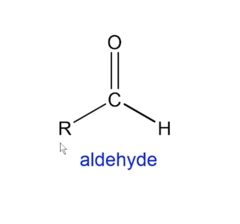
Aldehyde
R = any C-H group
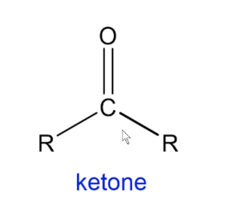
Ketone
R = any C-H group
Formaldehyde is the common name for __________.
methanal
Naming: Carboxylic Acids
follow the rules for naming alkanes, except:
1. We number the parent chain in the direction that gives the highest priority (lowest number) to the carboxylic acid group.
2. We replace "e" with "oic acid".

Naming: Acid Halides
Follow the same rules as for carboxylic acids, and change the suffix to "oyl halide".

Naming: Esters
1. The alkyl group attached to the ester oxygen gets listed first with the suffix "yl". The parent chain then follows.
2. The parent chain starts at the carbonyl carbon and is counted moving away from the ester oxygen. Parent chain's suffix is replaced with "oate".

Naming: Amides
Follow the same pattern of naming esters, except:
1. Any alkyl groups attached to the nitrogen gets listed as "N-methyl", "N-ethyl", "N-propyl" etc.
2. The parent chain starts at the carbonyl carbon and is counted moving away from the amide nitrogen.
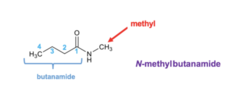
Naming: Acid Anhydrides
1. Determine the length of the chain on either side of the bridging oxygen.
2. List both lengths alphabetically, replacing each suffix "e" with "oic".
3. Write "anhydride" at the end of the name.

Naming: Nitriles
Follow the same rules for naming alkanes, except:
1. The parent chain is the longest carbon chain that involves the nitrile carbon.
2. Number the parent chain in the direction that gives the smallest number to the nitrile carbon.
3. Add the suffix "nitrile" to the parent name.
Carboxylic Acid Derivatives
MEMORIZE

Naming: Substituted Benzenes
1. Identify the parent chain, which is the benzene containing the highest-priority functional group. That parent chain is the parent chain name.
2. The carbon atom in the ring that is attached to the priority functional group is numbered as carbon #1.
3. Number around the ring in whichever direction (clockwise or counterclockwise) that gives the lowest number at the first point of difference.
4. If the numbers are the same in both directions, pick the one that gives the lower number to the substituent that is alphabetically first.

Naming: Polyfunctional Compounds
1. You must identify the highest-priority functional group. The parent chain containing this functional group is the parent chain name.
2. Once you identify the parent chain and its functional group, follow the naming rules for that particular functional group. All other functional groups in the molecule are considered and named as substituents.
Naming: Spiro Alkanes
IUPAC names for spiro alkanes have the format spiro[a.b]parent name.
1. Count the total number of carbons across the entire molecule. This tells you the alkane parent name that goes at the end.
2. Count the number of carbons to the left, and to the right of your spiro-carbon center. These numbers are a and b in your IUPAC name, listed from lowest to highest.
3. Write your final IUPAC name as spiro[a.b]parent name.

Naming: Bicyclic Alkanes
IUPAC names for bicylic alkanes have the format bicyclo[a.b.c]parent name.
1. Count the total number of carbons across the entire molecule. This tells you the alkane parent name that goes at the end.
2. Count the number of carbons to the left, and to the right, and above your bridgehead carbons. These numbers are a, b, and c in your IUPAC name, listed from highest to lowest.
3. Write your final IUPAC name as bicyclo[a.b.c]parent name.

Spiro Alkanes
are carbon-hydrogen molecules that have two or more rings fused together at a single carbon point

Bicyclic Alkanes
are carbon-hydrogen molecules that have two or more rings fused across multi carbon bridges
the bridging carbons are called the bridgehead carbons
