Physics
 Call Kai
 Learn
Learn Practice Test
 Spaced Repetition
 Match
Match Flashcards
 Knowt Play
1/29

There's no tags or description
Looks like no tags are added yet.
Name | Mastery | Learn | Test | Matching | Spaced | Call with Kai | Chat |
|---|
No analytics yet
Send a link to your students to track their progress
30 Terms

Physical quantities are the quantities with magnitude and unit
Temperature is a physical quantity and its si unit is K
45K

![<p>Definitions</p><ul><li><p><strong>Systematic Error</strong>: A consistent, repeatable error where measurements differ from the true value by a <strong>fixed amount or ratio</strong> in the same direction every time. [1, 2, 3, 4, 5]. The problem is in the apparatus and experimental design</p></li></ul><p><strong>Affects Accuracy</strong><br></p>](https://assets.knowt.com/user-attachments/10bbb5ce-b484-423e-85aa-db51ab1d4f03.png)
Definitions
Systematic Error: A consistent, repeatable error where measurements differ from the true value by a fixed amount or ratio in the same direction every time. [1, 2, 3, 4, 5]. The problem is in the apparatus and experimental design
Affects Accuracy
Random Error: Unpredictable variations in measurements that fluctuate above and below the true value due to chance, environmental changes, or human limitation like human reaction time and changing eye level.
Affects precision


Systematic error can be when the line does not pass from (0,0)
Caused by zero error
Uncertainites
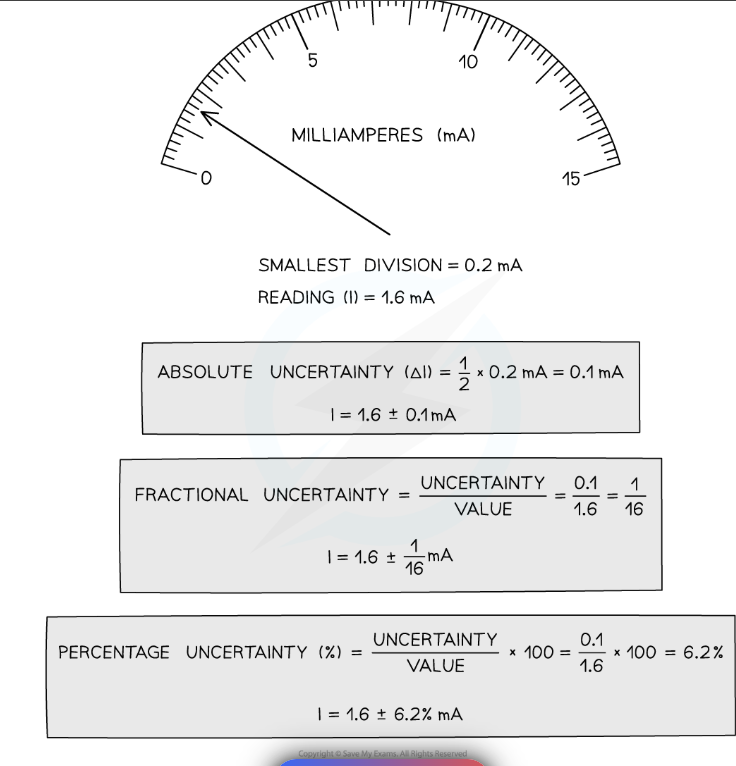
Both the uncertainty and value needs to be same decimal places

Basically just add
The percentage uncertainty in difference is 1.2/34 × 100 = 3.59%
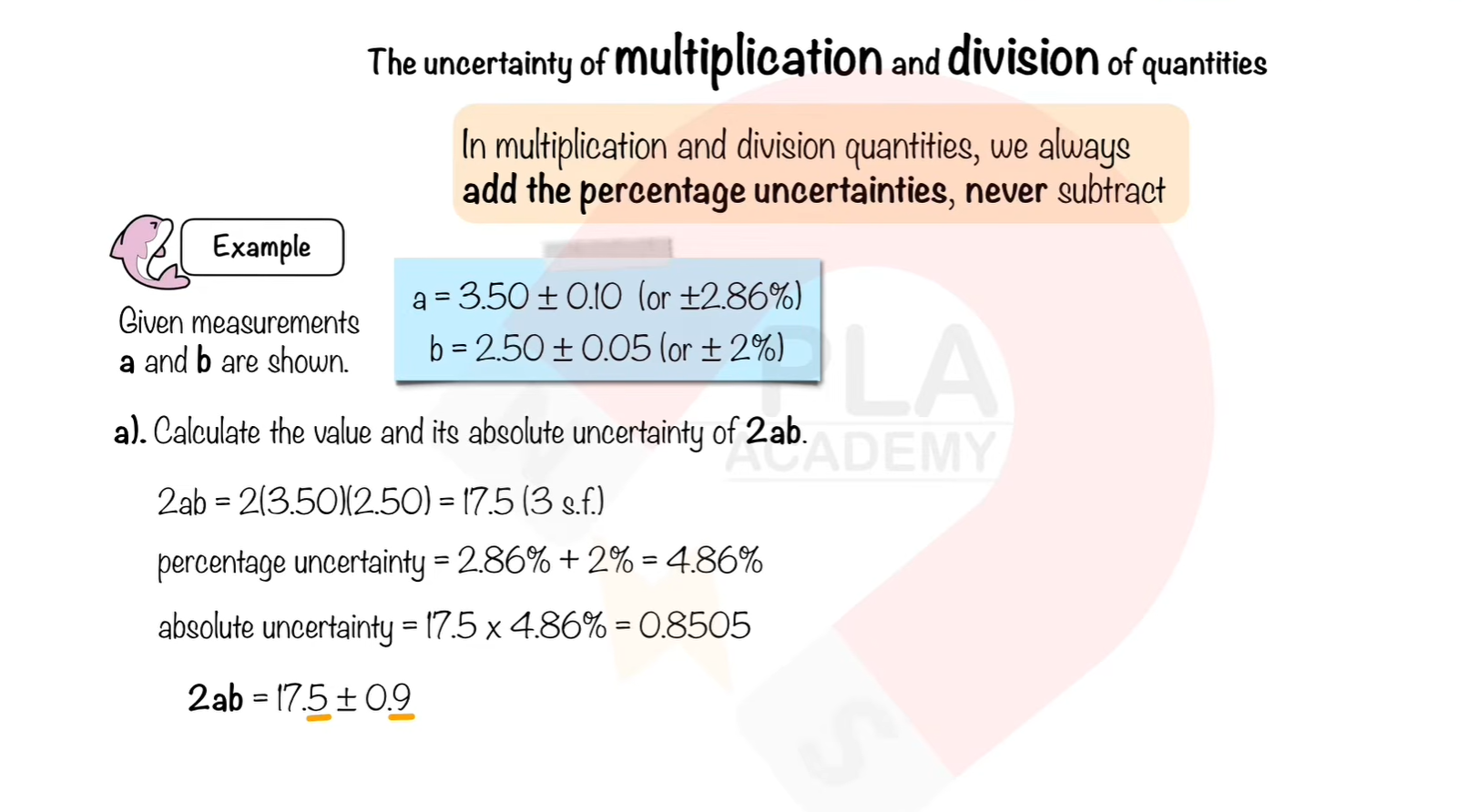
We add the percentage uncertainty of both quantities to get the percentage uncertainty of 2ab.
And then after getting the percentage uncertainty we calculate the absolute uncertainty .
Coplanar vectors are the vectors that are either parallel or anti parallel( on the same axes but in different direcitons)
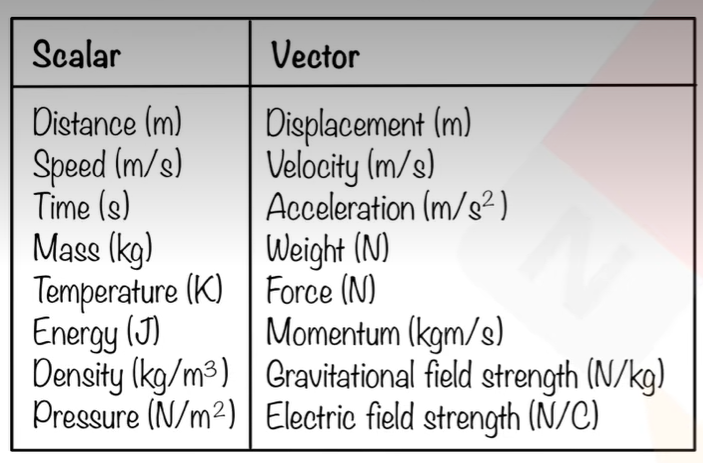
Also scalar- Pressure
Also vector-


Absolute power means the modulus of the power
We can do the second one by putting denominator at numerator.
Displacement is represented as a straight line it is shortest distance between to poiints
remember it pleasee

Used when acceleration is constant


During free fall the ball only experiences the -9.8m/s² acceleration
When an object is thrown upwards and is in free fall, it slows down because it has a downward acceleration due to gravity. Since the acceleration is opposite to its upward velocity, the object decelerates.
Same for force even if resultant force is on left the object can be still be moving to right if velocity is positive.
Force determines direction of acceleration
Velocity determines direction of motion
Opposite signs means that acceleration is in the opposite direction sort of like resisting the movement


When an object is falling.
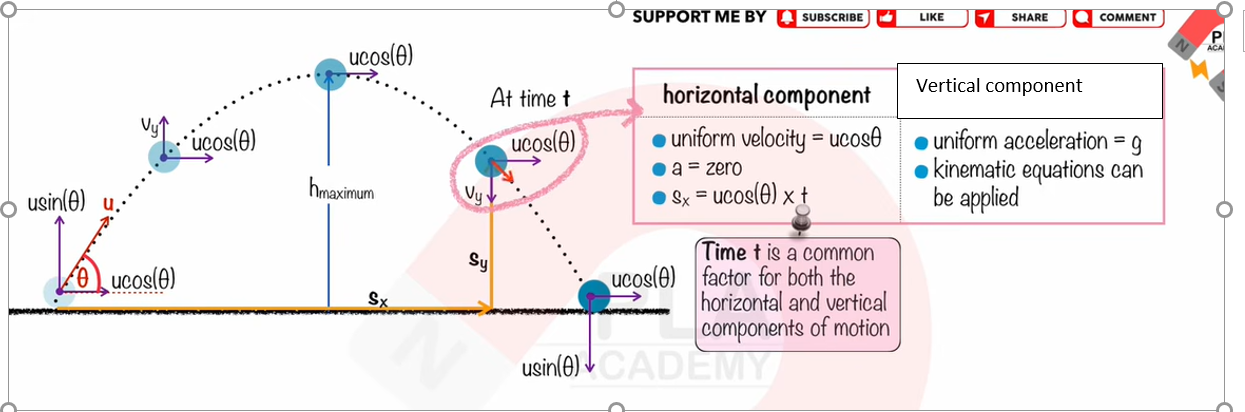
When horizontal velocity is constant zero acceleration


Initial vertical velocity is 0
See that vertical velocity is same but different direction when they are at same height
Gravity only affects the vertical component of velocity
At the peak there is no vertical velocity. vertical velocity is zero
Total speed²= (horizontal component of velocity)² + (vertical component of velocity)²
Mass is a property of an object that resists change in motion
Linear momentum (Momentum in straight line)— Product of mass and velocity
Force - rate of change of momentum
Weight- Effect of gravitational field on a mass
Weight of an object may be taken as acting at a single point known as its centre of gravity
Drag force= VIscous force
Drag force increases as speed increases.
Principal of conservation of momentum - The sum or total momentum of the bodies in a closed system is constant provided no resultant external forces act.
Elastic collision- Total kinetic energy is conserved and the relative speed of approach is equal to the relative speed of separation
Moment of a force- Force x perpendicular distance of the pivot from the line of action of force.
Torque of a couple- one of the forces x perpendicular distance of the two forces
Density- mass per unit volume
Pressure-force per unit area
Newton’s first law of motion- An object will remain at rest or in a state of uniform motion unless it is acted upon by a resultant force.
If a object has a high mass it has more inertia meaning that it has more resistance to acceleration and hence requires a larger resultant force to be act upon
Newton’s second law of motion- Resultant force is proportional(or equal) to the rate of change of momentum.
Can be also written as -Resultant force is proportional(or equal) to mass x acceleration.
Basically — F=ma
Newton’s third law of motion- When two bodies interact, The forces they exert on each other are of equal in magnitude but opposite in direction.
The forces must be same type
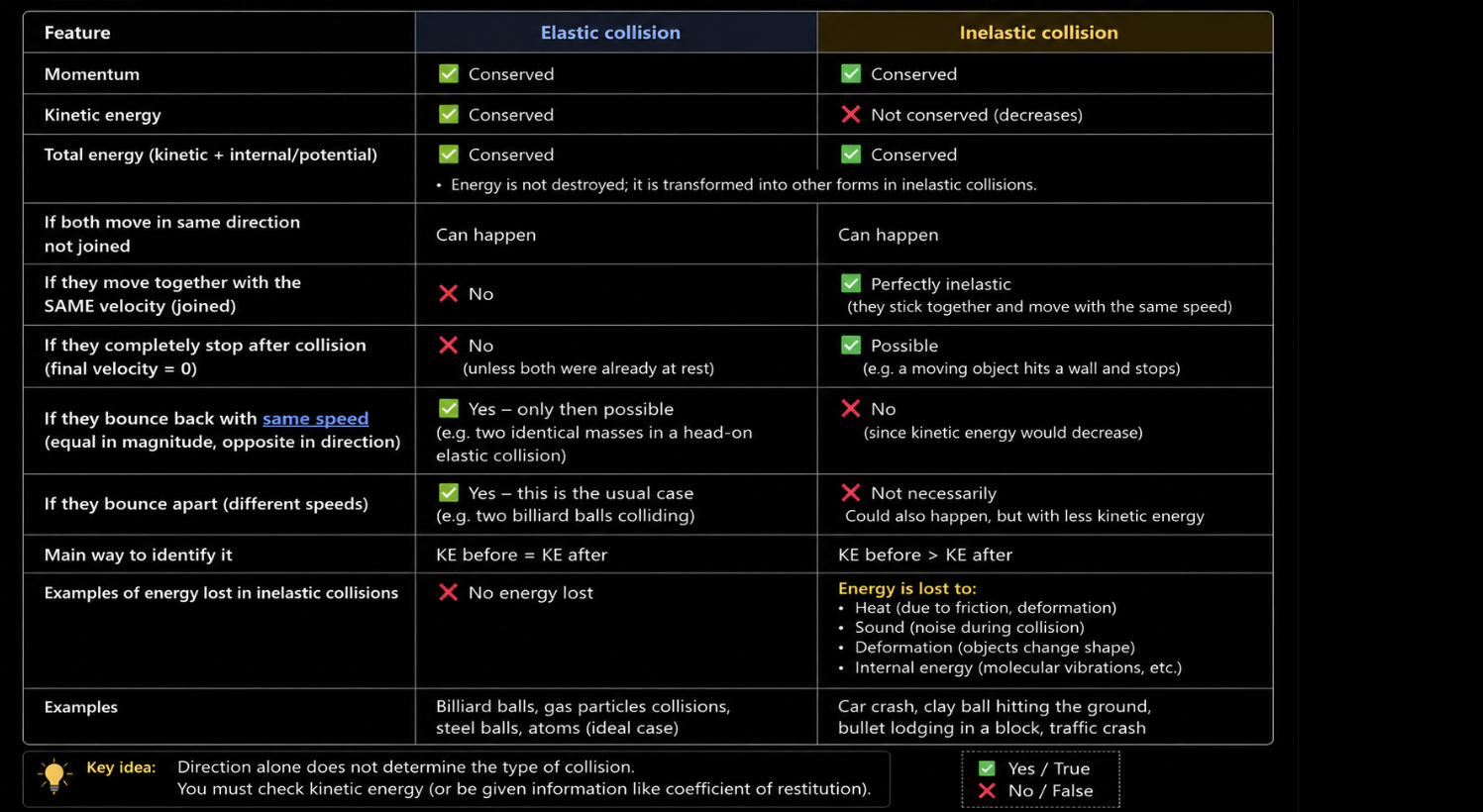
Head on elastic collision means they collide and then move in same plane but with different directions.
For newtons third law of motion
The opposite forces must be of the same type
You push a wall with a contact force.
The wall pushes you with a contact force.
Earth pulls you downward with gravitational force.You pull Earth upward with gravitational force.
Remember that earth pulls you
Earth exerts a gravitational force on the book → pulls the book toward Earth.The book exerts a gravitational force on Earth → pulls Earth toward the book.


When elastic collision happen
magnitude of relative velocity before = magnitude of relative velocity after.
A

Newton’s third law two forces act on different objects
They are not the cause of an object being in equilibrium
For an object to be equilibrium the forces should be acting on the same object be equal in magnitude and opposite in direction basically there vector resolution should be zero.
Both are newton’s third law pair
The equilibrium force that keeps book intact is the Earth pulls down on the book and table pushes up on the book as both of them act on book.

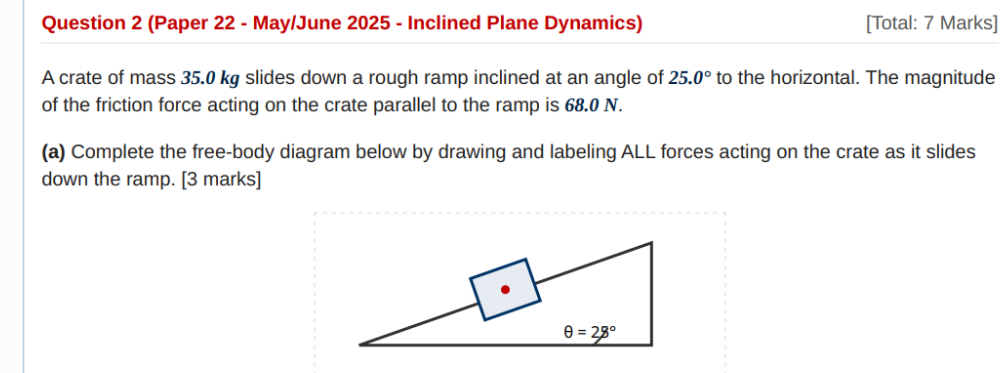
Write value of all forces
mg sin theta = 145
mg cos theta=312
mg sin theta is not the whole length of ramp infront of object.


For each mass on both sides
The heavier mass moves down
But magnitude of acceleration for both is same
resultant force is the upward force - downward force
B
Resultant force is 40kg x 9.8 =392N
392N = (600+640) a
To find tension in rope
Just use one side
the total downward weight is 600× 9.8=5880
x-5880 =392
x=6272N


2-D momentum

A couple is a pair of forces that act to produce rotation only.
Briefly speaking,
A couple is a pair of equal, parallel but opposite forces whose effect is to produce a turning effect on a body by giving it a rotational acceleration.
Torque of this couple is the product of one of the forces and the perpendicular distance between the forces
Torque of the couple is FS.


Objects in equilibrium always form a closed vector polygon
You need to connect the tip to tail for every vector.
Assume that the resultant force on spider is 0.
Draw the vector triangle
Even if the masses are different, in a vacuum objects have the same acceleration due to gravity.


How to derive the pgh = pressure formula (Δ P)
It is the formula for hydrostatic pressure and measures the difference between pressure at the bottom and at the top
Total pressure of a object in water = atmospheric pressure + hydrostatic pressure
Upthrust is the F = ρgV which is the weight
of liquid or gad displaced
when you add an object in water or air.
Archimedes principle- The upthrust acting
on a body is equal to the
weight of the liquid or gas displaced.
Upthrust acting on an object is due
to difference in hydrostatic
pressure.
Pressure is scalar quantity as it acts in all
direction and it’s not possible
to define a direction to it.( expl not needed)
For an object submerged in a liquid:
Pressure on the top surface produces a
downward force.Pressure on the bottom surface
produces an
upward force.Since liquid pressure
increases with depth, the
pressure at the bottom is greater
than at the top.Therefore, the upward force
is greater than the downward force.
The resultant upward force is called upthrust:Net Upthrust=upward force−downward force
Net Upthrust = pgv
volume is the volume of the object that
experiences the upthrust
Density of the fluid
In gases it is known as thrust
which is the upward force
and direction it is moving in.
Also, when imagining drag force in
liquid apply the same principle of air
resistance that drag increases with speed.


Work done= force x displacement in the direction of force
Gpe formula only works in uniform gravitational field strength
The important distinction is between GPE and change in GPE.
An object can have GPE even when it is stationary.
GPE is usually calculated as:
Ep=mgh or deltaEp=mgh
where h is the height above a chosen reference level.
If the object stays in the same place, then hh doesn't change, so:
ΔEp=0
Note that to calculate change in Ke = final ke - initial ke


Efficiency of a system is the ratio of useful energy output from the system to the total energy input.
Power is the work done per unit time
Power is also force x velocity both being in same direction.


D
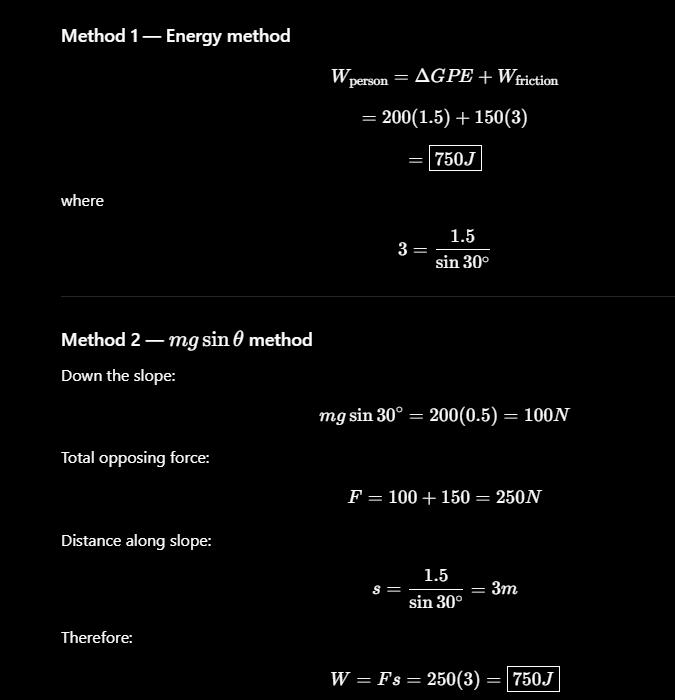
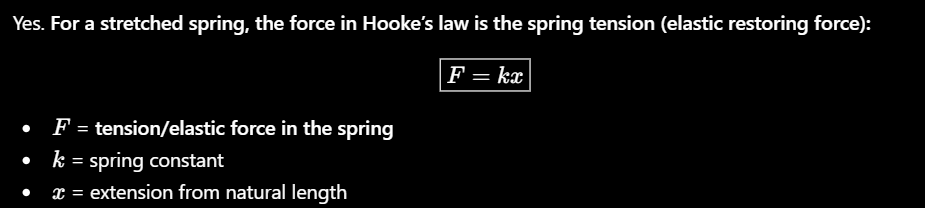
Deformation is caused by tensile or compressive forces (assumed to be in one direction)
Hooke’s law- force is directly proportional to extension provided that the limit of proportionality is not reached.
Strain- extension per unit length (No unit)
Stress-force per unit cross-sectional area that acts at right angles to a surface (Pa or Nm^-2)
Young modulus- The stress in the material divided by the strain (Pa or Nm^-2)
it measures how stiff or elastic a object is
Normal force is the force that acts at right angle to the wire
Same material and diameter mean same stress
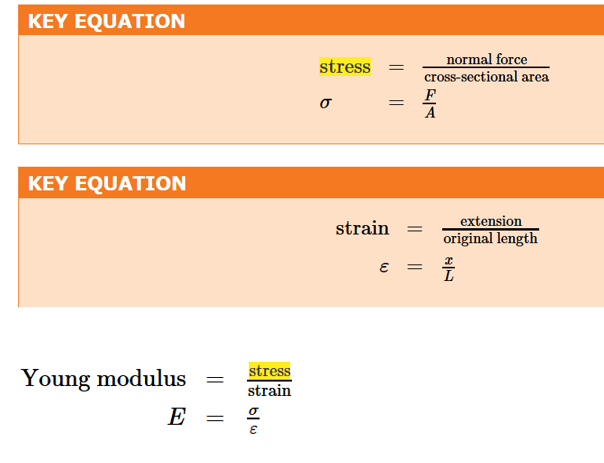

When it is not straight it does not obey the hooke’s law meaning that it has been permanently or temporarily deformed.
Elastic deformation-Elastic deformation is the temporary deformation of a material where it returns to its original shape and dimensions once the applied force is removed.
Plastic deformation- Plastic deformation is the permanent deformation of a material where it does not return to its original shape after the deforming force is removed.
Elastic limit- The elastic limit is the maximum stress or force that can be applied to a material without causing permanent (plastic) deformation.
Limit of proportionality does not equal to elastic limit, it can be either that it has become permanent of temporarily deformed
The image is oversimplifying it, it is not always that the curved region will be plastic, curved region can be elastic deformation too for both types of graph.

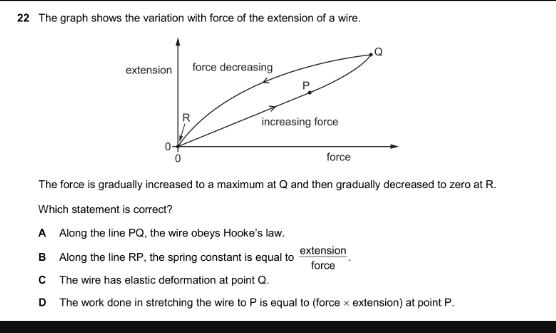
C

Work done in stretching or compressing the spring or the work done by the force as the force is transferred to the elastic potential energy store.
This is true for graphs that obey Hooke's law and also for those which don't.
The graphs with no plastic deformation-
All the energy is elastic potential energy. SO, Elastic potential energy for a material deformed within its limit of proportionality is found from the area under the force-extension graph
When it is deformed beyond elastic limit the material undergoes plastic deformation meaning the
work done in stretching or compressing the spring is elastic energy stored + energy converted to thermal/internal energy
This is for a material deformed within its limit of proportionality
The final force
Why the 1/2? Because the force starts at 0 and increases to F, so the average force is:
(0+F)/2 = F/2.
So elastic potential energy is essential average forcex extension
