Fungi
 Call Kai
 Learn
 Practice Test
 Spaced Repetition
 Match
 Flashcards
 Knowt Play
1/60

There's no tags or description
Looks like no tags are added yet.
61 Terms
What mode of nutrition defines all fungi?
Absorptive heterotrophy, where fungi secrete enzymes into the environment and absorb digested nutrients.
What are the digestive enzymes secreted by fungi into their surroundings called?
Exoenzymes
Why are fungal exoenzymes potentially useful in bioremediation?
They can degrade complex carbon-based pollutants, including crude oil, heavy metals, and environmental toxins.
What polysaccharide forms the primary structural component of fungal cell walls?
Chitin
How do fungal cell walls differ structurally from plant cell walls?
Fungal cell walls are composed of chitin, whereas plant cell walls are composed of cellulose.
What are the fine, threadlike filaments that make up the body of a multicellular fungus called?
Hyphae
What term describes the interwoven mass or network of fungal hyphae that forms the main vegetative body?
Mycelium

What are haustoria?
Specialized hyphae that penetrate the tissues of host organisms to absorb nutrients or exchange materials.

How do nematophagous fungi use modified hyphae?
They form specialized trapping loops or structures to capture, constrict, and consume soil nematode worms.
Approximately how long ago did fungi diverge from their eukaryotic ancestor?
1 to 1.5 billion years ago
What type of organism represents the closest living relative of kingdom Fungi?
An aquatic, unicellular, flagellated protist (specifically nucleariids).
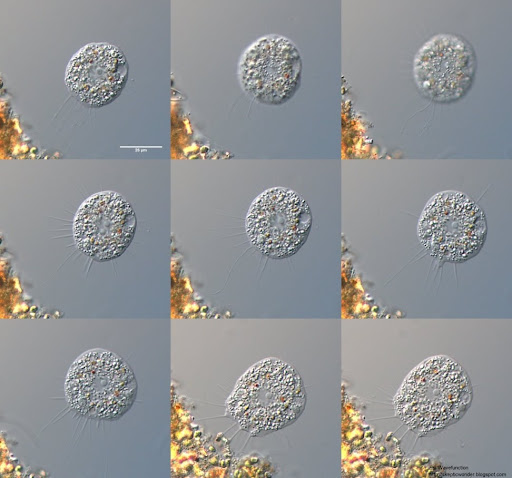
What does the aquatic, unicellular nature of the fungal ancestor imply about the evolution of multicellularity?
Multicellularity evolved later in the fungal lineage and independently from multicellularity in plants and animals.
In general fungal asexual reproduction, spores are produced by which cell division process?
Mitosis
What is plasmogamy in the fungal life cycle?
The fusion of the cytoplasm from two compatible mycelia without immediate fusion of their nuclei.
How do compatible fungal mycelia locate each other for sexual reproduction?
By releasing signaling chemicals called pheromones.
What is the heterokaryotic (or dikaryotic) stage in fungi?
A stage following plasmogamy where a cell contains two or more unfused, genetically distinct haploid nuclei from different parents.
What specifically defines a dikaryotic cell (n+n) in fungi?
A cell containing exactly two unfused haploid nuclei per cell.
What is karyogamy in the fungal life cycle?
The fusion of paired haploid nuclei within a heterokaryotic/dikaryotic cell to form a diploid zygote.
What is the only diploid (2n) stage in the fungal life cycle?
The short-lived zygote formed immediately following karyogamy.
By what process does the diploid fungal zygote divide to produce haploid sexual spores?
Meiosis
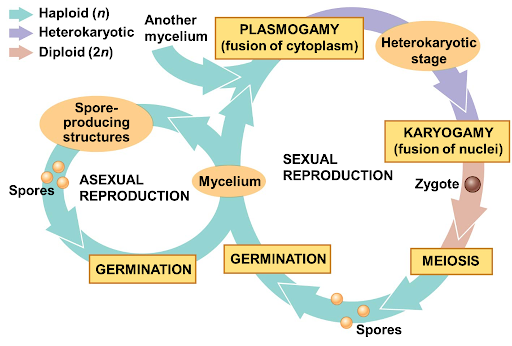
What are the three sequential stages of sexual reproduction in fungi?
Plasmogamy (fusion of cytoplasm)
Karyogamy (fusion of nuclei)
Meiosis (reduction division producing haploid sexual spores)

Which fungal phylum diverged earliest from all other main fungal lineages?
Chytridiomycota (Chytrids)
What structural feature makes Chytrid spores unique among fungi?
They possess flagella, making the spores (zoospores) motile in aquatic environments.
Why is the presence of flagellated zoospores in chytrids considered an ancestral trait?
It is shared directly with the aquatic, unicellular flagellated protist ancestor of fungi.
What is the common name for fungi belonging to phylum Zygomycota?
Sugar molds (commonly known for spoiling bread and fruits).

In Zygomycota, what structure produces asexual spores by mitosis?
Sporangium (plural: sporangia)
What durable, stress-resistant structure is formed during sexual reproduction in Zygomycota?
Zygosporangium
What type of sexual spores are produced inside the zygosporangium via meiosis?
Zygospores
What is the common name for phylum Ascomycota?
Sac fungi
In Ascomycota, what are the microscopic, sacklike structures that bear sexual spores called?
Asci (singular: ascus)
What is the complex fruiting body that houses the asci in Ascomycota called?
Ascocarp

How many ascospores are typically contained inside a single mature ascus?
Eight ascospores (formed when meiosis yields four haploid nuclei, followed by one round of mitosis).
What are the asexual spores produced by Ascomycota called?
Conidia
What specialized hyphae produce conidia via mitosis in Ascomycetes?
Conidiophores
What is the common name for phylum Basidiomycota?
Club fungi
What is the fruiting body produced during sexual reproduction in Basidiomycota called?
Basidiocarp (commonly known as a mushroom, puffball, or shelf fungus).
Where are basidia located on a classic mushroom basidiocarp?
Lining the gills beneath the cap of the mushroom.
How many basidiospores are produced per basidium following meiosis?
Four basidiospores

What biological structure causes the formation of a circular 'fairy ring' of mushrooms?
An expanding subterranean mycelium of a single fungal individual that fruits at its outer growing edge.
What ecological role distinguishes fungi as indispensable primary actors in terrestrial habitats?
They are the primary decomposers of tough plant materials, breaking down cellulose and lignin.
How does fungal decomposition directly support the global carbon cycle?
By digesting organic carbon compounds in dead biomass and releasing carbon dioxide (CO2) back into the atmosphere for photosynthesis.
What is a lichen?
An obligate mutualistic association between a fungus and a photosynthetic partner (green algae, cyanobacteria, or both).

In a lichen symbiotic relationship, what does each partner contribute?
Fungus: Provides physical structure, surface area, moisture retention, and inorganic minerals. Phototroph: Provides organic carbon compounds produced by photosynthesis.
Why are lichens ecologically significant in primary succession?
They act as pioneer species capable of colonizing bare rock and harsh environments like deserts and Arctic tundra.
What is a mycorrhiza?
A mutualistic association between fungal hyphae and plant roots.
Approximately what percentage of plant species form mycorrhizal relationships?
Over 90%
How do plants and fungi benefit mutually from mycorrhizae?
Fungus: Increases root surface area for enhanced water and mineral absorption (e.g., phosphorus, nitrogen). Plant: Supplies organic photosynthetic sugars to the fungus.
How do ectomycorrhizae differ structurally from endomycorrhizae?
Ectomycorrhizae form a sheath around the outside of root cells; endomycorrhizae penetrate through plant cell walls to form internal structures.

Which fungal phylum forms arbuscular mycorrhizae (endomycorrhizae) with plants?
Glomeromycota
What are plant endophytes?
Harmless or beneficial fungi that live inside plant stems, leaves, or non-root tissues.
What defensive advantages do fungal endophytes provide to host plants?
They produce toxic metabolites that deter herbivores, protect against pathogens, and improve tolerance to drought and heat.
Describe the mutualistic relationship between leaf-cutter ants and cultivated fungi.
Ants collect, chew, and feed plant leaves to cultivate underground fungal gardens; in return, the fungus produces specialized hyphal tips packed with proteins, lipids, and carbohydrates for the ants to eat.

What agricultural crop disease is caused by the ergot fungus (Claviceps)?
Ergotism, which infects cereal crops like rye and replaces grains with dark fungal sclerotia.
What physiological symptoms occur in humans who ingest ergot-infected grain products?
Headaches, severe nausea, muscle spasms, convulsions, hallucinations, gangrene, and potential death.

Why is Candida auris considered an urgent global healthcare concern?
It is a multidrug-resistant pathogenic yeast causing severe, widespread infections in medical facilities.

What fungal phylum contains the pathogen responsible for global amphibian population declines?
Chytridiomycota (causing chytridiomycosis, which infects skin and has led to declines in over 500 frog and salamander species).

What is White-Nose Syndrome, and what organism does it infect?
A deadly fungal infection caused by Pseudogymnoascus destructans that infects hibernating North American bats.
How does White-Nose Syndrome cause mortality in bat colonies?
It interrupts winter hibernation, causing bats to awaken frequently and burn vital fat reserves prematurely, leading to starvation.
Name three commercial food products processed or fermented using unicellular yeast.
Bread (leavening), beer, and wine (alcoholic fermentation).
What notable medical antibiotic was famously derived from a fungus?
Penicillin (derived from Penicillium).
Why are fungi widely utilized as model organisms in scientific genetic research?
They are simple eukaryotic organisms, allowing scientists to study fundamental eukaryotic cellular processes more easily than in animals or plants.