Genetics Chapter 9: DNA and RNA Molecular Structure
 Call Kai
 Learn
 Practice Test
 Spaced Repetition
 Match
 Flashcards
 Knowt Play
1/54

There's no tags or description
Looks like no tags are added yet.
55 Terms
What is molecular genetics?
The study of DNA structure and function at the molecular level.
What are the four criteria that genetic material must fulfill?
Information (Must hold the data to build an organism), Transmission (Be able to pass down to offspring), Replication (Must be copied and accurate), Variation (Must be capable of changes to account for phenotypic differences)
Who conducted experiments that identified DNA as the genetic material?
Frederick Griffith.
What are the two strains of Streptococcus pneumoniae?
Type S (smooth) and Type R (rough).
What does Type S of Streptococcus pneumoniae do?
Secretes a polysaccharide capsule that protects it from the immune system.
What is the process called when type R bacteria are transformed into type S?
Transformation.
What did Griffith conclude about the transforming principle?
Something from the dead type S bacteria was transforming type R bacteria into type S.
Who were the scientists that identified the genetic material using Griffith's observations?
Avery, MacLeod, and McCarty.
What did Avery, MacLeod, and McCarty discover in their experiments?
Only the extract containing purified DNA could convert type R bacteria into type S.
What did the Hershey and Chase experiment demonstrate?
That DNA is the genetic material of T2 phage.
How did Hershey and Chase distinguish between DNA and proteins?
Using radioisotopes: 32P for DNA and 35S for proteins.
What are nucleic acids?
Large macromolecules known as DNA (deoxyribonucleic acid) and RNA (ribonucleic acid).
Who first identified DNA and what did he name it?
Friedrich Miescher named it 'nuclein'.
What are the components of a nucleotide?
A phosphate group, a pentose sugar (ribose in RNA, deoxyribose in DNA), and a nitrogenous base.
What is the structure formed by two strands of DNA?
A double helix.
Human DNA is 2 Meters long
About 10 nucleotides long
What is the significance of the nitrogenous bases in nucleotides?
They can decrease the hydrogen ion concentration in a solution, acting as bases in an acid-base sense.
What are the levels of nucleic acid structure?
Nucleotides, single strand, double helix, three-dimensional structure.
What happens to the hydrogen ion concentration when nitrogenous bases are protonated?
The concentration decreases.
What is the role of DNA in organisms?
It contains the information necessary to make an entire organism.
What is the importance of replication in DNA?
It allows genetic information to be passed from parent to offspring.
What does variation in genetic material account for?
The known phenotypic variation in each species.
What is the role of the capsule in type S bacteria?
It protects the bacteria from the immune system.
What experimental techniques were used to identify DNA as the genetic material?
Biochemical techniques in the experiments of Avery, MacLeod, and McCarty.
What is the significance of the transforming principle in genetics?
It demonstrates how genetic information can be transferred between organisms.
What is a nucleoside?
A nucleoside is formed from a base and a sugar.
What is a nucleotide?
A nucleotide is formed from a base, sugar, and phosphate(s).

What is the difference between adenosine and deoxyadenosine?
Adenosine is made with ribose sugar, while deoxyadenosine is made with deoxyribose sugar.
What type of bond links nucleotides in a DNA strand?
Covalent bonds called ester bonds.
What is a phosphodiester linkage?
A phosphodiester linkage connects the 5' carbon of one nucleotide to the 3' carbon of another nucleotide.
What directionality does a DNA strand have?
A DNA strand has 5' to 3' directionality.
Who elucidated the double helical structure of DNA?
James Watson and Francis Crick in 1953.
What crucial data did Erwin Chargaff provide?
Chargaff's rule states that the percent of adenine equals the percent of thymine, and the percent of cytosine equals the percent of guanine.
What are the key features of the DNA double helix?
Two strands form a right-handed double helix, bases hydrogen bond according to the AT/GC rule, and strands are antiparallel.
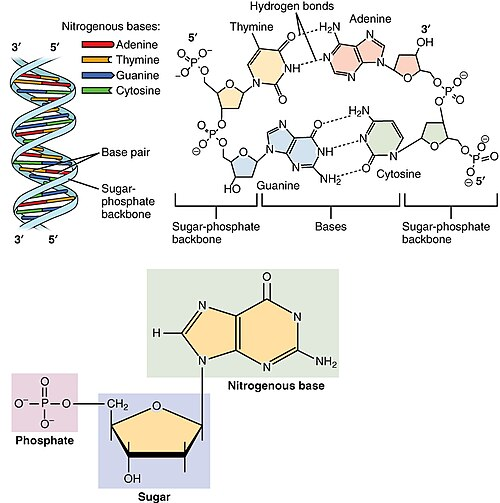
What stabilizes the double helix structure of DNA?
Hydrogen bonding between complementary bases and base stacking.
What are the major and minor grooves in DNA?
Asymmetrical grooves on the outside of the helix where proteins can bind.
Compaction Level 1
Compaction Level 2
Compaction Level 3 Euchromatin Verus Heterochromatin
Compaction Level 4 Chromosome - Territories
Each chromosome occupies a discrete, non-overlapping territory in the nucleus

What is the predominant form of DNA found in living cells?
B DNA.
What is Z DNA?
A left-handed helix form of DNA that can occur under certain conditions.
What is the primary structure of RNA?
Similar to DNA but uses uracil instead of thymine and ribose instead of deoxyribose.
How does RNA typically differ from DNA in terms of structure?
RNA is usually single-stranded but can form short double-stranded regions through complementary base pairing.
What base pairs with adenine in RNA?
Uracil pairs with adenine in RNA.
What is the typical length of RNA strands?
Several hundred to several thousand nucleotides in length.
What is the significance of Rosalind Franklin's work?
She used X-ray diffraction to study DNA, providing crucial insights into its helical structure.
What did Watson and Crick's model of DNA include?
A sugar-phosphate backbone on the outside with bases projecting toward each other.
What is the structure of a transfer RNA (tRNA)?
tRNA has a tertiary structure formed by base-pairing and interactions with ions, small molecules, and proteins.
What is the role of hydrogen bonds in DNA structure?
Hydrogen bonds form between complementary bases, stabilizing the double helix.
What is the significance of the 3.4 nm measurement in DNA?
It indicates the distance between base pairs in the DNA double helix.
How many base pairs are there per complete turn of the DNA helix?
Approximately 10 base pairs.
What is the difference between the sugar-phosphate backbone of DNA and RNA?
DNA has deoxyribose, while RNA has ribose with a 2' OH group.
What type of secondary structure can RNA form?
RNA can form various secondary structures, including stem loops and bulge loops.
What is the importance of Chargaff's rule in DNA structure elucidation?
It provided critical evidence for base pairing in the DNA double helix.
What was the contribution of Linus Pauling to the understanding of DNA?
He proposed the α-helix structure in proteins, influencing the understanding of nucleic acid structures.