Public Art Program
 Call Kai
 Learn
 Practice Test
 Spaced Repetition
 Match
 Flashcards
 Knowt Play
1/54

There's no tags or description
Looks like no tags are added yet.
55 Terms

Agave Dreams
Julian Voss-Andreae (German)
Stainless Steel and mild painted steel
2015
Biology Building, TTU
a female figure, kneeling on the earth with outstretched hands touching the ground. Sheltered between her hands grows a live agave, a plant with a history of deep significance to the native peoples in this area. Through her gesture of blessing the plant, Agave Dreams encourages us to question our attitude toward nature and the entire web of life. The mindset of separating subject and object, of detaching ourselves from nature, and of dividing the world into small parts assuming this will lead to an understanding of the whole, is contrasted with a holistic dream that seeks to integrate human, physical, and spiritual needs with the rest of creation by recognizing both as fundamentally one.
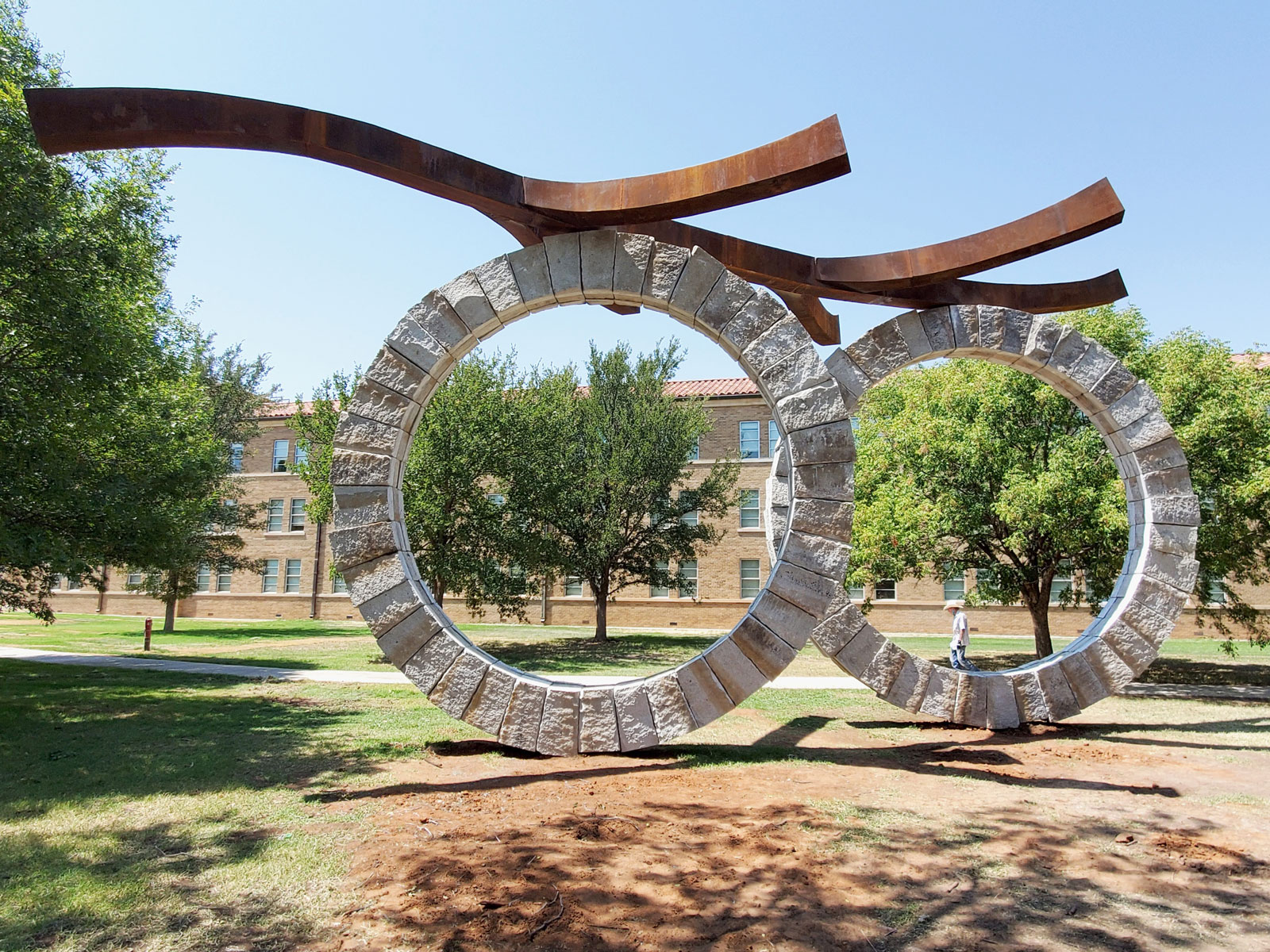
As Far as the Eyes Can See
Ilan Averbuch (Israeli)
Cor-ten weathering steel and granite
2020
Weeks Hall, TTU
two colossal rings of rough-cut granite stone and a branch made of Cor-ten weathering steel. The rings are made of recycled curbstone from old cities and roads. From a distance it is an object and an image, but as we enter the sculpture it becomes architectural and spatially engaging. The twin stone circles suggest wheels, movement, and physical motion, but can also be read metaphorically representing the circles of natural cycles. The stone rings remind us of two massive frames that offer alternating views of the surrounding landscape. The sculpture becomes a lens into and out of the campus inspired by the curiosity of inquisitive minds, asking students to look further than the limits they see before them.

Astrolabe
Owen Morrel (American)
stainless steel and painted aluminum
2014
Experimental Sciences Building, TTU
referent to a primitive navigational instrument. Unlike the original astrolabe, which was an instrument designed to orient navigators to the stars, in this instance, it asks the viewer to reorient the mind within a constructed landscape through the act of seeing. It is puzzle-like and requires the viewer to be active, to walk around the piece in an effort to discover what is happening and how it works formally and visually, not necessarily to solve a riddle in a linear and rational fashion. This piece asks the viewer to accept the totality of the experience as irrational, unfamiliar, challenging, and irreducible.

Bulls
Peter Woytuk (American)
Bronze
1995
Animal & Food Sciences Building, TTU
playful and satirical animal sculptures that exude personality and challenge our interpretation of animal form. Although Woytuk animates his subjects’ character, these bulls are freed from any conventional portrayal or romanticized themes that one often associates with this animal in Western art. Instead, the simplified organic forms are subject to artistic invention. The artist considers the bull grouping to be “one unified sculpture that the viewer is able to walk around and within.”

Comma
Po Shu Wang (Chinese)
Stainless steel and Bronze
2007
Student Union Building, TTU
blends art with science and encourages passersby to interact with it. The seven-foot stainless steel piece is a spherical resonator. By pushing the knob attached to the sculpture, viewers can hear acoustical waves bouncing from one end to the other. This is created by the bronze bells inside the sphere that are tuned at slightly different pitches, one small interval apart. This musical acoustical phenomenon is known as “comma.”

Fountain
Juanjo Novella (Spanish)
Cor-ten weathering steel
2013
Terry Fuller Petroleum Engineering Research Building, TTU
the organic forms of this sculpture were cut out of one-inch thick steel; the deliberately amorphous forms allow viewers the opportunity to interpret the sculpture based on their own experiences and frame of reference. For some, the sculpture may recall swirling water, strata of the earth, oil flowing through pipes, or other organic motifs. Novella is an internationally successful artist, with completed works in Europe, Asia, and New Zealand; this is his first commission in the United States.

Four Faces
Michael Stutz (American)
Bronze
2013
J.T. Margaret Talkington Hall
these four monumental faces are made of bronze straps using a “weaving” technique, originally developed by Stutz in the 1990s. Each face bears unique physical characteristics, subtly suggesting differences in gender, age, and ethnicity, while also producing a sense of unity derived from shared material, scale, and aesthetic temperament. In short, these sculptures hinge upon a series of dichotomies—individuality and universality, open and closed, traditional and contemporary, monumentality and intimacy—both extremes of which are simultaneously represented.

Headwaters
Larry Kirkland (American)
Granite and tile
2002
TTU Humanities and Education Complex
the central fountain features two monumental hands holding letters of the alphabet. The letters remain a fragment of a word and symbolize the potential for communication and thirst for knowledge. Water pouring over the fountain reminds the viewers of the variety of sounds that letters create. On all sides of the fountain, the artist placed carved books and sculptural motifs that invite contemplation: an egg on a nest suggests nurturing new ideas, a book with water ripples carved on its surface implies dissemination of knowledge, a house with a keyhole portal suggests opportunities for education within a community, a boat with a series of water ripples carved on its surface is a metaphor of life’s journey.

Knowledge Structure
Marco Cianfanelli (South African)
Rusted mild steel
2015
Innovation Hub at Research Park, TTU
sections through the brain, as profiles, are layered in the reconstruction of the three-dimensional form of “Knowledge Structure”, where a parallel between tree and intellect is seen, exploring the structures of these organic forms. The trunks and branches represent a notion of different disciplines, which are interrelated, and interdependent, sharing resources and displaying a process of growth and interconnectedness. The form of the human brain is evident, a neural network that is connected to, as well as dependent on, the earth. The five columns supporting the brain become conduits. The emphasis lies in the importance of innovation, science, and technology in the furthering of humanity, as endeavors that need to be responsive to and in synergy with, the environment.

Lluvia Luminosa
Ray King (American)
Dichroic glass and stainless steel
2007
Student Wellness Center, TTU
this work was created from 2,257 individual pieces of glass threaded onto and suspended by stainless steel cables at precise intervals to create a three-dimensional pattern. The sunlight from the eastern window strikes the glass elements, which contain a dichroic laminate film. The film is designed to split light wavelengths into a spectrum of colors. These colors change from a deep violet blue to cyan and may reflect a brilliant gold hue based on the time of day and the viewer’s position in relation to the work.
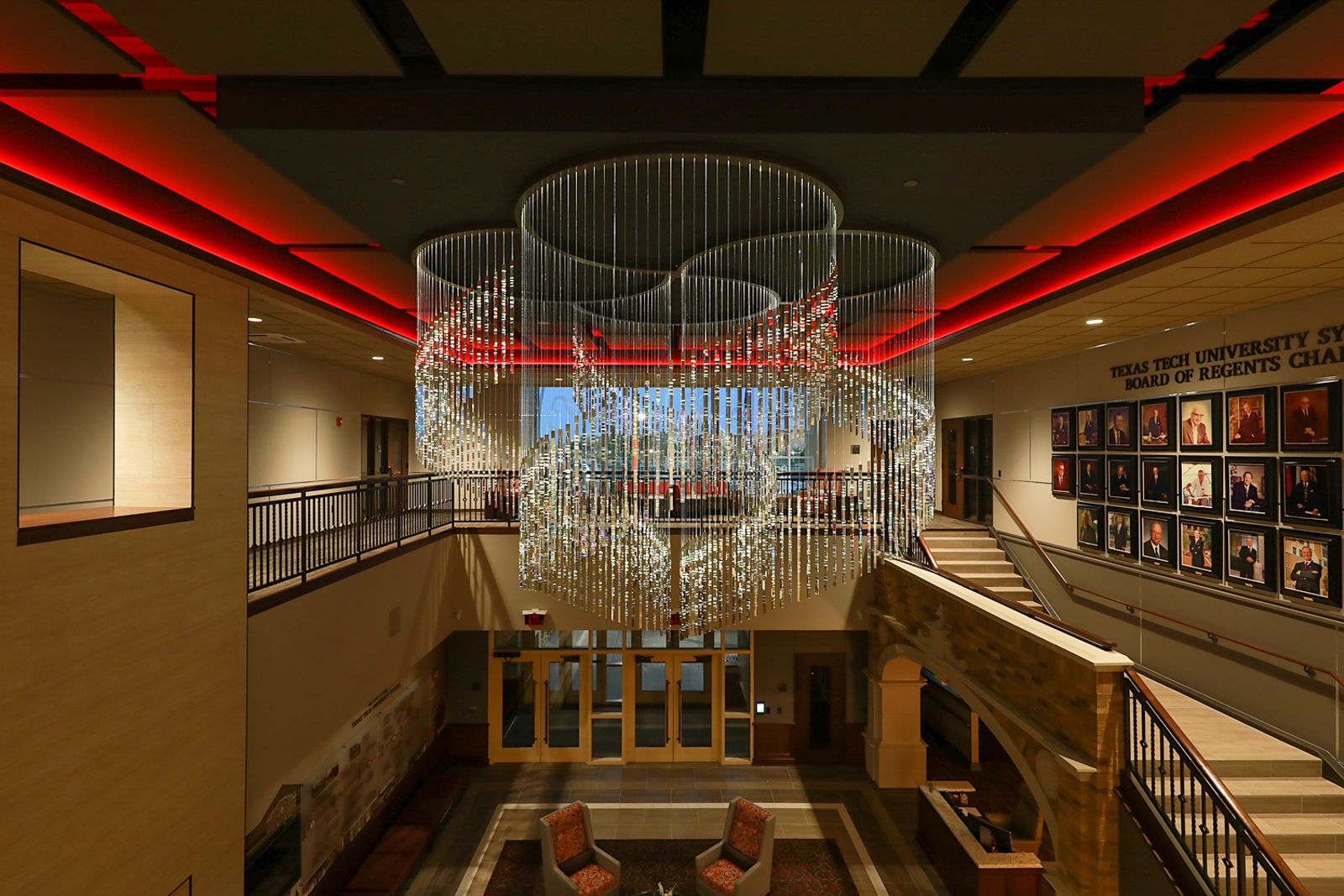
Viva Tree
Bruce Munro (british)
2017
LED lights, optical fiber, acrylic, stainless steel
TTU, Facilities Planning and Construction Lobby
Viva Tree is a site-specific sculpture from the artist’s Light and Language series. The words “Honor” and “Vision” are etched into the prisms, written in the dot and dash language of Morse code.

The Messengers
David B. Hickman
2013
Steel and limestone
TTU, Media and Communications Building
consists of five kinetic sculptures in the form of stylized messenger pigeons bearing the names of the five senses in their tails, and ten limestone benches arranged in concentric circles. The benches in the outer circle are engraved with the words “THINK ABOUT HOW YOU COMMUNICATE.” The combination of this phrase, the senses, and the pigeons is intended to provoke the viewer to contemplate rudimentary tools of human interaction and how they employ these tools daily. The Messengers is the first kinetic artwork in the collection.

Untitled
Robert Bruno
1974
steel
TTU, Architecture Building
Bruno, a former professor in the College of Architecture, is best known for the creation of the Steel House in Ransom Canyon. This untitled sculpture, a fusion between art and architecture, is said to have been the inspiration for the Steel House and one of his few remaining sculptures. It was moved to the Texas Tech campus in late January 2015. The presence of one of Bruno’s works at the Architecture building serves as a memorial to Bruno and provides an educational site for students.

Seasons of the Llano Estacado
Steve Teeters
2002
Iron and Bronze
Flint Parking Garage
motifs based on the natural history of the Llano Estacado, Teeters conveys that Texas Tech is a natural home for ideas to be planted, incubated, and allowed to flourish. The four seasons and the phases of the moon remind the viewer of the cycles of time, growth, and change. The western panels represent Spring and the raw beauty of furrowed fields ready to be planted. Summer, a season illuminated by life and rapid growth, is depicted on southern panels. The eastern panel’s mature plant forms symbolize Fall, when ideas are ready for harvest. To the north is Winter, a time for quiet reflection on lessons learned.

Liquid Assets
Terry Allen
1996
Bronze
TTU School of Art
consists of a round well-like base in which a corporate executive stands. The figure is dressed in his business suit and holds his briefcase. Yet he is placed in the middle of a fountain, dripping wet. The water leaks from behind his neck and down his sleeves, as well as from his pockets. He is hunched over, his expression blank. This is not the strong, diligent businessman but a man consumed by stress, stuck where he is unable to move.
This sculpture is one in a series Allen has been making associated with corporate America. Liquid Assets is at once funny and pathetic.
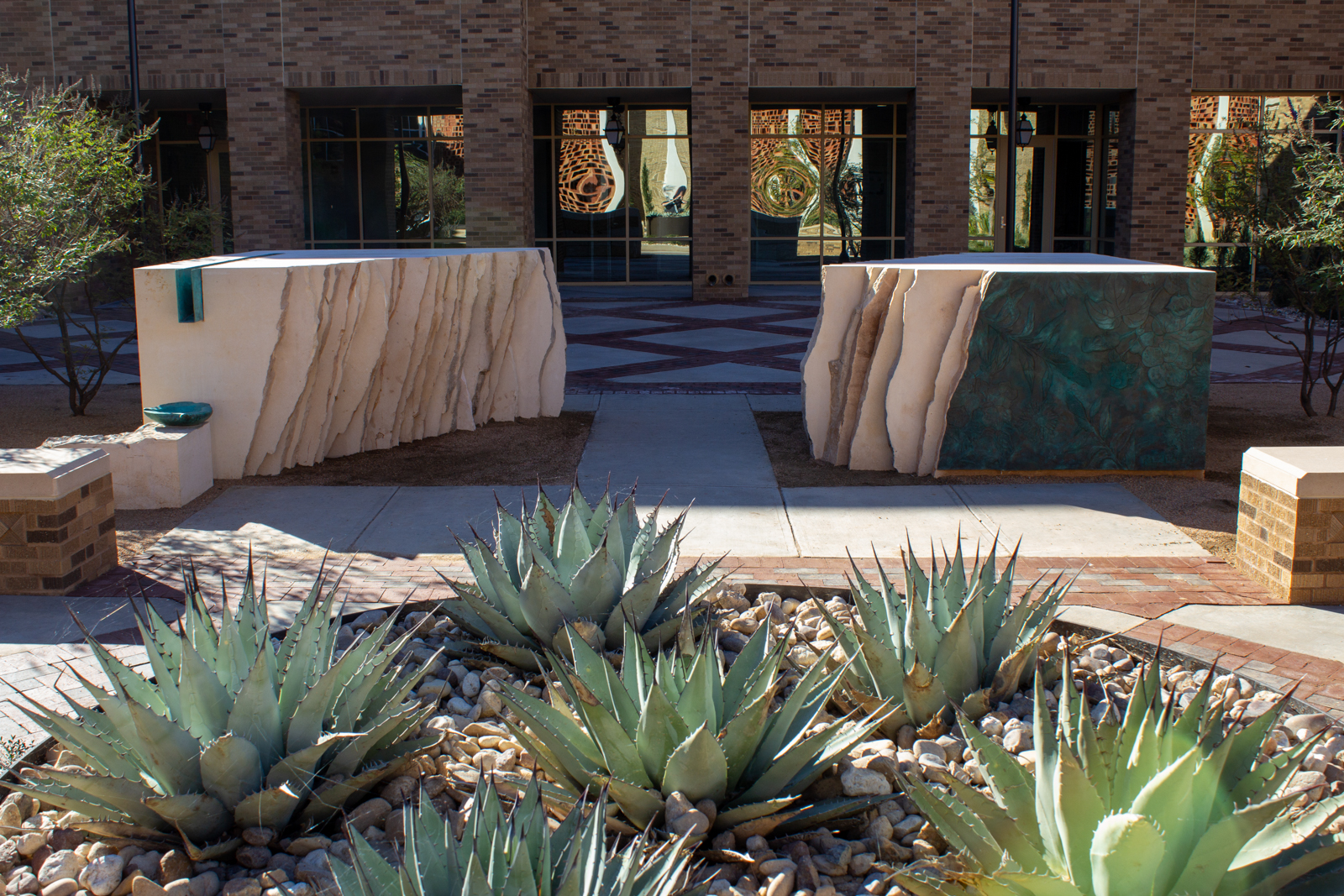
Rain Stones
Rebecca Thompson
2015
Bronze and Texas Sandstone
TTU Bayer Plant Science Building
an interactive experience designed to integrate with the courtyard space while highlighting the importance of our Earth’s natural resources. Visitors are encouraged to walk between the sculptures through the courtyard path and view the ancient past of soil that is revealed on the west face. During the rains, the bronze waterway will direct water to the handmade bronze bowl, which then flows to the landscape nearby. This piece is a meditative reminder of sustainability, erosion, and the important event of rain. Primary Texas crops are illustrated on the bronze relief, including cotton, sorghum, sunflowers, and grapes.
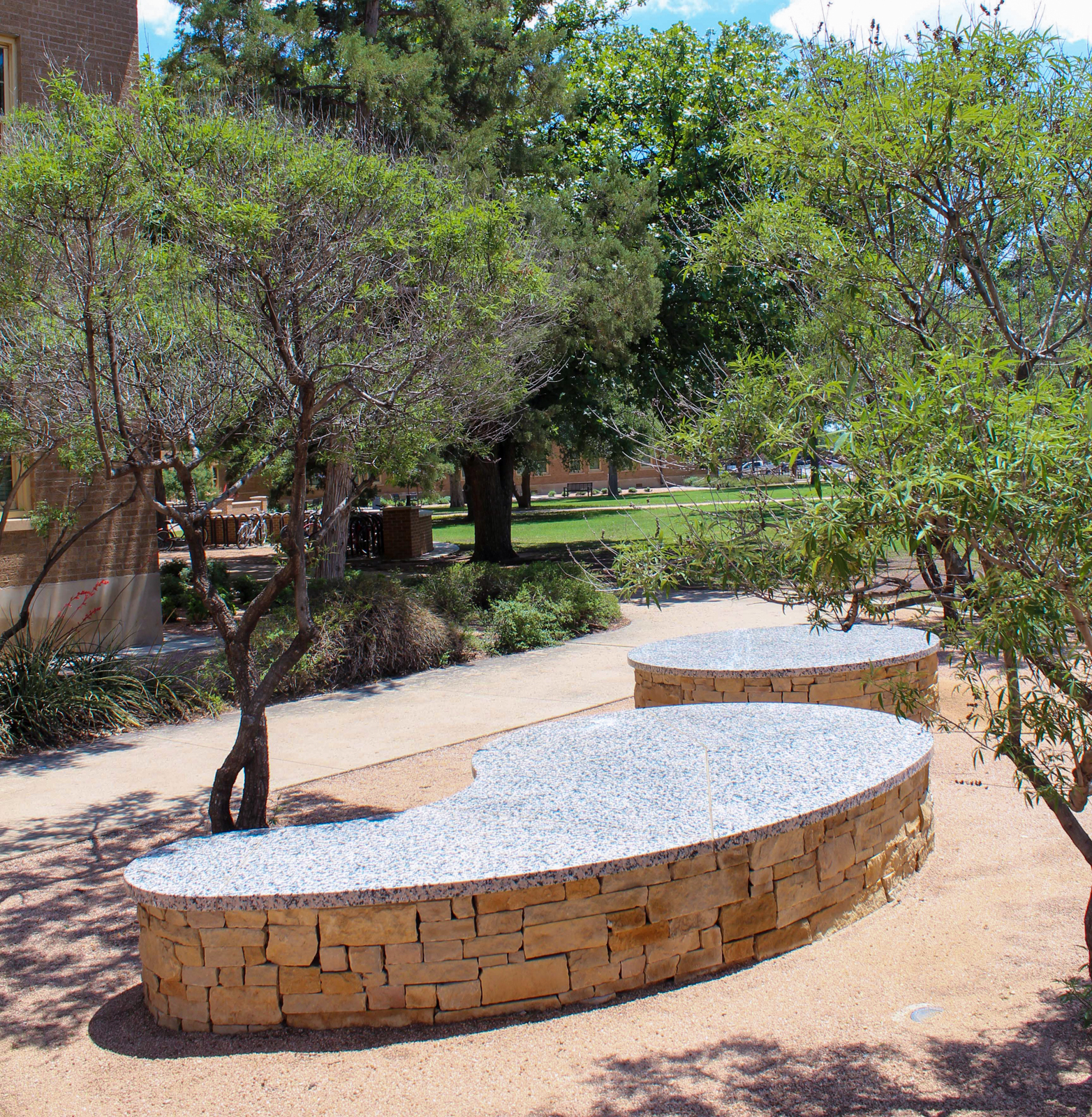
Universal Signs
Barbara Grygutis
2004
Granite and Limestone
TTU Jones ATT Stadium, Stangel/Murdough Hall, and Knapp Hall
Inspired by the flat landscape of West Texas, Grygutis designed the punctuation signs of this low horizontal sculptural seating in Texas granite and limestone. From cartoon books to abbreviated internet communications, human emotions and action are often reduced to symbolic punctuation signs. The artist’s placement of the symbols capture the wide range and grand scale of conflicting emotions inspired by football and life on a college campus
Park Place
Glenna Goodacre
1997
Bronze
TTU Health and Human Sciences Building
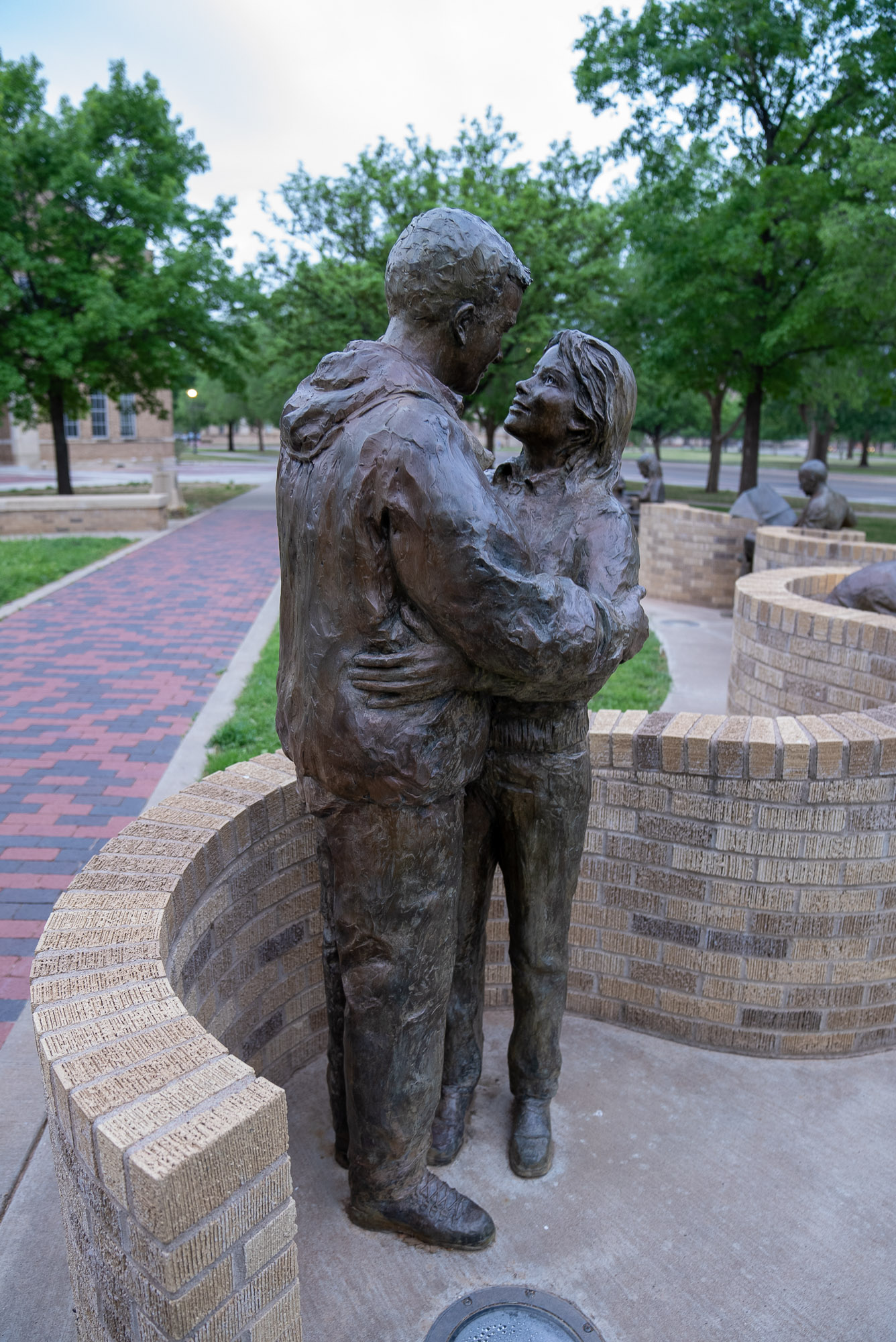
art that can be admired, yet also that very rare art that beckons to be sat upon, designed to further break down art stereotypes. Here, several slightly larger-than-life figures stop to rest. Two young people hugging, a mother sitting with a youngster, a man reading a newspaper, an elderly gentleman with his dog, and a jogger stretching are open not only to interpretation, but to touch and interaction. Goodacre sought to create a piece that would appeal to everyone—men, women, and children. She wanted viewers to sit down and enjoy “visiting” with the figures, and in so doing, identify with them.

Preston Smith
Glenna Goodacre
1985
Bronze
TTU Administration Building
commemorates Preston Smith, the former Texas governor from Lubbock. Known for his relentless work ethic and corny sense of humor, Smith was the first lieutenant governor to be directly elected to the governorship and the first West Texan to be elected. He was inaugurated as governor on January 16, 1969, and was re-elected to a second term in 1970. As governor, he signed into law the legislation that established the Texas Tech University School of Medicine. His papers are located in Texas Tech’s Southwest Collection/Special Collections Library.

All the Worlds A Stage
The Art Studio at RDG Design: Matt Niebuhr & David Dahlquist
2019
Stainless Steel, High-Performance Coating, Lighting
TTU Theater and Dance Building
ceremonial experience of entering the building where for a moment everyone is a performer on stage. Laser-cut metal panels suggest the opening of the stage curtains; the overlap of the moiré pattern panels creates a sense of shifting light and shadows; interior illumination casts an aura of theatric light; a simple stool prop is a glowing artifact at center stage. By walking through this portal, everyone steps into the world of theater and dance on the stage of imagination. artist team of Matt Niebuhr and David Dahlquist, working with The Art Studio at RDG Planning & Design, have completed installations in over one hundred public spaces throughout the United States and Canada.

Summer Tree Autumn Tree
Corinne Ulmann
2013
Hand-painted Architectural Glass
TTU Burkhart Center for Autism Education and Research
depicts an autumnal scene in golds and oranges, while the interior pane portrays a lush, green treetop scene. As lighting conditions change throughout the day, the artwork displays either one season or both seasons simultaneously. This shift between interior/exterior, autumn/summer refers to the subtle distinctions between internal and external worlds common to many individuals with Autism Spectrum Disorders.
Tornado of Ideas
Tom Otterness
2003-04
Bronze
TTU Student Union Building
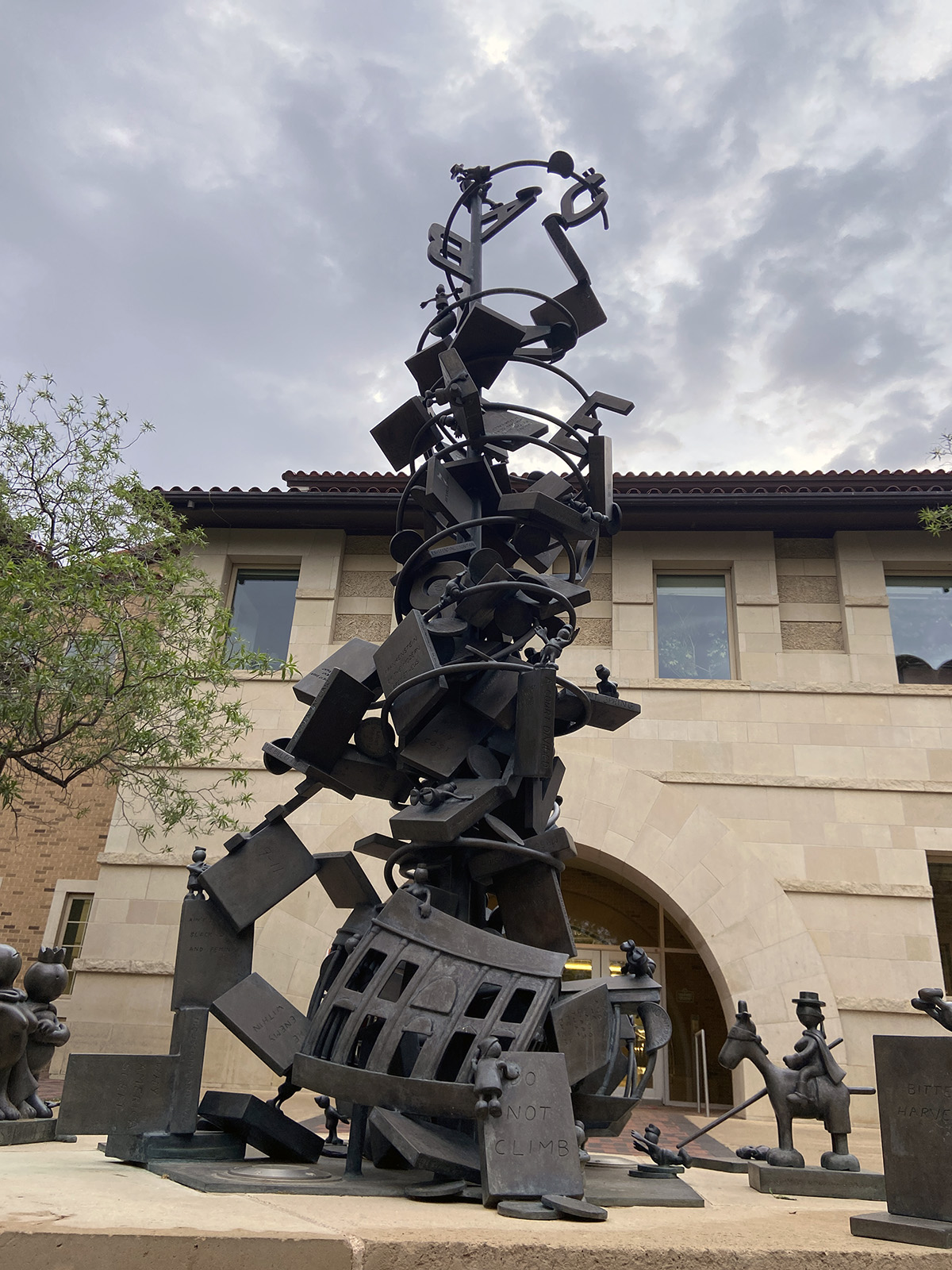
contains characters that play a role in the narrative of this piece. At the base is a house splitting in two from the force of a tornado; books flying through the spiraling storm form the bulk of the piece. Titles on the books reflect conflicting ideologies; symbolically, these polar ideas fuel the tornado’s energy. Seated inside the divided house is a plump prairie dog eating coins. Riding high atop the piece is the artist’s rendering of the Masked Rider, kicking her feet triumphantly in the quest for truth. Otterness hopes this piece provokes discussion and discovery among viewers.
Read Reader
Terry Allen
Bronze
2002
TTU Student Union Building
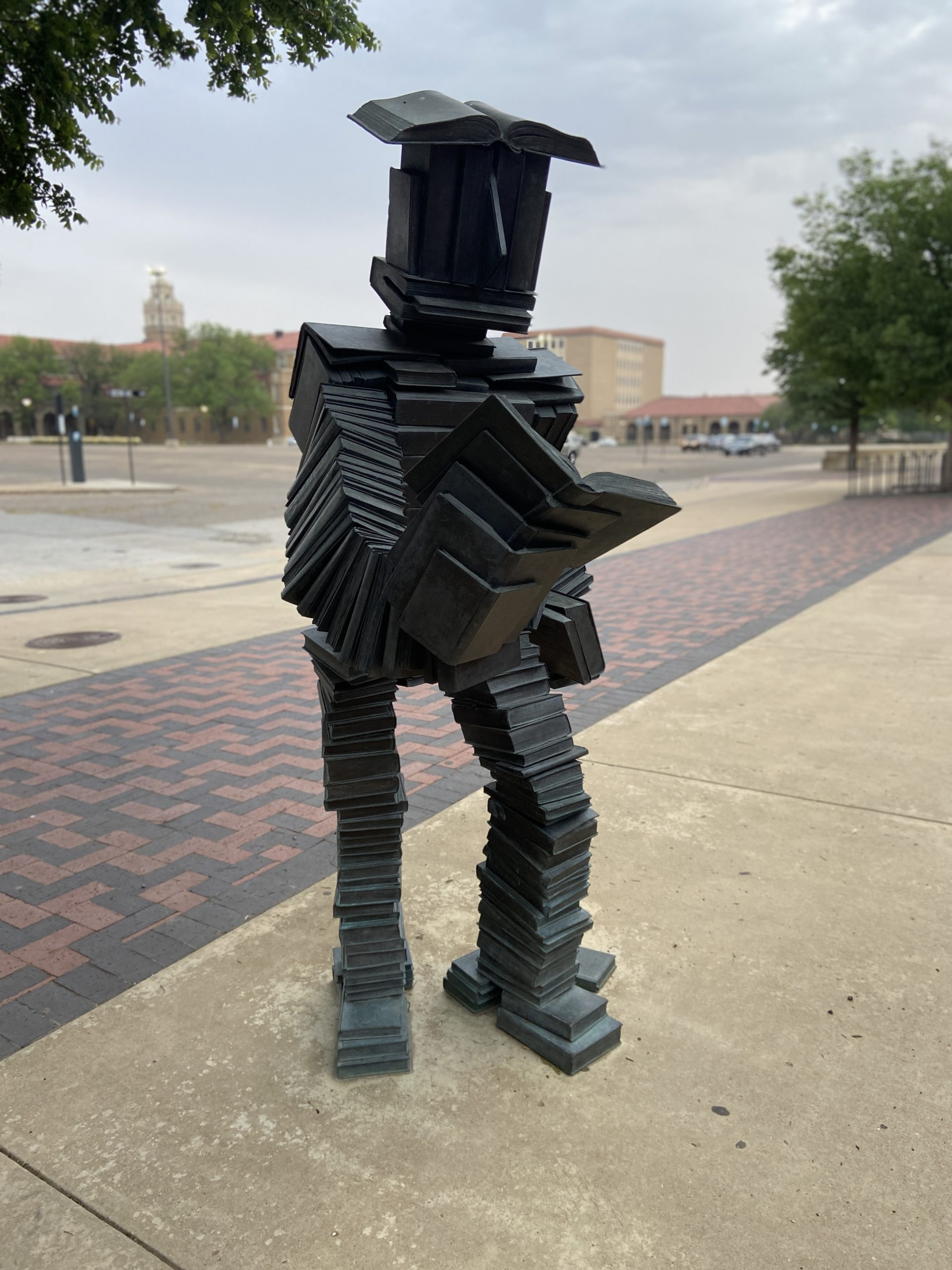
bronze sculpture is made entirely out of cast books. The spines of eight books are aligned vertically to make up the backbone of the figure, and an open book on the figure’s head resembles a mortar board. The artist selected, among other things, old self-help books for their titles and warped pages. He employed a burnout casting process to ensure that embossed lettering and delicate textures of pages were retained. When visiting this piece, study the book titles and see what is discovered.

Milton’s Legacy
Farley Tobin
Granite and Tile
TTU Center for the Study of Addiction and Recovery
this mosaic is inspired by aerial views of the West Texas landscape. The designs are based on the geometric landscape patterns created by the mechanics of irrigation. The artist’s interpretation of crop circles are featured in conjunction with the more delicate patterns created by the oil production sites.

Irish Madonna
Glenna Goodacre
Bronze
2001
TTU Health and Human Sciences Building
sculpture of a mother and child represents the hopes and dreams of those who settled our country. This sculpture is a fitting tribute to Maxine Blankenship, loving wife, mother, and grandmother, a woman of quiet determination and strength who possessed a love for art and beauty.
Donated by the Blankenship Family in memory of Maxine Blankenship
*Artwork not funded by the Texas Tech University System Public Art Program

Raider Red
Garland Weeks
2022
Bronze
Frazier Alumni Pavilion
Raider Red has been a Texas Tech icon for over 50 years. The mascot was created by Jim Gaspard with an inspiration from drawings by Dirk West. This statue was created by artist Garland Weeks and is life-sized to the Raider Red costume that visitors see around campus and at TTU games. The statue depicts Raider Red on his way to Jones AT&T Stadium holding his guns up. This project was funded by a donation from the Texas Tech Credit Union.
Run
Simon Donovan & Ben Olmstead
2017
Stainless Steel and LED Lighting
TTU Sports Performance Center
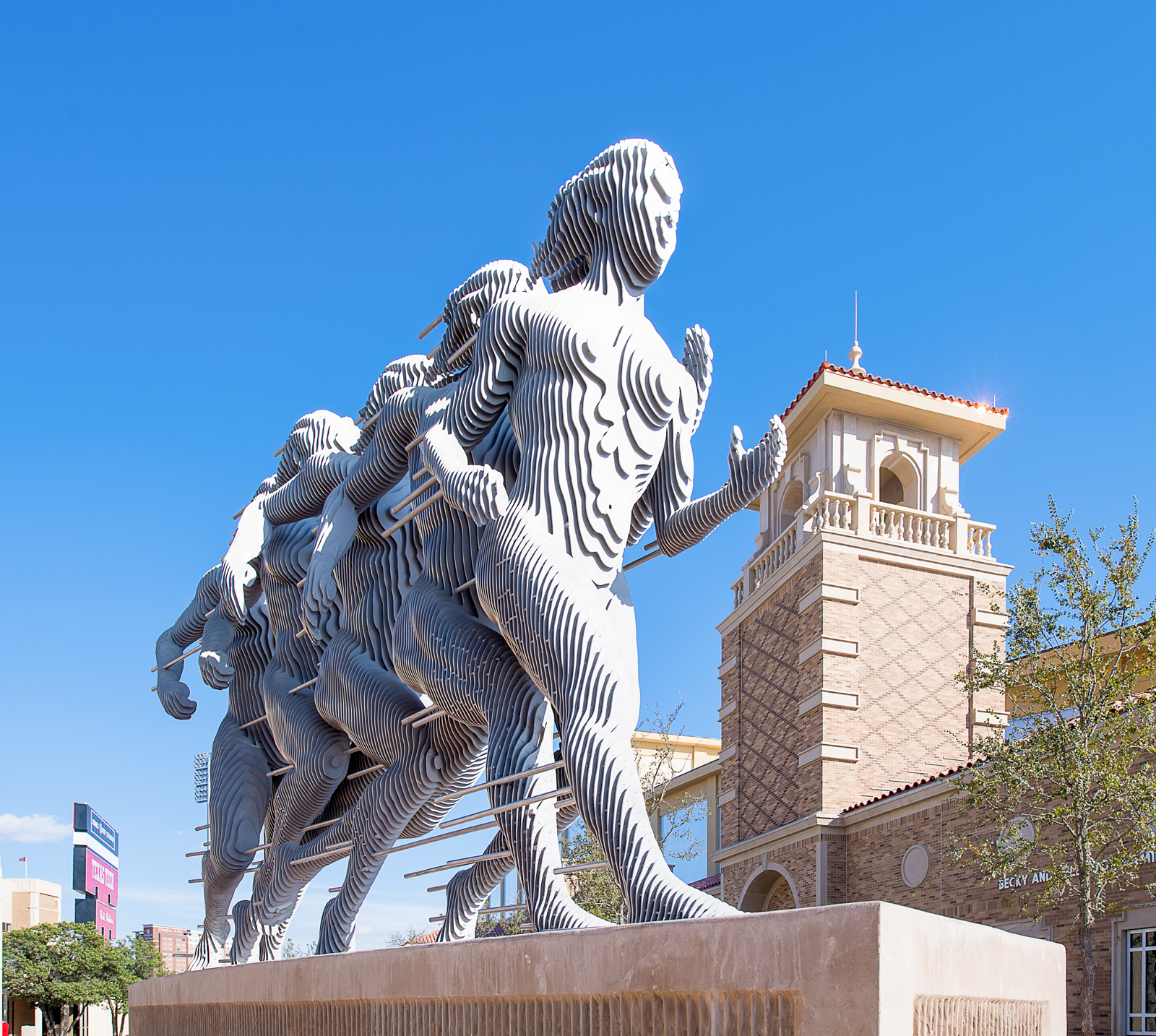
showcases five sequential depictions of a female athlete running, inspired by images of Texas Tech track athletes. It is as if each pose is captured by freeze-frame or stop-motion animation. To create the illusion of movement, each figure is created out of dozens of laser-cut vertical slices of stainless steel, with each layer held apart by pegs. This special construction creates an effect of an ever-shifting nature as you move around the piece, changing from a topographical view to figures almost disappearing from varying angles. Steel rod connectors between figures appear as free-floating lines exiting the back of each figure, instilling a sense of motion with a cartoonish flair.

Masked Rider
Grant Speed
2000
Bronze
TTU Frazier Alumni Pavilion
this life-and-a-quarter sized sculpture represents one of Texas Tech’s well-known mascots, the Masked Rider. Renowned sculptor Grant Speed captures the celebratory gallop of the university’s rider and black American Quarter Horse. The rider’s cape flows while the rider gives the “Guns Up” sign. Names of all former Masked Riders and their horses are etched near the granite base.
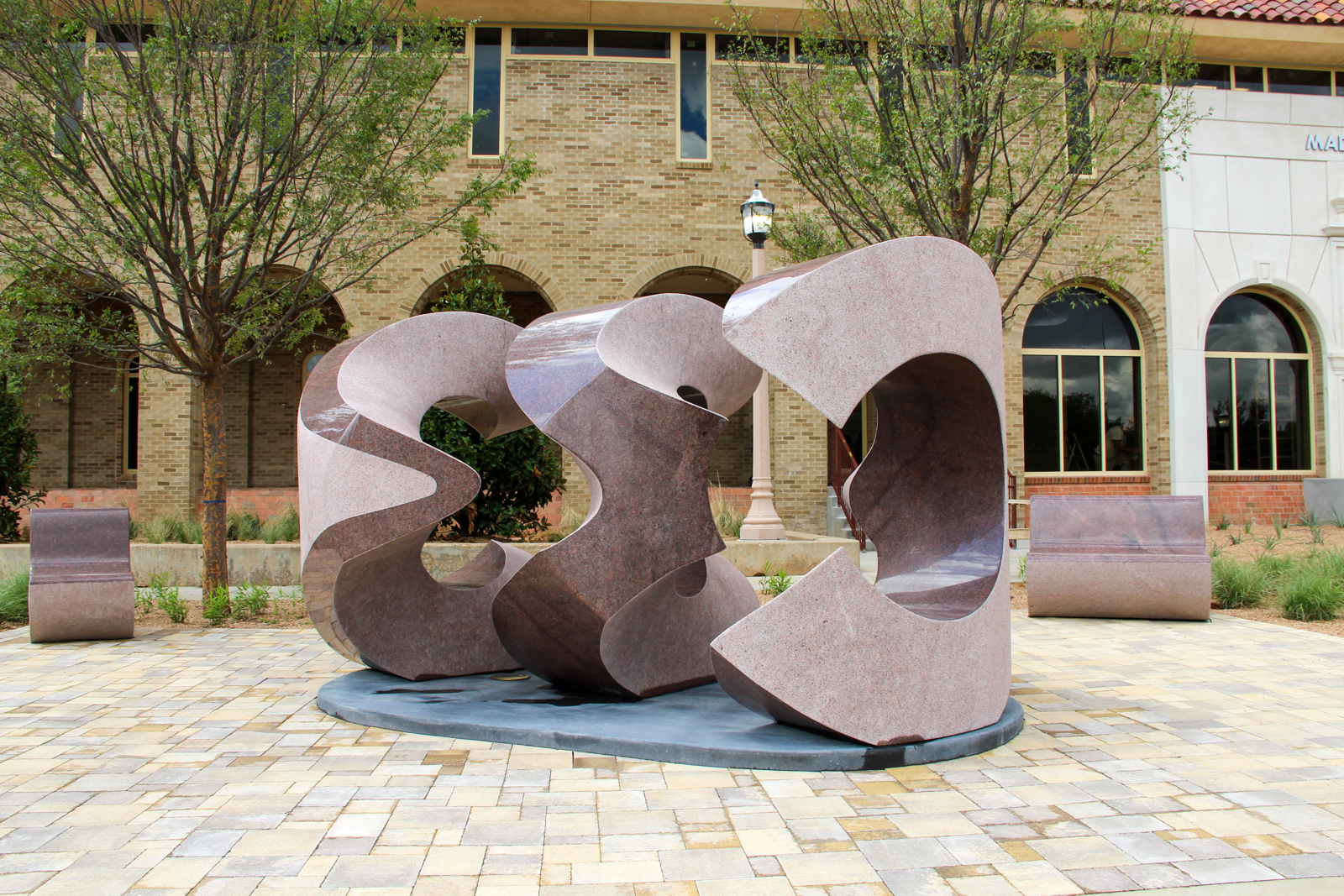
Mechanism
Frank Swanson
2016
Rose Red Granite
TTU, Maddox Engineering Research Center
A mechanism in engineering is anything that can transmit or transform energy. The sculpture can be viewed as mechanism, abstractly based on a sliding shaft coupler used to engage or disengage the transfer of energy.
The sculpture also honors the Maddox brothers, Jack and Donovan, and the JF Maddox Foundation. The center piece represents the Foundation, formed by the brothers. The two outer pieces represent each brother. They were the mechanism that transformed their goodwill into a foundation to benefit their community, a transformation of energy that will live on for generations.

Riding Into the Sunset
Electra Waggoner Biggs
1947
Bronze
TTU Memorial Circle
One of the most well-known landmarks on campus is the statue of Will Rogers and his horse, Soapsuds. This memorial was dedicated on February 16, 1950 by Amon G. Carter, a longtime friend of Rogers, who believed Texas Tech was the perfect setting for the statue. On the base of the statue, the inscription reads, “Lovable Old Will Rogers on his favorite horse, ‘Soapsuds,’ riding into the Western sunset.” Today, Texas Tech tradition and legend surrounds the statue. According to one legend, the plan to position Rogers to ride off into the sunset would cause Soapsuds’ rear to be facing downtown; to solve this problem, the sculpture was turned 23 degrees to the east so the horse’s posterior would face in the direction of College Station and Texas A&M.

Team Spirit
Stephen T. Johnson and Franz Mayer of Munich
2022
Glass Mosaic Tile
Dustin R. Womble Basketball Center, TTU
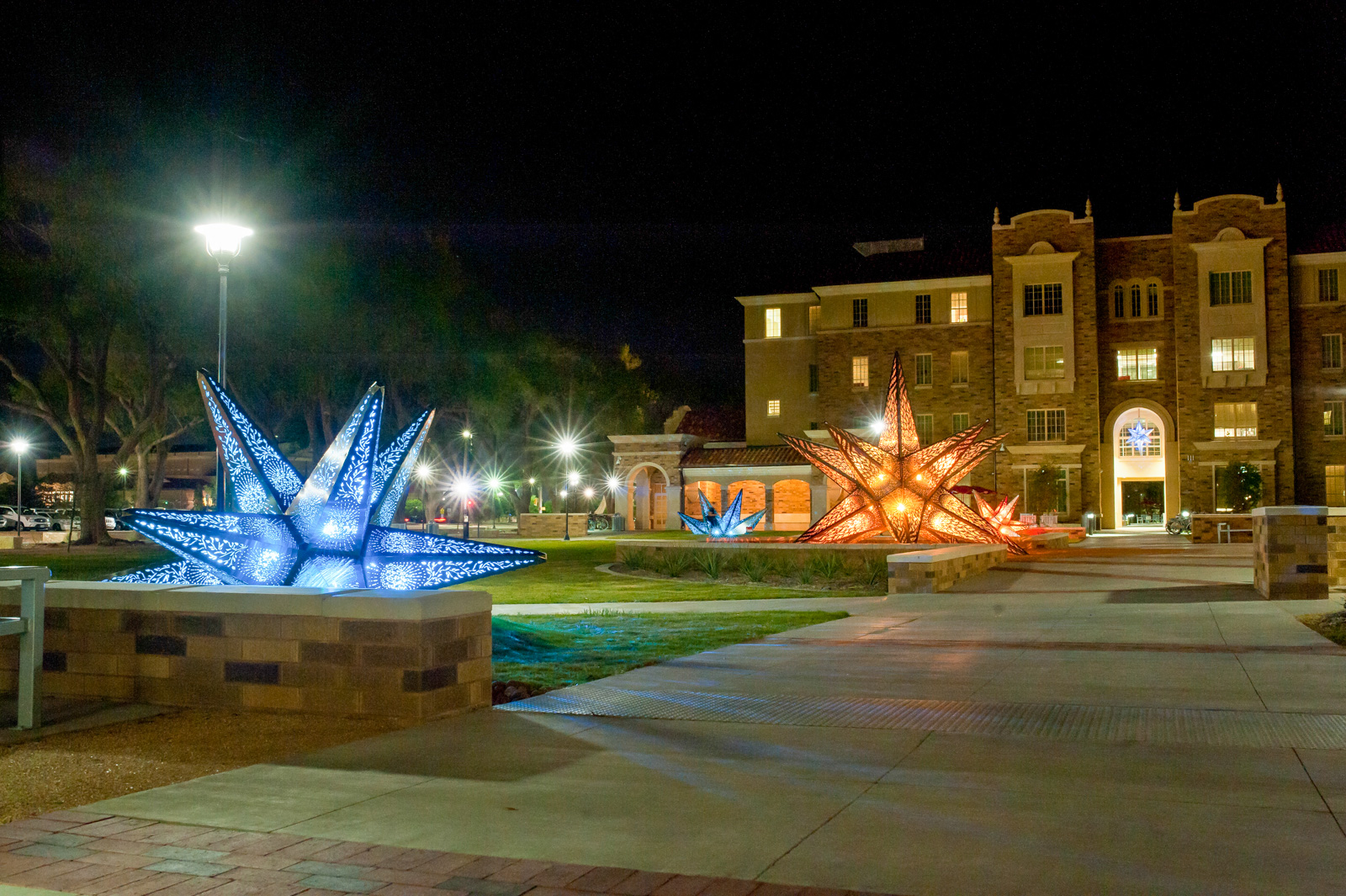
Texas Rising
Joe O’Connell and Blessing Hancock
2014
Stainless Steel and LED Lights
West Village Residence Hall, TTU
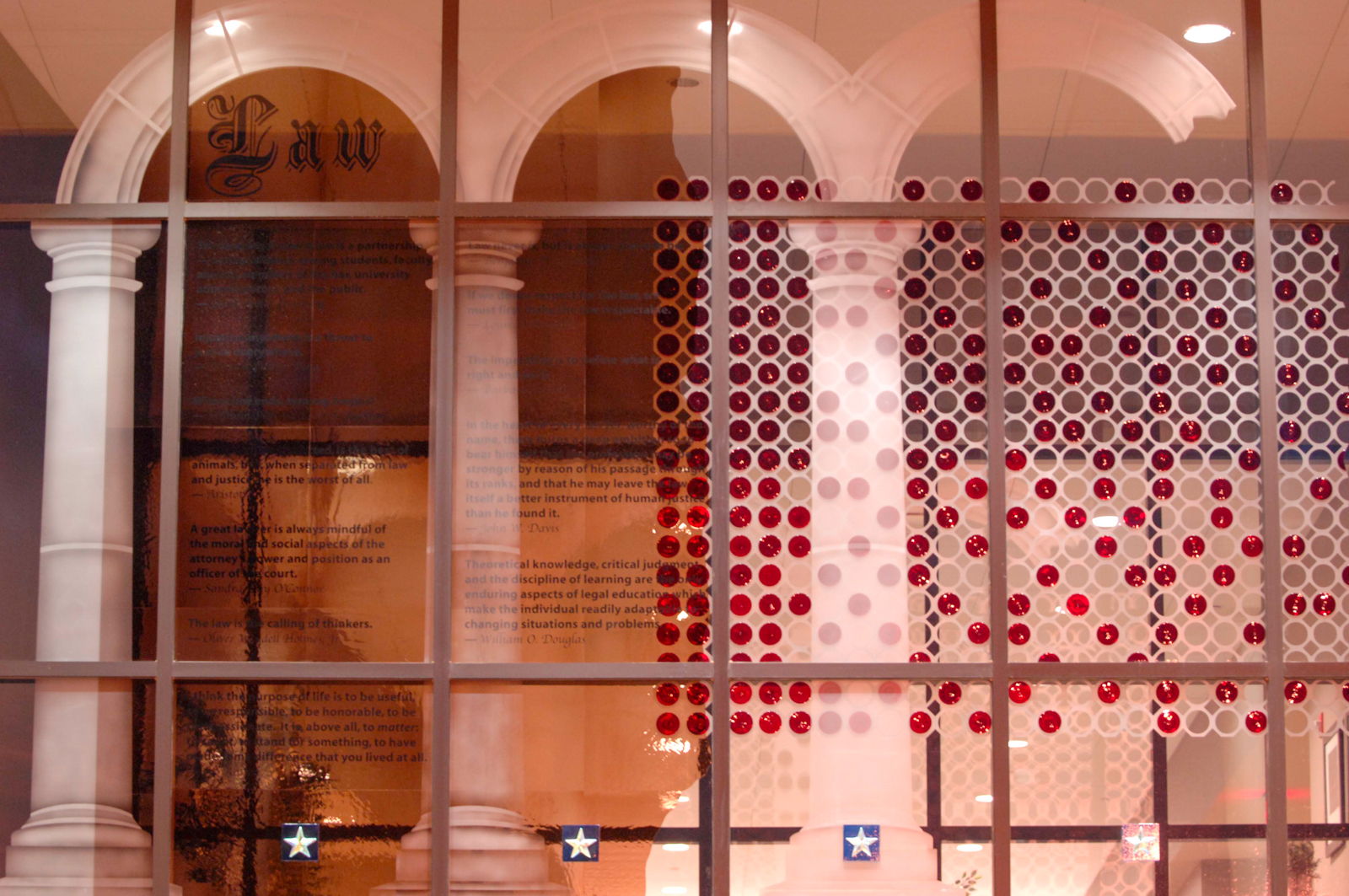
Untitled
Gordon Huether
2007
Architectural Art Glass
Lanier Professional Development Center, TTU
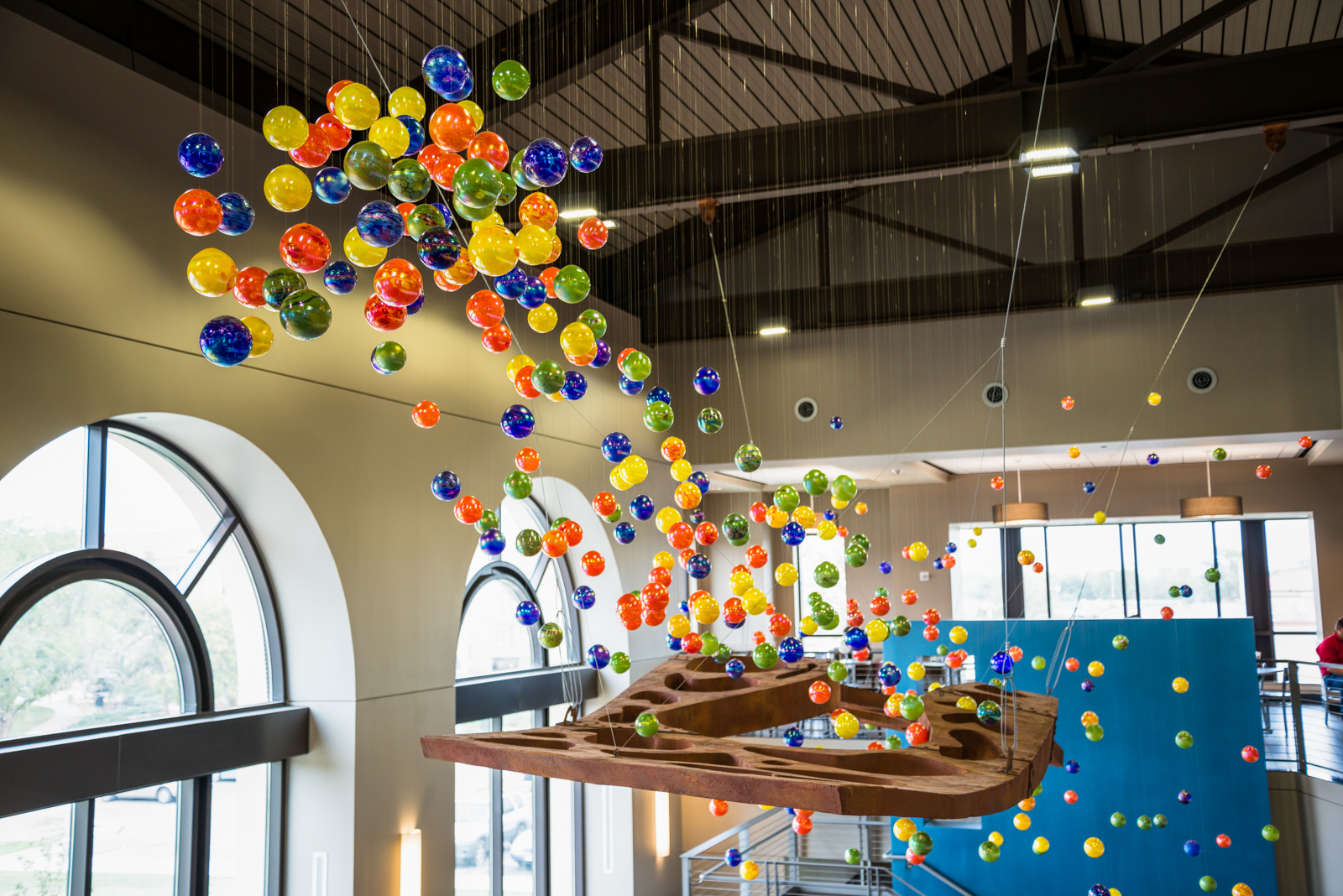
Transitions
Studio Art’s Desire
2012
Glass and High-Density Foam
The Commons by United Supermarkets, TTU

Seis Cuatrifolios
Joe Barrington
2012
Forged Steel, Reclaimed Steel, Cast Bronze, Powder Coat
Kent R. Hance Chapel, TTU

Seed Pod Benches
Robert Tully
2010
Steel and Limestone
Horn Hall, TTU

Blades of Grass
Barbara Grygutis
2006
Granite and Limestone
Clement Hall, TTU

Dos Barra del Oro
Tina Fuentes
1987
Mixed Media on Board
TCVPA Theatre and Dance Complex,TTU

Austin Plus Ultra
Farley Tobin
2006-2007
Granite and Tile
Child Development Center, TTU
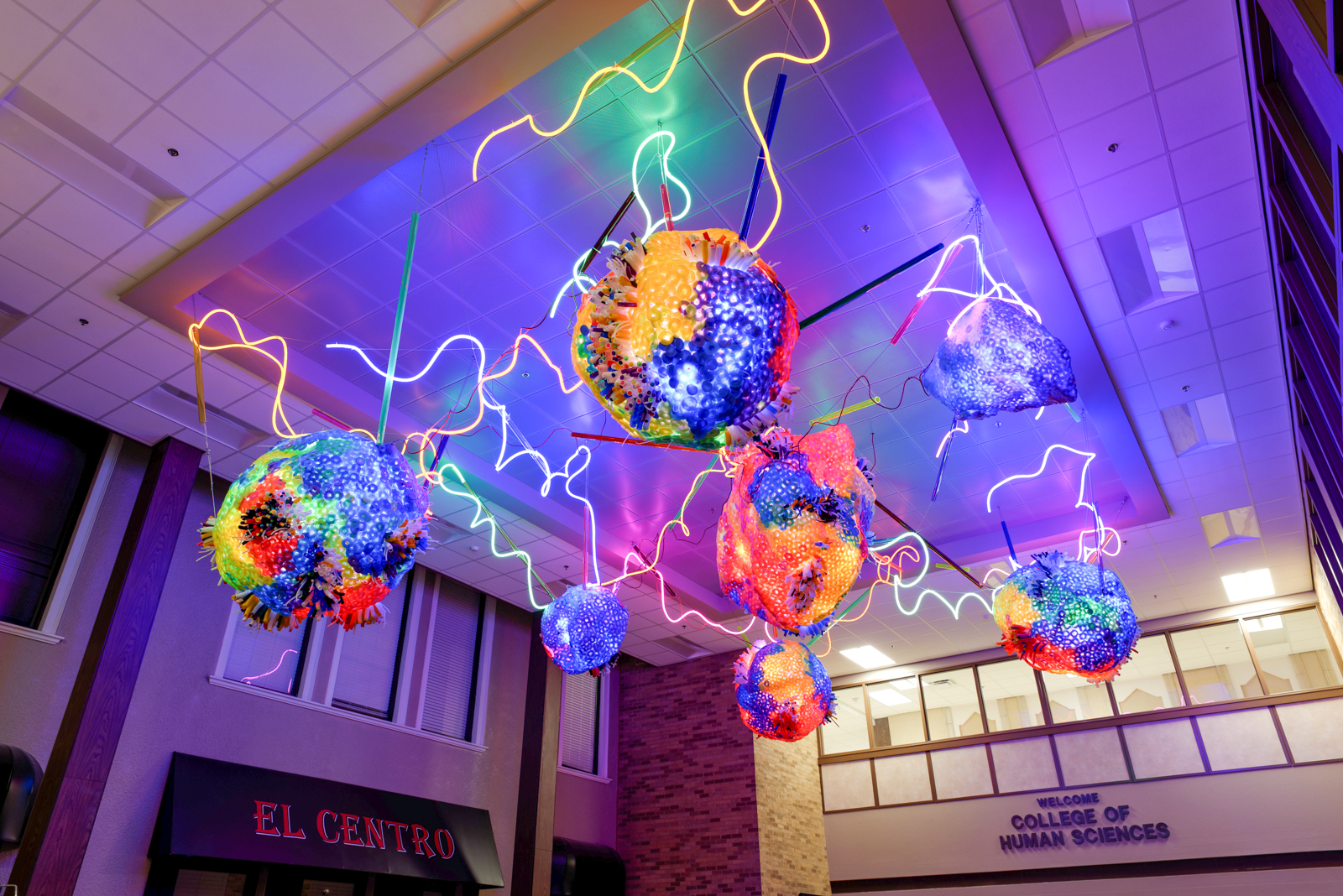
Primordial Garden
Adela Andea
2016
Flex Neon, Steel, Foam, Health & Human Sciences Building, TTU

Fairyland, Exhibits F, J, M, P, W
Diana Dopson
2004
Digital Chromogenic Color Print
Administration Building, TTU

La Silla
Joel Salcido
1998
Silver Gelatin Print on Archival Paper
Administration Building, TTU

Zabila
Joel Salcido
1998
Silver Gelatin Print on Archival Paper
Administration Building, TTU

El Aprendizaje
Joel Salcido
2000
Silver Gelatin Print on Archival Paper
Administration Building, TTU

Camino a Casa
Joel Salcido
2002
Silver Gelatin Print on Archival Paper
Administration Building, TTU

Toro Obscuro
Joel Salcido
2002
Silver Gelatin Print on Archival Paper
Administration Building, TTU

Pioneer Mural
Peter Hurd
1954
Fresco
Holden Hall, TTU

Lapstrake
Jesus Moroles
2005
Granite
Discovery Mall, TTU

Aureole
Shane Allbritton
2017
Ceramic-Steel Discs
Industrial Engineering Building, TTU

Hive
William Cannings
2010
Inflated Steel
Electrical & Computer Engineering Building, TTU

Flowmotion
Nancy Lovendahl
American
Powder-coated Spun Aluminum
2014
TTU Exercise and Sports Sciences Building
inspired by the science of water dispersion when a swimmer dives into a pool. It relates to basic scientific flow concepts such as the nature of fluids, relative motions, flotation of the human body, skin friction, and drag and lift. Lovendahl portrays a diver penetrating water using color and abstract form made of spun aluminum hemispheres attached to the brick wall. The mural is intended to inspire activated energy for the viewer.

Oblique Intersection
Lead Pencil Studio: Annie Han & Daniel Mihalyo
Korean American, American
Black Oxide Stainless Steel
2019
TTU Experimental Sciences Building II
retains the language of recognizable building elements seen on campus. The translucent sculptural form is made legible with viewer movement around the sculpture. Constructed entirely with stainless steel rods, the ephemeral form is intended to be visually ever-changing based on a viewer’s position relative to the sun and seasons

Square Spiral Arch
Jesús Moroles
American
Granite and Limestone
2005
Experimental Sciences Building I
At 25 feet tall and 31 feet wide, Square Spiral Arch features spiraling lines of texture that radiate out like fingers of energy, reminiscent of a sunset. A polished rectangular path cuts through the center of the arch. This circle and square motif represents heaven and earth, respectively, and reflects the artist’s work and travels in Asia. It is this tall so emergency vehicles can get though it.