Bio Unit 2
 Call Kai
 Learn
 Practice Test
 Spaced Repetition
 Match
 Flashcards
 Knowt Play
1/98

There's no tags or description
Looks like no tags are added yet.
99 Terms
Cytoskeleton
dynamic network of fibrous proteins throughout the cytoplasm (three major fiber types: microtubules, microfilaments/actin, intermediate filaments)
functions: provide cell with shape and rigidity and help attach cell to neighboring cells and surroundings
movement of vesicles, organelles, chromosomes during mitosis, cells, and muscles
Microtubules
Provide Support and Enable Movement
Hollow tubes assembled of tubulin (protein)
Dynamic - grow and shrink with the addition or removal of individual proteins
Maintain cell shape (compression-resistant beams)
Functions: movement of chromosomes during cell division, vesicles/organelles move on MT tracks like trains, cell: cilia, flagella
Form the mitotic spindle that pull chromosomes apart during cell division
Motor proteins use microtubules as tracks
Microfilaments
solid rods, actin (protein) polymers, form linear and branched structures
dynamic - grow and shrink with the addition or removal of individual proteins
functions: maintain cell shape, movement (skeleton-muscle, cell-amoeboid movement)
The motor protein myosin pulls actin filaments together to contract muscles
Connective Tissue
mostly structural, includes bones, cartilage and fat
Epithelial Tissue
forms barriers between different spaces
Muscle Tissue
movement
Nervous Tissue
communication and coordination
Gap Junction
pathway: protein pore connecting cytoplasm of neighbors
Desmosome
rivet: transmembrane proteins anchor cells together
Tight Junction
liquid seal: transmembrane proteins pull cell membranes together, often making a water-tight barrier between cells
Reactants/Substrates
the starting materials in a chemical reaction, it is the specific reactant that binds to the active site of an enzyme to be transformed in to a product
Products
the final molecule created after the chemical reaction is complete
Transition State
the highest-energy, most unstable point of a chemical reaction where old bonds are half-broken and new bonds are half-formed
Activation Energy
energy required to get from reactants to transition state
Enzymes
proteins which speed up chemical reactions, shaped to stabilize the structure of the transition state, enzyme not only recognized substrate but also induces the formation of transition state, by stabilizing transition state enzymes reduce activation energy to speed up reactions, enzymes only affect reaction kinetics (speed) not energy absorbed or released by reactions, can be reused over and over, its structure includes an active site, amino acids found at the active site might not be next to each other in primary structure of polypeptide
Active Site
where substrates/reactants bind and the reaction can be catalyzed
Metabolism
the sum total of chemical reactions in an organism
Anabolic
small to big
biosynthetic, join small to get larger molecules, consumes energy
Catabolic
big to small
degradative, break down large to smaller, releases energy
Competitive Modulator
similar shape to substrate, compete for active site
always inhibit enzyme because takes space of substrate
overcome by increased substrate
Allosteric Modulator (noncompetitive)
noncompetitive
bind away from active site (no competition), alter protein shape
can increase or decrease enzyme activity depending on how it changes enzyme shape
unaffected by substrate
Negative Feedback
products of a reaction or pathway inhibit an enzyme in the pathway, reducing production of the product
Positive Feedback
products of a reaction or pathway activate an enzyme in the pathway, increasing production of the product
ATP
adenosine triphosphate, the cell’s useable energy
ATP Hydrolysis
catabolic reaction where ATP reacts with water to break a phosphate group off, producing ADP and a phosphate group, releases energy
Phosphorylation
addition of a phosphate group
Autotroph
“self feeders”
producers: generate food from non-living sources (ex: CO2)
-photoautotroph: use light energy to synthesize organic compounds
Heterotroph
“other feeders”
consumers: live on compounds produced by other organisms
Photosynthesis
captures light energy, stores in stable forms (light to carbohydrates)
6CO2 + 12H2O + Light → C6H12O6 + 6O2 + 6H2O
Cellular Respiration
converts energy from stable to versatile forms (carbohydrates to ATP)
Endosymbiosis
one organism living inside another, eukaryotic ancestors engulfed prokaryotes (evidence: double membrane, own DNA, ribosomes, and proteins, autonomous growth/replication, energy production)
Chloroplasts
sites of photosynthesis, three membrane bound compartments:
inter-membrane space
stroma
thylakoid space
Light Reactions
“Photo”
-where: thylakoid
-what: convert solar energy to chemical energy
Calvin Cycle/Dark Reactions
“synthesis”
where: stroma
what: transform chemical energy into storable forms
Pigments
plants use pigments to absorb light, pigments absorb specific wavelengths of light and reflect others, pigments can send high energy electrons to NADPH, water is the source of new electrons for photosynthesis
Flow of Electrons during Light Reactions
water → PSII → ETC → PSI → NADPH
Electrons flow from water to NADPH
ATP Synthase
A spinning turbine that uses hydrogen ion flow to power ATP production (ADP + P → ATP)
Cyclic Electron Flow
electrons cycle within PSI
generates additional ATP, provides photo protection (light can’t harm molecule if it were to be absorbed else where)
What are the tenets of cell theory?
Cells are the simplest unit that can carry out all functions of life
All living things are composed of one or more cells (organismal functions have basis in cell functions)
New cells are created by previous cells (all family)
What characteristics do prokaryotic and eukaryotic cells/organisms have in common? How are they different?
Prokaryotic and Eukaryotic cells/organisms have a cell(plasma) membrane composed of a phospholipid bilayer, a selective barrier, and encloses cytoplasm, they also both have biological molecules such as carbohydrates, lipids, proteins, and nucleic acids (DNA and RNA)
Prokaryotic and Eukaryotic cells/organisms differ because:
prokaryotic is “before nucleus”, domains: archaea and eubacteria, smaller, DNA stored in cytoplasm, only single-celled organisms
eukaryotic is “true nucleus”, domain: eukarya, DNA stored in nucleus (surrounded by membrane), Organelles (“little organs”) surrounded by membranes with specialized jobs, larger, single and multi-called organisms
Why don’t larger organisms have larger cells?
Larger organisms don’t have larger cells, just more cells. This is because metabolism imposed theoretical limits on cell size, the need to exchange things with the environment limits the size of cells. This is due to the constraint of metabolism on the surface area to volume ratio of cells. Smaller cells have a higher surface area to volume ratio.
What is a vesicle?
small sack surrounded by membrane used to move things between organelles
Explain the functions of the following structures:
a) Mitochondria
b) Lysosome
c) Rough Endoplasmic Reticulum (RER) and Golgi Apparatus
d) Vesicles
a) site of most energy production in Cell Respiration, found in all eukaryotic cells but cells with higher energy demand have more
b) digest objects brought into the cell by endocytosis, found in most animal cells but more found in endocytic cells like immune cells
c) rough because covered in protein-making factories called ribosomes, site of protein synthesis for proteins that will be released to outside of cell
Golgi sorts, modifies, and ships proteins meant for release to outside of cell
d) small sack surrounded by membrane used to move things between organelles
What is the cytoskeleton made of and why is it described as “dynamic”?
made of fibrous proteins throughout the cytoplasm (three major fiber types: microtubules, microfilaments/actin, intermediate filaments), described as dynamic because the protein subunits are constantly assembling and disassembling
What effects can cytoskeletal fibers have on other structures when the fibers get longer or shorter? Provide two examples from class.
They can exert physical forces that directly manipulate other cellular structures. Examples would be movement of chromosomes during cell division and the movement of vesicles/organelles on MT tracks like trains.
What are the types of tissues found in animals and what are their functions?
-Connective Tissue: mostly structural, includes bones, cartilage, and fat
-Epithelial Tissue: forms barriers between different spaces
-Muscle Tissue: movement
-Nervous Tissue: communication and coordination
How do enzymes increase the speed of a chemical reaction?
by stabilizing transition state, enzymes reduce activation energy to speed up reactions
How does an enzyme’s environment dictate its evolution and activity?
enzyme and substrate concentrations influence reaction rate
temperature increases reaction rate to an optimum (can denature enzyme or alter active site if above optimum)
enzymes function best at a specific pH (alters acidic/basic amino acids, prevents ionic bonds, binding and catalytic amino acids affected)
What is negative feedback?
products of a reaction or pathway inhibit an enzyme in the pathway, reducing production of the product
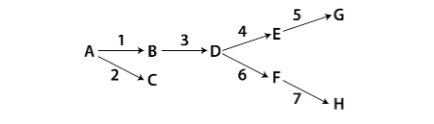
In the above pathway, which enzymes would have to be active, inactive, or would not matter to maximize the concentration of: F? B? C?
F: active: 1, 3, 6 inactive: 2, 4, 5, 7
B: active: 1 inactive: 2, 3, 4, 5, 6, 7
C: active: 2 inactive: 1, 3, 4, 5, 6, 7
Define biosynthetic, anabolic, and catabolic.
biosynthetic: the multi-step, enzyme-catalyzed process where living cells convert simple nutrients into complex molecule
anabolic: join small to get larger molecule, consumes energy
catabolic: breaks down large to get smaller molecules, releases energy
What is the role of ATP in the cell?
the cell’s useable energy, ATP powers most cellular work such as chemical work, transport work, and mechanical work
How does phosphorylation provide energy for proteins to carry out work?
phosphorylation of a protein adds a phosphate group that temporally changes its structure, allowing it to do work
What are the relationships between photosynthesis and cell respiration? What happens to the atoms and energy that move through these processes?
They are reciprocal processes, the products of photosynthesis are the inputs for cellular respiration and vice versa. Photosynthesis: light → carbohydrates. Cellular Respiration: carbohydrates → ATP. Energy flows through ecosystems and is used up, chemical elements are recycled.
How did the mitochondria and chloroplast evolve? What is the evidence for this?
They evolved through endosymbiosis (one organism living inside another). Eukaryotic ancestors engulfed prokaryotes, with oxygen-using mitochondrion and photosynthetic chloroplast. Evidence is a double membrane, own DNA like ribosomes and proteins, autonomous growth/replication and energy production
What is the source of carbon for photosynthesis and where does it come from?
The source of carbon is carbon dioxide that comes from the surrounding atmosphere.
What role do each of the following play in photosynthesis:
1. Water
2. Pigments
3. NADPH
electrons are transferred from water to NADPH, water is the source of new electrons of Photosynthesis, releases oxygen as a byproduct into the atmosphere, the breaking of water realizes hydrogen ions that help build a proton gradient to drive ATP synthesis and reduce NADP+
plants use pigments to absorb light, pigment electrons absorb photon energy and fluoresce, pigments can send high energy electrons to NADPH, excite electrons to drive the ETC
high energy electron carrier, powers the Calvin cycle, helps build sugars (G3P)
What are the products of the Light Reactions?
O2 (oxygen), ATP, NADPH
What are the products of the Calvin Cycle?
G3P, ADP, P, NADP+
What molecules are needed for the Calvin Cycle? Where do they each come from?
CO2 (carbon dioxide): from the atmosphere
ATP: from the light reactions
NADPH: from the light reactions
What molecules are needed for the light reactions? Where do they each come from?
H2O: absorbed from the soil by plant roots
light: sunlight
ADP:
P
NADP+
What are pigments and what happens with them during photosynthesis?
Pigments light absorbing molecules, used by plants. In photosynthesis they help the plant absorb light, exciting the electrons and sending them to high energy electron carriers
What molecule is the source of new electrons for photosynthesis?
water
How is ATP generated in the light reactions?
the flow of electrons pulls hydrogen ions into the thylakoid space, creating a concentration gradient across the thylakoid membrane, ATP synthase uses this gradient to power ATP production
What is the useful product of the Calvin Cycle? Why is it important?
G3P, it goes towards making glucose
What is the source of energy for cell respiration?
glucose
Where will you find:
A. Glycolysis Enzymes?
B. Citric Acid Cycle Enzymes?
C. Electron Transport Chain Proteins?
D. High concentration of hydrogen ions?
What is the source of electrons in glycolysis? How are those electrons transferred to the Electron Transport Chain (ETC)?
What are the products of glycolysis?
What is the function of the ETC?
How does ATP Synthase work? What does it need and how does it relate to other processes in respiration?
What is the role of oxygen in respiration?
What processes in cell respiration won’t work under anaerobic conditions and why?
What processes in cell respiration will work under anaerobic conditions and why?
What is accomplished in fermentation reactions?
Transpiration
CAM Pathway
C4 Pathway
Thylakoid
Stroma
Glycolysis
Pyruvic Acid/Pyruvate
Citric Acid Cycle
Substrate-level Phosphorylation
acetyl-CoA
Anaerobic Respiration
Lactic Acid Fermentation
Alcoholic Fermentation
3 Tenets of Cell Theory
Prokaryotic Cell
Eukaryotic Cell
Mitochondria
site of most energy production in cell respiration
found in all eukaryotic cells, but cells with higher energy demand have more
Vacuole
Lysosome
digests objects brought into the cell by endocytosis
found in most animal cells, but more found in endocytic cells like immune cells
Smooth Endoplasmic Reticulum (SER)
contains enzymes for destroying toxins
where phospholipids are made
Peroxisome
manages hydrogen peroxide levels
regulates fat metabolism
Rough Endoplasmic Reticulum (RER)
rough because covered in protein-making factories called ribosomes
site of protein synthesis for proteins that will be releases to outside of cell
Golgi apparatus
sorts, modifies, and ships proteins meant for release to outside of cell
Vesicle
a small sack surrounded by membrane used to move things between organelles