Modo de aprendizaje: GTC Exam 3; Part 3: Fluids and Electrolytes
 Call Kai
 Learn
 Practice Test
 Spaced Repetition
 Match
 Flashcards
 Knowt Play
1/59

There's no tags or description
Looks like no tags are added yet.
60 Terms
two major fluid compartments in the body:
• intracellular fluid (ICF) 67%
major cations: K⁺, Mg²⁺
major anions: PO₄³⁻ (phosphate), also proteins
• extracellular fluid (ECF) (33%) = plasma + interstitial fluid
major cations: Na⁺
major anions: Cl⁻, HCO₃⁻ (bicarbonate)
While intracellular fluid varies significantly from extracellular fluid, interstitial fluid, and plasma have similar electrolyte compositions
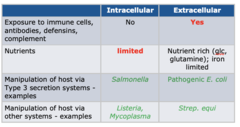
In a clinical setting, _______________ is used to obtain blood.
venipuncture; The levels of dissolved solutes (glucose, enzymes, ions) are determined in plasma (extracellular fluid)
normal levels for Na⁺ and K⁺ in plasma are
Na⁺ = 135-145 mEq/L
K⁺ = 3.5-5.1 mEq/L
water balance (gain vs loss)
1. daily water gain: approximately 2500 mL
• drinking: 1500 mL
• food: 750 mL
• cellular respiration: 250 mL
2. daily water loss: approximately 2500 mL
• kidneys: 1500 mL
• lungs/skin: 750 mL
• perspiration / feces: 250 mL
Name two ways the hypothalamus regulates water balance:
1. Thirst mechanism
2. ADH production
movement of water
- moves freely between extracellular and intracellular spaces
- moves through the cell membrane by osmosis through channels called aquaporins
- follows Na⁺, glucose, and protein (albumin)
Does water move from a hypertonic to a hypotonic solution or from a hypotonic solution to a hypertonic one? Explain
Water moves from a hypotonic solution to a hypertonic solution because water moves toward higher solute concentration

An increase in plasma Na⁺ will __________ osmotic pressure of the blood
increase
Explain how the ICF (intracellular fluid) composition will change if the ECF (plasma) becomes too salty
Water will move out of the cells into the ECF, causing cells to shrink and intracellular fluid volume to decrease
Dehydration
Dehydration can be due to the loss of water (lack of ADH) or due to the loss of solutes and water (for example, diarrhea).
- A significant loss of ECF can lead to hypovolemic shock.
Assuming that primarily water is lost (more water than solutes), what would happen to the amount of ICF as the level of ECF decreases?
ICF would decrease because water would move from ICF to ECF
Explain why Na⁺ levels in the plasma would increase when water is lost, even though there is really no change in the amount of Na⁺
because the solvent volume decreases while the total amount of sodium remains the same. This increases the ratio of particles to fluid, making the blood more concentrated (hypertonic)
Overhydration (hypotonic hydration)
water intoxication, a large amount of a hypotonic solution is taken in
- Na⁺ levels would decrease (dilutional hyponatremia)

What would happen: to the volume of the ICF if ECF water increases?
ICF volume would increase because water moves into cells
Edema
swelling caused by abnormal accumulation of fluid in interstitial spaces of tissues.

How would edema affect nutrient exchange in the capillaries?
It increases diffusion distance, reducing nutrient and oxygen exchange
Explain why edema results from each of the conditions listed below: increased venous pressure, poor lymph drainage, increased capillary permeability, right congestive heart failure, decreased plasma albumin levels
• increased venous pressure
Increases capillary hydrostatic pressure pushing more fluid out of capillaries into interstitial space.
• poor lymph drainage
Fluid is not returned to the blood so it accumulates in interstitial space.
• increased capillary permeability
Proteins leak into interstitial fluid, increasing osmotic pressure and pulling water out of capillaries.
• right congestive heart failure
Blood backs up in systemic circulation increasing venous pressure and causing edema.
• decreased plasma albumin levels
Decreases blood osmotic pressure so less fluid is pulled back into capillaries.
sodium balance
Sodium is responsible for much of the osmotic pressure of the blood and helps control water distribution
Hyponatremia
Low sodium levels in the blood.
- makes the blood hypotonic
- ICF volume increases (cells swell)

Hypernatremia
high sodium in the blood
- makes the blood hypertonic
- ICF volume decreases (cells shrink)

hormonal control of sodium levels
a. aldosterone (made in adrenal cortex)
b. atrial natriuretic peptide (ANP) (made in heart/atria)
What causes aldosterone to be made?
I. Low blood pressure
II. Low sodium levels
III. High potassium levels
What are the effects of aldosterone?
I. Increases Na⁺ reabsorption
II. Increases water reabsorption
III. Increases blood pressure
What causes ANP to be made?
High blood pressure or high blood volume (stretch of atria)
What are the effects of ANP?
Decreases Na⁺ reabsorption, increases urine production, decreases blood volume
Does ANP increase or decrease blood pressure? Explain
Decreases blood pressure because more Na⁺ and water are excreted, reducing blood volume
potassium balance
- Homeostasis of this ion is vital for heart and skeletal muscle function.
- most of the potassium in the body is located in the ICF
- Changes in the amount of potassium in the blood can have an effect on the action potential, affecting both the resting membrane potential and repolarization
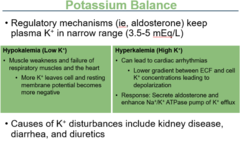
What part of the nephron regulates the amount of K⁺ in the urine?
Distal convoluted tubule and collecting duct
Hypokalemia
Low potassium levels in the blood. typically causes muscle weakness and paralysis

Hyperkalemia
high levels of potassium in the blood. leads to muscle spasms and cardiac dysrhythmias
- K⁺ and H⁺ levels in the blood are linked. Hyperkalemia leads to acidosis

hormonal control of potassium levels: what hormone and what does it do
Aldosterone increases the secretion of K⁺ by the nephron as well as the absorption of Na⁺ by acting on the distal convoluted tubule and collecting duct
- when aldosterone levels are high; K⁺ levels in the blood decrease.
calcium balance
Calcium plays a role in the cardiac muscle action potential; alterations in blood calcium can cause cardiac dysrhythmias. In addition, the levels of calcium will affect muscle function and nerve impulse conduction across synapses.
- most of the calcium in the body at any given time is in the Bones (skeletal system).

Explain the importance of calcium in each system: skeletal, nervous, cardiovascular, and muscular
• skeletal system: Bone structure and strength; calcium is stored in bones.
• nervous system: Required for neurotransmitter release at synapses.
• cardiovascular system: Important for cardiac muscle contraction and cardiac action potentials.
• muscular system: Required for muscle contraction (skeletal and smooth muscle).
Hypocalcemia
Low calcium levels in the blood. increases muscle excitability

Hypercalcemia
excessive calcium in the blood. causes muscle weakness and pain

hormones regulating calcium levels
• parathyroid hormone (PTH)
- activates osteoclasts
- Ca²⁺ levels in plasma increase when PTH is made
- Increases calcium reabsorption and increases phosphate excretion in the kidney tubule
• calcitonin
- activates osteoclasts
- made by thyroid gland
- Ca²⁺ levels in plasma decrease when calcitonin levels are high
magnesium balance
Magnesium is often required for the breakdown and synthesis of ATP

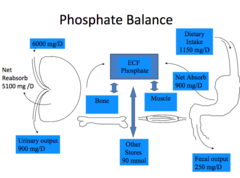
phosphate balance
Phosphate is a major intracellular anion needed for ATP synthesis as well as the synthesis of nucleic acids.
acid base balance
normal pH range of the blood = 7.35 - 7.45
A blood pH > 7.45 is called alkalosis
a blood pH < 7.45 is acidosis

Why is a change in blood pH so detrimental for the body?
Because enzymes and proteins only function properly within a narrow pH range.
bicarbonate / carbonic acid buffer system
plays a key role in regulating both acidic and alkalotic conditions in the body. If pH drops (acidic), H⁺ combines with HCO₃⁻ to form CO₂ and H₂O. If pH rises (alkaline), CO₂ and H₂O form H⁺ and HCO₃⁻ to lower pH
- unique because It is regulated by both the lungs (CO₂) and kidneys (H⁺ and HCO₃⁻)
- formula: CO₂ + H₂O ↔ H₂CO₃ ↔ H⁺ + HCO₃⁻

Where does hemoglobin play an important role as a buffer?
In red blood cells (blood)
plasma protein buffers
The -COOH groups on proteins can also act as buffers that pick up and release H⁺
phosphate buffers
found in the intracellular fluids as bicarbonates. They control small fluctuations in pH and respond quickly.
Acid-base disturbances are described as either...
respiratory or metabolic
• respiratory acidosis / respiratory alkalosis
- If it is respiratory, the reason for the acidosis or alkalosis is an altered CO₂ level in the blood
• metabolic acidosis / metabolic alkalosis
- If the reason for what caused a change in HCO₃⁻ in the blood and pH change is anything other than breathing, the patient is in metabolic acidosis or alkalosis
The carbonic anhydrase equation links pH with pCO₂ in the blood.
Low pCO₂ leads to...
low H⁺and high pH
respiratory acidosis
If a patient is in respiratory acidosis, the patient is hypoventilating and CO₂ levels are high
- Respiratory acidosis is due to hypercapnia

respiratory alkalosis
If a patient is in respiratory alkalosis, the patient is hyperventilating and CO₂ levels are low
- Respiratory alkalosis is due to hypocapnia

The lungs control pH through _____ levels. The kidneys help control pH through reabsorption and secretion of ____ and ______
The lungs control pH through CO₂ levels. The kidneys help control pH through reabsorption and secretion of H⁺ and HCO₃⁻
Metabolic Acidosis causes:
i. Kidney failure
ii. Diarrhea
iii. Diabetic ketoacidosis
iv. Lactic acidosis (shock or hypoxia)

If a person is in metabolic acidosis....
the HCO₃⁻ level would below and Hyperventilating to blow off CO₂ to compensate the acidosis

metabolic alkalosis causes
i. Vomiting
ii. Excess antacid use or excess bicarbonate
Which acid-base disturbance would the following patients have?
Patient 1: pCO₂ is normal & HCO₃⁻ is elevated
patient 2: pCO₂ is high & HCO₃⁻ is normal
patient 3: pCO₂ is normal & HCO₃⁻ is low
patient 4: pCO₂ is low & HCO₃⁻ is normal
P1: Metabolic alkalosis
P2: Respiratory acidosis
P3: Metabolic acidosis
P4: Respiratory alkalosis
-------------------------
--------------------------
Review of hormones That Control Electrolytes and Water Balance
aldosterone, atrial natriuretic peptide, calcitonin, parathyroid hormone (PTH), antidiuretic
Aldosterone: Organ That Synthesizes the Hormone & Effects on Electrolytes and/or Water Balance
Organ That Synthesizes the Hormone: Adrenal cortex
Effects on Electrolytes and/or Water Balance: Increases Na⁺ reabsorption, increases water reabsorption, increases K⁺ secretion, increases blood pressure
atrial natriuretic peptide: Organ That Synthesizes the Hormone & Effects on Electrolytes and/or Water Balance
Organ That Synthesizes the Hormone: Heart (atria)
Effects on Electrolytes and/or Water Balance: Decreases Na⁺ reabsorption, increases urine output, decreases blood volume and blood pressure
calcitonin: Organ That Synthesizes the Hormone & Effects on Electrolytes and/or Water Balance
Organ That Synthesizes the Hormone: Thyroid gland
Effects on Electrolytes and/or Water Balance: Decreases blood Ca²⁺ by inhibiting osteoclasts
parathyroid hormone: Organ That Synthesizes the Hormone & Effects on Electrolytes and/or Water Balance
Organ That Synthesizes the Hormone: Hypothalamus (released by posterior pituitary)
Effects on Electrolytes and/or Water Balance: Increases water reabsorption in DCT and collecting duct, decreases urine volume, increases blood pressure
antidiuretic hormone: Organ That Synthesizes the Hormone & Effects on Electrolytes and/or Water Balance
Organ That Synthesizes the Hormone: Parathyroid glands
Effects on Electrolytes and/or Water Balance: Increases blood Ca²⁺ by stimulating osteoclasts and increasing Ca²⁺ reabsorption in kidneys