Year 10 term 1 Science
 Call Kai
 Learn
 Practice Test
 Spaced Repetition
 Match
 Flashcards
 Knowt Play
1/25

There's no tags or description
Looks like no tags are added yet.
Name | Mastery | Learn | Test | Matching | Spaced | Call with Kai | Chat |
|---|
No analytics yet
Send a link to your students to track their progress
26 Terms
Why is photosynthesis important for plants
it converts sunlight, water, and carbon dioxide into glucose and oxygen, providing the primary energy source and building blocks needed for their survival, growth, and reproduction
What reactants are needed
water , sunlight and carbon dioxide
Products of photosyntheis
glucose and oxygen
word equation for photosynthesis

symbol equation for photosynthesis

Where does photosynthesis ocour
light energy required is absorbed by a green pigment called chlorophyll that can be found in the leaves. Chlorophyll is located in chloroplasts in plant cells, particularly the palisade and spongy mesophyll cells.
Plant leaves are the main photosynthetic organ, but any part of the plant exposed to the light will develop chlorophyll and photosynthesise.

Label the cross section of a leaf

What are waxy cuticle and how have they been adapted for photosynthesis ?
It is a transparent, waterproof layer that reduces water loss through evaporation from the leaf surface. This helps the plant retain water, which is a raw material for photosynthesis. Its transparency allows sunlight to pass through to the palisade mesophyll layer below, where most photosynthesis occurs.
What is the upper epidermis and how has it been adapted for photosynthesis ?
A, single continuous layer of flat transparant cells that lack cloroplasts. allowing light to pass through to the chloroplast-rich palisade mesophyll cells, where most photosynthesis occurs.
The upper epidermis is usually one cell thick, allowing light to pass through with minimal obstruction to reach the palisade mesophyll below.
what is the palisade mesophyll how has it been adapted for photosynthesis
A layer located just beneath the upper epirdermis consists of vertical palisade cells. That carry out the vast majority of the plants photosynthesis. It is packed with cloroplasts containing the green pigment clorphyll that alow it to capture maximum sunlight energy.
What is the spongy mesophyll how has it been adapted for photosynthesis
a layer of loosely packed, irregularly shaped cells located in the middle of a plant leaf, positioned just beneath the palisade mesophyll layer. The cells are spaced far apart to create a network of large air gaps/chambers. This drastically increases the internal surface area and allows carbon dioxide to diffuse quickly to the palisade cells above, while letting oxygen and water vapor diffuse out.
What is the vein and how has it been adapted for photosynthesis
A vascular bundle - network of specialised transport tubes containing the Xylem and Phloem that run through the blade of the leaf.
Xylem transports water from the roots to the leaf a vital raw material required for photosynthesis.
Phloem carries the glucose produced by photosynthesis away to other parts of the plant for respiration or storage to prevent a buildup of products that could slow down the rate of photosynthesis.
What are stomata and how have they been adapted for photosynthesis ?
Stomata are microscopic pores in the leaf that allow gas exchange. Carbon dioxide diffuses into the leaf for photosynthesis, while oxygen diffuses out as a by-product of photosynthesis.
What are gaurd cells and how have they been adapted for photosynthesis ?
Specilised plant cells that occour in pairs and surround the stomata. Opening and closing stomata: Guard cells control the opening and closing of stomata, allowing carbon dioxide to enter for photosynthesis.
Turgidity: Guard cells take in water and become turgid, opening the stoma. When they lose water, they become flaccid, closing the stoma.
Preventing water loss: Closing the stomata reduces water loss through transpiration.
How can you measure photosynthesis in a lab and why are they not perfect
Oxygen output.
Carbon dioxide uptake
Carbohydrate production
the plant will also be respiring using up carbohydrates and oxygen and increasing carbon dioxide output
Factors affecting the rate of photosynthesis
Carbon dioxide concentration
light intensity
temperature
amount of chlorophyll
how can the amount of chlorophyll be affected and what is the affect on the plant
Plants with favorable light conditions for photosynthesis develop more chlorophyll to absorb the light required. Some plant diseases affect the amount of chlorphyll there for affecting its ability to photosynthesize
What is a limiting factor, include examples.
A factor in which if it becomes short in supply it limits or reduces the rate of photosynthesis e.g carbon dioxide concentration, light intensity and temperature.
Photosynthesis increases as you raise , ______ ,______ ,______ until ____________
carbon dioxide concentration, light intensity and temperature until one of them becomes a limiting factor
What happens to the rate of photosynthesis as light intensity increases?
The rate increases because light is needed for photosynthesis, until another factor becomes limiting and the graph levels off due to the rate becoming constant .
Why does a photosynthesis graph level off as light intensity increases?
Light is no longer the limiting factor. Another factor, such as carbon dioxide concentration or temperature, limits the rate.
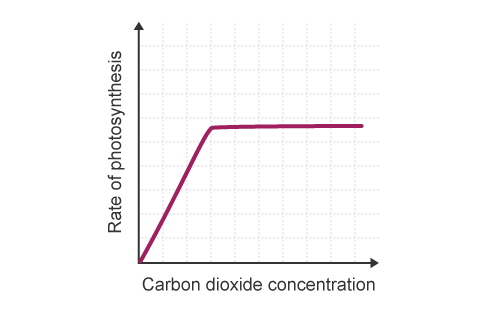
What happens to the rate of photosynthesis as carbon dioxide concentration increases?
The rate increases until another factor becomes limiting, causing the graph to level off because the rate of photosynthesis becomes constant.
How does temperature affect the rate of photosynthesis?
The rate increases as temperature rises towards the optimum because enzyme-controlled reactions happen faster. Above the optimum, the rate decreases as enzymes change shape and denature causing the rate of photosynthesis decreases .
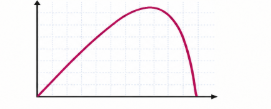
Label this diagram
The rate increases as temperature rises towards the optimum because enzyme-controlled reactions happen faster. Above the optimum, the rate decreases as enzymes change shape and denature causing the rate of photosynthesis decreases .


Carbon dioxide concentration: As carbon dioxide concentration increases, the rate of photosynthesis increases because carbon dioxide is a raw material needed for photosynthesis. Eventually, the graph levels off because another factor, such as light intensity or temperature, becomes limiting.
Light intensity: As light intensity increases, the rate of photosynthesis increases because light provides the energy needed for photosynthesis. Eventually, the graph levels off because another factor, such as carbon dioxide concentration or temperature, becomes limiting.
Is photosynthesis an exothermic or endothermic reaction
Endothermic The process absorbs energy from its surroundings, specifically light energy from the Sun, rather than releasing heat or energy.