week 8: fluid and electrolyte balance
 Call Kai
 Learn
 Practice Test
 Spaced Repetition
 Match
 Flashcards
 Knowt Play
1/179

There's no tags or description
Looks like no tags are added yet.
180 Terms
what are some interrelated concepts of fluid and electrolytes?
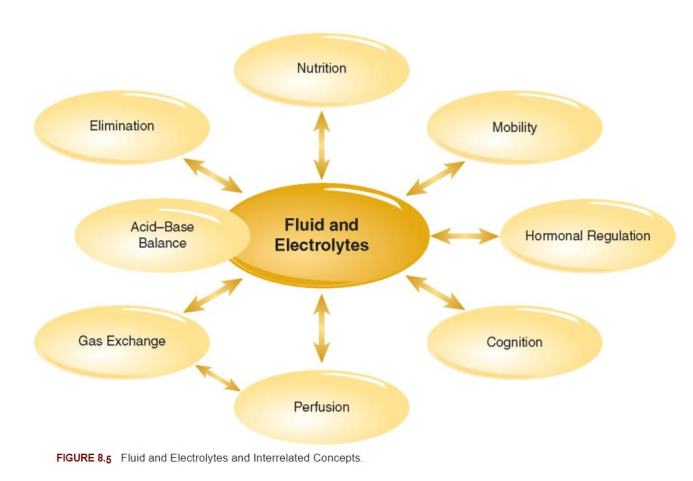
what does the concept of fluid and electrolytes refer to?
the process of regulating the extracellular fluid volume, body fluid osmolality, and plasma concentrations of electrolytes
what is fluid?
water plus the substances dissolved and suspended in it
what are some important characteristics of fluid?
volume
concentration (osmolality)
pH
what is required to maintain homeostasis?
the interplay between 3 processes
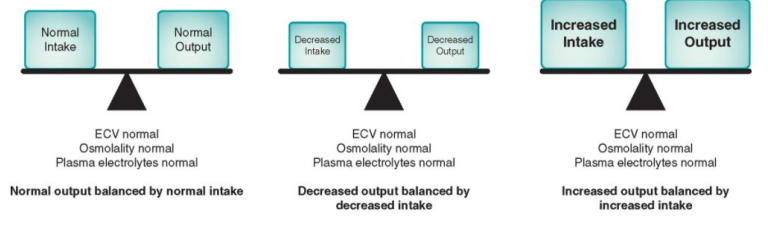
intake/absorption
distribution
output
how does intake/absorption help to maintain homeostasis?
intake of fluids and electrolytes into the body and movement to bloodstream
how does distribution help to maintain homeostasis?
process of moving fluid and electrolytes between body fluid compartments
intracellular fluid - inside cell
extracellular fluid - outside cell
diffusion and osmosis
what is fluid between cells called?
interstitial
what is fluid inside of blood vessels called?
vascular
how does output help to maintain homeostasis?
removal of fluid and electrolytes
primary process of voiding
what does optimal fluid and electrolyte balance keep?
keeps the volume, osmolality, and electrolyte concentrations of fluid in the various body fluid compartments within their normal physiological ranges
what is the scope of fluid and electrolytes?
ranges from optimal balance (homeostasis) to imbalance (too little, too much, or misplaced)
what is fluid balance?
extracellular volume, body fluid osmolality, and plasma concentrations
optimal extracellular volume (ECV)

optimal osmolality
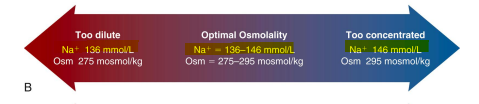
optimal K+ concentration

what are the most common routes of intake and absorption?
PO (oral) and IV (intravenous)
oral is main way we get absorption
how must PO intake be absorbed to contribute to maintain homeostasis?
must be absorbed into the bloodstream
w/ expectations to IV because they are direct
what is intake and absorption influenced by?
habit, anticipation of need for fluid, and thirst*
*important stimulus in physiological process
what are normal excretory routes?
renal (urine)*, GI (feces), skin (perspiration/sweat), and lungs (water vapor)

how does aldosterone correspond to output?
impacts EVC, Na+ concentration, and K+ concentration
ends up being excreted and increase uptake of Na+
decrease urine output
what does ADH impact?
impacts ECV (and osmolality*)
anti-diuretic → helps regulate H2O and not Na+
what are abnormal routes of output?
emesis (vomiting), hemorrhage, drainage through tubes/fistulas/wounds
what does the extracellular space compose of?
vascular space/plasma (volume)
interstitial space
what is the organization from outermost layer to innermost layer of water distirbution?
extracellular space
vascular/plasma
interstitial space
intracellular
who is at more of a risk for fluid and electrolyte imbalances?
very young and older adults
hypovolemia and dehydration
explain how the elderly are more at a risk for fluid and electrolyte imbalance?
diminished thirst (reflex)
decrease muscle mass and lower fluid weight % age
less water stored in muscle
age related kidney structural changes which impact kidney function
explain how infants are more at a risk for fluid and electrolyte imbalance?
communicating thirst = crying (vulnerable)
high % age body weight is fluid, higher risk for rapid fluid shifts
immature kidneys unable to concentration/dilute urine as well as adult kidneys
what are electrolytes?
substances whose molecules dissociate or split into ions when placed in solution
what are ions?
electrically charged molecules
what are cations?
positively charged ions (ex: Na+, K+)
what an anions?
negatively charged ions (ex. Cl-, HCO3-)
what electrolytes are found in the extracellular vascular blood?
high Na+ and Cl-
little K+
what electrolytes are found in the intracellular?
high K+, PO43- (phosphate)
little Na+
what is diffusion?
movement of molecules from high to low concentration through permeable membrane
no energy used
what is facilitated diffusion?
uses a protein carrier in cell membranes for molecules too large to pass through the cell membrane
no energy used
ex. glucose
what is active transport?
molecules move across concentration gradients
requires energy
ex. sodium/potassium pump
what is osmosis?
movement of water between 2 compartments separated by semi-permeable membrane from areas of low solute concentration (high water) to high solute concentration (low water)
what is osmotic pressure?
amount of pressure necessary to stop osmotic flow of water
determined by the concentration of solutes in solution
what is normal plasma osmolality?
= 285-295 mOsm/kg
an osmolality of >295 indicates?
water deficit-too little water or too much solute (Na)
more concentration → more deficit
an osmolality of <285 indicates?
water excess-too little solute (Na) or too much water
less concentrated → more dilute → fluid volume surplus
what do isotonic fluids have?
= concentration
what do hypertonic fluids have?
higher osmolality (shrink cells)
conc. increases outside cells than inside

what do hypotonic fluids have?
lower osmolality (swell cells)
h2O move into cell

At which end of the capillaries does fluid move into the interstitial space?
Arterial end — fluid moves out of capillaries, delivering oxygen and nutrients to cells.
At which end of the capillaries does interstitial fluid move back into the bloodstream?
Venous end — fluid moves back into capillaries, carrying waste products for excretion.
what happens during oncotic pressure?
osmotic p
Na+, protein, albumin can pull fluid back to ECF
what are ways of regulation of water balance (homeostasis)?
hypothalamic/pituitary regulation
adrenal cortical regulation
renal regulation
GI regulation
how does the hypothalamic/pituitary regulation regulate water?

how does the adrenal cortical regulate regulate water?

how does renal regulation help regulate water?
regulates water with adjustments in urine volume and excretion of electrolytes
total plasma volume filtered by kidneys many times day; 99% reabsorbed for a total avg. of 1.5L or urine production a day
kidney is primary organ, autoregulate electrolyte and H2O losses
how does the GI regulate fluid water balance?
most fluid intake occurs orally (PO)
small amount eliminated in feces
normally secretes ~8L of fluid daily; vast majority is reabsorbed
diarrhea and emesis prevent GI reabsorption → leading to significant fluid and electrolyte losses
has to have fluid and digestive enzymes excreted to work
why is water losses not able to be accurately measured?
individual is unaware that the loss of water has occurred
invisible vaporization from the lungs and skin → cant be measured
~900mL daily
how is water loss accelerated by body metabolism?
water vapor with breathing
skin; NOT sweat
insensible skin water loss → trans-epidermal water loss (continues, invisible, passive evaporation of water plays a role in healthy skin barrier)
temp. or exercise
what are the nursing considerations for insensible water loss?
general
vital signs, assessments, bloodwork
intake and output
24-hour record
intake: drinking, eating, IVs, GI tubes
output: urine, vomit, diarrhea
daily weight measurements
estimates volume status
rapid increase 1kg body weight apporx. 1000mL (1L) of fluid retention
standardized conditions (same time everyday, with same clothes, same scale)
What cardiovascular changes occur with decreased fluid volume?
Hypotension, weak (+1) pulses, tachycardia, and pale appearance due to SNS stimulation.
Why does tachycardia occur with decreased fluid volume?
SNS activation compensates for reduced circulating volume by increasing heart rate.
What cardiovascular changes occur with increased fluid volume?
Hypertension, bounding (+4) pulses, and jugular vein distension (JVD).
What respiratory changes occur with decreased fluid volume?
Decreased tissue perfusion and possible hypoxia (low SpO2).
volume perfusion issue
What respiratory changes occur with increased fluid volume?
Pulmonary congestion/edema, increased respiratory rate, shortness of breath, and crackles.
Why can increased fluid volume cause pulmonary edema?
Increased hydrostatic pressure in pulmonary vessels pushes fluid into lung tissues.
What neurological changes can occur with decreased fluid volume?
Hypernatremia may cause water to shift out of brain cells, causing shrinkage; brain perfusion may decrease.
decrease systemic perfusion (include to brain)
What neurological changes can occur with increased fluid volume?
Hyponatremia may cause water to shift into brain cells, resulting in cerebral edema and altered LOC.
How does decreased fluid volume affect the skin?
Dry skin, decreased skin turgor, and dry mucous membranes.
How does increased fluid volume affect the skin?
Edema; skin may appear taut and feel firm.
What does a weak (+1) pulse suggest in fluid volume assessment?
Possible decreased circulating fluid volume.
What does a bounding (+4) pulse suggest in fluid volume assessment?
Possible increased circulating fluid volume.
how is blood work used to assess water balance?
water dehydration primarily water only is lost; not water and Na+
↓ volume
↑Na+? (hypernatremia)
↑ serum osmolality
↑volume
what is intake and output?
24 hour record (tracked daily)
intake: drinking, eating, IVs, GI tubes
output: urine, vomit, diarrhea, drains (hemorrhage)
in - out
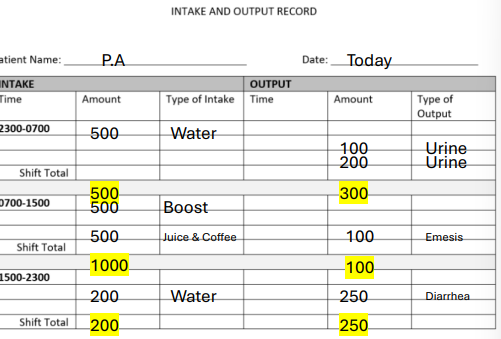
what would a positive balance indicate in intake and output?
more went in than what came out
what would a negative balance indicate in intake and output?
output is higher than our intake
how do we use daily weights to assess water regulation?
estimates volumes status
rapid increase of 1kg body weight approx. 1000mL (1L) of fluid retention
standardized conditions (same time everyday, with the same clothes, same scale)
if flucation over 24h → most likely fluid loss
what are 3 overarching causes of fluid and electrolyte imbalances?
fluid and electrolyte is greater than intake and absorption
hypovolemia
fluid and electrolyte is less than intake and absorption
hypervolemia
fluid and electrolyte distribution is altered
what are the 3 mechanisms that cause fluid to shift between body compartments?
Hydrostatic pressure, osmotic/oncotic pressure, and changes in capillary permeability.
What is hydrostatic pressure?
The physical force of fluid pushing against vessel walls, promoting fluid movement out of capillaries.
What is osmotic pressure?
The pulling force created by solutes (Na+, glucose, proteins) that draws water toward areas of higher solute concentration.
What is oncotic pressure?
Osmotic pressure created by proteins, especially albumin, that helps pull water into blood vessels.
How can osmotic pressure affect fluid distribution?
Changes in solute concentrations cause water to move into or out of cells, affecting cell volume.
How does increased capillary permeability affect fluid distribution?
Capillaries become leaky, allowing fluid and proteins to escape into interstitial spaces (e.g., severe burns).
What are the 2 major fluid shifts caused by altered fluid/electrolyte distribution?
Vascular fluid shifts into interstitial space (edema). 2. ECF shifts into a third space (third spacing).
What causes edema?
Fluid moves out of capillaries faster than it is returned or removed, causing accumulation in interstitial tissues.
ecv excess (hypervolemia)
inflammation
more force pushing fluid out than in
What conditions can contribute to edema?
ECF volume excess (hypervolemia) and inflammation.
What is third spacing?
Abnormal accumulation of ECF in a space outside the vascular and usual interstitial compartments, reducing effective circulating volume.
What is a common example of third spacing?
Ascites — abnormal accumulation of fluid in the peritoneal cavity.
organ failing
What conditions can contribute to third spacing or ascites?
Low plasma albumin and liver failure.
Where is potassium (K⁺) normally found in the highest concentration?
Inside cells (intracellular fluid).
What happens to serum potassium when K⁺ shifts OUT of cells?
Serum K⁺ increases, causing hyperkalemia.
What 3 conditions cause potassium to shift OUT of cells?
Acidosis (H+ moves in), tissue catabolism, and acute cell death. (crushing tissue injuries)
What happens to serum potassium when K⁺ shifts INTO cells?
serum K⁺ decreases, causing hypokalemia.
What 3 conditions cause potassium to shift INTO cells?
Alkalosis, insulin, and trauma/tissue repair (following massive trauma)
How do acidosis and alkalosis affect potassium shifts?
Acidosis: K⁺ shifts OUT of cells (↑ serum K⁺). Alkalosis: K⁺ shifts INTO cells (↓ serum K⁺).
what is first spacing?
ECF-ICF shift
can get back
what is second spacing?
abnormal accumulation of fluid in interstitial spaces, reversible
fluid can easily be moved back
ex. edema
what is third spacing?
abnormal accumulation of fluid trapped in spaces where it is difficult/impossible to return to where it should be
ex. ascites
what causes hypovolemia?
vomiting
diarrhea
lack of intake
wound drainage
overuse of some diuretics
hemorrhage
hypotension, systemic perfusion
What are the cardiovascular and urinary manifestations of fluid volume deficit?
↓ Weight
↓ BP
↑ HR, weak (+1) pulse, flat neck veins,
dizziness/syncope
prolonged capillary refill
oliguria, and ↑ urine specific gravity (concentrated urine).
What are the skin, mucosal, and GI manifestations of fluid volume deficit?
↓ Skin turgor (tenting with slow fluid loss), dry mucous membranes, furrowed/cracked tongue, constipation, hard stools, and sunken fontanelle in infants.
what causes hypervolemia?
intake way higher than out put
organ failure
iv fluid overload (NS, R/L), steroids
what are clinical manifestations of hypervolemia?
VS: ↑ weight - Bounding pulses 4+ - ↑ B/P
CVS: Distended neck veins • Skin/PVS: Edema (lower legs, sacrum, around eyes)
RESP: Dyspnea, frothy pink sputum (Pulmonary edema = medical emergency)