Metabolism: Energy and Enzymes, Metabolism and Energy
 Call Kai
 Learn
 Practice Test
 Spaced Repetition
 Match
 Flashcards
 Knowt Play
1/56

There's no tags or description
Looks like no tags are added yet.
57 Terms
Kinetic energy
The energy of motion

Potential energy
Energy stored due to an object's position or arrangement

chemical energy
A form of potential energy that is stored in chemical bonds between atoms.
mechanical energy
The amount of work an object can do based on its potential and kinetic energy.

first law of thermodynamics
Energy can be transferred and transformed, but it cannot be created or destroyed.

second law of thermodynamics
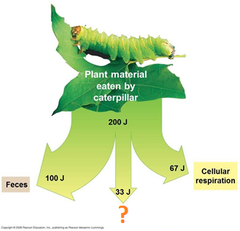
Every energy transfer or transformation increases the entropy of the universe.
heat
Every time energy is transferred in an ecosystem, some of the energy is lost as ___________________

energy efficiency
The percentage of energy put into a system that does useful work
entropy
(thermodynamics) a thermodynamic quantity representing the amount of energy in a system that is no longer available for doing mechanical work (heat)
metabolism
All of the chemical reactions that occur within an organism
reactants
A starting material in a chemical reaction

products
Ending materials in a chemical reaction.

free energy
energy available to do work

exergonic reaction
A spontaneous chemical reaction in which there is a net release of free energy.

endergonic reaction
A chemical reaction that requires energy input(heat, light, or electricity) in order to proceed.

spontaneous reaction
A reaction that will proceed or occur on its own without an input of energy from its surroundings.

phosphorylation
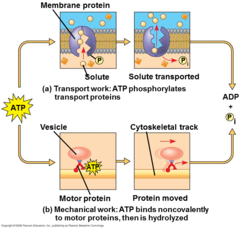
the transfer of a phosphate group to a molecule

transport work
Enables cells to move ions, molecules, and larger particles through the cell membrane and through the membranes of organelles in the cell. Particularly useful for creating concentration gradients.
mechanical work
energy needed to contract molecules, beat flagella, etc

ribozyme
a type of RNA that can act as an enzyme
metabolic pathway
Begins with a specific molecule, which is then altered in a series of defined steps, resulting in a certain product.

substrates
The material or substance on which an enzyme acts.

enzyme-substrate complex
Formed by the temporary binding of enzyme and reactants enables the collisions to be more effective and lowers the activation energy of the reaction

Active site
The specific portion of an enzyme that attaches to the substrate by means of weak chemical bonds.

synthesis
Combining of small molecules or substances into larger, more complex ones

degradation
Substrate is broken down into smaller parts
Induced fit
Brings chemical groups of the active site into positions that enhance their ability to catalyze the chemical reaction.

Energy of activation
The amount of energy required to start a reaction. Enzymes work by diminishing the activation energy needed for a reaction to go to completion.

denaturation
A process in which a protein unravels, losing its specific structure and hence function; can be caused by changes in pH or salt concentration or by high temperature.

Enzyme cofactors
molecules or ions required for normal enzyme function
Coenzymes
vitamins that assist in the normal functioning of enzymes
enzyme inhibition
occurs when an active enzyme is prevented from binding to a substrate by an inhibitor

oxidation
The loss of electrons

reduction
Gaining electrons

Redox reaction
Another name for an oxidation-reduction reaction

Mitochondria
An organelle in eukaryotic cells that serves as the site of cellular respiration; uses oxygen to break down organic molecules and synthesize ATP

cellular respiration
Process that releases energy by breaking down glucose and other food molecules in the presence of oxygen. Glucose is oxidized to carbon dioxide.

The 2 groups that chemical processes in cells.
Catabolic and Anabolic
Breaking down processes are degradative processes are called _____________ processes are net energy ___________ processes.
catabolic; releasing.
Building up processes are synthetic processes are called ______________ processes are net energy _____________ processes.
anabolic; storing.
Oxidation reactions __________ energy.
release
Reduction reactions _____________ energy
absorb
Oxidation and Reduction reactions occur together:
Energy __________ (oxidation) must be ____________ (reduction)
Energy _____________ (reduction) must have __ _______________ (oxidation)
released; absorbed; absorbed; a source
Hydrogen bonds indicate....
the level of reduction.
Energy is needed to ________ molecules together
bring or collide
Effective Collision
When molecules collide in the proper orientation during a reaction
Energy may come from....
the reacting ________ or ____________________
the _____________________
breaking chemical __________ and ____________ them to make a new chemical bond.
atoms; molecules; environment; bonds; linking
_____________ energy is the amount of energy required to bring __ potentially _________ molecules into the __________ ________________ for the desire ___________________ to occur.
Activation; 2; reactive; proper orientation; reaction
If the activation energy is too high, the higher the chances....
the reaction will not occur.
Another way of describing enzymes as ____________.
facilitators
Enzymes can be worn out due to .....
the 2nd Law of Thermodynamics
Enzymes ________ activation energy by bringing the reacting molecules into the proper _________________ for the desired reaction.
reduce; orientation
Enzyme attachment can cause 4 actions:
turn the enzyme _______ or ________
or ___________ or ______________ enzyme activity.
on; off; increase; decrease
The _______ ______ is where the substrates bind with the enzyme, thus causing the ______________ to occur
active site; reaction
The substrate binding into the active site is an example of ...
proper orientation
Two factors can affect enzymes:
temperature and pH
After 40 degrees C, the starts to slowly ____________ and ____________ the activation energy, thus slow the process of ___________ products.
denature; oxidize; producing