Aggression slides and chapter 14 reading
 Call Kai
 Learn
 Practice Test
 Spaced Repetition
 Match
 Flashcards
 Knowt Play
1/70

There's no tags or description
Looks like no tags are added yet.
71 Terms
Broadly there are _ types of aggression.
________ aggression and _____________ aggression
2;
Hostile; Instrumental
Hostile Aggression:
aggressive acts carried out with the intention of causing harm
• E.g., “I am going to get back at him”
Instrumental Aggression:
aggressive action
conducted in service of another cause
• E.g., attempting to look tough to gain attention
All people can behave ___________ and for a
variety of _______.
aggressively; motives
Aggression can be ________ or
________.
proactive; reactive.
Proactive aggression:
unprovoked
acts, done without a clear cause
Reactive aggression:
aggressive acts
in response to another person’s
behavior
Imagine person A pushes someone, and person B responds in kind. Who
was proactive and who was reactive?
FINISH WHEN HE GIVES THE ANSWER
In the social learning experiment, Bandura’s (1965) Bobo - Doll Study:
Participants watched a video of an adult beating up the bobo - doll. Next in the video, another adult either scolded the actor as a “bully”, rewarded them as a
“” or was not present (control). Some children were also given further incentive (juice boxes, stickers, etc.) for each aggressive act taken against the doll. Children were left alone in a room with the doll, a mallet, balls, and other toys.
In Bandura’s (1965) Bobo - Doll Study, boys were more _________ than girls. And it was found that regarding aggression _________ aggression.
aggressive; increases
People learn from ____ experiences.
past
Past experience can include ______
___________, what a person has been ____, or
___________ through media
direct experiences; told; observation
Draw/Talk about the Social Information Processing circle graph:
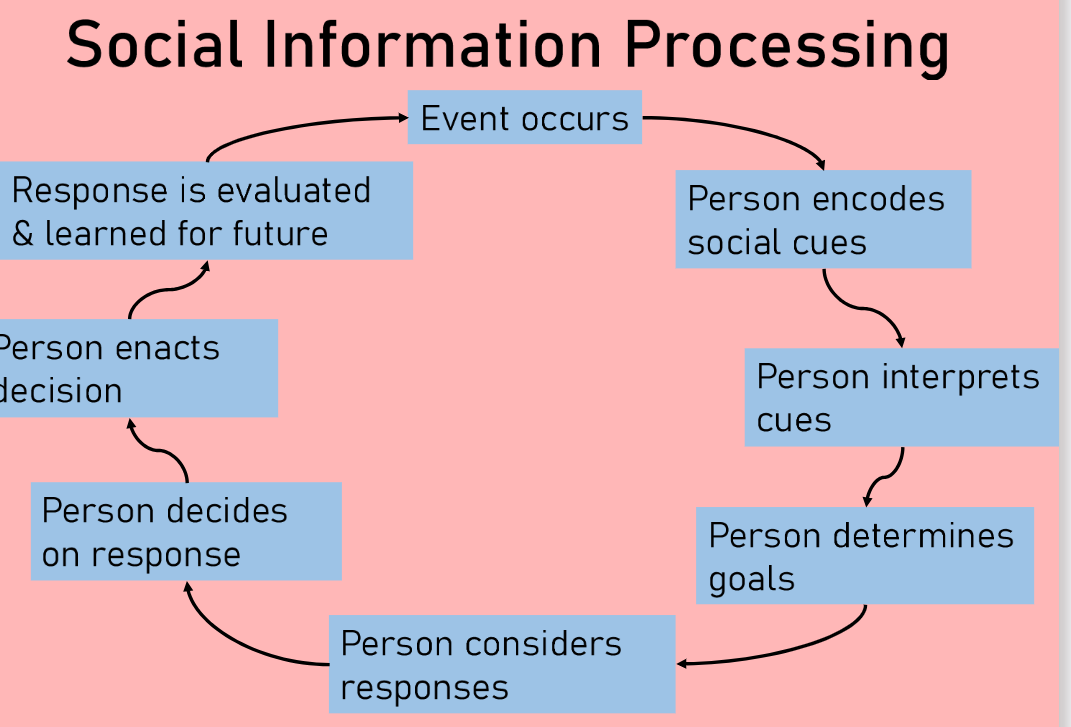
_________ or __________ stimuli can cause anger.
Unpleasant; unwanted
Anger tends to make us think the things around us are ______, that
others act ______.
unfair; hostile.
Anger predicts responding with _________.
aggression.
___ weather is a common unpleasant stimuli
that predicts aggression
Hot
Most people are ___ _____ of the effect of heat
on their _________.
Recall: in the fundamental attribution error, we
make attributions about others in a biased manner
because we can see them. You cannot see the ____,
but you can see a ______ near you
not aware; attributions.
heat; person
A major concern for climate change is the
effect heat will have on ________.
conflict.
Frustration - Aggression
Hypothesis:
Being blocked from achieving a goal leads to feelings of anger and aggression. Thus, the failure acts as a negative stimuli
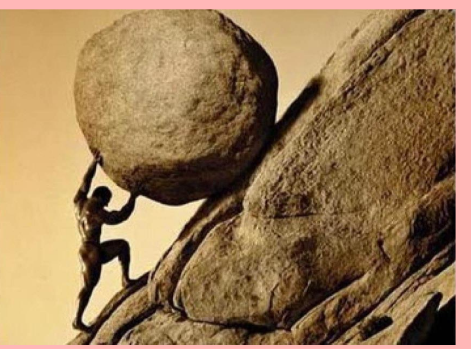
A Sisyphean task is
aggravating because we
get _____, and then have
our goal ________.
close; blocked.
It is much easier to act aggressively towards
someone or a group that has been
____________.
dehumanized.
Many people have tested a link between
__________ play and aggression.
Note: no _______ link has been observed between
the two
videogame.
direct
People have also theorized that videogames might
relieve aggressive feelings, there is ______ to __
evidence for this theory.
little; no.
There is evidence of relationships between violent
____ ____ and correlates of aggression in ___
settings
game play; lab
Videogames may also elicit _________ response
aligned with ________ - aggression hypothesis
frustration; frustration.
People who are socially ________ or _________
display higher rates of aggression.
rejected; isolated
Evidence from the “cyber - ball” task, shows activity in ______ _________ ________ ______, which process pain.
dorsal anterior cingulate cortex
__________ is the worst psychological human
experience.
Ostracism
_________ isolation is devastating and can lead
to aggression (among many other negative
outcomes).
So, be ____ & ________ whenever possible.
Prolonged;
kind; inclusive
Additional predictors of social isolation and aggression:
Income ________ (at a societal level)
May cause feelings of _______ or ______ rejection
inequity.
distrust; social
Additional predictors of social isolation and aggression:
A lack of ______ space
• Green space is good for ______ (a positive stimuli)
• Lack of green space is a ________ stimuli
green;
health;
negative
Culture of Honor –
A culture in which people
(men) prioritize toughness and a willingness
to defend wrongdoing
Culture and Aggression can be close links to histories of ________ (high risk of
losing one’s ______ is herd of animals is
harmed)
herding; wealth
______ violence and ______ against women is
disturbingly common:
~__% of women in US report being sexually
harassed
Sexual; violence.
80%
Rape - Prone Cultures:
a culture in which rape
is used as a weapon, a ritual act, or as a threat
against women
Rape - prone cultures tend to have histories of
___, women relegated to _____ ______ status
war; lower social
Many fraternities promote a culture of ____.
(often connected to norms of ______ _______).
rape;
heavy drinking.
When comparing cultures that are not rape -
prone, Sanday (1996) observes more ______
for women and more _________ gender roles.
respect; egalitarian
Cultures that _______ violence against women
tend to have less sexual violence
sanction.
A goal of evolution is to survive long enough to
__________.
reproduce.
Women have to be ________ with partners
(pregnancy is dangerous).
selective
Men do ___ have to be selective with partners
Sex is relatively ___ - ____ for men.
Thus, men could have multiple partners and be
in _______ competition for those partners
not;
low-risk
greater
_______ competition + _____ risks to offspring
result in men being (overall) more ________.
Greater; fewer; physical.
Women are still aggressive, but this tends to
be more _________ aggressive (______
sanctioning one another)
relationally; socially
Solomon’s work outlines various problems in
________, in part the role of a “______”
framework for policing – in part, protecting
___________ through violence
policing; warrior; masculinity
In cultures where masculinity must be
displayed due to competition, masculinity must
be ______.
proven.
Cultural norms make it such that masculinity
is easily _________.
threatened.
_________ manhood can lead to violence if a
man needs to ________ his masculinity (think
culture of honor)
Precarious; reassert
Summary:
• Aggression is an ______ evolutionary
response.
• Often elicited from _______ stimuli in
environment (including blocked goals).
• People have ______ that influence how they
interpret their ___________.
• ______ isolation and ______________ can have
serious consequences for __________ and
_________.
• A more _______, __________- _______
world may decrease the risk of violence
adaptive
negative
biases; environment.
Social; dehumanization; aggression; violence.
equitable; environmentally - friendly
Which of the following correctly describes the social intuitionist model of moral judgment?
A. Moral judgments are almost entirely based on deliberative reasoning.
B. Moral judgments are initially based on quick, emotional reactions, which then influence deliberative reasoning and judgement.
C. Moral judgments are initially based on deliberative reasoning, which is followed by an emotional reaction.
D. Moral judgments are not processed beyond initial emotional reactions.
B. Moral judgments are initially based on quick, emotional reactions, which then influence deliberative reasoning and judgement.
Greene and colleagues (2013; 2001) had participants make a decision about different moral dilemma scenarios while their brains were scanned using fMRI. In the “trolley dilemma,” participants had to decide whether they should hit a switch that would turn the trolley to save five people but would kill one person. In the “footbridge dilemma,” participants had to decide whether they should push a stranger off of a bridge to save five people but consequently kill one stranger. Which of the following correctly describes the results of the study?
A. The trolley dilemma was more impersonal, and thus the moral judgments made were generally based more on rational thought.
B. The trolley dilemma was an emotionally charged moral dilemma, and thus the moral judgments made were generally more based on rational thought.
C. The footbridge dilemma was a more impersonal dilemma, and thus the moral judgments were generally based more on rational thought.
D. The footbridge dilemma was a more impersonal dilemma, and thus the moral judgments were generally based more on quick, emotional reactions.
A. The trolley dilemma was more impersonal, and thus the moral judgments made were generally based more on rational thought.
Zaral feels angry when he reads the news about a group of telemarketers responsible for a phishing scam. Which moral foundation is Zaral most likely using as the basis for his judgment?
A. Ingroup loyalty
B. Authority/respect
C. Fairness/reciprocity
D. Purity/sanctity
C. Fairness/reciprocity
When our moral judgments are based on the purity/sanctity foundation, which of the following emotions are we most likely to be experiencing?
A. Disgust
B. Anger
C. Pride
D. Sympathy
A. Disgust
Which of the following correctly describes the moral views of conservatives and liberals in the United States?
A. Liberals tend to focus on purity/sanctity when making moral judgments.
B. Liberals tend to be aware that conservatives value authority, loyalty, and purity more than they themselves do.
C. Conservatives place more importance on ingroup loyalty and authority when making moral judgments.
D. Conservatives tend to respond more positively to messages framed in terms of harm and care than liberals.
C. Conservatives place more importance on ingroup loyalty and authority when making moral judgments.
If Miguel were experiencing pluralistic ignorance, which thought would he most likely have while walking by the student?
A. “I would like to help this person, but I don’t know what to do.”
B. “No one else is paying attention to this person, so they must be okay or else other people would be helping.”
C. “I would like to help this person, but it is too dangerous to do so.”
D. “This person needs help, but I am sure someone else will do it.”
B. “No one else is paying attention to this person, so they must be okay or else other people would be helping.”
If Sadie were experiencing diffusion of responsibility, which thought would she most likely have while witnessing the fight?
A. “I would like to help, but I don’t know what to do.”
B. “No one else seems to be helping, so why should I?”
C. “I would like to help, but it is too dangerous to do so.”
D. “I should call the police, but I am sure someone else already has.”
D. “I should call the police, but I am sure someone else already has.”
Diffusion of responsibility and pluralistic ignorance are similar, but there are subtle differences between the two concepts. Review what you learned by determining which characteristics belong to pluralistic ignorance, which belong to diffusion of responsibility, and which belong to both.
This phenomenon occurs when someone may need help.
A. Only pluralistic ignorance
B. Only diffusion of responsibility
C. Both pluralistic ignorance and diffusion of responsibility
C. Both pluralistic ignorance and diffusion of responsibility
Diffusion of responsibility and pluralistic ignorance are similar, but there are subtle differences between the two concepts. Review what you learned by determining which characteristics belong to pluralistic ignorance, which belong to diffusion of responsibility, and which belong to both.
This phenomenon interferes with helping.
A. Only pluralistic ignorance
B. Only diffusion of responsibility
C. Both pluralistic ignorance and diffusion of responsibility
C. Both pluralistic ignorance and diffusion of responsibility
Diffusion of responsibility and pluralistic ignorance are similar, but there are subtle differences between the two concepts. Review what you learned by determining which characteristics belong to pluralistic ignorance, which belong to diffusion of responsibility, and which belong to both.
This phenomenon occurs when a bystander thinks other people will help.
A. Only pluralistic ignorance
B. Only diffusion of responsibility
C. Both pluralistic ignorance and diffusion of responsibility
B. Only diffusion of responsibility
Diffusion of responsibility and pluralistic ignorance are similar, but there are subtle differences between the two concepts. Review what you learned by determining which characteristics belong to pluralistic ignorance, which belong to diffusion of responsibility, and which belong to both.
This phenomenon occurs when other people are around.
A. Only pluralistic ignorance
B. Only diffusion of responsibility
C. Both pluralistic ignorance and diffusion of responsibility
C. Both pluralistic ignorance and diffusion of responsibility
Diffusion of responsibility and pluralistic ignorance are similar, but there are subtle differences between the two concepts. Review what you learned by determining which characteristics belong to pluralistic ignorance, which belong to diffusion of responsibility, and which belong to both.
This phenomenon occurs when a bystander witnesses an incident but determines that no one needs help.
A. Only pluralistic ignorance
B. Only diffusion of responsibility
C. Both pluralistic ignorance and diffusion of responsibility
A. Only pluralistic ignorance
Lulu, a 4-year-old child, gives a toy to her crying younger sister with the hope that her father will see her sharing. Which of the following motives best describes Lulu’s behavior?
A. Social reward
B. Personal distress
C. Empathic concern
A. Social reward
Tuan sees another student fall and drop a stack of textbooks. He feels uncomfortable seeing the student struggle to pick up the heavy books and decides to run over and help the student. Which of the following motives best describes Tuan’s behavior?
A. Social reward
B. Personal distress
C. Empathic concern
B. Personal distress
In one study looking at the causes of altruism, participants received notes from another student, “Janet,” who had shared that she was feeling out of place at her university. Participants in the low-empathy condition were asked to be as objective as possible when reading the notes, while participants in the high-empathy condition were asked to imagine how Janet felt. Afterward, participants indicated how much time they would spend with Janet. The researchers told half the participants in each condition that their responses would be sent to a professor anonymously and told the other half of the participants that both the experimenter and Janet would see their responses. Which of the following describes how the researchers of this study were able to determine that empathy was the cause of altruism and rule out social reward?
A. Low-empathy participants who were distressed by Janet’s notes volunteered as many hours as high-empathy participants.
B. Low-empathy participants were more likely to volunteer time with Janet when their responses were shared with an experimenter.
C. High-empathy participants who were distressed by Janet’s notes were more likely to volunteer a greater number of hours than high-empathy participants who were not distressed.
D. High-empathy participants volunteered more hours than low-empathy participants, even when their sacrifice was anonymous.
D. High-empathy participants volunteered more hours than low-empathy participants, even when their sacrifice was anonymous.
Which of the following statements is supported by research on social class and empathy?
A. Having access to abundant resources makes wealthier people more empathetic.
B. Wealthier people are more in tune with other people’s emotions, which makes them more altruistic.
C. People from lower socioeconomic groups tend to be more empathic than wealthier people.
D. The motivation for social reward makes people from lower socioeconomic backgrounds engage in altruistic behavior.
C. People from lower socioeconomic groups tend to be more empathic than wealthier people.
Latané & Darley (1968) had participants complete a questionnaire in a room either by themselves, with two other participants, or with two passive confederates. While participants were in the room, smoke started to come in from beneath the door, filling the room. Participants who were with others in the room were much less likely to leave the room and report the smoke, compared to participants who were alone. Participants who didn’t report the smoke later reported that they didn’t believe it was dangerous. Which of the following is the correct interpretation of this study?
A. Pluralistic ignorance took hold when participants were with others in the room.
B. Pluralistic ignorance took hold when participants were alone in the room.
C. Diffusion of responsibility took place when participants were with others in the room.
D. Diffusion of responsibility took place when participants were alone in the room.
A. Pluralistic ignorance took hold when participants were with others in the room.
Which of the following correctly describes reciprocal altruism?
A. Reciprocal altruism is limited to food sharing.
B. People will only engage in reciprocal altruism with kin to ensure the survival of their kin.
C. Reciprocal altruism is practiced only by humans and not by nonhuman species.
D. The tendency to reciprocate acts of altruism is likely universal, present in all countries.
D. The tendency to reciprocate acts of altruism is likely universal, present in all countries.
Which of the following situations would make Shakyra most likely to cooperate on a prisoner’s dilemma game?
A. Shakyra is playing the game with a partner face-to-face.
B. Shakyra plays the game with a partner who looks similar to herself.
C. Before the game, Shakyra is told that her partner has a reputation of being greedy.
D. Shakyra is told that she will only play one round of the prisoner’s dilemma with her partner.
B. Shakyra plays the game with a partner who looks similar to herself.
Which of the following correctly describes the tit-for-tat strategy?
A. Tit-for-tat was superior in every round compared to the 61 other prisoner’s dilemma strategies.
B. Tit-for-tat involves mimicking whatever the opponent did on the previous round.
C. Tit-for-tat always begins by defecting on the first round.
D. Tit-for-tat is only effective for the prisoner’s dilemma, not for other situations.
B. Tit-for-tat involves mimicking whatever the opponent did on the previous round.
Henrich et al. (2001) examined cultural factors that predict cooperative generosity in the ultimatum game in 15 cultures. Which of the following is a cultural factor that predicts an increased likelihood of cooperation in the ultimatum game?
A. Cultures that are relatively peaceful, without war
B. Cultures with more resources and wealth
C. Cultures that are highly independent
D. Cultures in which members rely on each other for survival
D. Cultures in which members rely on each other for survival