B3 Community Ecology
 Call Kai
 Learn
 Practice Test
 Spaced Repetition
 Match
 Flashcards
 Knowt Play
1/16

There's no tags or description
Looks like no tags are added yet.
17 Terms
What are the two ways that we describe communities?
Physical characteristics: emphasizing the environment
Biological characteristics: emphasizing the dominant species
What are the two ways that we characterize communities?
Structure: types and number of species
Change: fluctuations in communities over time (succession)
What are the difference parts of community structure?
# of species
Species abundance
Distribution across phylogeny
Types and strengths of interactions
Foundation species
Species that cause physical/chemical changes in the environment that affect other species
Add complexity to the environment
Often a dominant member of the community in biomass
Keystone Species
Controls the distribution or abundance of other species
Typically apex predators
Effects on the ecosystem is disproportionate to their relative abundance (few beavers → LARGE impact)
What would happen if you removed keystone species?
Competition would increase because the lower ranking species would increase in abundance and compete for the same limited resources
Dominant Species
Most abundant in either numbers of biomass, out-competing similar species
Whittaker Plot
Plots describing how communities change over elevation (y) and cardinal direction (x)

Clementsian vs Gleasonian theories of community evolution
Clementsian: Communities evolve as one superorganism — you cannot find species of a community in other locations
Gleasonian: Communities blend together; species have independent evolutions
Richness
number of different species in a community
Evenness
Relative abundance of a species compared to other species
high evenness: equal distribution of species
low evenness: clear dominant species
Diversity
Richness + evenness combined → how diverse is a community?
Rank Abundance Curve
Quantifying and visualizing evenness
Ranking by dominance (x); abundance (y)

Shannon-Weiner Index
The index describes how diversity is related to evenness/richness in a particular community
Diversity is directly proportional to evenness; diversity is directly proportional to richness
Higher values indicate more diverse communities

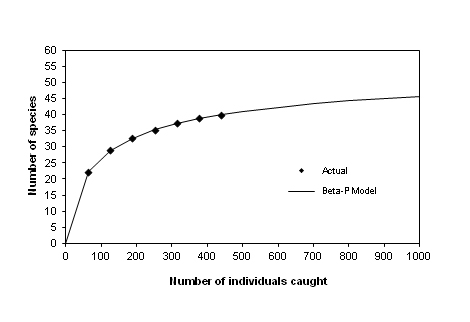
Species Accumulation Curve
An estimate used in collecting sample data that tells us when enough species have been observed to reflect the community population
Eventually your # of new species observed will taper
Determinants of community structure
Climate
Geography
Environmental Heterogeneity (diverse resources in an area)
Frequency of disturbances/disruptive events
Interactions between organisms
Community A: Many species, one dominant
Community B: Few species, high evenness
Which has higher diversity?
Cannot tell without numerical values.