MicroBio - In Lab Q's
 Call Kai
 Learn
 Practice Test
 Spaced Repetition
 Match
 Flashcards
 Knowt Play
1/77

There's no tags or description
Looks like no tags are added yet.
78 Terms
Which characteristic of bacteria cannot be determined by simple staining?
Species.
What is a smear in a microbiology lab?
A thin film of bacteria on a glass microscope slide.
Why can a simple stain of ear exudate help diagnose swimmer’s ear?
The common bacterial causes can be differentiated by their morphology.
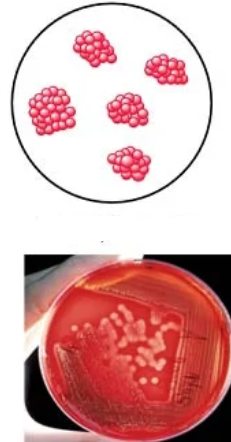
What does this image show?
Staphylococci.

What does this image show?
Streptococcus.
What principle explains why a simple stain sticks to bacteria?
The stain sticks because opposite electrical charges attract.
Staining is important because bacteria are small and clear. True or false?
True.
The best staining results come from a thick bacterial smear. True or false?
False.
What pH classification applies to stains used in simple staining?
Basic.
What should you do if a stained smear appears completely red with no visible spaces?
Move to the thinner edge of the smear to look for individual cells.
What electrical charge do bacterial cells have?
Negative.
Why are slides heat-fixed?
To help the bacteria adhere to the slide.
Which common causes of swimmer’s ear can be differentiated by morphology?
Staphylococcus aureus and Pseudomonas aeruginosa—cocci versus bacilli.
Which medium is classified as enriched?
Blood agar.
What do “enteric” and “coliform” describe?
Bacteria associated with the intestines.
What cellular morphology characterizes coliform bacteria?
Gram-negative bacilli.
Why is E. coli considered an indicator organism?
Its presence suggests fecal contamination and the possible presence of other pathogens.
Enterobacter aerogenes produces a metallic green sheen on EMB agar.
False; E. coli typically produces the metallic green sheen.
What function do eosin and methylene blue perform in EMB agar?
They make the medium selective by inhibiting most Gram-positive bacteria.
Which ingredient makes EMB agar differential?
Lactose.
Can EMB agar be used to check food or water for fecal contamination?
True.
What is the scientific term for salt-tolerant?
Halophilic.
Which findings showed that a catheterized patient’s fever was caused by infection rather than the heart attack?
Elevated white blood cells, insertion-site inflammation, and Gram-positive cocci in the site sample.
What happens to a medium’s pH when bacteria ferment carbohydrates?
It becomes more acidic.
What does yellow growth surrounded by yellow MSA indicate?
The bacteria fermented mannitol and produced acidic products.
Which ingredient in MSA can bacteria ferment?
Mannitol.
What characteristics can make Staphylococcus aureus pathogenic?
Producing shock-causing toxins, enterotoxins, and enzymes that kill white blood cells.
What does greenish discoloration around growth on blood agar indicate?
Alpha hemolysis
What causes bacterial hemolysis on blood agar?
Bacterial toxins called hemolysins.
Which organism causes strep throat, and what type of hemolysis does it produce?
Streptococcus pyogenes produces beta hemolysis.
What is hemolysis?
The rupture or destruction of red blood cells.
What determines how environmental factors such as temperature affect microbial growth?
Enzyme systems.
What are microorganisms that grow best at moderate temperatures called?
Mesophiles.
Temperatures below a microorganism’s minimum growth range cause protein denaturation.
False; low temperatures generally slow metabolic activity.
Some bacteria require oxygen, while other bacteria find it toxic. True or false?
True.
Which microbial classifications can use oxygen during metabolism?
Facultative anaerobes and obligate aerobes.
Can thioglycolate broth reveal a bacterium’s oxygen requirements?
True.
Do obligate anaerobes grow only at the top of thioglycolate broth?
False; they grow near the bottom, away from oxygen.
What are pH values below 7 called?
Acidic.
How was bacterial growth measured in the pH broth exercise?
By observing turbidity.
What can happen when microorganisms encounter pH levels outside their optimal range?
Their proteins can denature.
At what pH do most bacteria grow best?
Neutral pH.
What metabolic process is used by bacteria that reduce nitrate?
Anaerobic respiration.
What does a red color after adding nitrate reagents A and B indicate?
Nitrite is present, so nitrate reduction is positive.
Why is group B streptococcal infection during pregnancy taken seriously?
It can cause preterm delivery, infect the baby during birth, and cause neonatal sepsis or meningitis.
A nitrate culture remains colorless after reagents A, B, and zinc. Is it positive or negative?
Positive; nitrate was reduced beyond nitrite.
Mechanisms that kill pathogenic microorganisms are called germicidal.
True.
Why might Bacillus survive UV exposure better than Staphylococcus?
Bacillus can form UV-resistant endospores.
Why was half of each plate covered during the UV experiment?
To provide a positive growth control protected from UV light.
Which type of UV radiation is most effective at killing microorganisms?
UV-C.
Which bacterium caused the respiratory infections linked to a contaminated spa whirlpool?
Legionella pneumophila.
What is UV radiation’s main effect on a bacterial cell?
It damages DNA, especially by forming thymine dimers.
What does it mean if four of six antibiotic disks have clear zones around them?
Four drugs inhibited the bacteria and may be effective treatments.
What does bacterial growth directly against an antimicrobial disk indicate?
The bacteria are resistant to that drug.
Most antimicrobial drugs work against every type of microorganism.
False.
What is the clear area surrounding an antibiotic disk called?
A zone of inhibition.
Which drug was the best choice based on the given susceptibility results?
Erythromycin, with a 25-mm susceptible result.
What is the scientific term for breaking down macromolecules such as starch?
Hydrolysis.
In the NICU case, was Bacillus cereus linked to ventilator-associated pneumonia?
True.
Must starch be broken down outside the cell because it is too large to enter?
True.
Which enzyme enables bacteria to break down starch?
Amylase.
Does iodine turn dark when starch is present?
True.
What does a positive starch-hydrolysis result look like?
Clear or amber agar beneath and around the bacterial growth.
What subunits make up starch?
Glucose.
How does coagulase affect blood plasma?
It stimulates clot formation.
Which bacterial genus is differentiated using the coagulase test?
Staphylococcus.
What does black agar at the bottom of a SIM tube indicate?
The bacteria produced hydrogen sulfide gas.
Which organism contaminated the tomatoes in the IMViC case study?
Salmonella enterica.
Why is one MR-VP broth divided between the MR and VP tests?
It ensures both tests use the same culture and growth conditions, reducing experimental variation.
Which bacterial family is differentiated using IMViC tests?
Enterobacteriaceae.
What does a red methyl-red result indicate?
Mixed-acid fermentation.
With which infections are bacteria identified by IMViC commonly associated?
Gastrointestinal infections.
Which compound causes a red layer after adding VP-A and VP-B?
Acetoin.
What characteristics describe bacteria differentiated by IMViC?
Gram-negative, non-spore-forming bacilli.
Which two organisms are especially well differentiated by MR-VP testing?
Escherichia coli and Enterobacter aerogenes.
What color change indicates a positive citrate test?
Green to blue.
What does a red ring after adding indole reagent indicate?
The bacteria possess tryptophanase and produce indole from tryptophan.
Does a clearly defined stab line in SIM indicate motility?
False; a defined stab line indicates nonmotility. Motile bacteria spread away from the line.