Mineralogy 2026 Midterm Chapters 1-10
 Call Kai
 Learn
Learn Practice Test
 Spaced Repetition
 Match
Match Flashcards
 Knowt Play
1/79

Earn XP
Description and Tags
Pain and suffering, chapter one through whatever we finish before Monday. I hate my life.
Name | Mastery | Learn | Test | Matching | Spaced | Call with Kai | Chat |
|---|
No analytics yet
Send a link to your students to track their progress
80 Terms
Mineral
a naturally occurring solid with a highly ordered
atomic arrangement and a definite (but not fixed) chemical
composition. It is formed by inorganic processes.
A Mineral has to be….
Naturally occurring, homogenous solid, have a definite chemical composition, a highly ordered atomic arrangement, and formed by inorganic processes
Properties primarily controlled by atomic
arrangement and bonding
hardness, habit, tenacity, magnetism, cleavage, density
Hardness
Related to the atomic structure of the mineral and its weakest bonds
Tenacity
Resistance to breaking, or “cohesiveness”
Cleavage
Breaking along planes of weakness
Fracture
broken surface is irregular
Habit
The external shape (appearance) of a mineral
Reflects internal structure
Habit - Fibrous
Long, slender fibers
Habit - acicular
elongate, needle-like
Habit - Bladed
elongate, slender
Habit - columnar
shaped like a column
Habit - tabular
shaped like a book
Habit - blocky
block like
Habit - radiating
a group of radiating crystals from a central point
Magnetism
Controlled by electron spin
Minerals can be non-______, or weakly to strongly _______
Density
_____= mass/volume (in g/cm3 or kg/m3)
Depends on composition, structure, temperature, and pressure
Specific Gravity
Density of mineral / Density of water = __________
Color of Minerals
Not always a reliable property, caused by absorption of various wavelengths of life, what isn’t absorbed is what we see
Chemical Bonding
The power of bonds derives from electrons and how
they are shared in the filling of outer orbitals; Negative and positive particles attract each other
Van der Waals forces
Between molecules, e.g., layers of graphite, talc
• Weak electrostatic attraction
• Due to short-term polarization between sheets
• Very soft
• High compressibility, thermal expansion
Steno’s Law
“The angles between equivalent faces of crystals of the same substance,
measured at the same temperature, are constant”
Motif
the fundamental part of a symmetric design that, when
repeated, creates the whole pattern. It has all the symmetry of the entire crystal.
Point symmetry
Repetition of patterns due to rotation, reflection or inversion (e.g., crystal faces)
Repeats something a specific(discrete) number of times about a central point
Returns a motif to its original position after the operations
Translational (space) symmetry
Repetition of patterns due to __________
Repeats something an infinite number of times to fill space (no voids!)
Does not return to original position: could go on forever!
Lattice
continuous repeating pattern of points in a plane
(2D). Could extend to infinity by translation. One point = a node
Unit Mesh
The smallest, fundamentally different shapes in 2D that a lattice can consist of
Unit Cell
a 3D unit mesh. It has all of the symmetry of the main structure
2D Lattice - Oblique
a ≠ b, γ ≠ 90°
2D Lattice - Rectangle (p)
a ≠ b, γ = 90°
2D Lattice - Rectangle ( c )
a ≠ b, γ = 90, Notice that this lattice has diamond shapes
2D Lattice - Rhombus
a = b, γ = 120°, Notice that this lattice has hexagon shapes
2D Lattice - Square
a = b, γ = 90
Bravais Lattices
14 unique ________ that all minerals can be classified into; divided amongst the six crystal systems based upon the shape of the unit cell
Operation (about a point)
some act that reproduces the motif to create the pattern. Includes translation, as well as reflection, rotation, inversion.
Element (about a point)
an operation located at a particular point in space
10 Unique Point Groups -2D
1, 2(i), 3, 4, 6, m, 2mm, 3m, 4mm, 6mm
3D Symmetry - Inversion
take every point and pass it through the center of the shape; Notation = i. Also called “center of symmetry”
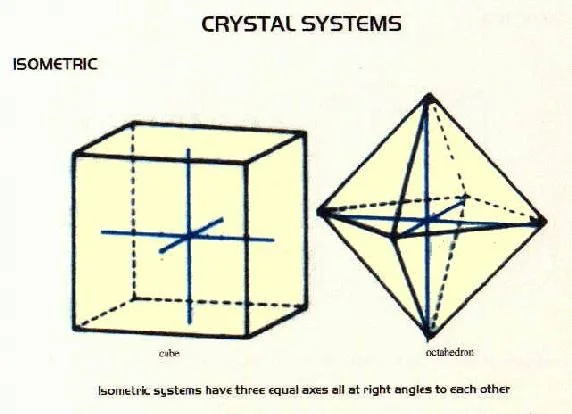
Isometric System
This literally means “equal measure” and refers to the equal length of the crystal axes.
■ Highest symmetry: All have four 3-fold or four 3-bar roto inversion symmetry elements.
Hexagonal System
Either have a single 3- or 6- fold rotation depending on if they are ______ or _______-trigonal
Three horizontal axes of same length (a1-a3) at 120° and a c axis perpendicular to them
Tetragonal System
Have one 4-fold axis (or 4-bar) (but beware! Some isometric minerals also have 4-fold axes!!)
Two axes with equal length (a1-a2) and a 3rd axis (c) mutually perpendicular
Orthorhombic System
All the axes are perpendicular, but they are all different lengths. Every axis has symmetry, either 2-fold or m
Monoclinic
____= one axis of symmetry (either a 2-fold or a mirror)
a and b perpendicular
b and c perpendicular
a and c oblique
Triclinic
Lowest symmetry group. The only options are 1 or 1-bar
All axes different lengths
All axes are at oblique angles to each other (none perpendicular)
Crystal Faces
The frequency with which a given ____ in a crystal is observed is proportional to the density of lattice nodes along that plane (Bravais Law)
Crystal Morphology
Because faces have a direct relationship to the internal structure, they must have a direct and consistent angular relationship to each other
Form
A set of symmetrically equivalent faces. These will have identical atomic structure
Open form
does not enclose space
Closed Form
They enclose a volume of space.
Crystals with one form must be closed.
General form
the form for which the crystal class is named; the max. number of faces of any form in its crystal class
Special Form
any form which is not a general form
Crystal Nucleation
First step in crystal growth; formation of a crystal nucleus from which a crystal will grow.
Heterogeneous nucleation
nucleation on a pre-existing solid material e.g. phenocryst, minute smaller crystals, xenoliths.
Homogeneous nucleation
random thermal fluctuations trigger _________. Undercooling of magmas and supersaturation of magmas is required.
Twinning
Two general types of twin styles - contact and penetration
Form as a result of an error during crystallization
Twinning Laws
An intergrowth of two or more orientations of the same mineral with a crystallographic relationship. Mistakes during crystallization, predominantly thought to be nucleation error
Coordination Number
number of nearest neighbors (# of anions surrounding a cation).
R C / R A
Metallic bonding
usually close packing, cubic or hexagonal, as atoms are generally identical size.
Ionic bonding
approaches close packing but packing also depends on radius ratio of
cation to anion
Covalent bonding
reflects the directional nature of the bond; generally 4-fold CN
Pauling’s 1st Rule: The Coordination Principle
Around every cation, a coordination polyhedron of anions forms.
The cation-anion distance = Σ radii
Use R C/R A (radius ratio) to determine the coordination number of the cation
Pauling’s 2nd Rule: Electrostatic Valency Principle
In a stable crystal structure, the total strength of the valency bonds that reach the cation from all the neighboring anions is equal to the charge of the cation (essentially sharing with nearest neighbors to balance charge).
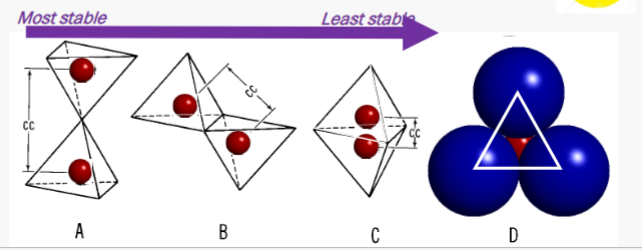
Pauling’s 3rd Rule: Sharing of polyhedral elements I
The sharing of edges (image B) and faces (image C) of adjacent polyhedral tend to decrease the stability of an ionic structure.
Highly charged cations, such as Si4+ use corner sharing (image A)
Pauling’s 4th Rule: Sharing of Polyhedral Elements II
In a crystal with different cations, those of large valence and small CN tend to not
share polyhedral elements (An extension of Rule 3)
Pauling’s 5th Rule: Principle of Parsimony
The number of different kinds of constituents in a crystal tends to be small:
simpler is better!
Precipitation from Fluid
These minerals are typically soluble in water
A decrease in temperature may lead to oversaturation and _______of the minerals
Evaporation of water may also lead to oversaturation and _______
Basaltic magma
high in Fe, Mg, and Ca It ranges in temperature from about 1000°C to 1200°C
Andesitic magma
moderate amounts of Fe, Mg, Ca with higher Si, Na, K, with a temperature range from about 800°C to 1000°C
Rhyolitic magma
high in K and Na, low in Fe, Mg, and Ca. It occurs in the temperature range of
about 650°C to 800°C
Solidus
A boundary where the rock/mineral is solid below the boundary, and starts to melt above the boundary
Metamorphism
change in mineral assemblage and texture of a rock in response to a change in the ambient physical conditions
Tridymite
Formation temperature of ______, 870°C, is well within the normal magmatic temperature range, however tridymite generally forms in silica-rich rocks at lower temperature and must therefore form meta-stably in most cases.
Cristobalite
No terrestrial magma gets as hot as the equilibrium formation temperature of ________(1470C). Since it is common in cavities in low-temperature volcanic rocks like obsidian, as well as some sedimentary settings, it must form also metastably.

Coesite
formed by deep burial of crust, due to
collisional processes
Solid solution
Combine two end member compositions to create a continuous range in mineral composition
Liquidus
A boundary where the rock/mineral is liquid above the boundary, and starts to crystallize below the boundary
Relief
the amount by which a mineral stands out from it’s surroundings
Isotropic
properties are the same in all directions
Anisotropic
properties change as a function of direction
double refraction
The splitting of a light beam into two perpendicular polarized rays