Terms for ESS Test 29/9
 Call Kai
 Learn
Learn Practice Test
 Spaced Repetition
 Match
Match Flashcards
 Knowt Play
1/122

There's no tags or description
Looks like no tags are added yet.
Name | Mastery | Learn | Test | Matching | Spaced | Call with Kai | Chat |
|---|
No analytics yet
Send a link to your students to track their progress
123 Terms
Soil
Forms the outermost layer of the Earth’s surface and consists of weathered rock, organic matter, air and water
Soil Inputs
Solar energy
Heat
Nutrients from weathered bedrock
Moisture
Organic matter
Stores in Soil
Weathered materials
Organic matter
Air
Moisture
Soil Outputs
Sediment (solid particulate matter that settles at the bottom of a liquid or is deposited by water, wind, or ice on the Earth’s surface)
Organic matter
Nutrients
Air
Moisture
Litter
Decomposing plant and animal matter
Humus
Decaying organic matter
Mineralization
Refers to the nutrients (especially nitrogen, phosphorous, and sulfur) that are released when organic matter is broken down.
Soil Pores
Spaces in the soil that may be filled with air and/or water. Macropores are large pore spaces (that may contain both air and water) whereas micropores are small spaces (that are often filled with water).
Ion
An electrically charged particle that is produced when an atom gains or loses an electron.
Three Main States of Water in Soils
Gravitational water: Unavailable for plant roots; lost by gravity; refers to water moving down through the soil due to gravity
Capillary water: Available for plant roots; lost by evapotranspiration; refers to water held by surface tension on small particles in the pore space
Hygroscopic water: Unavailable for plant roots; always present; refers to water that is held in a very thin layer around each individual soil particle
Field Capacity (Related to Gravitational Water)
Occurs when all the smaller pores are filled with water and the larger pores are filled with air.
Permanent Wilting Point (Related to Hygroscopic Water)
Occurs when plants are unable to withdraw any water tightly held by the soil.
Weathering
Refers to the breakdown of rocks in situ (without movement). The weathering of bedrock provides mineral particles in the lower horizon.
Two Types of Weathering
Mechanical (physical) weathering: Leads to the development of smaller particles of the same rock (scree or pebbles/stones)
Chemical weathering: A rock substance is transformed into a different, new material
Soil Horizons
Refers to the development of soil over time into into distinct layers.
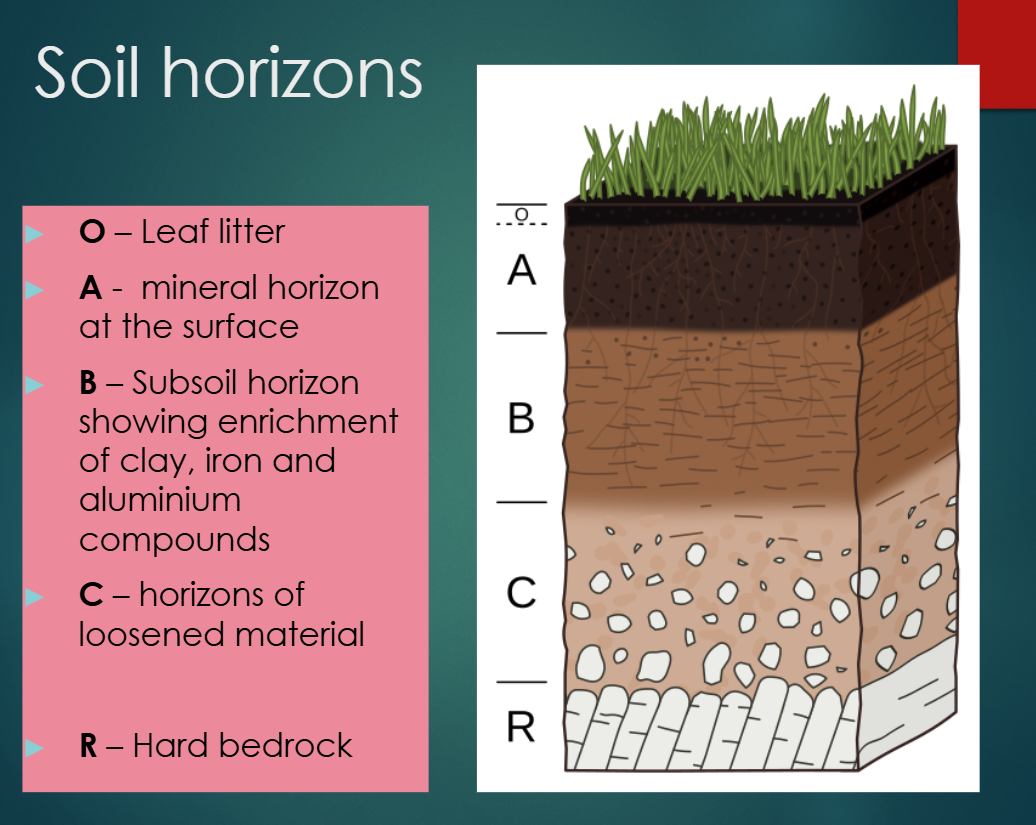
Soil Profile
Refers to the combination of soil horizons. Shows the vertical changes of layers in a soil from the surface to the bedrock
Pedon
A three-dimensional sample of a soil that is large enough to show its characteristics.
Soil Fertility
The ability of soil to sustain plant growth by providing essential nutrients, water, and a healthy physical and biological environment.
Soil Aggregation
The natural process where individual mineral particles (sand, silt, and clay) bind together into stable clusters called aggregates or peds.
Oxidation
A chemical reaction where an atom, molecule, or ion loses electrons, gains oxygen, or loses hydrogen.
Parent Material
The underlying geological deposit or weathered rock from which a soil develops.
Waterlogging
The saturation of soil by water when the rate of water input (rainfall, irrigation) exceeds the rate of drainage, filling all pore spaces and cutting off oxygen to plant roots.
Soil Salinization
The process where water-soluble salts accumulate in the soil to levels that harm plant growth and reduce agricultural productivity.
Biomass
Renewable organic material that comes from plants and animals.
Manure
Organic matter that primarily consists of animal feces mixed with bedding materials like straw.
Podzol
Soil leached under acidic conditions.
Fermentation
A natural metabolic process where microorganisms convert sugars into acids, gases, or alcohol without using oxygen.
Podzolization
A form of leaching under acidic conditions in which iron and aluminium are leached from the upper horizons and deposited in the lower horizons.
Examples of Solutes
Calcium
Nitrates
Chlorine
Potassium
Sulfates
Bicarbonates of sodium, magnesium, and dissolved gases
Sulfur dioxide
Carbon dioxide (CO2)
Nitrous oxide (N2O)
Oxygen (O2)
Methane (CH4)
Germination
The process where a plant or fungus grows out from a seed or spore after a period of dormancy.
Albedo
A measure of how much sunlight a surface reflects.
Radiation
Energy that travels through space or matter in the form of waves or particles.
Convection
The transfer of heat through the physical movement of fluids like liquids or gases.
Conduction
The process where heat moves through a substance by direct physical contact.
Latent Heat
The energy absorbed or released by a substance during a change in its physical state without changing its temperature.
Soil Bulk Density (SBD)
The mass of dry soil divided by its total volume (including pore space). Express as g/cm³ or MG/m³.
Synthetic Fertilizers
Human-made products that are used to increase the level of nutrients in the soil and enhance plant growth.
Agro-Chemicals (Pesticides, Herbicides, and Insecticides)
Organic compounds used in modern agriculture for crop protection and disease control.
Irrigation
Refers to the additional input of water into agricultural systems to encourage plant growth
Sodicity
The presence of large amounts of sodium ions in relation to other cations.
Decomposition
The process whereby complex organic materials in dead plant and animal tissue are broken down into their original inorganic materials such as CO2, water, minerals, and elements.
Nitrification
Release of inorganic nitrogen (N2).
Soil Erosion
The wearing away and removal of the fertile top layer of soil by natural elements or human activity.
Evapotranspiration
The combined process of water moving from the Earth's surface to the atmosphere via evaporation from soil and water bodies and transpiration from plants.
Permeability
The capacity of a porous material to allow fluids and gases to pass through it
Leaching
The process where water or another liquid dissolves and extracts soluble substances or chemicals from a solid material, such as soil, ore, or waste.
Soluble
A substance can dissolve in a liquid.
Diffusion
Occurs when there is a greater concentration of molecules or ions at one point compared to another.
Infltration
The process by which water soaks into or is absorbed by the soil.
Infiltration Capacity
The maximum rate at which rain can be absorbed by soil in any given condition.
Runoff
Excess water from rain, snowmelt, or irrigation that flows over the land surface because the soil cannot absorb it fast enough.
Percolation
Refers to water moving slowly downwards from the soil into the bedrock.
Water Table
The upper layer of the permanently saturated zone (where nearly all the pore spaces are filled with water).
Aeration Zone
The zone that is seasonally wetted and seasonally dries out.
Aquifers
Rocks which contain significant quantities of water.
Aquiclude (Aquifuge)
A rock that will not hold water; are impermeable rocks that prevent the large-scale storage and transmission of water.
Aeration
The process of introducing air, oxygen, or gases into soil or liquids to improve health, reduce compaction, or remove unwanted gases.
Seapage
The slow flow of a fluid through a porous material.
(Soil) Seed Bank
A natural reserve of viable, dormant or semi-dormant seeds present on the soil surface or buried within the leaf litter and soil.
Heterotrophs
Organisms that feed on other organisms.
Autotrophs
Organisms that convert sunlight energy into food energy.
Wilting
Loss of rigidity in the non-woody parts of plants when water loss exceeds water absorption.
Volatilization
Conversion of chemical substances from a liquid/solid state to a gaseous state.
Soil Texture
Refers to the proportion of differently sized materials, usually sand, silt and clay, present in a soil.
Primary Productivity
Primary productivity of soil depends on its:
Mineral content
Drainage
Water-holding capacity
Air spaces
Biota
Potential to hold organic matter
Soil Structure
Refers to the way in which soil particles are combined to form larger soil aggregates.
Workability
How ‘light’, ‘medium’, or ‘heavy’ specific soil is.
Loam
A well-balanced soil with significant proportions of sand, silt, and clay.
Influence of Soil Texture on Properties and Behaviour of Soils
Drainage
The natural or artificial removal of surface water and groundwater from a specific area.
Terracing
The method of turning a sloped or hilly piece of land into a series of flat, step-like platforms to make it usable for framing.
Land Reclamation
The process of creating new land from oceans, seas, or lakes, or restoring damaged or abandoned land for agricultural, industrial, or urban use.
Nutrition Transition
Change in diet with increasing income (up to a point).
World Agriculture
Produces enough food to feed everyone on Earth, but the food produced is not equitably distributed, and at least one third of the food produced is wasted.
Outputs of Farming
Arable (crops)
Pastoral (livestock)
Mixed (arable and pastoral)
Non-food (e.g. tobacco and cotton)
Monoculture (farming of a single product)
Diverse (farming of many products)
Reasons for Farming
Commercial (aiming to sell products to make a profit)
Subsistence (aiming to provide food products for the household)
Sedentary
The farmer farms the same area each year.
Shifting Cultivation
An agricultural system where farmers clear a plot of land, which is cultivated for a few years, and then left dormant for a long period to naturally recover its fertility.
Nomadic Pastoralism
A mobile way of life where herders move livestock continuously to find fresh water and grazing land.
Intensive vs Extensive Farming
Intensive (maximises productivity from a given unit of land with a relatively high number of inputs per hectare)
Extensive (low levels of inputs of fertilizers, pesticides, machinery, and and outputs per unit of land, although the total cost of the inputs can be very high)
Hydroponics
Growing crops in water.
Aquaculture
The controlled farming of aquatic organisms.
Organic vs Inorganic Farming
Organic: Attempts to be a natural form of farming
Inorganic: May use synthetic fertilizers and pesticides
Corporate Farms
Large-scale farms that are owned by companies and their shareholders, and the work is mainly done through a farm manager and hired labour.
Family Farms
Farms that are owned and run by families.
Irrigated Farming
A type of farming in which extra water, taken from rivers, groundwater and/or reservoirs, is provided for crop growth.
Market Gardening/Horticulture
A type of farming involving the production of only one type of crop.
Nomadic Farmers
Farmers that move seasonally with their herds.
Rain-Fed Farming
A type of farming that relies on natural rainfall for crop germination and growth.
Soil-Based Farming
A type of farming in which crops are grown in soil in fields.
Intercropping
Growing two or more crop species simultaneously in the same field or plot of land.
Crop Rotation
Growing different crops families in the same plot of land in a planned sequence year after year.
Fallow
Farmland that is plowed and left unseeded for a season or more to recover its fertility and retain moisture.
Agribusiness
Highly commercialized and large-scale farming.
Farm Fragmentation
A farmer owns many different plots of land rather than just a single of piece.
Transhumance
Seasonal movements up to higher slopes in summer and down to lower slops during winter.
Bush Encroachment
The aggressive, unchecked increase in density of native woody plants and shrubs that outcompete grass and herbaceous layers in grasslands and savannas.
Green Revolution
Involved the application of science and technology to increase crop productivity.
Eutrophication
Over-enrichment of a water body with nutrients like nitrogen and phosphorous, leading to excessive plant and algal growth that depletes dissolved oxygen.
Organic Fertilizers
Fertilizers that are derived from animal matter, human excreta and/or vegetation matter (compost)