Bio2 ch30- Plant Diversity II
 Call Kai
 Learn
 Practice Test
 Spaced Repetition
 Match
 Flashcards
 Knowt Play
1/47

There's no tags or description
Looks like no tags are added yet.
48 Terms
What is the process by which a trait present in an ancestral organism is modified by natural selection over time in descendants of that ancestor?
descent with modification
In plants, the ________ produces haploid gametes (eggs and sperm) by mitosis, whereas the ________ produces haploid spores by meiosis.
gametophyte; sporophyte
When you look at a pine or maple tree, the plant you see is a __________.
diploid sporophyte
All seed plants _____.
a) exhibit a dominant gametophyte generation
b) are heterosporous
c) produce flowers
d) produce antheridia and archegonia on the same gametophyte
b) are heterosporous
The adaptation that made possible the colonization of dry land environments by seed plants is most likely the result of the evolution of _____.
pollen
Where in an angiosperm would you find a megasporangium?
within an ovule contained within an ovary of a flower
In addition to seeds, which of the following characteristics is unique to seed-producing plants?
a) sporopollenin
b) lignin present in cell walls
c) pollen
d) megaphylls
pollen
In seed plants, what is part of a pollen grain and has a function most like that of the seed coat?
sporopollenin
Which of the following plant structures most directly produces the pollen tube of angiosperms?
a) male gametophyte
b) female sporophyte
c) male sporophyte
d) female gametophyte
male gametophyte
What are the products of meiosis in the life cycle of a seed plant?
Megaspores or microspores
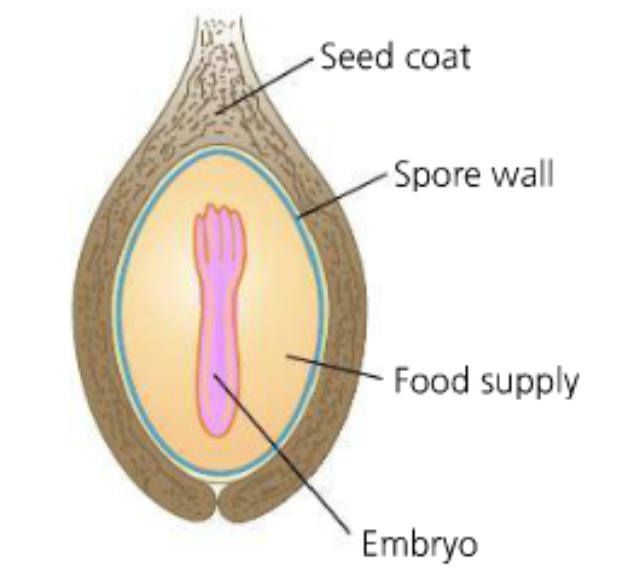
Consider the seed shown in this figure. Select the correct description of this seed.
a) The structures of a seed are all diploid (2n).
b) The embryo within the seed is the offspring of the sporophyte plant.
c) A seed includes contributions from three separate generations of plants.
c) A seed includes contributions from three separate generations of plants.
Which of these structures is a separate generation from the plant sporophyte?
a) The ovule
b) A seed
c) A male gametophyte within a pollen grain
A male gametophyte within a pollen grain
In which of the following pairs do the structures play comparable roles in the plant and animal life cycles?
Select all that apply.
The male gametophyte of a plant and the testes of an animal
A plant seed and a bird egg
A plant sporophyte and an adult animal
A plant sporophyte and an adult animal
Gymnosperms were most abundant during the _____.
Mesozoic
In gymnosperms, megaspores develop into __________.
female gametophytes
Which of the following statements correctly describes a portion of the pine life cycle?
a) Seeds are produced in pollen-producing cones.
b) Pollen grains contain female gametophytes.
c) Female gametophytes use mitosis to produce eggs.
d) A pollen tube slowly digests its way through the triploid endosperm.
Female gametophytes use mitosis to produce eggs.
Which of the following statements about the pine life cycle is correct?
a) Male and female gametophytes are in close proximity during gamete synthesis.
b) The pine tree is a gametophyte.
c) Double fertilization is a relatively common phenomenon.
d) Conifer pollen grains contain male gametophytes.
Conifer pollen grains contain male gametophytes.
Which of the following generations in the conifer life cycle directly produces the megasporangium of pine ovules?
a) female sporophyte
b) male gametophyte
c) female gametophyte
d) male sporophyte
female sporophyte
What contains multiple gymnosperm ovules?
ovulate cone
What’s found inside a pollen grain?
male gametophyte
What are the main components of a mature gymnosperm seed?
seed coat, embryo, food supply, spore wall
What’s the ploidy of:
Gametophyte generation
Sporophyte generation
Megaspore
Embryo
Haploid, diploid, haploid, diploid
After fertilization, the ovule develops into a seed. Match the parts of the ovule with the corresponding parts of the seed.
1.) After fertilization of the ovule, the ______ develops into the food supply of the mature seed.
2.) After fertilization of the ovule, the ______ develops into the seed coat.
3.) After fertilization of the ovule, the ______ develops into the embryo of the mature seed.
Megaspore, Integument, Fertilized egg
Angiosperms are different from all other plants because only they have _____.
flowers
Many mammals have skins and mucous membranes that are sensitive to secretions of plants like poison oak. These secondary compounds are primarily adaptations that function in which of the following ways?
to prevent plants from being eaten by animals
The Brazil nut tree, Bertholletia excels, is native to tropical rain forests of South America. Scientists have discovered that the pale yellow flowers of Brazil nut trees cannot fertilize themselves and admit only female orchid bees as pollinators.
Entrepreneurs attempted, but failed, to harvest nuts from plantations grown in Southeast Asia. Attempts to grow Brazil nut trees in South American plantations also failed. In both cases, the trees grew vigorously, produced healthy flowers in profusion, but set no fruit. Which of the following statements best explains the failure to cultivate Brazil nut trees in these other locations?
The flowers were not pollinated due to the absence of female orchid bees.
The Brazil nut tree, Bertholletia excels, is native to tropical rain forests of South America. The agouti (Dasyprocta spp.), a cat-sized rodent, is the only animal with teeth strong enough to crack the hard wall of Brazil nut fruits. It typically eats some of the seeds, buries others, and leaves still others inside the fruit into which moisture can then enter and allow the remaining seeds to germinate. The agouti is most directly involved in dispersal of which structure?
sporophyte embryos
Which of the following could best be investigated by measuring fruit production in plants?
a) primary productivity
b) phototropism
c) seed dispersal success
d) pollination success
d) pollination success
Scarlet gilia (pomopsis aggregata) usually has red flowers. In certain populations in the Arizona mountains, however, the flowers range from red to pink to white. In early summer, most (but not all) of the flowers were red. In late summer, the same individual plants were still present; the flowers ranged from pink to white, and few red flowers were present. The table below describes the pollination process in these plants.
Pollinator | Time of Day of Pollination Activity | Color of Flowers Producing Fruit |
Hummingbirds | Daytime | Mostly red |
Hawk moths | Sunset and later | White |
Late in the season, when only hawk moths were present, researchers painted the red flowers white. Which of the following results is most likely in this situation?
a) Unpainted red flowers would produce the same number of fruits as the white flowers.
b) Red flowers painted white would produce more fruits than red flowers would.
c) Unpainted red flowers would produce more fruits than white flowers would.
d) Red and white flowers would produce the same numbers of fruits.
b) Red flowers painted white would produce more fruits than red flowers would.
Scarlet gilia (Ipomopsisaggregata) usually has red flowers. In certain populations in the Arizona mountains, however, the flowers range from red to pink to white. In early summer, most (but not all) of the flowers were red. In late summer, the same individual plants were still present; the flowers ranged from pink to white, and few red flowers were present. The table below describes the pollination process in these plants.
Pollinator | Time of Day of Pollination Activity | Color of Flowers Producing Fruit |
Hummingbirds | Daytime | Mostly red |
Hawk moths | Sunset and later | White |
Some plants continued to produce only dark (red) flowers whereas others produced lighter colored flowers later in the season. Which plants do you expect produced more fruit over the entire season?
a) the plants whose flowers were always light colored
b) those that stayed dark
c) those that changed their color to a lighter shade
d) the same numbers of fruit on both
those that changed their color to a lighter shade
Immature seed cones of conifers are usually green before pollination, and flowers of grasses are inconspicuously colored. What does this indicate about how they are pollinated?
They are probably wind pollinated.
In onions (Allium), cells of the sporophyte have 16 chromosomes within each nucleus. How many chromosomes should be in an endosperm nucleus?
24
In onions (Allium), cells of the sporophyte have 16 chromosomes within each nucleus. How many chromosomes should be in an embryo nucleus after fertilization?
16
Which structure in an angiosperm is triploid?
endosperm
Which of the following arranges the structures from largest to smallest, assuming that they belong to two generations of the same angiosperm?
a) embryo sac, carpel, egg, ovary, ovule
b) carpel, ovary, ovule, embryo sac, egg
c) carpel, embryo sac, ovule, ovary, egg
d) embryo sac, ovary, carpel, ovule, egg
carpel, ovary, ovule, embryo sac, egg
Which feature of cycads makes them similar to many angiosperms?
They are pollinated by animals.
Oviparous (egg-laying) animals have internal fertilization (sperm cells encounter eggs within the female's body). Yolk and/or albumen is (are) provided to the embryo, and a shell is then deposited around the embryo and its food source. Eggs are subsequently deposited in an environment that promotes their further development, or are incubated by one or both parents.
The yolk of an animal egg is similar to what structure in angiosperms?
endosperm
What’s the difference between wind-pollinated angiosperms compared with animal pollinated plants?
Wind pollinated plants produce much more pollen because winds disperse pollen randomly.
Select the correct statement describing the life cycle of angiosperms.
a) Double fertilization in the life cycle of seed plants results in the production of a diploid zygote and a triploid endosperm nucleus.
b) In angiosperm life cycles, the female gametophyte is the ovule.
c) The life cycle of seed plants does not include a gametophyte generation.
Double fertilization in the life cycle of seed plants results in the production of a diploid zygote and a triploid endosperm nucleus.
Which of the following problems will likely increase if the human population continues to increase?
a) decrease in global temperature
b) increase in disease-causing organisms
c) reduction in available medicines
d) reduction in plant and animal diversity
reduction in plant and animal diversity
In gymnosperms, which of the following characteristics are unique to cycads?
palm-like leaves
only one living species today
leaves have fan-like appearances
includes 3 genera that vary greatly in appearance
pines
redwoods
all species produce cones
undergo alternation of generations
seeds don’t form in an enclosed structure
palm-like leaves
In gymnosperms, which of the following characteristics are unique to ginkgos?
palm-like leaves
only one living species today
leaves have fan-like appearances
includes 3 genera that vary greatly in appearance
pines
redwoods
all species produce cones
undergo alternation of generations
seeds don’t form in an enclosed structure
only one living species today
leaves have fan-like appearance
In gymnosperms, which of the following characteristics are unique to gnetophytes?
palm-like leaves
only one living species today
leaves have fan-like appearances
includes 3 genera that vary greatly in appearance
pines
redwoods
all species produce cones
undergo alternation of generations
seeds don’t form in an enclosed structure
includes 3 genera that vary greatly in appearance
In gymnosperms, which of the following characteristics are unique to conifers?
palm-like leaves
only one living species today
leaves have fan-like appearances
includes 3 genera that vary greatly in appearance
pines
redwoods
all species produce cones
undergo alternation of generations
seeds don’t form in an enclosed structure
pines
redwoods
all species produce cones
In gymnosperms, which of the following characteristics apply to all phylum?
palm-like leaves
only one living species today
leaves have fan-like appearances
includes 3 genera that vary greatly in appearance
pines
redwoods
all species produce cones
undergo alternation of generations
seeds don’t form in an enclosed structure
undergo alternation of generations
seeds don’t form in an enclosed structure

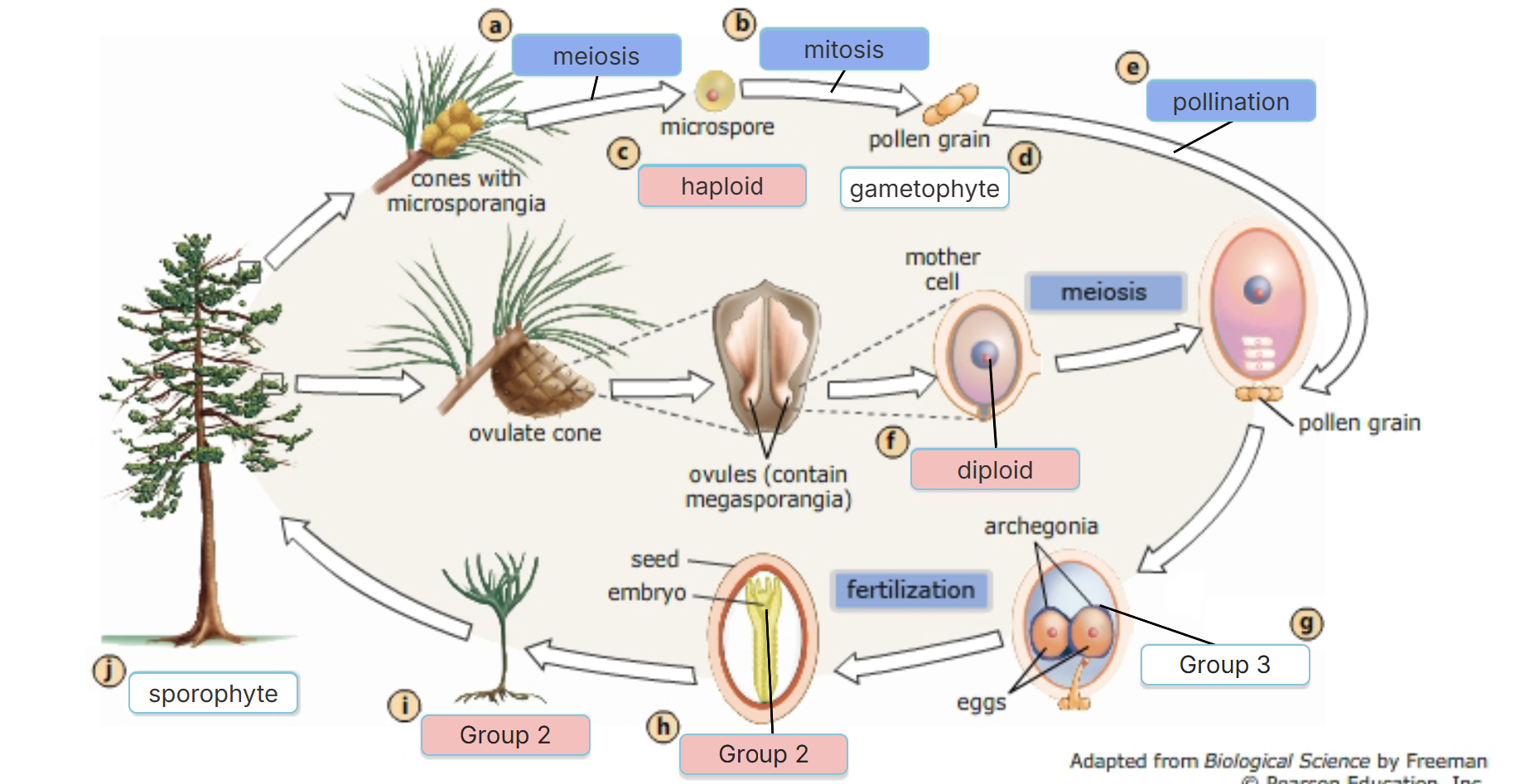
The diagram below illustrates the life cycle of one type of gymnosperm, a conifer. Indicate which structures in the life cycle are haploid or diploid (using labels of Group 2), and label the processes (using labels of Group 1) and stages (using labels of Group 3).
Place the labels to their appropriate locations on the diagram. Labels may be used more than once.
a) meiosis
b) mitosis
c) haploid
d) gametophyte
e) pollination
f) diploid
g) gametophyte
h) diploid
i) diploid
j) sporophyte
What’s part of a seed?
embryo and its food supply
What are seed plants reduced in?
gametophytes, heterospory, ovules, and pollen