clinical biochem - HPLC DRY PRACTICAL
 Call Kai
 Learn
 Practice Test
 Spaced Repetition
 Match
 Flashcards
 Knowt Play
1/30

There's no tags or description
Looks like no tags are added yet.
31 Terms
What are the aims Parts A & B of the HPLC prac?
Part A: Identify drugs in an unknown plasma extract
Part B: Determine the conc. of phenytoin in plasma
What stationary phase was used in the HPLC prac?
A non-polar, lipophilic C18 reversed-phase column
What mobile phase was used in Part A?
Methanol & 10 mM ammonium phosphate, pH 4.6, in a 65:35 volume ratio
Which drugs are retained longer in reversed-phase HPLC, and why?
More hydrophobic drugs, because they interact more strongly with the non-polar C18 stationary phase

What is retention time (tR)?
The time between injection & the detection of an analyte peak

What is the solvent front (tm)?
The early signal representing unretained material; its time provides the reference for corrected retention time

What does the area under a chromatographic peak indicate?
The amount of analyte detected. Peak area is related to conc. and can be compared with a standard
Which five drugs standards were used in Part A?
Phenobarbital, phenytoin, phenacetin, theophylline & diazepam

How were unknown drugs identified in Part A?
Compare their corrected retention times with those of known drug standards

How is corrected retention time calculated?
Corrected retention time = tR - tm
Phenobarbital has tR = 4.501 mins and tm = 2.326 mins. What is the corrected tR?
4.501 - 2.326 = 2.175 mins

An unknown has corrected tR = 0.634 mins; which drug is it?
Theophylline. Its standard has corrected tR = 0.688 mins

An unknown has corrected tR = 13.910 mins; which drug is it?
Diazepam. Its standard has corrected tR = 14.088 mins

Why is the theophylline peak area potentially inaccurate?
The theophylline peak overlaps with the solvent front, so its integrated area may include another signal
How do you calculate a drug conc. from peak areas?
Unknown concentration = (unknown peak area/standard peak area) x standard conc. (0.2 mM)
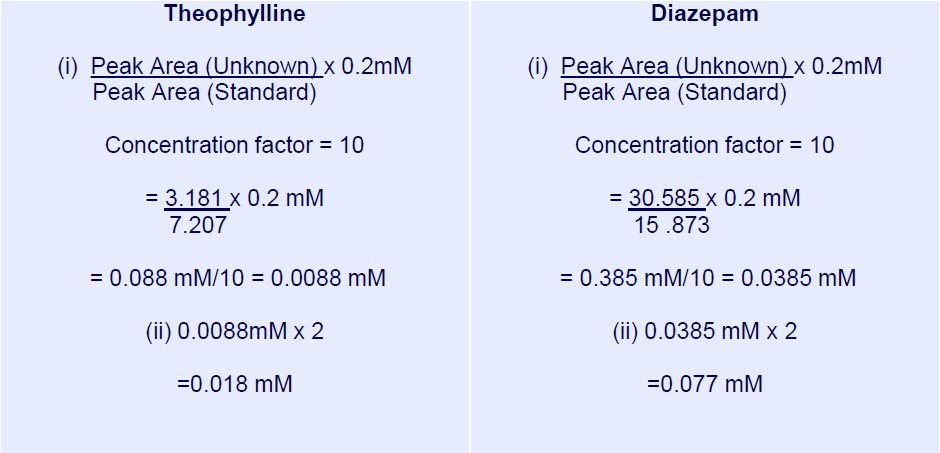
The plasma extract was concentrated tenfold. How do you correct for this?
Divide the measured extract conc. by 10 when converting back to the original sample, before recovery correction
How do you correct a conc. for 50% extraction recovery?
Multiply by 2 because only half the original drug was recovered
Which drug is specifically quantified in Part B?
Phenytoin, an anticonvulsant
What is MPPH and what is its purpose?
Methylphenytoin, the internal standard. It helps account for extraction & analytical variation
When is the MPPH internal standard added?
Before extraction, to both standards & unknown samples
Why should an internal standard resemble phenytoin?
Similar chemical properties make it more likely to undergo similar losses during preparation & analysis
How is the phenytoin/MPPH peak-area ratio calculated?
Phenytoin peak area/MPPH peak area

What are the x-axis & y-axis of the Part B standard curve?
X-axis = phenytoin conc. (μM)
Y-axis = phenytoin/MPPH peak-area ratio


What peaks appear in the 0 μM phenytoin standard?
Solvent front & MPPH peak. There should be no phenytoin analyte peak
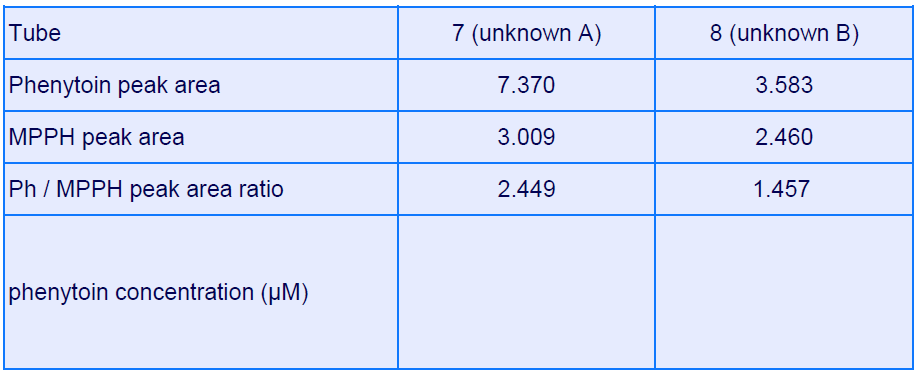
Which unknown had the higher phenytoin/MPPH ratio?
Unknown A = 2.449
Unknown B = 1.457
Therefore, Unknown A is higher
Why might MPPH peak areas differ between samples?
Differences in extraction recovery, pipetting, injection volume or temp can alter the response
Why use prepared plasma instead of untreated whole blood?
Cells & particulates in whole blood can interfere with analysis or obstruct the column
How can very hydrophobic drugs be eluted faster?
Increase the organic solvent strength of the reversed-phase mobile phase
Why rerun standards after HPLC conditions change?
Changing the mobile phase or other conditions can alter retention times, so prior standards may no longer match
How would you separate more hydrophilic drugs?
In reversed-phase HPLC, hydrophilic (polar) drugs elute quickly because they interact weakly with the non-polar C18 stationary phase
Changing the mobile phase can improve drug separation by altering retention times
Lecture answer: Use a more non-polar mobile phase to separate hydrophilic drugs
General HPLC principle: Increasing the aqueous (polar) proportion usually increases retention in C18 columns
*Mobile phase composition controls how strongly drugs are retained & how well they separate
Why are broad or overlapping chromatographic peaks problematic?
They reduce separation quality & make peak identification, integration & quantification less reliable