DM MIDTERM - DENTAL IMPRESSION MATERIALS
 Call Kai
 Learn
 Practice Test
 Spaced Repetition
 Match
 Flashcards
 Knowt Play
1/165

There's no tags or description
Looks like no tags are added yet.
Name | Mastery | Learn | Test | Matching | Spaced | Call with Kai | Chat |
|---|
No analytics yet
Send a link to your students to track their progress
166 Terms
Dental impression is defined as -
A negative likeness of a dental structure
record accurately the dimensions of oral tissues
material in the soft state is placed against the oral tissues to set (harden)
+ vs - replica
(model or cast of the oral tissues) = POSTIVE REPLICA
(dental impression) = NEGATIVE REPLICA

Impression material is defined as -
negative likeness of a dental structure
accurately record dimensions of oral tissues
material in the soft state is placed against the oral tissues to set (harden)
What are the ideal properties of impression materials?
Have pleasant taste, odor and esthetic color
Not contain any toxic or irritating ingredients
Be economical
Have adequate shelf life for storage and distribution
Be easy to use with minimum equipments
Exhibit dimensional stability
Have adequate strength so that it will not break or tear while removing from the mouth
Posses elastic properties with freedom from permanent deformation after strain
Be able to be electroplated
Be compatible with die and cast materials
Which impression materials set by chemical reaction (irreversible) and are rigid (edentulous)?
Impression plaster, Zinc oxide eugenol
Which impression materials set by chemical reaction (irreversible) and are elastic (non-rigid, dentulous)? - most commonly used
Alginate, Polysulfide, Polyether, Silicone
Which impression materials set by temperature change (reversible) and are rigid (edentulous)?
Compound, Waxes
Which impression materials set by temperature change (reversible) and are elastic (non-rigid, dentulous)?
Agar hydrocolloid
What is impression plaster?
Basically a GYPSUM product (Type-1)
What is impression plaster used for?
Used as mucostatic impression material for making final impressions for edentulous patients
When is impression plaster applicable?
Applicable to patients with displaceable soft tissues that should be recorded in a passive state
What are the advantages of impression plaster?
Cheap and long shelf life, easy to prepare
Very good surface detail reproduction
Excellent dimensional stability
What are the disadvantages of impression plaster?
Very rigid -
Fractures if undercuts are present
May dry soft tissues, unpleasant to patients
Separation from cast may become difficult
What is zinc-oxide eugenol impression paste used for?
Secondary (final) impression material for edentulous patients
Temporary relining material for dentures
Bite registration paste
Surgical pack paste for periodontal wound healing
How is zinc-oxide eugenol impression paste supplied?
Supplied in two separate pastes dispensed in tubes.
What is the composition of Tube no 1 (Base) in zinc-oxide eugenol impression paste?
Zinc oxide
Fixed vegetable or mineral oil
What is the composition of Tube no 2 (Accelerator) in zinc-oxide eugenol impression paste?
Oil of cloves or eugenol
Gum or polymerised rosin
Filler (silica type)
Lanolin
Resinous balsam
Accelerator solution (CaCl2)
What is the setting reaction of zinc-oxide eugenol impression paste?
Ionic in nature
What does the setting reaction of zinc-oxide eugenol impression paste require?
Requires ionic medium in which it can proceed at any desired rate
What is the first reaction in zinc-oxide eugenol setting?
Hydrolysis of zinc oxide to its hydroxide form
What happens when the two zinc-oxide eugenol pastes are mixed?
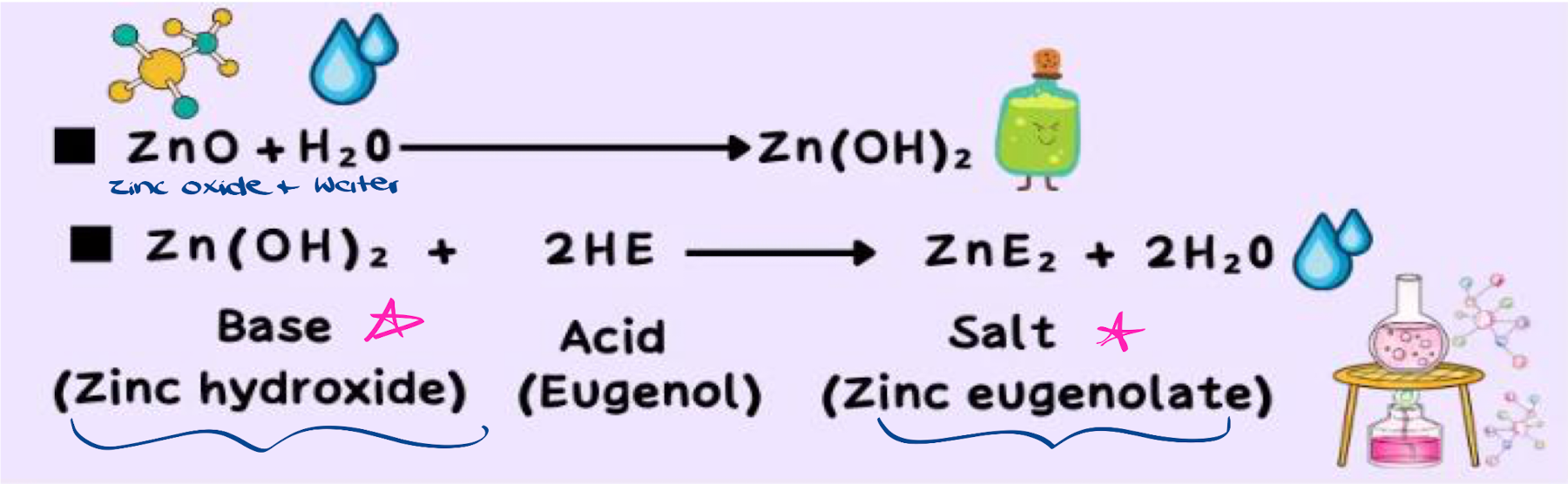
The phenol -OH of the eugenol acts as a weak acid and undergoes an acid-base reaction with zinc hydroxide
What salt forms during zinc-oxide eugenol setting?
Zinc eugenolate.
Setting reaction of zinc eugenol chemical equation:
Base -
Acid -
Salt -
Base - zinc hydroxide
Acid - eugenol
Salt - zinc eugenolate.
Why can the zinc-oxide eugenol setting reaction also be described as autocatalytic?
As water is used for initiation and obtained as a by-product, the reaction can also be described as an autocatalytic reaction.
What is the initial setting time of Type I zinc-oxide eugenol impression paste?
3-6 min
What is the final setting time of Type I zinc-oxide eugenol impression paste?
10 min
What is the initial setting time of Type II zinc-oxide eugenol impression paste?
3-6 min
What is the final setting time of Type II zinc-oxide eugenol impression paste?
15 min
Consistency and Flow
According to ADA specification No. 16, what is the spread of Type I zinc-oxide eugenol?
30 to 50 mm
Consistency and Flow
According to ADA specification No. 16, what is the spread of Type II zinc-oxide eugenol?
20 to 45 mm
RIGIDITY AND STRENGTH:
What is the compressive strength of hardened ZOE two hours after mixing?
Approximately 7 MPa
DETAIL REPRODUCTION:
Why does zinc-oxide eugenol reproduce surface details accurately?
It registers surface details quite accurately due to the good flow
DIMENSIONAL STABILITY:
What dimensional change may occur during zinc-oxide eugenol hardening?
A negligible shrinkage (less than 0.1%) may occur during hardening.
What biological consideration applies to zinc-oxide eugenol?
Some patients experience a burning sensation in the mouth due to eugenol. - allergic
What are the advantages of zinc-oxide eugenol impression paste?
Low viscosity - no compression of soft tissues (flows slowly)
Dimensional stability (shrinkage less than 0.1%)
Good surface detail reproduction
Low price
What are the disadvantages of zinc-oxide eugenol impression paste?
Cannot be used in deep undercuts
Eugenol allergy in some patients
How is zinc-oxide eugenol impression paste mixed?
Mixed on oil impervious paper or glass mixing slab
How is the proper proportion of zinc-oxide eugenol pastes obtained?
By squeezing 2 strips of paste of the same length, one from each tube, onto the mixing slab
What spatula is used to mix zinc-oxide eugenol pastes?
Flexible stainless steel spatula
How long is zinc-oxide eugenol paste mixed?
Approx 1 min, until a uniform color achieved.
What are the two main groups of elastic impression materials?
Aqueous Hydrocolloids; Non-aqueous elastomeric impression materials
Which materials are aqueous hydrocolloids?
Agar-agar; Alginate
Which materials are non-aqueous elastomeric impression materials?
Polysulfides; Silicones; Polyethers
What does the agar conditioning unit allow?
Liquefaction, storage and tempering
How many compartments does the agar tray material conditioning unit have?
3 compartment conditioning unit
In which compartments is syringe material used when making the agar impression?
Syringe material used only in liquefaction and storage compartments
What is alginate?
Irreversible elastic hydrocolloid
What is alginate derived from?
Mucous extract yielded from certain brown seaweeds.
How is alginate described in the lecture?
Most widely used impression material
Why was alginate developed?
Developed as a substitute for agar
What are the types of alginate?
Type 1- Fast Setting; Type 2 - Normal Setting
When is alginate used for impression making?
When there are undercuts; in mouth with excessive flow of saliva
What are the applications of alginate?
For impression to make study models and working casts
For making preliminary impression
What is the function of sodium or potassium alginate?
React with calcium ion
What is the function of calcium sulphate (reactor) in alginate? **
React with potassium alginate
What is the function of zinc oxide in alginate? **
Acts as filler
What is the function of potassium titanium flouride in alginate? **
Gypsum hardener
What is the function of diatomaceous earth in alginate? **
Acts as filler
What is the function of sodium phosphate (retarder) in alginate? **
React with calcium sulphate
What are the colouring and flavouring agents in alginate? **
Wintergreen, orange etc.
What are the two main reactions in alginate setting?
2Na3PO4 + 3CaSO4 → Ca3(PO4)2 + 3Na2SO4
Sodium alginate + CaSO4 + H2O
Calcium Alginate + Na2SO4
What happens first during the alginate setting reaction?
Firstly the retarder is completely reacted to delay the reaction time.
How is alginate manipulated?
The measured powder is sifted into pre-measured water
A vigorous figure - 8 motion, with the mix being stropped against the sides of rubber mixing bowl
What is the mixing time for alginate?
Between 45 secs - 1 min
What causes dimensional change in alginate? **
Dimensional change due to syneresis and imbibition.
What is syneresis?
gel contracts and expels liquid (water) from its structure, leading to shrinkage and dimensional reduction.
What is imbibition?
gel absorbs water from the surroundings, resulting in swelling and dimensional increase.
Why does an alginate impression shrink slightly?
due to thermal differential between mouth temperature (37℃) and room temperature (23℃)
What are the elastic properties of alginate?
Good elasticity and elastic recovery
How is alginate flow described?
Highly flexible
How is alginate accuracy described?
Fine reproduction of tissue detail
What is the compressive strength of alginate?
500-8000 gm/cm2
What is the tear strength of alginate?
350-700 gm/cm2
How does sodium sulfate affect gypsum setting after alginate gelation?
Gelation produces sodium sulfate which acts as an gypsum-setting accelerator at low concentrations and a retarder at higher concentrations.
What is used as a gypsum surface hardener with alginate?
Potassium titanium fluoride
What are the advantages of alginate?
Ease of manipulation
No need of expensive equipments
Relatively low cost
Comfort to patients
What are the disadvantages of alginate?
High viscosity
Ability to displace tissues
Tears easily
Poor dimensional stability
What is the working time of normal set alginate?
2 min
What is the working time of fast set alginate?
1¼ min
What is the setting time of normal set alginate?
4½ min
What is the setting time of fast set alginate?
1-2 min
In what increasing order of filler content are elastomer consistencies formulated? **
Extra light body → Light body → Medium or regular body → Heavy body → Putty (extra heavy)
What was the first synthetic elastomeric impression material?
Polysulphide, NOT used anymore.
What were polysulphides used for?
record impressions for crowns, bridges, inlays, onlays, and partial dentures.
What are addition silicones commonly referred to as?
Polyvinyl siloxanes (PVS) or Vinyl poly siloxane
Composition of base paste of polysulphides:
Fillers
Strengthener
Plasticizer (confers viscosity to base, gives elastic property)
Composition of accelelator paste of polysulphides:
Reactor
Promoter, accelerates the reaction
Retarder, controls setting reaction
Why are polysulphides NOT used anymore?
water = byproduct, low dimensional stability, easily distorts
longest setting time out of all elastomers (7-10 mins)
hydrophoic
unacceptable odor
untidy stains clothing
What is condensation silicone also known as?
Conventional silicones or room temperature vulcanizing (RTV) silicones.
How is condensation silicone supplied?
two-paste system
base-paste with low-viscosity liquid catalyst
two-putty system
What is the putty-wash technique for condensation silicone impressions?
Using putty as tray material with a low-viscosity silicone.
Give an example of a condensation silicone brand:
Speedex
What are the uses of condensation silicone?
Impressions for:
crowns, bridges, inlays, onlays, and complete dentures.
What is in the base paste in condensation silicone?
Hydroxyl-terminated polydimethyl siloxane
Colloidal silica or titanium dioxide
What is the function of hydroxyl-terminated polydimethyl siloxane in condensation silcone?
Low-molecular-weight silicone polymer
What are the fillers in condensation silicone?
Colloidal silica or titanium dioxide
What are the liquid accleators in condensation silcone?
Alkyl silicate
Stannous octoate
What is the function of alkyl silicate in condensation silicone?
Cross-linking
What is the function of stannous octoate in condenstaion silcone?
Activator
What is the by-product of condensation silicone?
Ethyl alcohol