ME115 - Week 3
 Call Kai
 Learn
Learn Practice Test
 Spaced Repetition
 Match
Match Flashcards
 Knowt Play
1/6

Earn XP
Description and Tags
Miller Indices
Name | Mastery | Learn | Test | Matching | Spaced | Call with Kai | Chat |
|---|
No analytics yet
Send a link to your students to track their progress
7 Terms
Allotropic/polymorphic
When certain materials can have more than one crystal structure, this can also change the volume of the material.
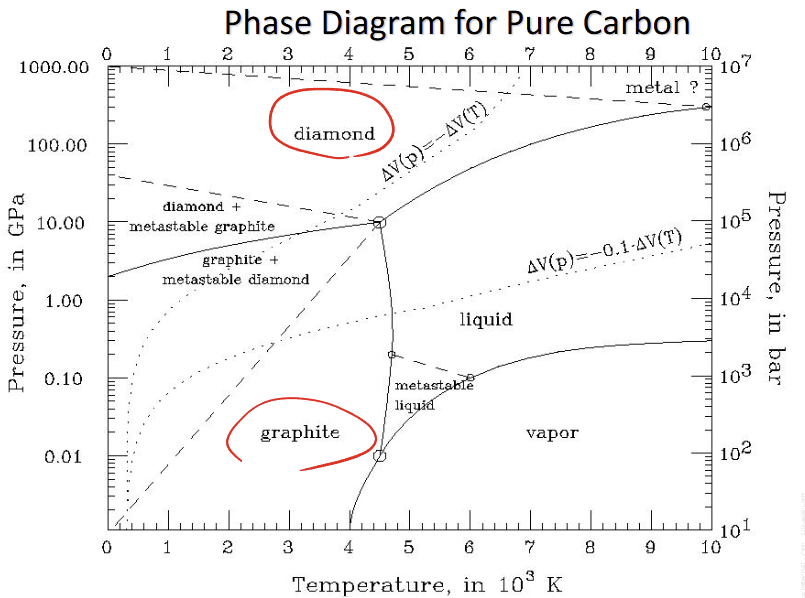
E.g. at room temperature iron has a BCC structure, but if you heat it to 912 Celsius it becomes FCC and if you heat it to 1394 Celsius it goes back to BCC. Or how carbon can be diamond or graphite (determined by the temp and pressure that the crystals form at).
Polymorphism is only for compounds (more than one element)
Examples of SC crystals
Polonium, alpha manganese
Examples of BCC crystals
Iron (ferrite; alpha-Fe), titanium (beta-Ti), tungsten (W), potassium, sodium, zirconium (beta-Zr), chromium, molybdenum, niobium, tantalum, vanadium
Examples of FCC crystals
Iron (austenite; gamma-Fe), copper, silver, lead, nickel, gold, platinum
Examples of close-packed hexagonal crystals (HCP)
Titanium (alpha-Ti), magnesium, zinc, beryllium, cobalt, zirconium (alpha-Zr), cadmium
Anisotropy
The structural property of a material or system where physical, mechanical, or optical properties vary depending on the direction of measurement.
This is the case with young’s modulus where the young’s modulus of bulk materials is the average of the young’s modulus in each direction.
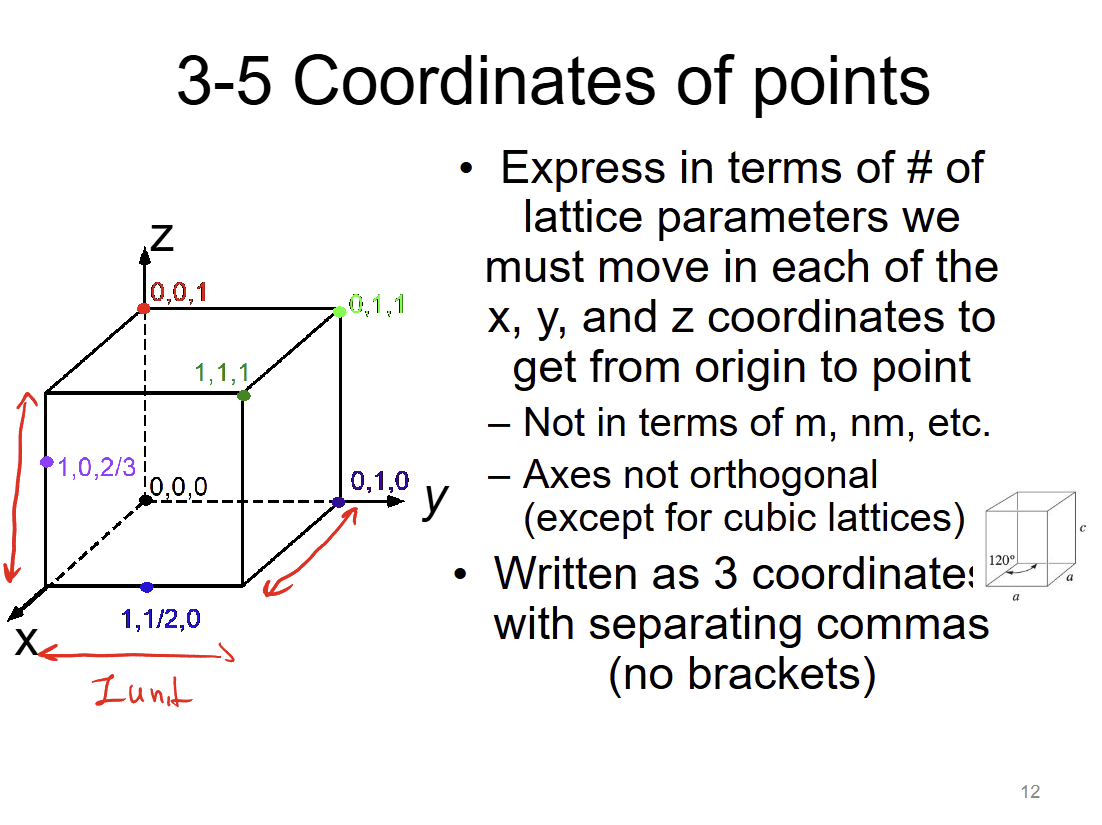
How to find the miller indices for a direction
Determine the coordinates of 2 points
Subtract the coordinates of the initial point from those of the final point
Clear fractions and/or reduce the results to the lowest integers.
Enclose the numbers in square brackets []. (No commas)
Negatives are represented by bar above number.
![<ol><li><p>Determine the coordinates of 2 points</p></li><li><p>Subtract the coordinates of the initial point from those of the final point </p></li><li><p>Clear fractions and/or reduce the results to the lowest integers.</p></li><li><p>Enclose the numbers in square brackets []. (No commas)</p></li><li><p>Negatives are represented by bar above number.</p></li></ol><p></p>](https://assets.knowt.com/user-attachments/ee585a5d-8628-420f-937e-f8210f850662.png)