control of blood water potential
 Call Kai
 Learn
 Practice Test
 Spaced Repetition
 Match
 Flashcards
 Knowt Play
1/16

There's no tags or description
Looks like no tags are added yet.
17 Terms
what is the function of the kidney?
to regulate blood water potential by filtering waste products out of the blood and reabsorb useful solutes
what is a nephron?
the long tubules along the bundles of capillaries where the blood is filtered- around one million per kidney
describe the structure of a nephron
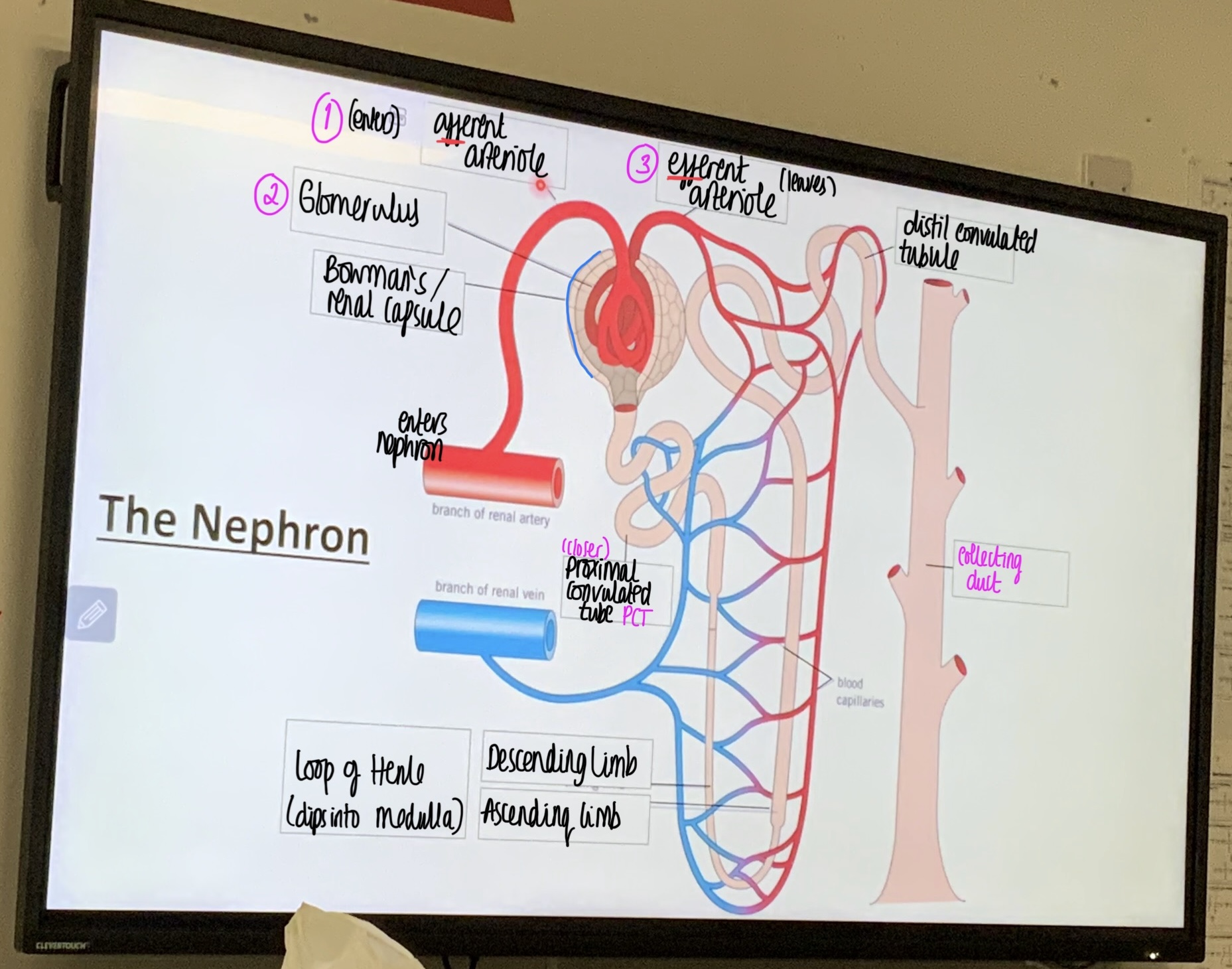
from what vessel does blood enter the kidneys?
renal arteries
describe the full journey that blood takes in the kidneys to become urine
blood enters the kidney via renal artery
then passes through capillaries in cortex (outer layer) of kidneys
as passes through cortex, substances are filtered out of blood & into long tubules surrounding capillaries = ultrafiltration
useful substances eg glucose & correct water volumes are re absorbed into blood = selective reabsorption
remaining unwanted substances pass along to bladder & excreted as urine
where in the nephron does ultrafiltration take place?
in the glomerulus & Bowman’s capsule
these are a bundle of capillaries looped into a hollow ball called the Bowman’s capsule
Describe the process of ultrafiltration and how it produces glomerular filtrate. (5)
afferent arteriole has a wider diameter than the efferent arteriole and glomerulus capillaries
so generates higher HS pressure in glomerular capillaries (higher than inside Bowman’s capsule)
forces ions, water, glucose, urea & other small molecules out of capillaries
(RBCs & WBCs & large proteins return to efferent arteriole)
through the 3 layers of Bowman’s capsule:
through capillary endothelium fenestrations
through basement membrane- acts as a filter
through gaps between podocytes
into lumen of Bowman’s capsule
this is glomerular filtrate
what is glomerular filtrate, where does it travel, and what does it contain?
the substances that enter the Bowman’s capsule lumen from the capillary
it passes along the rest of the nephron & useful substances are reabsorbed
filtrate flows through collecting duct & passes out of kidney along ureter
It contains: some small proteins, amino acids, urea, mineral ions, glucose, water
In a mammal, urea is removed from the blood by the kidneys and concentrated in the filtrate. Describe how urea is removed from the blood. (4)
Hydrostatic pressure / description of pressure / description of how pressure generated;
Causes ultrafiltration (Allow description of ultrafiltration) at Bowman's capsule / glomeruli / renal capsule;
Through basement membrane;
Enabled by small size urea molecule;
where does the glomerular filtrate go after leaving the Bowman’s capsule?
the proximal convulated tubule (PCT)
describe the process of selective reabsorption
Na+ ions actively transported out of PCT epithelial cells into surrounding capillaries - via Na+/K+ pump
Low conc of Na+ ions in epithelial cells
Sodium ions move into PCT cells from the tubule lumen down their concentration gradient via co-transport proteins.
As sodium diffuses in, it brings glucose or amino acids with it
Glucose and amino acids leave the PCT cell by facilitated diffusion into the blood capillaries
As solutes (Na⁺, glucose, etc.) are reabsorbed, water follows by osmosis, down the water potential gradient.
~85% of water is reabsorbed at this stage.
what are the adaptations of the proximal convoluted tubule (PCT)?
Microvilli - These are small, finger-like projections that greatly increase the surface area for reabsorption.
Basal in folding - These structures further increase the surface area for moving substances into surrounding blood capillaries.
Numerous mitochondria - These organelles provide ATP for the active transport processes involved in reabsorption.
Co-transporter proteins in the plasma membrane - These allow co-transport of substances from filtrate into epithelial cells.
what are the features of the ascending and descending limbs of the Henle’s loop?
The ascending limb is permeable to ions but impermeable to water
The descending limb is impermeable to ions but permeable to water
describe the role of the loop of Henle in the absorption of water from the filtrate and maintaining the Na+ ion gradient
In the ascending limb sodium ions actively removed; via the Na+/K+ pump = Na+ ion concentration gradient
Into medulla
Low water potential in the tissue fluid of medulla;
Ascending limb impermeable to water;
In descending limb sodium ions diffuse in;
Descending limb water moves out by osmosis down wp gradient
The longer the loop / the deeper into medulla, the lower the water potential in tissue fluid of the medulla;
Water increases hydrostatic pressure in medulla
Water leaves collecting duct / DCT; via vasa recta capillaries
By osmosis / down water potential gradient;
what is the counter-current multiplier?
filtrate goes in the opposite direction to blood in the vasa recta capillaries- in both ascending & descending
helps maintain CG between loop of Henle & capillaries along the whole length of the loop of Henle so water + ions can be reabsorbed
what happens when we have low blood wp?
Low WP detected by osmoreceptors in hypothalamus.
Posterior pituitary gland stimulated to reledse more ADH into blood.
ADH binds to receptors on CSM of cells lining the DCT and collecting duct.
Triggers vesicles containing aquaporins to fuse with CSM = more aquaporins incorporated into
CSM of cells lining the DCT and collecting duct.DCT and collecting duct more permeable to water, as there are more places for water to leave by osmosis.
More water reabsorbed into blood by osmosis.
what happens when high blood wp?
High WP detected by osmoreceptors in hypothalamus.
Posterior pituitary gland releases less ADH into blood.
Less ADH molecules bind to receptors in CSM of cells lining the DCT and collecting duct = less aquaporins incorporated into CSM of cells lining these tubules.
DCT and collecting duct less permeable to water, as there are fewer places for water to leave by osmosis.Less water reabsorbed into blood by osmosis.
→ More water lost
→ Urine more dilute