Cel Bio Exam 3
 Call Kai
 Learn
 Practice Test
 Spaced Repetition
 Match
 Flashcards
 Knowt Play
1/62

There's no tags or description
Looks like no tags are added yet.
63 Terms
Which of the following pathways is most likely going to result in a short-term, rapid response by a receiving cell?
Norepinepherine (triggers fight-flight-freeze response)
Some G-Protein coupled receptors cause ion channels to open.
True
Cellular responses depend on the type of receptor present; the same signaling molecule can elicit different responses depending on the receptors present.
True
Which of the following is NOT a form of cell-to-cell signaling?
Simulacrine signaling
Which of the following best explains the benefit of signal amplification?
It allows for a small amount of signaling molecule to generate a large and/or prolonged cellular response.
Which of the following polypeptides is most likely to bind to a receptor in the nucleus?
a nonpolar polypeptide
Which of the following is NOT a feature of G-Protein coupled receptors (GPCRs)?
GPCRs are active when they are bound by GDP and inactive when they are bound by GTP.
Which of the following are likely to increase the strength and length of a signal?
Decreasing the dissociation constant of the receptor molecule
Increasing the number of receptor molecules
Increasing the concentration of the signaling molecule
Selective serotonin reuptake inhibitors (SSRIs) can increase the time serotonin, a signaling molecule, spends outside of cells. What effect do SSRIs likely have on the serotonin-receptor equilibrium?
More serotonin receptors will be bound.
PI3 kinases are activated by the same receptors as many tyrosine kinase pathways.
True
Which of the following best explains why the Wnt pathway is not typically used by unicellular eukaryotes?
It wastes molecular resources by constantly being "on."
Which of the following are possible cellular effects of RTK activation? Select ALL that apply.
Transcriptional deactivation and Transcriptional activation
Cytokine receptors can activate many of the same kinase pathways as RTKs.
True
Which of the following occurs in cytokine receptor activation and RTKs?
Phosphorylation of activation loop tyrosines Ligands bind to the monomeric receptors , Dimerization of two monomeric receptors
Which of the following is not a kinase?
Ras
Which of the following best describes what kinases do?
Act as enzymes, transferring a phosphate from ATP to a substrate
What type of signal transduction pathway best describes the insulin receptor pathway in fat and muscle cells?
Enzyme receptor
Which of the following environments would signal the pancreas to STOP releasing insulin?
Low glucose levels in the blood
Which of the following best describes the relationship between insulin and glucagon?
Inhibitory: The signals initiate opposite responses in the cell
What is the cellular response of the insulin pathway in liver cells? Select ALL that apply.
Phosphorylation of GSK3 for glycogen synthesis and Increase GLUT2 transporter in membrane
What is the cellular response of the insulin pathway in fat cells?
Increase GLUT4 transporter in membrane
Which of the following is NOT a requirement for a cellular response pathway (such as responding to blood sugar or low oxygen) for a cell to maintain homeostasis?
stimulus/signal, sensor and effector
What is cell-to-cell communication essential for?
Regulation of growth, Differentiation and Specialization, and Metabolism and Homeostasis
What does cell-to-cell communication require?
Signaling molecule, Receptor, and an Effector protein
What is a Signaling molecule? What produces it?
Proteins, peptides, amino acids, nucleotides, steroids, retinoids, fatty acid derivatives, dissolved gases, and ions
Produced by the signaling cell
What is a receptor? What produces it?
May be at the surface of the cell, in cytosol, or in the nucleus, varies by cell and is specific to signaling molecule
Produced by the target cell
What is an effector protein/what does it do?
Creates the response, and includes enzymes, transcription factors, ion channels and more
What is a signal transduction pathway?
The series of chemical interactions that occur from the binding of a signaling molecule to its receptor until the final cellular response
One signaling molecule will continue to generate secondary messengers until the signaling molecule is removed
True
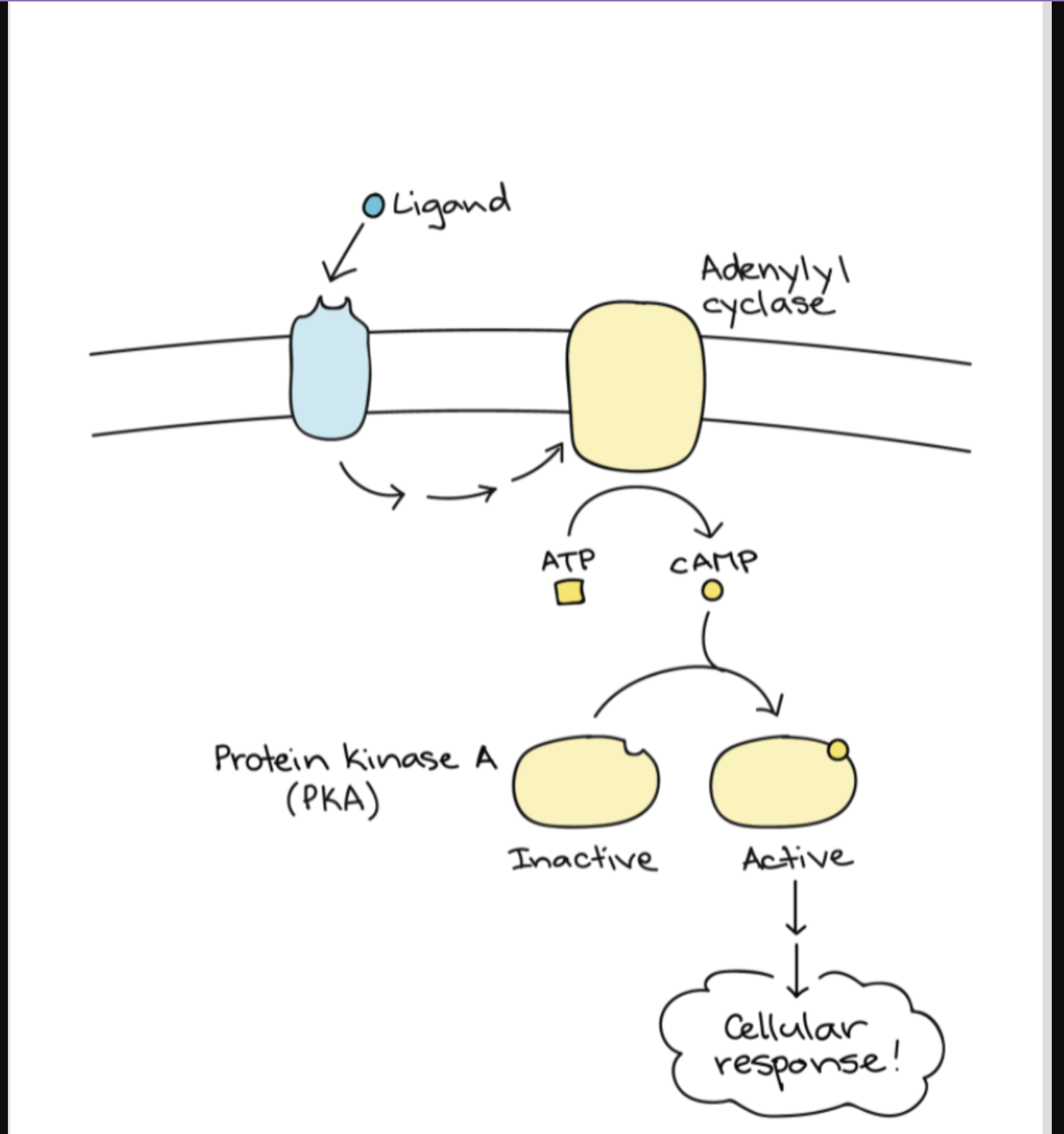
According to the diagram, which molecule is the secondary messenger?
cAMP
The use of signal transduction allows communication to be amplified?
True
receptors have high binding affinity for signaling molecules.
True
What does the strength of a signal depend on?
Amount of signal, amount of receptor, dissociation constant between signal and receptor
As Kd increases what happens to binding afinity?
Decreases

Tang et al (2008) wanted to understand the signaling pathway of BRI1, an enzyme receptor in Arabidopsis. After identifying BRZ as a product of the pathway, the researchers next treated seedlings with BRZ and observed their growth. Based on the graph to the left, which of the following statements are TRUE? Select ALL that apply.
BRZ participates in a negative feedback loop.
What is a kinase?
An enzyme that attaches a phosphate from a nucleotide (ex. ATP) to the sustrate
Most enzyme-linked receptors ultimately activate transcription factors for regulating gene expression
True
What can Receptor Tyrosine Kinases (RTKs) do to increase their own activity?
They can phosphorylate themselves (autophosphorylate)
Does the phosphorylated kinase interact with proteins on the membrane or cytosolic side?
Cytosolic
Why are Ras/MAP pathways often the target of cancer treatments?
they respond to growth factors
Which of the following is the most likely outcome for the organism if a cytokine receptor (such as IL-5R) is overexpressed in the gut?
Frequent irritation of the gut lining from inflammation
What is cis-inhibition?
If the same signaling protein is produced by the cell with a NOTCH receptor, the NOTCH receptor will be ubiquitinated
Where might you expect NOTCH pathways to be used?
Immune, epithelial, and cancer cells
What is trans-activation?
When the signaling protein is on a different cell
What is Wnt
Wnt is a signaling molecule that binds to a multipass membrane receptor; When bound, the receptor interacts with a protein complex and de-ubiquitinates it so the TF can make it to the nucleus
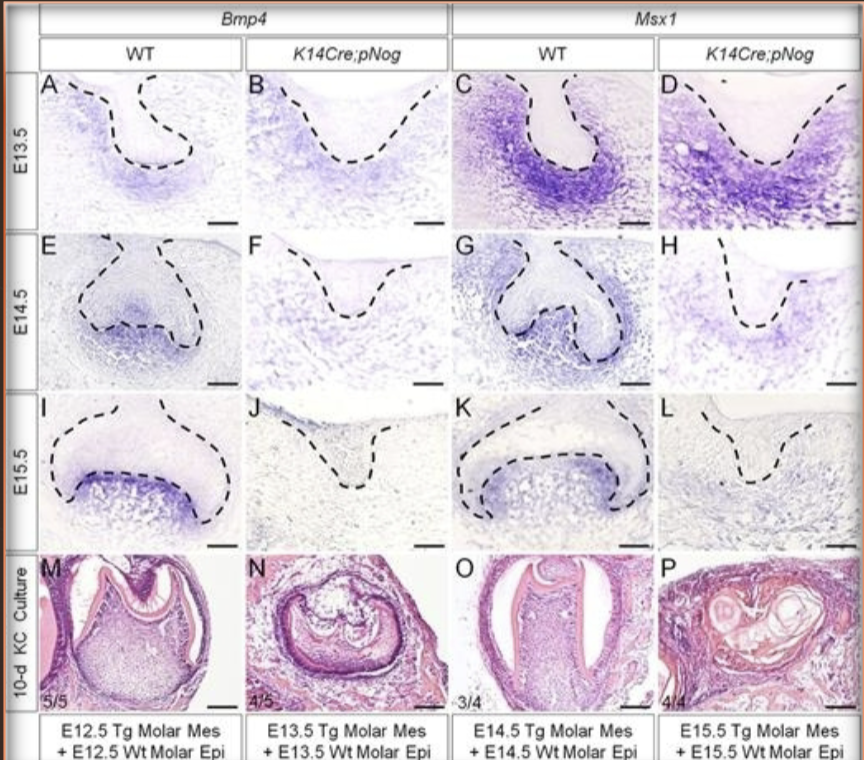
Yuan et al (2015) studied the role of Wnt in tooth development. What seems to be the role of the Wnt pathway in mice tooth development?
Tooth root development

Above is a dissociation graph of hemoglobin and myoglobin, two proteins capable of binding oxygen. Hemoglobin (show as the red curve) dissociates carbon monoxide (CO), a toxic gas, about 200 times less than it does oxygen. What would the curve for carbon monoxide-bound hemoglobin look like?
The curve would shift upward, more closely resembling the myoglobin curve.

The figures above are from Meier (2012) of glucose or insulin over time under fasting or fed conditions. Patients in the trial were given 0.4 pmol, 0.8 pmol, or 1.2 pmol of GLP-1 or a placebo (0 pmol of GLP-1). Which of the following best explains why administration of GLP-1 in these patients resulted in lower blood glucose levels while fasting?
GLP-1 stimulated insulin production.

Apical periodontitis (AP) is inflammation of the gums caused by plaque buildup on teeth near the gumline. Which of the following conclusions are supported by the graph on the left? Select ALL that apply.
There is a greater expression of Wnt in AP patients than in control patients, Wnt and b-catenin have similar expression profiles, these data do notsho a dose-dependent response
The low oxygen response pathway is shown in the diagram to the left. Which part of the low oxygen pathway distinguishes it from a signal transduction pathway? Select ALL that apply.
The signaling molecule is not bound at the surface, the message is not being transduced intracellularly
Which of the following statements about the insulin pathway is FALSE?
Insulin primarily alters blood glucose levels by directly targeting the GLUT4 vesicles for exocytosis.
PCOS is associated with increased risk in a number of diseases including:
Gonadal cancer, metabolic diseases (including diabetes), and Endometriosis (in men as well)
What can lipophilic hormones do?
Cross the cell membrane to initiate responses independent of a receptor.
Compare and Contrast Signal transduction pathway and Hormone signaling pathway
Signal transduction: Membrane receptor, 3 main types (GCPRs, Enzyme, Protein), Crosstalk among pathways
Hormone signaling pathway: Receptor not required, 3 main types (signal transduction, direct response, indirect response), Crosstalk among pathways
What does insulin do?
Stimulates the absorption of glucose into cells, reducing blood sugar levels
What does glucagon do?
Glucagon stimulates the release of glucose from cells, increasing blood sugar levels
Glucagon and insulin, both produced by the pancreas, are ________
Antagonistic
High levels of glucose detected by the ____ stimulates the fusion of insulin vesicles within the cell membrane
Pancreas
The insulin receptor (IR) is a ____
Kinase that dimerizes and autophosphorylates to activate
What does the IR pathway activate?
A number of other proteins including: PI3 kinase and RAS/MAP kinase, ultimately resulting in the transport of GLUT4 transporters from endosomes to the plasma membrane as well as other responses
The IR pathway can be activated independent of either ____ or ______.
Insulin, its receptor
Insulin independent signaling:
Ir can be activated by unknown factors in the extracellular matrix (ECM)
Receptor independent signaling:
E4orf1 is an adenovirus protein that can activate PI3 after infecting a host cell