Introduction to financial accounting - chapter 8
 Call Kai
 Learn
Learn Practice Test
 Spaced Repetition
 Match
Match Flashcards
 Knowt Play
1/39

There's no tags or description
Looks like no tags are added yet.
Name | Mastery | Learn | Test | Matching | Spaced | Call with Kai | Chat |
|---|
No analytics yet
Send a link to your students to track their progress
40 Terms
Cash transaction
A cash transaction is one where goods or services are paid for in cash, bank transfer, or credit card when they are received or delivered.
Credit transaction
A credit transaction is where payment is made or received some time after delivery.
Trade discount
Credit transactions often involve a trade discount. This is typically given by one trader to another. Usually expressed as a percentage reduction of the recommended retail price. It is deducted in arriving at the amount the trade customer is charged for the goods. This discount does not enter the accounting system.
Cash discount
Is a reduction in amount that the credit customer has to pay provided payment is made within a given period stipulated by the seller at the time of sale. The discount must be recorded within the accounting system if the customer uses it.
Documents involved in a credit transaction

Invoice
The purpose of the invoice, which is sent by the seller, is primarily to inform the buyer how much is owed for the goods supplied. It is not a demand for payment.
Invoice example
FROM: | Trendy Gear Ltd | |
High Street | ||
London | ||
TO: | Catalogue Times Ltd | INVOICE NO: 38167 |
Middlesex Street | Date: 30 January 20X9 | |
London | ||
Delivered to: 23 Oxford Road, London | ||
No. of units | Details | Unit price | Total price |
100 | Dresses size 14, pattern no. 385 | £6.50 | £650 |
50 | Leather bags, pattern no. 650 | £3.00 | £150 |
£800 | |||
Less: 25 per cent trade discount | (£200) | ||
£600 | |||
Add: VAT at 20 per cent | £120 | ||
Total | £720 | ||
Tights unavailable – to follow later |
Date of Delivery: | 30 January 20X9 |
Mode of Delivery: | Our transport |
Cash Discount Terms: | 5 per cent monthly account |
Your Order No: | 6382 |
What is typically in an invoice
The name and address of the seller and the buyer
The invoice and delivery note number of the seller (usually the same)
The date of the invoice
The address to which the goods were delivered
The buyers order number
The quantity of goods supplied
Details of the goods supplied
The price per unit of each of the goods
The total value of the invoice before value added tax (VAT)
The trade and cash discount
VAT payable and the total value of the invoice including VAT
When payment should be made
The sellers terms of trade
Debit note
A debit note will be sent if the buyer has been undercharged on the invoice. It has the same information as an invoice but will detail the undercharge instead of goods. It is recorded in the books of the seller and buyer the same as an invoice.
Credit note
A credit note will be sent from the buyer to the seller for a variety of reasons - including the buyer returning goods due to them not being ordered or them being defective or they were the wrong type, quality or quantity. Other reasons include the seller charging the wrong amount on the invoice which may be due to an error in unit price or calculations.
Credit note
A credit note will have largely the same information as an invoice except it will detail why it was issued instead of detailing goods. It will be recorded in a similar manner to the invoice except the entries will be reversed.
The statement
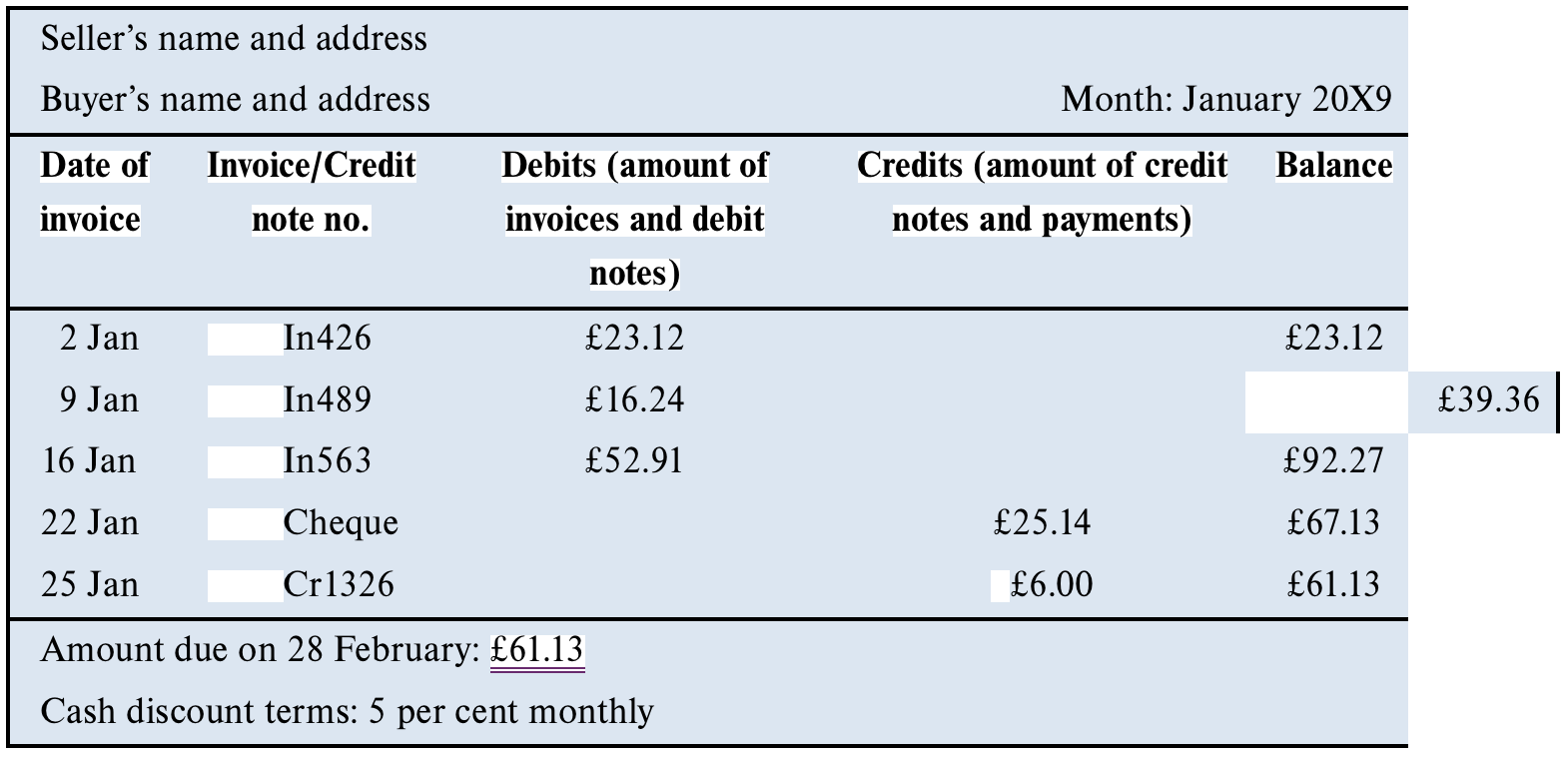
The statement is a historic list of the invoices, debit notes and credit notes that the seller has sent to the buyer during a given calendar month or months and the payments received. It also shows how much the buyer owes the seller (the balance) and when it should be paid. The statement is often a copy of the buyer’s account in the seller’s books.
The statement example
Direct debit
This is where the business has a standing arrangement with its bank to allow third parties e.g. the supplier to access their bank account and transfer money on agreed dates to pay for items bought on credit. The amounts can vary and the third party will notify the bank.
Standing order
A standing order is similar to a direct debit though it is less flexible as the regular payment is a set amount. This can be used to pay expenses that do not vary such as rent.
Credit card
A business provides its credit card details to a third party who takes payment electronically. Payment using a credit card comes from the credit card account. This is a form of loan that the business typically pays back by instalment.
Cheque
Payment can be made by cheque. Most cheques are crossed and therefore have to be paid into a bank account.
Bank transfer
Bank transfer is when a payment is transferred between two bank accounts.
The receipt
Consumer law in many jurisdictions requires the seller to give the buyer a receipt for goods or services that have been paid for in cash. A receipt must contain the following information:
the name of the payer
the signature of the recipient
the amount of money in figures
the date.
Ledger
The main book of account which contains all transactions is called the ledger (sometimes referred to as the general ledger or nominal ledger)
Book of prime entry
Summarises transactions of the same type that can be posted periodically, in total, rather than one at a time. It typically contains more information on these transactions than the nominal ledger.
Book of prime entry contains - sales day book
The sales day book records the sale on credit of goods bought specifically for resale. It captures all of the sales invoices (net of trade discounts when applicable) and debit notes issued to customers.
Book of prime entry contains - sales returns day book
The sales returns day book records goods sold on credit that are returned by customers. It records the details of credit notes issued to customers.
Book of prime entry contains - bills receivable book
The bills receivable book records bills of exchange received by the business from customers. A bill of exchange is a written contract requiring the credit customer to pay the holder of the bill amount owed on a specific date in the future (credit period).
Book of prime entry contains - sales
Book of prime entry contains - sales
Book of prime entry contains - sales
Book of prime entry contains - purchases ledger
The purchases day book records the purchase on credit of goods intended for resale. It captures all the invoices (net of trade discounts) and debit notes received from suppliers.
Book of prime entry contains - purchases ledger
The purchases returns day book records the goods purchased on credit that are returned to suppliers. It captures the details of the credit notes received from suppliers.
Book of prime entry contains - purchases ledger
The bills payable book records bills of exchange given to creditors as payment.
Book of prime entry contains - cash book
The petty cash book records physical cash received and cash paid by the company for immaterial consumable items.
Book of prime entry contains - cash book
The cash book records monies received (and paid into the bank by whatever means) and payments made (by whatever means ). This is written up from bank and credit card statements and whatever other means of payment are used.
Book of prime entry contains - Adjustments
In the past a separate book, the journal was used to record other entries. However, these entries are now made to the nominal ledger directly. For example, transactions involving the purchase and sale of non-current assets on credit, the correction of errors, opening entries in a new set of books and any remaining transfers.
Books of prime entry

Bill of exchange
A bill of exchange is prepared by a business to whom the money is owed (the seller) and then signed by the entity/person paying the money (customer) as agreed and returned to the seller. When the period of credit given by the bill of exchange has expired, which is typically 30, 60 or 90 days, the entity in possession of the bill presents the bill to the customer and receives payment.
Bills payable book
Records bills of exchange given to creditors as payment
Bills receivable book
Records bills of exchange received by the business from customers.
Bills payable/ Bills receivable
Records bills of exchange received by the business from customers
Bills payable/ Bills receivable
Records bills of exchange given to creditors as payment